Front page · The fusion center · Suspicious activity
The fusion center: where the reports go, and who decides
L.A. County’s Supervisors ordered a watch on its Fusion Center. The County funded the Center: it eliminated the watching.
In April 2022, the Board of Supervisors said it was worried about privacy at the Sheriff’s Fusion Center, the Joint Regional Intelligence Center, which sends reports on residents to federal agencies. It ordered its Inspector General, Max Huntsman, to monitor the Center and the Auditor-Controller to check its money. Before the audit came back, the Sheriff locked out the watchdog. The audit, when it came, said it had not looked at privacy, and no one has examined the Center’s privacy practices since. In 2025, the County slashed OIG’s staff by a third while continuing to approve the Center’s contracts, and the Center kept sending reports on residents under the Functional Standard, a rule that, a federal appeals court held, requires no suspicion of a crime.
Audit Veritas staff · Sources: ISE-SAR Functional Standard; federal court record (N.D. Cal. No. 3:14-cv-03120; 9th Cir. No. 17-16107); ACLU of Northern California; LAPD Office of the Inspector General; FEMA; U.S. Department of Justice; GAO
The Functional Standard
The federal rule every fusion center applies to every report of “suspicious activity”:
“Observed behavior reasonably indicative of pre-operational planning associated with terrorism or other criminal activity.”
No suspicion of a crime required.
Never put to public comment.
Upheld by the U.S. Court of Appeals for the Ninth Circuit, Gill v. U.S. Department of Justice, Jan. 29, 2019.
Information Sharing Environment, SAR Functional Standard, v. 1.5.5, Feb. 23, 2015; first issued Jan. 25, 2008.
October 19, 2022: the audit checked the money and wrote that it did not look at privacy
On October 19, 2022, Auditor-Controller Arlene Barrera delivered twelve pages, Report No. K22FL. It checked the Sheriff’s arithmetic and found what he had left out: $44.9 million in contracts, two-thirds of the center’s contract spending, with Palantir Technologies the largest. Then, in its limitation paragraph, it answered the supervisors’ question about privacy:
The report made no recommendations. The Sheriff’s Department, it said, “indicates general agreement.” It went to each Supervisor, the Chief Executive Officer, the Board’s Executive Officer, the Sheriff and the District Attorney. It did not go to the Inspector General or the Civilian Oversight Commission, the two offices that oversee the department’s conduct. It was sent as correspondence, never placed on an agenda, and no Board document since has cited it.
The Board never widened the watch
The only office the Board sent in could look at contracts and nothing more. Its monitoring, Inspector General Max Huntsman told Surveillance Today, “was limited to reviewing contracts to advise the Board of Supervisors of any mission creep they might not hear about.” Going further “would have required aggressive county action and the Board did not pursue it.”
The office itself was locked out by the Sheriff twelve days before the audit came back, and in 2025 the Board cut ten positions from it. That story is The Gutting of OIG.
The fusion center and everything that was supposed to stop it, in three stages. The four in the hatches are the federal agencies that sit inside it or draw from it: the FBI, Customs and Border Protection, ICE and its investigations arm, HSI. Drawing: Surveillance Today.
Reports of “suspicious activity” made in Los Angeles County are sent to one room: the Sheriff’s Joint Regional Intelligence Center, the county’s Fusion Center. The FBI and U.S. Customs and Border Protection are housed there; ICE and Homeland Security Investigations sit inside it or draw from it. Its technicians, the people who decide which reports go federal, are supplied by a defense contractor, General Dynamics Information Technology. Its software is Palantir’s. Palantir was founded in 2003, right after 9/11, with early money from the CIA’s venture arm, and since January 2024 has supplied its technology to Israel’s Defense Ministry “in support of war-related missions.” One of the 29 applications Palantir built for it, Tips and Leads, “automatically submit[s]” every tip to eGuardian, the FBI’s national database of suspicious activity reports, which federal, state, local and tribal law enforcement agencies across the country can search. A report the FBI finds no use for is deleted from eGuardian after 180 days and kept by the FBI for thirty years.
Four years ago, Los Angeles County set out to look inside that room. These were supposed to stand in the Fusion Center’s road: the County’s Inspector General and its Auditor-Controller, the Legislature, the federal office that owns the Functional Standard, the public, and consequences for misuse. The drawings above show what became of them.
“[W]e did not review the privacy implications of JRIC operations.”
Los Angeles County Auditor-Controller, on the Fusion Center, in the only review the Supervisors ordered. Oct. 19, 2022
By the numbers
0privacy reviews of the Fusion Center in twenty years
$44.9Min contracts the Sheriff left out of his report
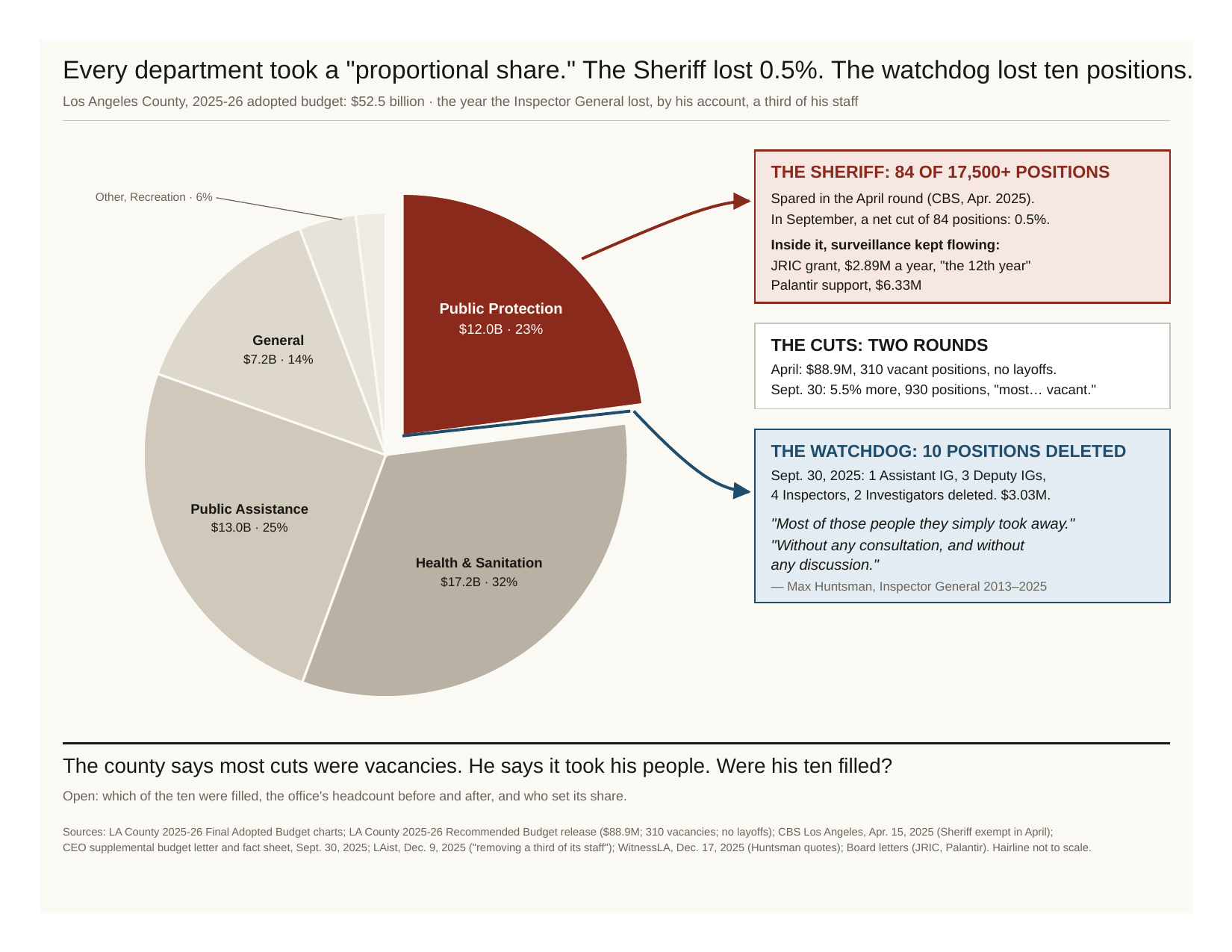
10positions cut from the Inspector General’s office, a third of its staff
$6.3MPalantir bridge contract, ends Nov. 30
2,144,138searches of Orange County Sheriff cameras, March–June
April 2022: the supervisors name privacy, and order a check of the money
On April 19, 2022, the Board of Supervisors voted 4–1 on a motion by Supervisors Holly Mitchell and Hilda Solis. Kathryn Barger dissented. The motion gave its reasons on its face. Watchdogs, it said, “have had difficulty obtaining information about JRIC, … especially as it pertains to practices that potentially infringe on privacy rights.” The Sheriff had “repeatedly refused” oversight, and the motion cited “investigations and intimidation of the Sheriff’s political enemies.”
“The Sheriff’s continued refusal to allow this legally required oversight undermines transparency and erodes public trust,” Mitchell said. The next day Sheriff Alex Villanueva said the Board was “trying to insert the fox into the hen house.”
The motion named privacy. Its orders asked for access and money. The Inspector General, Max Huntsman, was to “monitor” the center, with no scope, no report and no deadline. The Sheriff was to report within 45 days on the center’s grants, spending, agreements and staff, and the Auditor-Controller was to check that report within 120 days. The first draft, in March, had no money report at all; the April revision added it. No order asked anyone to examine what the center does with what it collects. The same day, the Board took up the Sheriff’s $2,983,500 homeland security grant for the center.
The Board kept approving the Center’s money
The money kept coming. Every dollar of the Palantir system was federal grant money. A $250,000 pilot in 2009. A $9.3 million sole-source contract in 2016, approved after eight months of work with no contract. $23.9 million by 2019. The center takes about $2.89 million a year in federal homeland security grants. In December 2023, the Board gave $6.3 million to Pat V. Mack, Inc., the only bidder, to keep Palantir running “while the Department seeks a replacement platform.” A replacement was solicited in October 2025. No award has been found. The bridge ends November 30.
Everyone else who could have looked
The center’s own privacy officer works for the contractor. State policy requires a “trained privacy official.” The Sheriff’s 2023 solicitation, RFP 707-SH, gives a manager at the contractor the duty of “Serving as the Privacy Policy Officer for JRIC.” The contract went to General Dynamics IT, capped at $39.5 million. The person who checks the technicians’ work works for the company that supplies them.
State law reaches only part of the room. California’s sanctuary law, SB 54, binds “All California agency designees working at JRIC.” The federal staff are not California designees. In March 2026, the State Auditor opened Audit 2026-134; State Auditor Grant Parks said, “my office does not have jurisdiction over the federal government or its intelligence data.” It has not been released. The public has filed ten records requests with the center on MuckRock, including for its Palantir records. None was acknowledged: “No records released from this agency.”
And since October 9, the federal grants that pay for centers like this one require each to report every quarter how many tips and suspicious activity reports it sends to the Homeland Security Task Forces, created to enforce immigration law, and how many seats it holds for ICE.
The Functional Standard
What decides which reports go through is one federal sentence. In 2019, in Gill v. U.S. Department of Justice, the U.S. Court of Appeals for the Ninth Circuit held that it requires no suspicion of a crime, and that it could be issued without public comment.
The sentence, in full
“Observed behavior reasonably indicative of pre-operational planning associated with terrorism or other criminal activity.”
Information Sharing Environment, Suspicious Activity Reporting Functional Standard, version 1.5.5, February 23, 2015. First issued January 25, 2008. Never put to public comment.
In 2019 the Los Angeles Police Department’s Inspector General found 19 reports LAPD had itself ruled unfounded that were sent to the Fusion Center anyway.
April 2022: the supervisors name privacy, and order a check of the money
On April 19, 2022, the Board of Supervisors voted 4–1 on a motion by Supervisors Holly Mitchell and Hilda Solis. Kathryn Barger dissented. The motion gave its reasons on its face. Watchdogs, it said, “have had difficulty obtaining information about JRIC, … especially as it pertains to practices that potentially infringe on privacy rights.” The Sheriff had “repeatedly refused” oversight, and the motion cited “investigations and intimidation of the Sheriff’s political enemies.”
“The Sheriff’s continued refusal to allow this legally required oversight undermines transparency and erodes public trust,” Mitchell said. The next day Sheriff Alex Villanueva said the Board was “trying to insert the fox into the hen house.”
The motion named privacy. Its orders asked for access and money. The Inspector General, Max Huntsman, was to “monitor” the center, with no scope, no report and no deadline. The Sheriff was to report within 45 days on the center’s grants, spending, agreements and staff, and the Auditor-Controller was to check that report within 120 days. The first draft, in March, had no money report at all; the April revision added it. No order asked anyone to examine what the center does with what it collects. The same day, the Board took up the Sheriff’s $2,983,500 homeland security grant for the center.
October 19, 2022: the audit checked the money and wrote that it did not look at privacy
On October 19, 2022, Auditor-Controller Arlene Barrera delivered twelve pages, Report No. K22FL. It checked the Sheriff’s arithmetic and found what he had left out: $44.9 million in contracts, two-thirds of the center’s contract spending, with Palantir Technologies the largest. Then, in its limitation paragraph, it answered the supervisors’ question about privacy:
“We did not assess the Sheriff’s processes and controls over their JRIC operations, the efficiency and/or effectiveness of the JRIC or the funding provided for it, and/or the Sheriff’s or JRIC’s compliance with the terms and conditions of their grant awards. In addition, we did not review the privacy implications of JRIC operations.”Los Angeles County Auditor-Controller, Report No. K22FL, Oct. 19, 2022
Privacy reviews of the Fusion Center
0
in twenty years. The one review ordered says so in its own text.
What the Sheriff left out of his own report
Palantir Technologies$23,919,737
SRA International$19,746,336
InfraGard Los Angeles$1,250,000
The report made no recommendations. The Sheriff’s Department, it said, “indicates general agreement.” It went to each Supervisor, the Chief Executive Officer, the Board’s Executive Officer, the Sheriff and the District Attorney. It did not go to the Inspector General or the Civilian Oversight Commission, the two offices that oversee the department’s conduct. It was sent as correspondence, never placed on an agenda, and no Board document since has cited it.
No one has examined the center’s privacy practices since.
The Board never widened the watch
The only office the Board sent in could look at contracts and nothing more. Its monitoring, Inspector General Max Huntsman told Surveillance Today, “was limited to reviewing contracts to advise the Board of Supervisors of any mission creep they might not hear about.” Going further “would have required aggressive county action and the Board did not pursue it.”
The office itself was locked out by the Sheriff twelve days before the audit came back, and in 2025 the Board cut ten positions from it. That story is The Gutting of OIG.
The Board kept approving the Center’s money
The money kept coming. Every dollar of the Palantir system was federal grant money. A $250,000 pilot in 2009. A $9.3 million sole-source contract in 2016, approved after eight months of work with no contract. $23.9 million by 2019. The center takes about $2.89 million a year in federal homeland security grants. In December 2023, the Board gave $6.3 million to Pat V. Mack, Inc., the only bidder, to keep Palantir running “while the Department seeks a replacement platform.” A replacement was solicited in October 2025. No award has been found. The bridge ends November 30.
Everyone else who could have looked
The center’s own privacy officer works for the contractor. State policy requires a “trained privacy official.” The Sheriff’s 2023 solicitation, RFP 707-SH, gives a manager at the contractor the duty of “Serving as the Privacy Policy Officer for JRIC.” The contract went to General Dynamics IT, capped at $39.5 million. The person who checks the technicians’ work works for the company that supplies them.
State law reaches only part of the room. California’s sanctuary law, SB 54, binds “All California agency designees working at JRIC.” The federal staff are not California designees. In March 2026, the State Auditor opened Audit 2026-134; State Auditor Grant Parks said, “my office does not have jurisdiction over the federal government or its intelligence data.” It has not been released. The public has filed ten records requests with the center on MuckRock, including for its Palantir records. None was acknowledged: “No records released from this agency.”
And since October 9, the federal grants that pay for centers like this one require each to report every quarter how many tips and suspicious activity reports it sends to the Homeland Security Task Forces, created to enforce immigration law, and how many seats it holds for ICE.
What the Functional Standard does to ordinary people
No privacy review, no monitor, no audit of conduct. What is left is the sentence the contract technicians apply. Here is what the Functional Standard did to fourteen ordinary people, and then what the Orange County Sheriff’s own logs show it doing two million times in four months.
Sources: ISE-SAR Functional Standard v. 1.0 (Jan. 25, 2008) and v. 1.5.5 (Feb. 23, 2015); PM-ISE privacy analysis (2008), in the 2014 federal lawsuit, Govt. Supplemental Excerpts of Record, vol. 2; U.S. Court of Appeals for the Ninth Circuit, No. 17-16107 (Jan. 29, 2019), opinion and court staff summary; USA Today, 2008, and The New York Times, 2011, as quoted in Cato Institute, Jan. 24, 2012; U.S. District Court, N.D. Cal., No. 3:14-cv-03120, Complaint, July 10, 2014; Excerpts of Record (plaintiff declaration, Ex. 1); GAO-23-105310; GAO-13-233; Bureau of Justice Assistance, SAR Support and Implementation Project, Oct. 2008 (LAPD Special Order 11); LAPD Counterterrorism and Criminal Intelligence Bureau paper (Washington Institute); LAPD Office of the Inspector General, Review of Suspicious Activity Reports, FY 2013/2014, Jan. 23, 2015; Stop LAPD Spying Coalition; Behind the Badge, May 7, 2016; ACLU of Northern California, Sept. 19, 2013; NPR, Sept. 19, 2013, and Sept. 8, 2011 (with the Center for Investigative Reporting); PetaPixel, Sept. 20, 2013; Attorney General, Implementing NSPM-7, Dec. 4, 2025; FEMA Information Bulletin No. 589, Oct. 9, 2026; Executive Order 14159; EFF, March 2019 (ICE records on OCIAC); LASD Board letter, May 21, 2019, Exhibit C; Cal OES FY25 HSGP allocations; OC Board of Supervisors, Axon amendment, May 19, 2026; City of Laguna Woods, Connect Orange County incentive program, 2026; Inadvertent/CALÓ News, July 8, 2026; Fullerton Observer, Oct. 6, 2026; CalMatters, Sept. 3, 2026; Max Huntsman, letter to the Board, Dec. 9, 2025; KWCH, Apr. 5, 2023 (Kechi); CBS Los Angeles, 2026 (Costa Mesa); California DOJ, CLETS Advisory Committee meeting summary, Apr. 8, 2025; Spectrum News, Jan. 5, 2026 (Louisville); Senate Select Committee on Intelligence, June 7, 2017, transcript; DHS, “If You See Something, Say Something” Campaign Overview; NSI training catalog (sar-training.ncirc.gov) and BJA NCIRC, NSI Line Officer Training; DHS, NSI Public Safety Telecommunications (2023); Boston Regional Intelligence Center, Tips and Leads SOP (rev. 2014); Utah Division of Emergency Management, SHSP Activities and Allowable Costs (2018); FEMA, FY2026 Transit Security Grant Program NOFO; John Mueller, “Terror Tipsters,” Cato Institute, Jan. 24, 2012; Brennan Center, “FBI: Fact or Fiction” (2011), on the 2008 Attorney General’s Guidelines; The New York Times, Aug. 24, 2011 (FBI assessment data, Mar. 2009–Mar. 2011); FBI v. Fazaga, 595 U.S. 344 (2022); Christian Science Monitor, Nov. 20, 2007; Elhady v. Kable (E.D. Va. Sept. 4, 2019), rev’d, 993 F.3d 208 (4th Cir. 2021); AP/Courthouse News, Feb. 20, 2019 (1,441 private entities); DHS, About the NSI; House Homeland Security Subcommittee on Counterterrorism and Intelligence, Sept. 13, 2017 (Robin Taylor written statement); Senate PSI staff report, Oct. 3, 2012; Los Angeles County OIG, Deputy Gangs, Feb. 26, 2024. U.S. DHS, “If You See Something, Say Something®” Rules and Restrictions, dhs.gov/see-something-say-something/rules-and-restrictions; DHS, About the Campaign, dhs.gov/see-something-say-something/about-campaign; DHS, See Say Campaign Partnership Guide (2018), as posted by the Florida Fusion Center, fdle.state.fl.us; DHS press release, “DHS Launches ‘If You See Something, Say Something’ Campaign at Walmart,” Dec. 6, 2010; MuckRock, “When Homeland Security came to Walmart,” Aug. 1, 2016 (DHS emails released under FOIA); Federal Times, Dec. 9, 2010.; U.S. District Court, N.D. Cal., No. 3:14-cv-03120, Complaint, July 10, 2014, and order of Feb. 20, 2015 (Seeborg, J.); Attorney General, Implementing NSPM-7, Dec. 4, 2025 (House Judiciary record, Feb. 11, 2026); FEMA Information Bulletin No. 589, Oct. 9, 2026; Executive Order 14159; ISE-SAR Functional Standard v. 1.0 (Jan. 25, 2008) and v. 1.5.5 (Feb. 23, 2015); GAO-23-105310; U.S. Court of Appeals for the Ninth Circuit, No. 17-16107 (Jan. 29, 2019); Stop LAPD Spying Coalition on the 2015 OIG audit; ACLU of Northern California, “The Government is Spying on You,” Sept. 19, 2013; NPR, Sept. 19, 2013; PetaPixel, Sept. 20, 2013; Bureau of Justice Assistance, Findings and Recommendations of the SAR Support and Implementation Project, Oct. 2008, App. B (LAPD Special Order 11); LAPD Counterterrorism and Criminal Intelligence Bureau paper (Washington Institute); LAPD Office of the Inspector General, Review of Suspicious Activity Reports, FY 2013/2014, Jan. 23, 2015; Behind the Badge, May 7, 2016; GAO-13-233, App. V; FBI eGuardian Privacy Impact Assessment, 2022; Orange County Sheriff’s Department, Network Audit logs, Mar. 1–June 30, 2026, released Oct. 16, 2026, in response to a Public Records Act request (2,144,138 rows), and cover letter of the same date; Fullerton Observer, Oct. 6, 2026; Inadvertent/CALÓ News, July 8, 2026 (OCSD Flock network audit); CalMatters, Sept. 3, 2026 (SB 1013); Senate Select Committee on Intelligence, Open Hearing on FISA Legislation, June 7, 2017, transcript; The Markup/CalMatters, June 18, 2025; CALÓ News/Inadvertent, Aug. 20, 2026; ODNI Annual Statistical Transparency Report, CY2025; American Prospect, May 11 and Sept. 24, 2026; House Judiciary letter to DNI Clapper, April 2016; New America, June 12, 2017.
The Functional Standard · the suspicious activity report
Under the Functional Standard, police can file a suspicious activity report on you without suspecting you of a crime. The Fusion Center puts it in a national database that federal, state, local and tribal law enforcement agencies across the country can search, the FBI and Homeland Security among them, agencies that hold the tools to track your phone, your car and your street, and to see through the walls of your home.
The fourteen in this issue are people whose reports became public through a federal lawsuit, police records releases and NPR. After their reports, an FBI agent left a card at J.P.’s door and questioned his neighbor. Two agents asked H.B. whether he held “any ill will toward the United States of America.” The FBI questioned T.R. Police searched W.G.’s home, and the FBI asked his sister about his religion. Deputies held A.C. at a refinery fence and told him he was going on an “NSA watch list.” The five who sued had not been charged with anything. The FBI can keep each file thirty years.
Where the file goes
Someone calls. 81 percent of LAPD’s reports start with a member of the public.
An officer writes it up under the Functional Standard: behavior “reasonably indicative” of terrorism “or other criminal activity.” No suspicion of a crime required.
It goes to the Fusion Center. In one year LAPD sent 161 of its 215 reports to the Fusion Center, JRIC, where the FBI and Customs and Border Protection are housed and ICE and Homeland Security Investigations sit or draw from it.
A contract IT technician says yes. The report goes into eGuardian, the FBI’s database, open to federal, state, local and tribal law enforcement agencies across the country; into the FBI’s classified system, and to Homeland Security’s intelligence office. Since October 9, fusion centers must count the reports they pass to the Homeland Security Task Forces, created to enforce immigration law.
The FBI keeps it thirty years, even when it is “later determined to be unfounded,” as W.G.’s was.
An FBI “assessment” can open with no factual predicate: informants, pretext interviews, watching, no time limit.
Agents come. J.P., H.B., T.R. and W.G. were visited or questioned; W.G.’s sister was asked about his religion.
No one is told, and no one has been disciplined. The government won the lawsuit.
What the same agencies are equipped to do
Find your phone from the street
Cell-site simulators pose as a cell tower so nearby phones connect to them, giving up their identity and location. The best known is the StingRay, made by Harris. LAPD used its StingRay 21 times in four months of 2012, for burglary, drug and murder cases. The Sheriff’s Department has a long record of Harris simulators. Orange County’s Supervisors approved one for their Sheriff on May 23, 2023. Anaheim bought a “dirtbox,” which can collect from thousands of phones at once, with a federal grant in 2009, and said “every city in Orange County has benefited.”
Put everything they hold about you on one screen
Palantir, founded after 9/11 with early CIA venture money and since January 2024 a partner to Israel’s Defense Ministry “in support of war-related missions,” runs the Fusion Center’s system: 29 applications that search 911 calls, jail visits, DMV records, confidential informants, warrants, tattoos, and plates by plate or by location, with every tip sent into the FBI’s national database. Contracts: $9.3 million in 2016, $23.9 million by 2019, a $6.3 million bridge through November 30; $39.8 million in federal money since 2009.
Follow your car
Plate readers photograph every passing plate and log the time and place. Orange County’s were searched 2,144,138 times in four months, by 334 agencies, with no warrant. The Los Angeles Sheriff keeps the data two years.
Watch your street through private cameras
Fusus pulls business and home security cameras into the Sheriff’s live system. Orange County’s Axon contract includes $3.02 million for it; Laguna Woods pays residents up to $10,000 to connect.
Open your phone
Phone-extraction tools such as Cellebrite copy a phone’s messages, photos, contacts and location history, often past the passcode. The Sheriff’s Department has not answered a 2017 records request for its contracts.
See through your wall
Through-wall radar such as Range-R detects a person breathing inside a home from about 50 feet. The FBI, which sits inside the Fusion Center, uses it, and so do the U.S. Marshals.
What is done with a file once it is inside, the agencies do not disclose, and the person named is never told. Every step, with its source →
Front page · The fourteen · The Functional Standard
Take a picture. Wait for your mother. Buy a pallet of water.
Fourteen people in California did ordinary things, and police officers, sheriff’s deputies and private security guards wrote each one up as a suspicious activity report. The reports went to fusion centers: the Fusion Center in Los Angeles, the Joint Regional Intelligence Center; the Central California Intelligence Center in Sacramento; the Orange County center. Each was judged under the Functional Standard, the federal rule that requires no suspicion of a crime. We know about them because five of the fourteen sued the Justice Department, and because the centers’ report summaries and NPR’s reporting made the rest public. First the days, as they happened. Then the reports.
Fourteen ordinary days…
Folsom. Los Angeles. Boston. Santa Ana. Chico. Dublin. Elk Grove. The United States. You are on the sidewalk outside a McDonald’s. You are at the next register. You are across Martin Luther King Boulevard, waiting for the light.
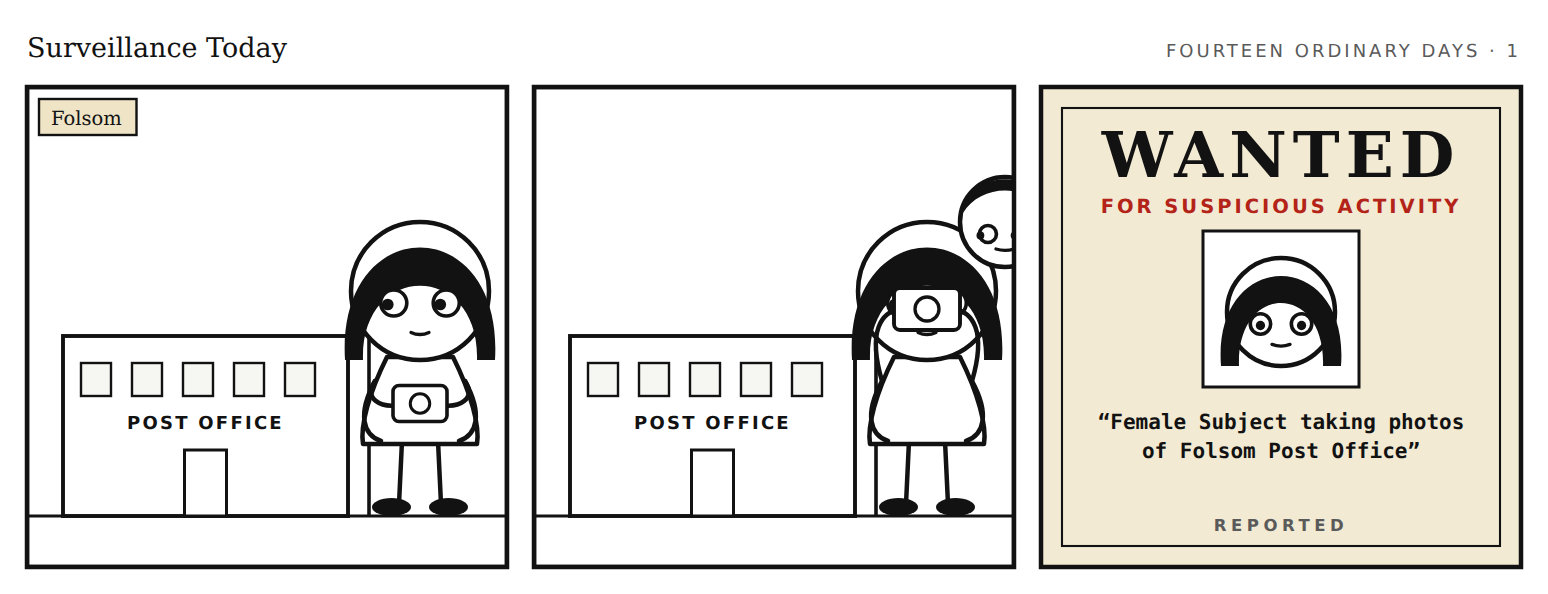
1. Woman, Folsom
A woman stops outside the post office in Folsom, east of Sacramento. She photographs the building. That is the whole of it: a woman, a post office, a camera.
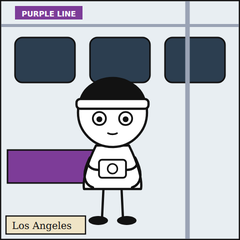
2. Rider, Purple Line
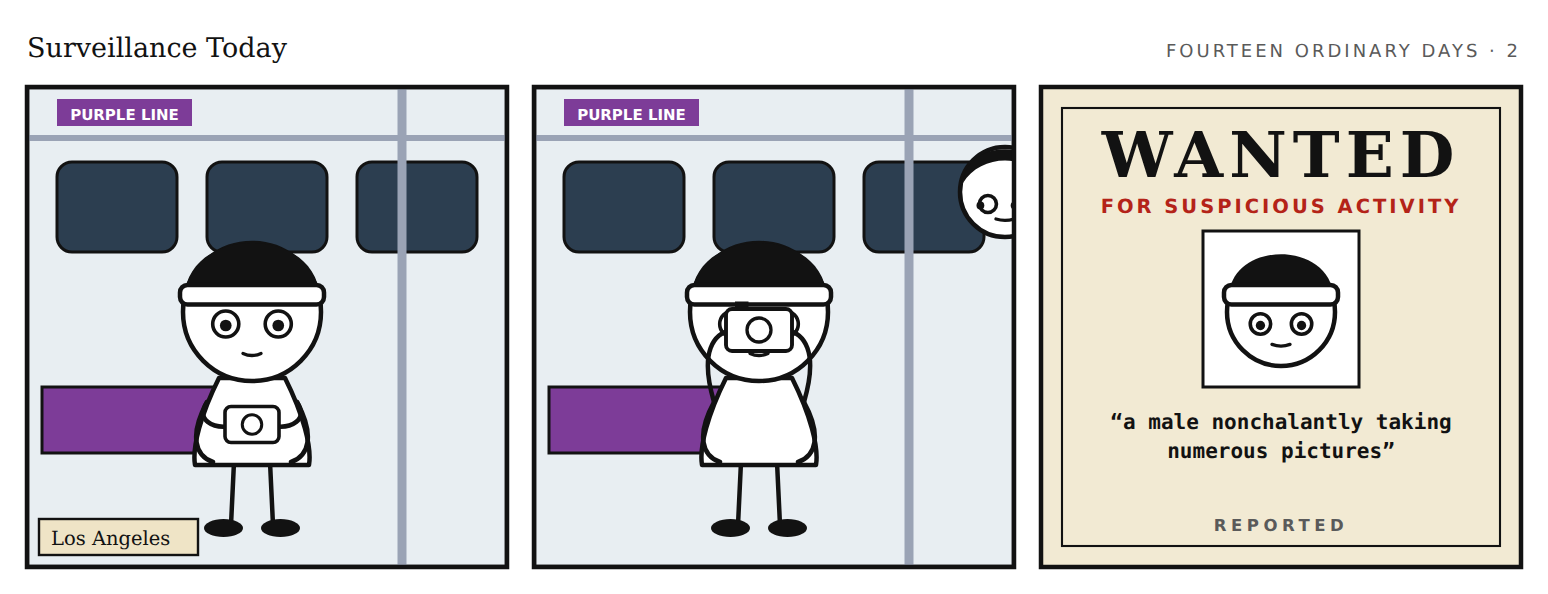
A man rides the Metro Purple Line under Los Angeles. He takes a lot of pictures inside the train car. He’s not in a hurry, and he’s not hiding it.
3. Man, Commerce
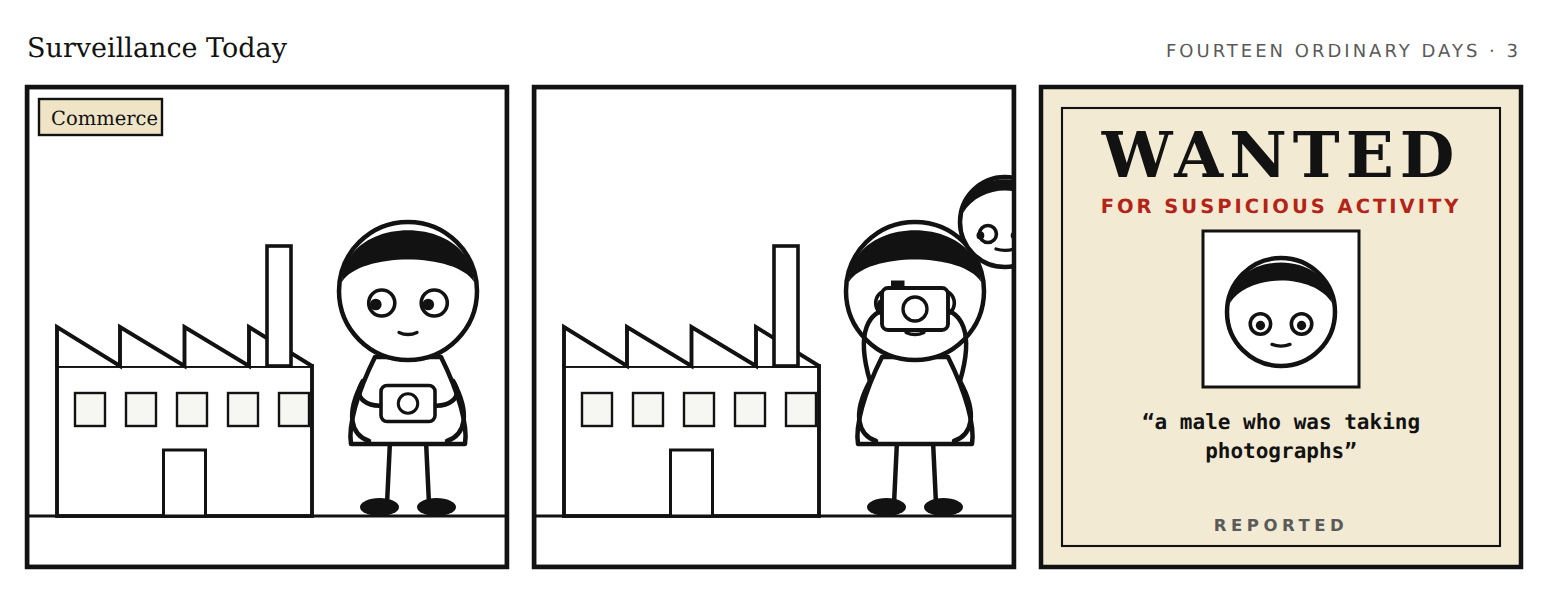
A man walks an industrial stretch of Commerce. He has a camera. Warehouses, loading docks, chain link. He stops at one building, looks it over, and photographs it.
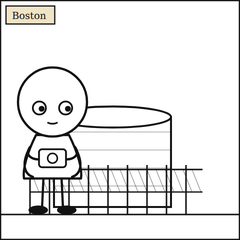
4. Visitor, Boston
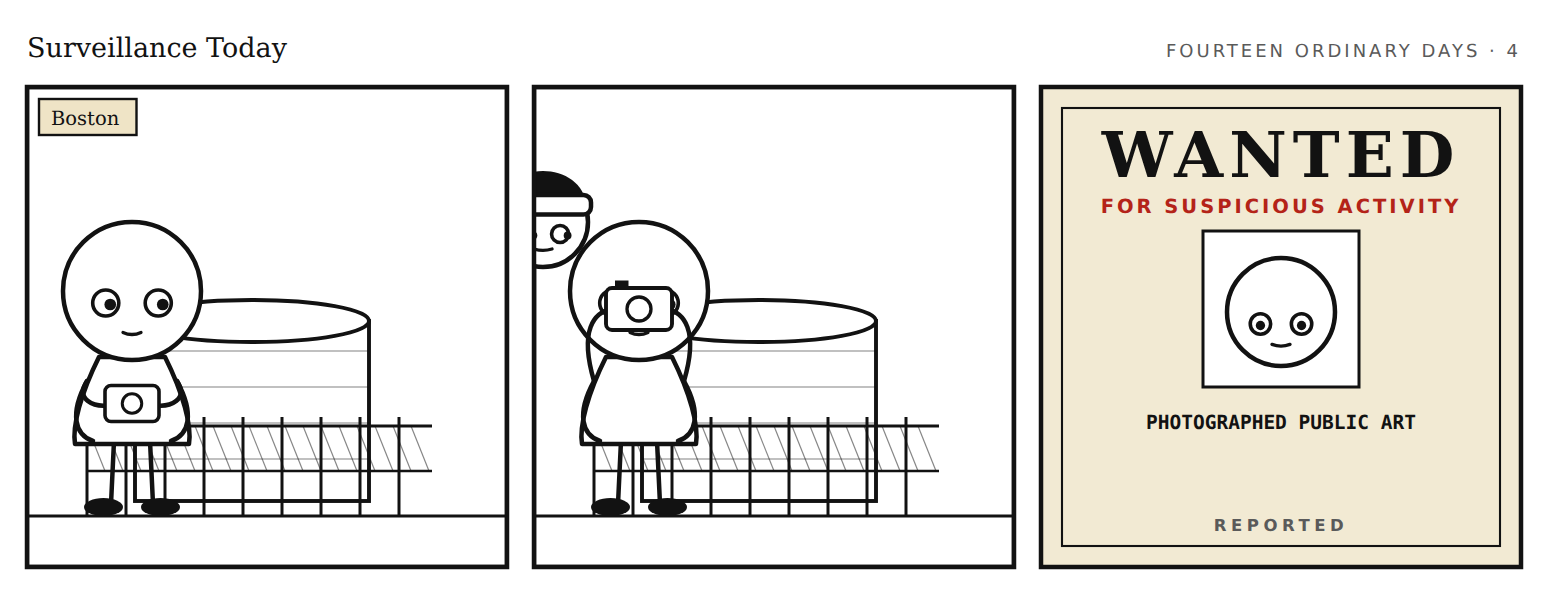
A man is visiting Boston. He photographs a well-known piece of public art, a landmark painted in rainbow stripes, from the public side of the fence. Then he goes home to Sacramento.
5. Man, the port
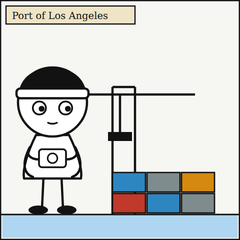
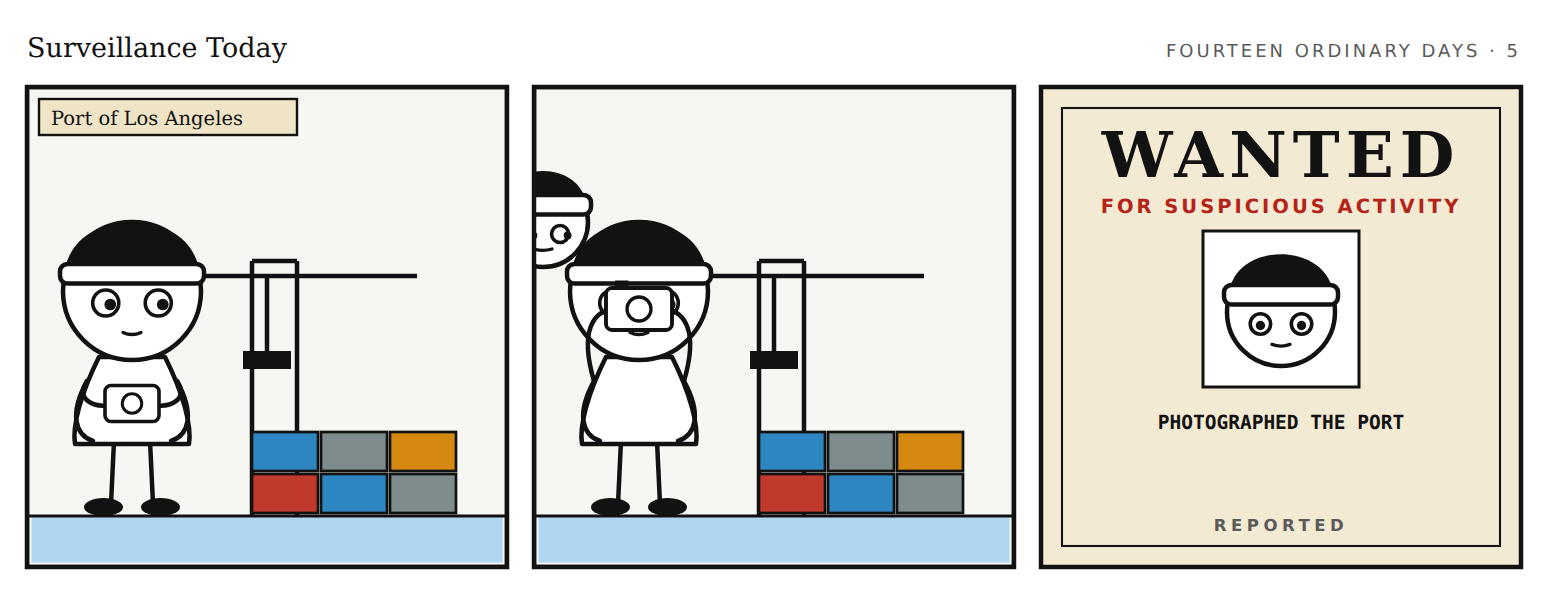
A man spends time at the Port of Los Angeles with his camera. Bridges, cranes, tank farms, a refinery across the channel. Not a view anyone would call pretty. He photographs the port.
6. Man, Benicia
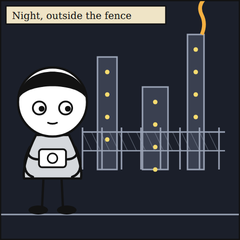
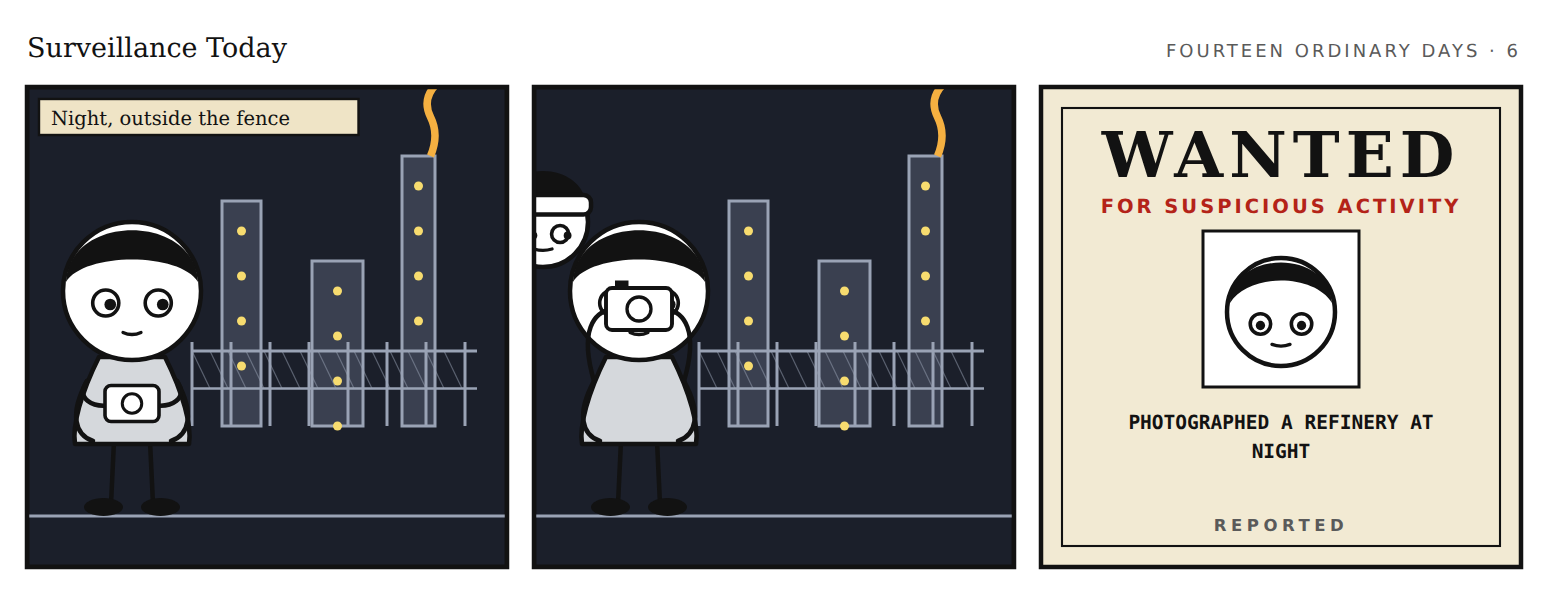
A man goes out to the oil refineries in Benicia and Martinez at night. He stands on the public road outside the fence and photographs the refinery.
7. Man and woman, Santa Ana
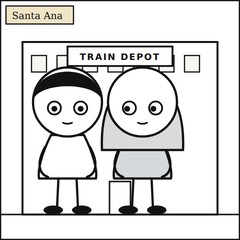
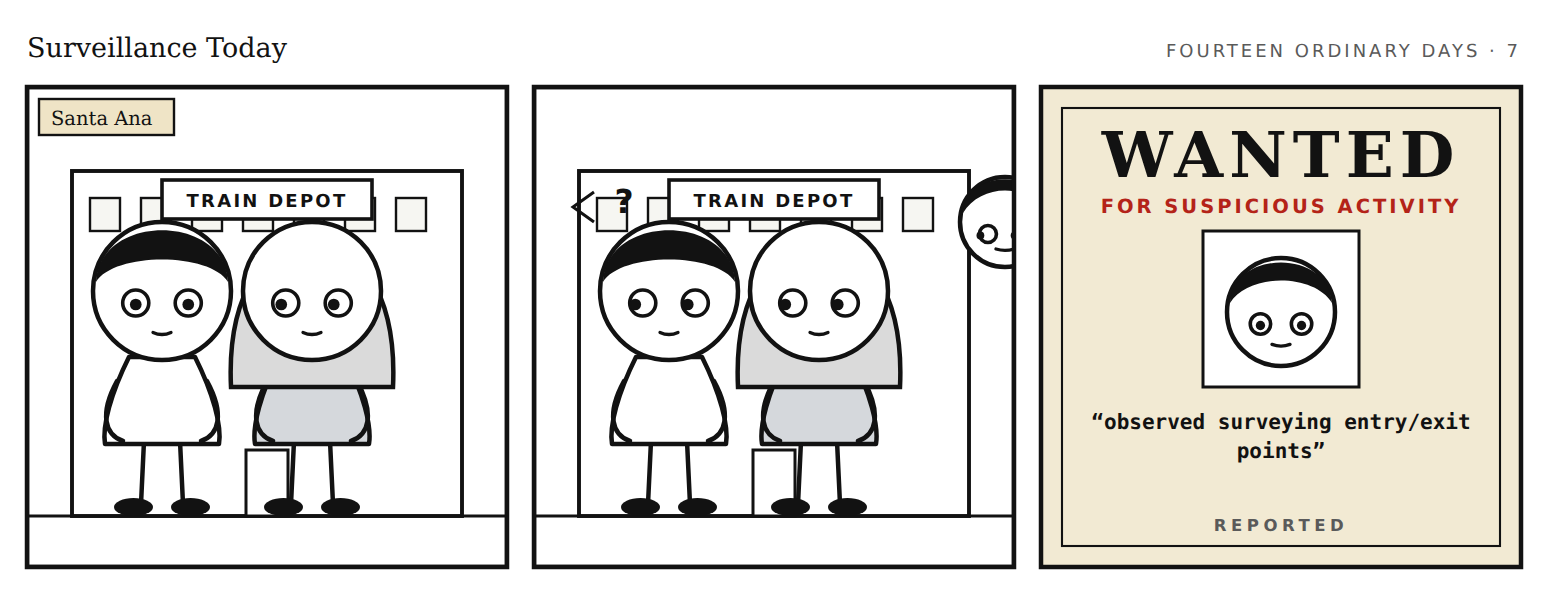
A man has an appointment at a county employment center inside the Santa Ana train depot. A woman comes with him. She wears a head covering. He walks the station toward the office, goes in, and comes out. The two of them leave together.
8. At home, Chico
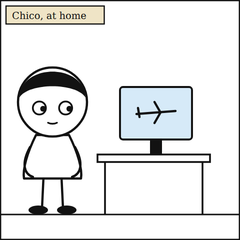
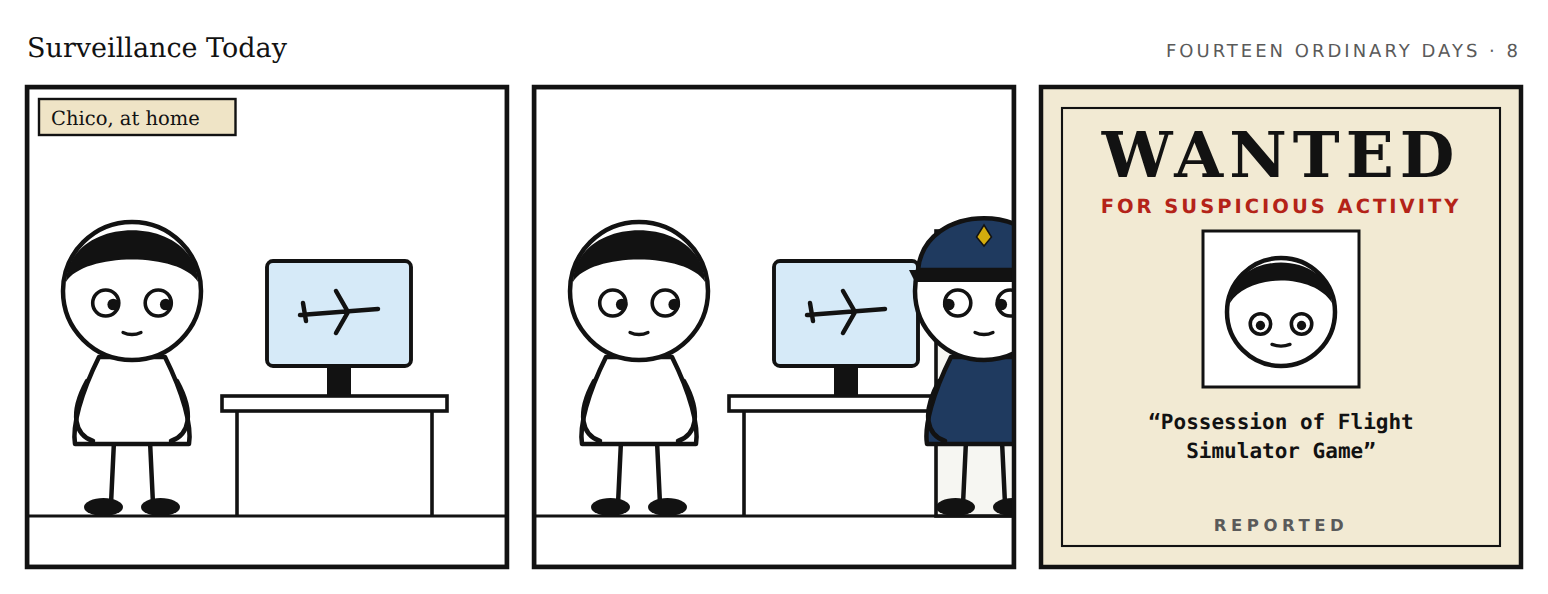
A man is at home in Chico. He is out of work. He converted to Islam as a young man. He is on a video game website, looking at a flight simulator game.
9. Man, Dublin
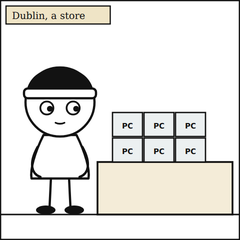
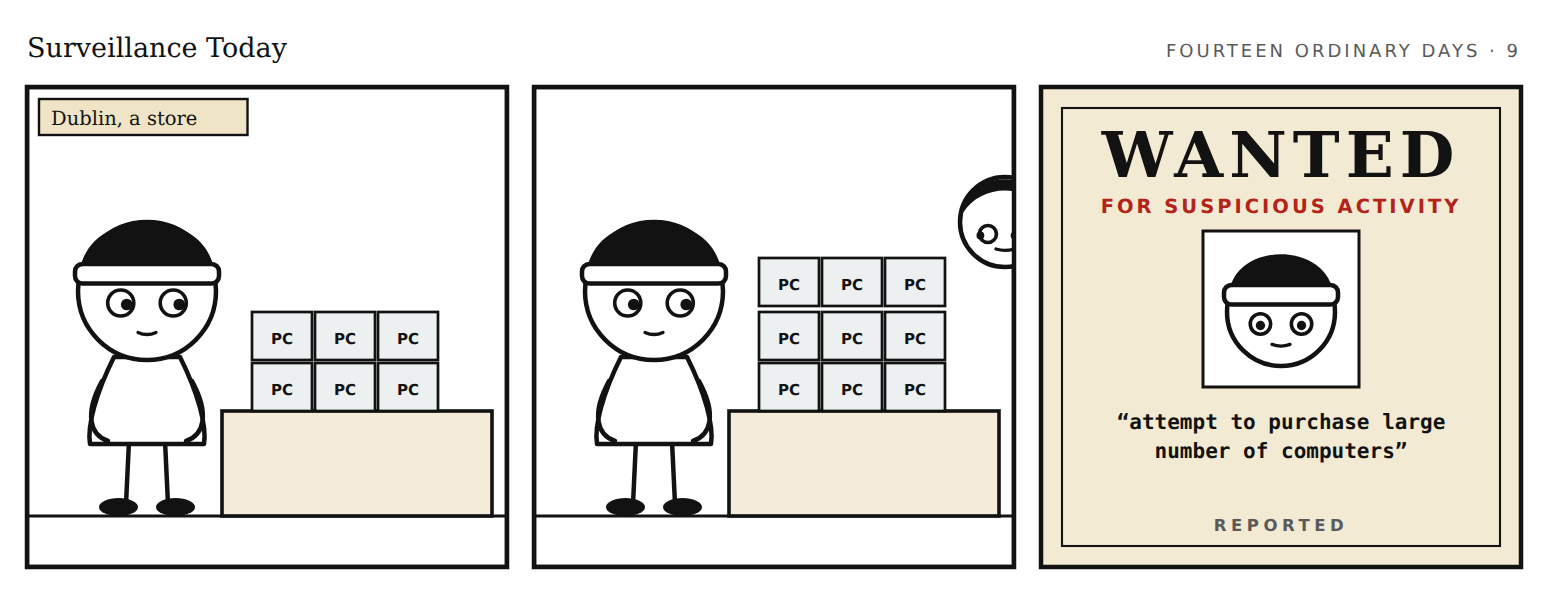
A man buys computers in bulk at a Best Buy in Dublin. He comes back more than once. One day a manager tells him the store doesn’t allow bulk purchases, and he leaves.
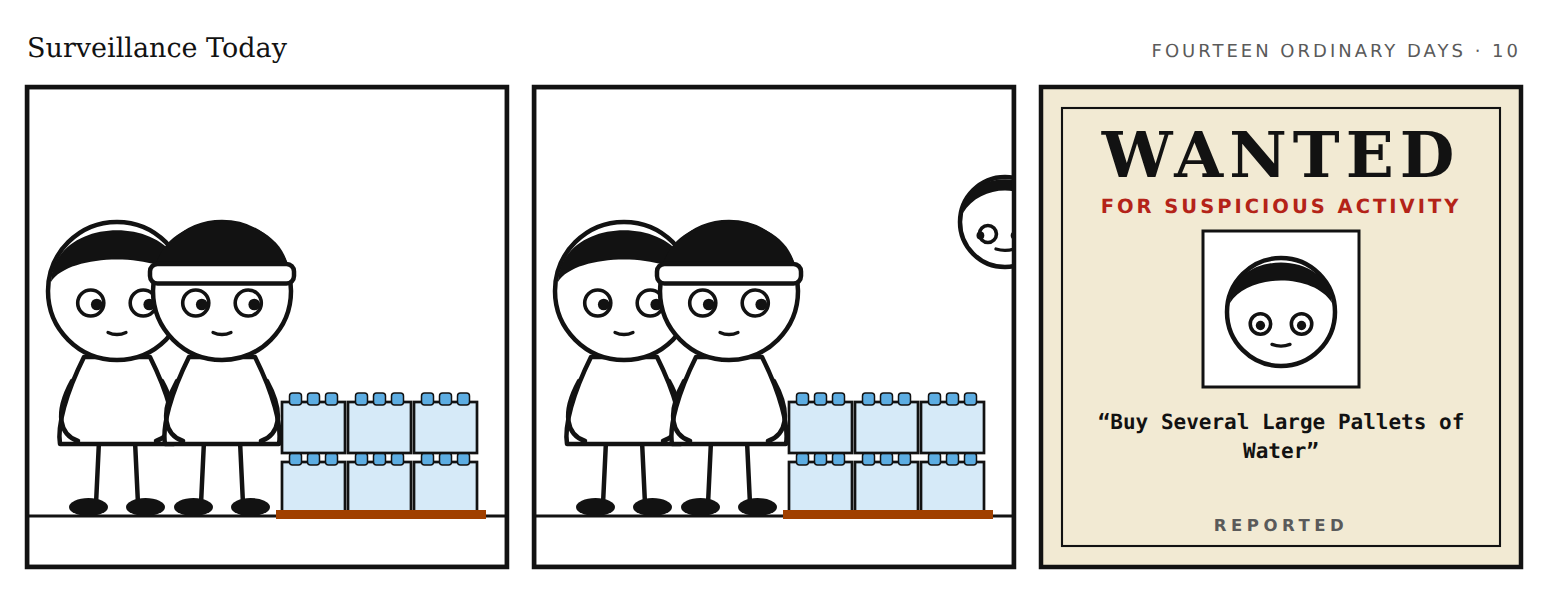
10. Two shoppers, bottles of water
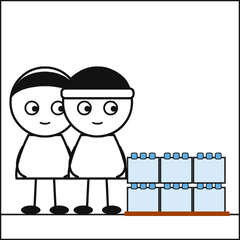
Two men buy several large pallets of bottled water.
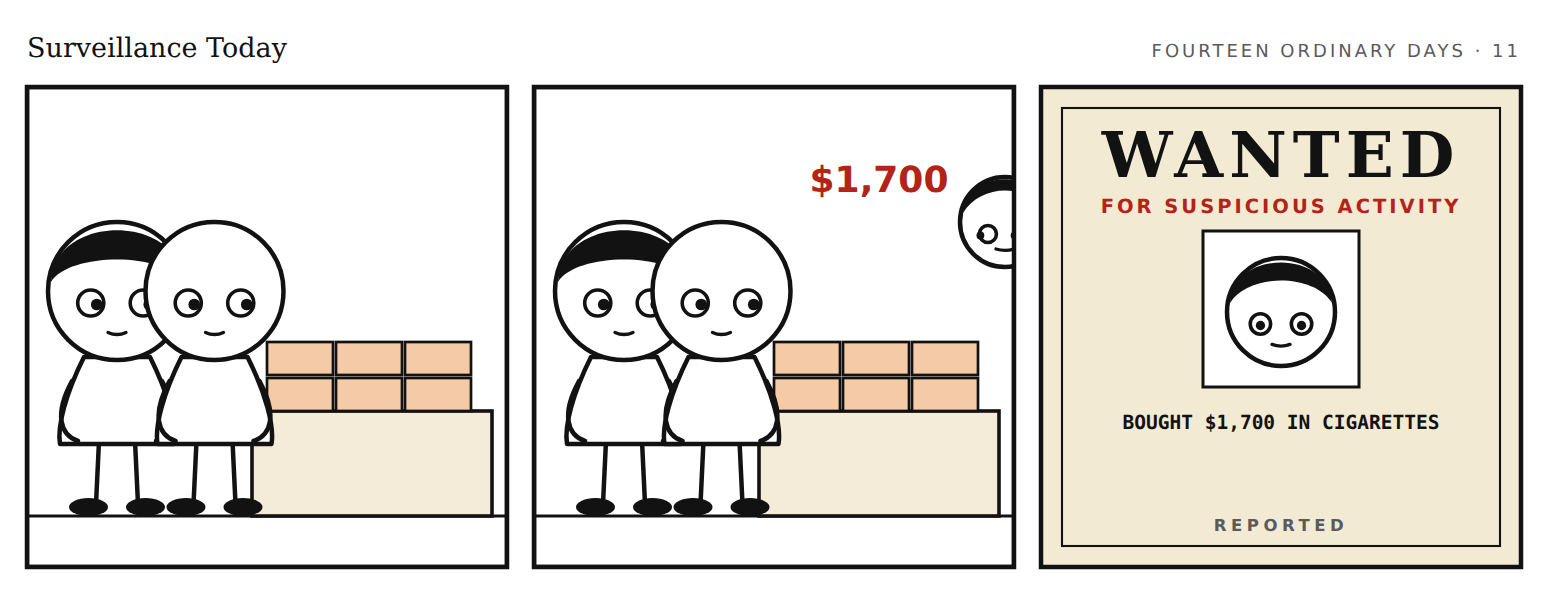
11. Two shoppers, cigarettes
Two men buy $1,700 worth of cigarettes.
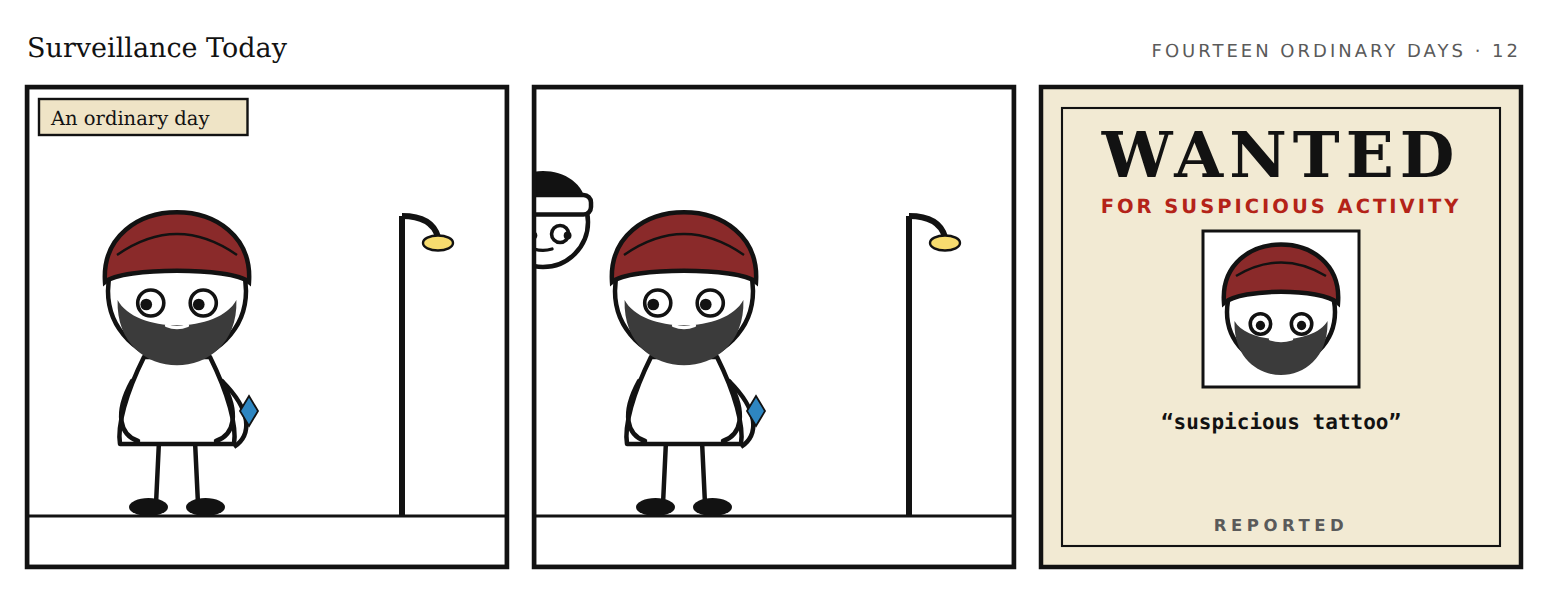
12. Pedestrian
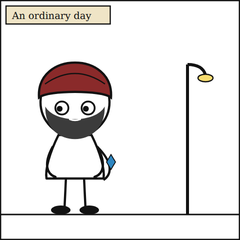
A man goes about his day. He has a tattoo.
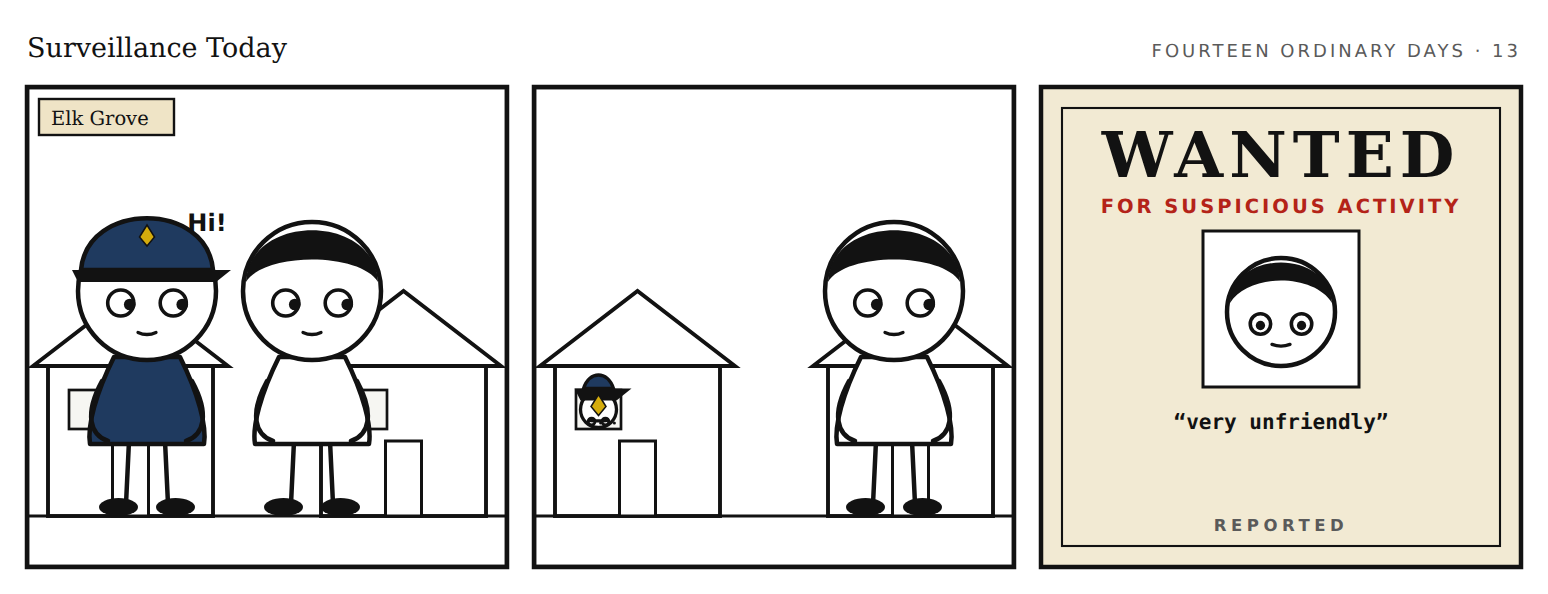
13. Neighbor, Elk Grove
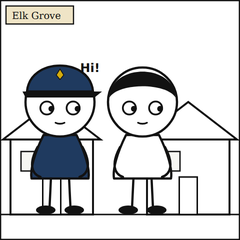
A doctor lives in Elk Grove, outside Sacramento. He keeps to himself. One of his neighbors is a police sergeant.
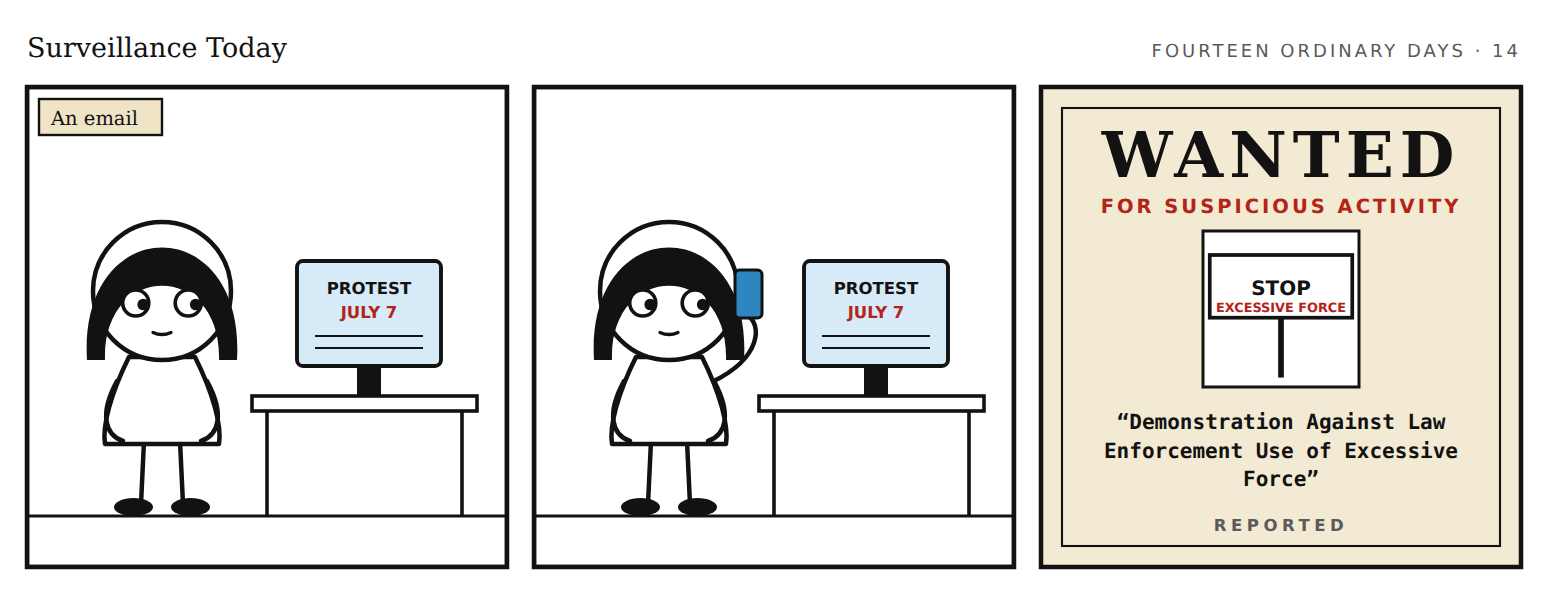
14. Email recipient
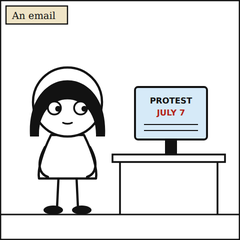
Someone opens an email. It describes a protest planned for July 7th against police use of excessive force.
Instructions from the Fusion Centers
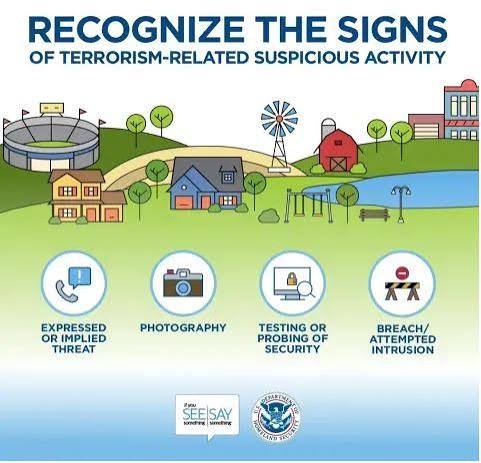
The poster from Issue No. 1, as handed out. Image: U.S. DHS.
Your turn: this part is interactive(Tap to answer)
Use the poster’s four signs. For each of the fourteen people above, tap every sign that applies. Your count fills in below.
1. Woman, Folsom
2. Rider, Purple Line
3. Man, Commerce
4. Visitor, Boston
5. Man, the port
6. Man, Benicia
7. Man and woman, Santa Ana
8. At home, Chico
9. Man, Dublin
10. Two shoppers, bottles of water
11. Two shoppers, cigarettes
12. Pedestrian
13. Neighbor, Elk Grove
14. Email recipient
The poster’s four signs
1
2
3
4
5
6
7
8
9
10
11
12
13
14
1Expressed or implied threat?
2Photography?
3Testing or probing of security?
4Breach/attempted intrusion?
Your count?.Put your number here.
“If you see something, say something.”
Every DHS poster
“Report suspicious activity to local authorities or 9-1-1 in case of emergency.”
DHS campaign poster
“Call 888-705-JRIC (5742).”
Fusion Center (JRIC) poster, Los Angeles
“Download the See Send app.”
Louisiana fusion center poster
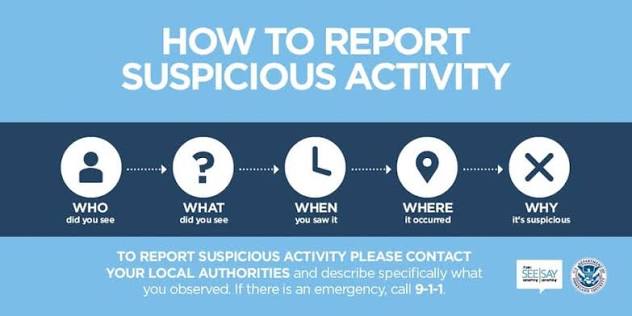
The report: who, what, when, where, why. Image: U.S. DHS.
“If it doesn’t look right, report it.”
Awareness Day poster, Sept. 25
“We immediately report all suspicious activities to the police department.”
Neighborhood sign
“Together, we can help keep our community safe.”
Fusion Center (JRIC) poster, Los Angeles
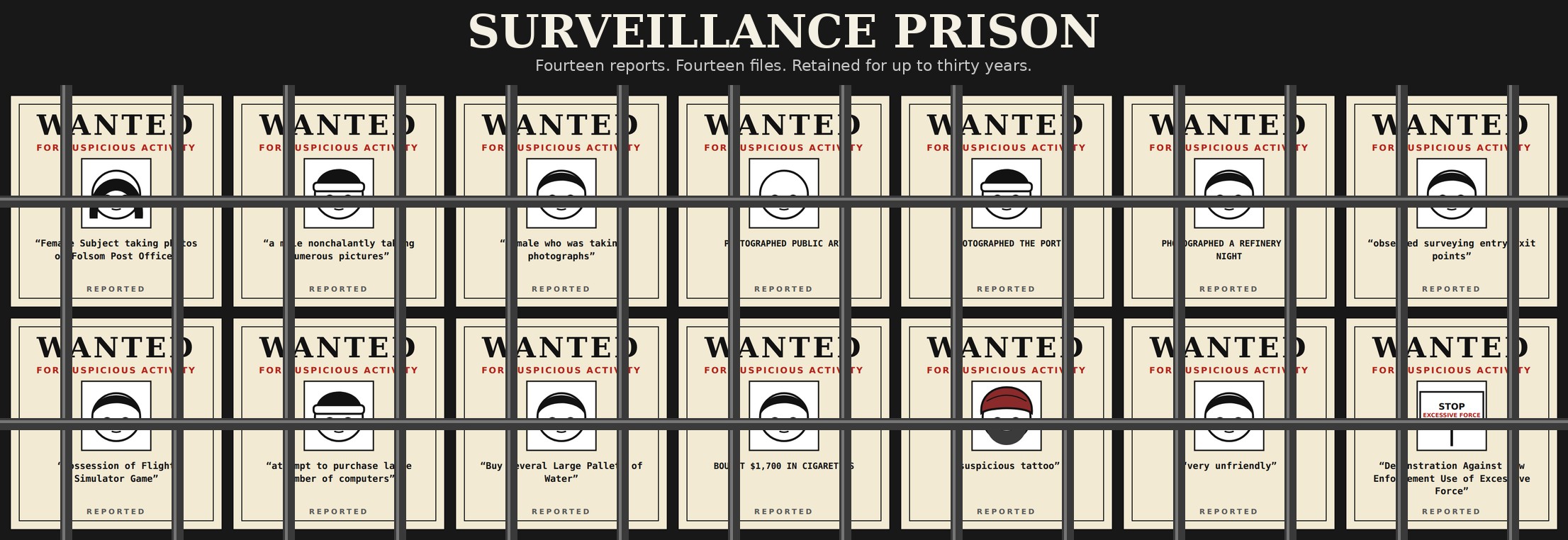
1. “Female Subject taking photos of Folsom Post Office.”
2. “a male nonchalantly taking numerous pictures inside a purple line train.”
3. Police were “called out to the above address regarding a male who was taking photographs.” He told them “he is an artist and enjoys photographing building[s] in industrial areas.” The report went to the fusion center anyway.
4. J.P. Private guards stopped him. Months later an agent from the Joint Terrorism Task Force left a card at his door in Sacramento and questioned a neighbor about him.
5. H.B. His subjects, by his own account, are industrial: bridges, ports, refineries. Two FBI agents came to his door to ask what he had been doing at the port. One asked him: “do you hold any ill will toward the United States of America?”
6. A.C. Private security stopped him. Sheriff’s deputies searched his camera and his car, photographed him, and told him he would be placed on an “NSA watch list.”
7. T.R. A security officer called the police. The report: “Male of Middle Eastern decent [sic] observed surveying entry/exit points.” It says he left with “a female wearing a white burka head dress.” That was his mother, in a hijab. He had an appointment at the county employment resource center inside the depot and had never been in the building; walking it to find the office is what the report called “surveying entry/exit points.” The report asked that it go to the Orange County fusion center. The FBI later questioned him.
8. W.G. Police searched his home. The report, “Suspicious Male Subject in Possession of Flight Simulator Game,” noted his “full conversion to Islam as a young WMA and pious demeanor,” that he “appears to shun law enforcement contact,” and his “potential access to flight simulators via the internet.” It records that the matter was “later determined to be unfounded.” The FBI asked his sister about his religion.
9. K.I. “[s]uspicious attempt to purchase large number of computers.” The computers were for his employer. Two reports on him went into the FBI’s eGuardian database.
10. “Suspicious ME [Middle Eastern] Males Buy Several Large Pallets of Water.”
11. A report was filed. NPR’s account of the reports describes them as “two Middle Eastern men.”
12. The report identified him as a Sikh man and called the tattoo “suspicious.”
13. The sergeant reported that he had “long been concerned about a residence in his neighborhood occupied by a Middle Eastern male adult physician who is very unfriendly.”
14. The email became a report: “Demonstration Against Law Enforcement Use of Excessive Force.”
Five of these people sued the Justice Department over their reports: J.P., A.C., T.R., W.G. and K.I. None of the five was charged with anything.
The record for each:
4, 6, 7, 8, 9.Gill v. U.S. Department of Justice, U.S. District Court, N.D. Cal., No. 3:14-cv-03120 (complaint July 10, 2014; summary judgment for the government Mar. 27, 2017); U.S. Court of Appeals for the Ninth Circuit, No. 17-16107 (affirmed Jan. 29, 2019).
1, 2, 3, 10, 12, 13, 14. Suspicious Activity Report summaries released by the Central California Intelligence Center and the Los Angeles Joint Regional Intelligence Center; ACLU of Northern California, coalition letter to the Attorney General, Sept. 19, 2013.
5, 11. NPR with the Center for Investigative Reporting, Sept. 8, 2011, and NPR, Sept. 19, 2013.
The Functional Standard
Every one of the fourteen reports above was measured against one federal sentence, the same sentence every fusion center applies to every report. The U.S. Court of Appeals for the Ninth Circuit upheld it in Gill v. U.S. Department of Justice, No. 17-16107, on January 29, 2019.
The sentence, in full
“Observed behavior reasonably indicative of pre-operational planning associated with terrorism or other criminal activity.”
Information Sharing Environment, Suspicious Activity Reporting Functional Standard, version 1.5.5, February 23, 2015. First issued January 25, 2008. Never put to public comment.
! The Functional Standard’s last four words
Read the Functional Standard to its end. Its last four words are where the fourteen came from.
Sold as
“…associated with terrorism
or
Covers
other criminal activity.”
It was sold as a counterterrorism tool. “Or other criminal activity” opens it to everything else.
Issue No. 1 · the FBI’s rule for searching Americans under Section 702
“reasonably likely to retrieve foreign intelligence or evidence of a crime”
Issue No. 2 · the Functional Standard
“associated with terrorism or other criminal activity”
Same build. The foreign or terrorist half justifies the database. The crime half decides who goes into it.
The new rule that replaced due process and the First Amendment
1 What the Ninth Circuit held, 2019
When T.R., W.G. and three others sued, the U.S. Court of Appeals for the Ninth Circuit ruled against them. Its staff summary puts the ruling in two paragraphs.
No reasonable suspicion
“The panel held that the Department of Justice’s decision to exclude SARs from Part 23 was not contrary to the record, and was consistent with the stated objectives of the Nationwide Suspicious Activity Reporting Initiative. The panel concluded that the Functional Standard was not arbitrary and capricious under the APA.”
What it means. The rule that protects people not suspected of a crime does not apply, because collecting reports on such people is the program’s objective. The opinion: “The government intentionally seeks more than reports showing a reasonable suspicion that terrorism-related crimes have occurred.”
No public comment
“The panel held that the Functional Standard was exempt from the APA’s notice and comment requirement because the significant discretion retained by agencies and their analysts in determining whether to disseminate information demonstrated that the Functional Standard was not a legislative rule. Legislative rules have the force of law, and are subject to notice and comment under the APA before becoming effective.”
What it means. A rule with the force of law must be put to the public first. The court held this one is not that kind of rule, because the person reviewing the report, at the Los Angeles Fusion Center a contract IT technician, decides case by case. The discretion that makes it unaccountable is what exempted it. The record shows outreach meetings with a handful of advocacy groups and an email to two state intelligence officials.
What the court left standing
A report on you needs no suspicion of a crime.
The Functional Standard that permits it needed no public comment.
Both are lawful.
Here is how it works.
2 What it takes to put you in a file
Criminal intelligence file · 28 CFR Part 23
“reasonable suspicion that the individual is involved in criminal conduct or activity”
≠
Suspicious activity report · the Functional Standard
“reasonably indicative”
The government’s own 2008 privacy analysis: “‘Reasonable suspicion’ is not a separate requirement.” It called the reports “fact-based information rather than criminal intelligence.”
3 The sixteen behaviors
7 are crimes
Breach/Attempted Intrusion
Misrepresentation
Theft/Loss/Diversion
Sabotage/Tampering/Vandalism
Cyberattack
Expressed or Implied Threat
Aviation Activity
9 need no crime
“potential criminal or non-criminal activity”
Eliciting Information
Testing or Probing of Security
Recruiting/Financing
Photography
Observation/Surveillance
Materials Acquisition/Storage
Acquisition of Expertise
Weapons Collection/Discovery
Sector-Specific Incident
On the poster. Two of its four signs need no crime.
Asking questions, taking pictures, looking at something too long and buying things are on the list.
4 Photography, 2008 and 2015
Version 1.0 · January 2008
“Taking pictures/video of facility/infrastructure/personnel or surrounding environment.”
→
Version 1.5.5 · February 2015
“Taking pictures or video of persons, facilities, buildings, or infrastructure in an unusual or surreptitious manner that would arouse suspicion of terrorism or other criminality in a reasonable person.”
2015 added people. Who counts as the reasonable person is up to whoever makes the call.
The office that issues and amends the standard has had no head since 2017. The 2015 text has not changed. This is the Functional Standard. The rest of this issue is what happens on top of it.
Six of the fourteen reports name a religion or an ethnicity
Someone looked at each of the fourteen and saw a threat: a security officer at a train station, private guards outside a fence, police at a man’s home, a sergeant about the man next door, callers whose names are not in the record. If nothing in the fourteen called for a report, then the reports are not about what people did. Read what they chose to write down.
Most of the rest are about a camera. That is the poster. Its second sign is a camera.
[CHECK: items 4 and 6 are alleged in the complaint “on information and belief”; item 11’s “Middle Eastern” is NPR’s wording, confirm against the report; item 13 “keeps to himself” is drawn from “very unfriendly.”]
Most reports start with a neighbor: 81 percent, by the LAPD Inspector General’s count
Mostly your neighbors.
January 25, 2008
The federal list: the Functional Standard, version 1.0.
March 5, 2008 · six weeks later
LAPD Special Order 11. It includes a person who “Takes pictures or video footage (with no apparent esthetic value).” Reports “may be reported to them by private parties,” anonymously.
October 2008
The Justice Department thanks LAPD for “spearheading the SAR initiative and bringing it to the national forefront.”
LAPD said what it wanted: “Terrorism liaison officers, or TLOs, are casting an ever-wider net to train more people in the city as public data collectors… The ultimate goal is to seamlessly blend crime-fighting and counterterrorism efforts.”
81%
of LAPD’s suspicious activity reports in one year were started by community members.
175 of 215 · 161 sent to the Fusion Center, JRIC · LAPD Inspector General, FY 2013–14
How long the training takes
Homeland Security public courseunder 10 min
Patrol officers (began as 15 min)24 min
Private security officers31 min
911 dispatchers38 min
The courses teach what to recognize, how to document it and where to send it. Dispatchers learn which questions get the most useful information for a report. For behavior that is not a crime and may be protected by the Constitution, the guidance says to gather more facts so the record supports it. Boston’s fusion center states the test: “articulable facts and circumstances that support the source agency’s suspicion.” The agency filing the report supplies the suspicion. None of the national course descriptions mentions race, religion or the First Amendment.
“People just like you send in leads and we get it out to the appropriate agencies.”Orange County fusion center deputies, training Neighborhood Watch block captains in Tustin
Who pays for the poster
The 2018 homeland security grant rules list “Implementation of the ‘If You See Something, Say Something™’ campaign” under Law Enforcement Terrorism Prevention Activities, the category that must get at least 35 percent of every Urban Area Security Initiative grant.
This year’s $88.35 million transit security grant lists “Community engagement efforts to foster trust and encourage threat reporting.”
The campaign tells partners to “forward” reports “to fusion centers or FBI/JTTFs for follow-up.”
New York spent $2 million to $3 million a year promoting its hotline, much of it federal money. Asked in 2008 how many tips had led to a terrorism arrest, the answer was none.
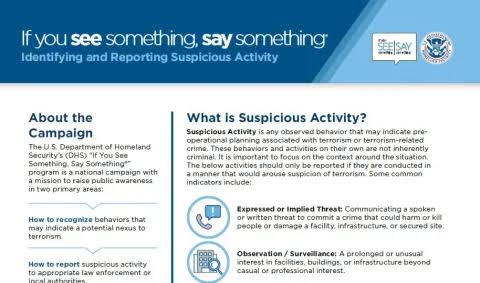
“What is Suspicious Activity?” The campaign handout. Image: U.S. DHS.“Report suspicious activity,” in a classroom. Image: New Jersey Office of Homeland Security and Preparedness.On a school wall: hotlines for school violence, bullying, and “suspicious activity.” Image: Kansas school-safety poster.
Now there is more · Attorney General, December 4, 2025
“better publicize the FBI’s tip line”
an upgraded Digital Media Tipline so “witnesses and citizen journalists can send media of suspected acts of domestic terrorism”
“a cash reward system”
“compile a list of groups or entities engaged in acts that may constitute domestic terrorism,” with agendas including opposition to “law and immigration enforcement”
A footnote: no investigation may be opened “based solely on activities protected by the First Amendment.”
The rule says race is not a factor. The reports keep describing it.
LAPD’s own rule
Race, ethnicity, national origin and religion “should not be considered as factors that create suspicion.”
The fourteen reports
“Middle Eastern” three times. “Burka.” “Full conversion to Islam.” “Pious demeanor.”
≈⅔
of the people reported at the Mall of America were minorities; almost half the reports went on to state and federal police (NPR and the Center for Investigative Reporting, 2011)
30%
of LAPD reports sent to the Fusion Center were on Black residents, in a city less than 10 percent Black, as the Stop LAPD Spying Coalition reads the 2015 audit [CHECK: confirm against the OIG chart]
One technician’s yes puts a report in a database open to agencies nationwide, the FBI and Homeland Security among them
“After receiving a report of suspicious activity, an officer creates a SAR. The SAR then undergoes a two-part evaluation process. An analyst determines whether the SAR meets certain behavioral criteria and has a potential nexus to terrorism. If the analyst concludes that it does, the SAR becomes an ISE-SAR, and is uploaded to the eGuardian repository, where it is available to all NSI participants. The ISE-SAR is also input into the Federal Bureau of Investigation (FBI) classified system and sent to the Department of Homeland Security Office of Intelligence Analysis.”Ninth Circuit, Gill v. DOJ, page 6
The route, as the Ninth Circuit described it on page 6 of its opinion. Graphic: Surveillance Today.
One technician’s decision sends a neighbor’s call into a database open to federal, state, local and tribal law enforcement agencies across the country, into the FBI’s classified files, and to Homeland Security’s intelligence office. Immigration and Customs Enforcement is part of the same department.
October 9, 2026 · FEMA Information Bulletin 589 · nine days before this issue
Every fusion center spending 2026 homeland security money must now report, each quarter:
the “Number of tips, leads, or Suspicious Activity Reports (SARs) provided to HSTFs,” the Homeland Security Task Forces created by the January 2025 immigration order
whether its lead agency “is an active 287(g) partner,” signed up to do immigration enforcement
“the number of seats the fusion center holds for officials from U.S. Immigration and Customs Enforcement”
FEMA called the change a correction of “an administrative error.”
The plumbing is already there. In 2017 an official from ICE’s investigations arm asked a detective inside the Orange County fusion center to run a license plate; the results came back within hours, according to ICE’s own records released to the ACLU. The system records where a report goes. It does not record what the report led to: the FBI “does not systematically track” whether the reports helped stop anything (GAO, 2013).
100,000 reports. About 2,300 touched an FBI case or the watch list.
The promise
“It’s the one that you don’t take seriously that becomes the 9/11.”
FBI National Threat Center, USA Today, 2008
“Any terrorism lead has to be followed up.”
FBI special counsel, The New York Times, 2011
The count · Homeland Security to Congress, 2017
100,000+ reports submitted since 2010
35,000+ sent to eGuardian
2,300+ opened or added to an FBI case, or matched the watch list
About two in every hundred. A 2012 bipartisan Senate investigation “could identify no reporting which uncovered a terrorist threat.”
$289M–$1.4B
to fusion centers, 2003–2011, by Homeland Security’s own estimate
$38.7M
Los Angeles–Long Beach, 2025 Urban Area Security Initiative
$8.8M
Anaheim–Santa Ana, 2025
After a suspicious activity report
Twelve steps after a report, every one on the record
Someone calls. Most of LAPD’s reports start with a member of the public: 81 percent, by the LAPD Inspector General’s count.
An officer writes it up. The Functional Standard asks for behavior “reasonably indicative” of terrorism “or other criminal activity.” No suspicion of a crime is required.
A contract IT technician decides. A yes makes it an ISE-SAR, “available to all NSI participants,” meaning federal, state, local and tribal law enforcement agencies across the country, entered into the FBI’s classified system and sent to Homeland Security’s intelligence office (Ninth Circuit, Gill).
It goes to the Fusion Center. In one year LAPD sent 161 of its 215 reports to the Fusion Center, JRIC. Tips and Leads “automatically submit[s]” every tip to eGuardian.
It is kept. Up to five years in eGuardian. With no tie to terrorism, it leaves eGuardian after 180 days and stays in FBI files for thirty years. W.G.’s report says “later determined to be unfounded.” It was kept.
An inquiry can open. An FBI “assessment” needs no factual predicate. Agents may use informants, interview under false pretenses and watch, with no time limit. 82,325 assessments in two years.
Agents come. A card at J.P.’s door and his neighbor questioned. Two agents at H.B.’s. The FBI questioned T.R. Police searched W.G.’s home; the FBI asked his sister about his religion. Deputies searched A.C.’s camera and car.
The watch list. About 1.2 million people in 2017, on “reasonable suspicion,” shared with 1,441 private entities. A traffic stop of someone on it can become a new report to JRIC.
The same rooms hold the cameras. The Fusion Center’s Palantir applications search 911 calls, jail visits, DMV records, informants, and plates by plate or by location. Orange County’s plate cameras were searched 2,144,138 times in four months, with no warrant.
Immigration is in the room. Customs and Border Protection is housed at the Fusion Center. Since October 9, fusion centers must count the reports they send to the Homeland Security Task Forces and the seats they hold for ICE. In 2017 ICE’s investigations arm had a plate run inside the Orange County center within hours.
You are not told. No notice, no hearing, no way to correct the record. For J.P., H.B. and T.R., the first sign was the FBI.
No one answers for it. Five sued; the government won, and the Ninth Circuit affirmed. We looked for one officer, technician or agency anywhere disciplined for a biased report. There is none on record.
What is done with a file once it is inside, the agencies do not disclose, and the person named is never told.
After the report: agents at the door, neighbors questioned, a watch list
One of the fourteen, and what a single report reaches according to the records in this issue. The drawing shows where the report goes and what sits there. It does not show what was done to any one person. Drawing: Surveillance Today.
A report is not the end of it. It is where an inquiry can begin.
82,325
FBI “assessments” of people and groups, March 2009 to March 2011. An assessment needs no factual predicate. Agents may use informants, interview under false pretenses and watch you, with no time limit (the Brennan Center’s reading of the 2008 guidelines).
3,315 became preliminary or full investigations: about four in a hundred · FBI data, The New York Times
Your neighbors can be recruited
In 2006 the FBI and the Orange County Joint Terrorism Task Force sent an informant into the Islamic Center of Irvine. He said he had converted and planted recorders in the mosque and in members’ homes. In 2022 the Supreme Court did not decide whether that was lawful; it held only that the surveillance statute does not override the government’s power to keep its evidence secret.
The map that was dropped
In 2007 LAPD’s counterterrorism bureau proposed mapping the city’s Muslim communities with census data. It dropped the plan on Nov. 15, 2007, after religious leaders protested.
The watch list follows you
About 1.2 million people in 2017, about 4,600 of them citizens or permanent residents, on “reasonable suspicion.” No one is told. Shared with 1,441 private entities. One man was handcuffed three times at the Canadian border. A judge found it violated due process in 2019; the Fourth Circuit reversed in 2021.
And it loops back
Traffic stop→Driver on the watch list→Suspicious activity report→JRIC
Twice in LAPD’s reviewed reports. The Inspector General noted that being on the list is not one of the sixteen behaviors.
You are not told. The same rooms hold the cameras.
The file stays
Up to five years in eGuardian. No tie to terrorism: deleted from eGuardian after 180 days, then kept in FBI files for thirty years. W.G.’s report says “later determined to be unfounded.” It was kept.
You are not told
No notice, no hearing, no way to correct the record. For J.P., H.B. and T.R., the first sign was the FBI.
The same rooms hold the cameras
The Fusion Center runs on 29 Palantir applications. One, Tips and Leads, “automatically submit[s]” every tip to eGuardian. Others search plates, 911 calls, jail visits and DMV records.
What it looked like for five of the fourteen
An agent’s card at the door
J.P. came home to it. The agent had already questioned his neighbor.
FBI agents at the door
Two of them at H.B.’s: did he hold “any ill will toward the United States of America?”
Followed to his car
A security officer followed T.R. and wrote down his plate, by his account in court. Later the FBI questioned him.
A home searched, a sister questioned
Police searched W.G.’s home. Then a call about his Facebook page and a “watch list”; by his account, an FBI file. The FBI asked his sister about his religion.
“NSA watch list”
A.C. was held 45 minutes to an hour at a refinery fence. Deputies searched his camera and car and told him he was going on the list.
The cameras, and the money
$2.89M a year: the Los Angeles fusion center’s homeland security grant. $39.8M in federal money for its Palantir system since 2009.
2 years: how long the Sheriff keeps plate-reader data. The Board had asked for 60 days.
$114,000: city money added to the Cheviot Hills residents’ own ring of plate readers. (See: A ring of cameras.)
$44.3M: the Orange County Sheriff’s Axon contract, including $3.02M for Fusus, which brings private cameras into the Sheriff’s system. Laguna Woods pays residents up to $10,000 to connect theirs, released only after the Sheriff confirms the feeds are visible.
How can this happen?
Every check that was supposed to stop it, and where each one stopped.
The county’s Inspector General. Ordered to monitor the Fusion Center in 2022. Max Huntsman told us its monitoring “was limited to reviewing contracts”; more “would have required aggressive county action and the Board did not pursue it.” Then the county cut ten of his positions, and the Sheriff lost half a percent. (See: A “proportional share.”) He retired in December 2025: “What you do about it is up to you.”
The public. It never had a say. The court said it did not have to.
The office that owns the Functional Standard. No head since 2017.
The Legislature. SB 1013 would have limited plate data to finding suspects and missing people, required Attorney General audits and a warrant for archived data. It passed the Senate. On the final day of the session the Assembly majority leader held it. Nearly 40 police agencies and unions opposed it.
The consequences. We looked for one officer, technician or agency anywhere disciplined, fired, charged or held liable for a pretextual or biased suspicious activity report. We found none.
The county’s Auditor-Controller. Ordered in 2022 to check the Sheriff’s report on the center’s money. It found $44.9 million in contracts left out, and wrote: “we did not review the privacy implications of JRIC operations.”
An inspector general checks conduct against rules. Under the Functional Standard the rule is the contract IT technician’s discretion, which the court held is why it needed no public process. A watchdog can count the reports. He has no rule to measure them against. The Fusion Center has had no privacy review in twenty years. (See: The county audited its Fusion Center, above.)
Misuse the tools for yourself
Kechi, Kan. Lt. Victor Heiar used Flock “to monitor his estranged wife’s location.” Pleaded guilty; 18 months’ probation.
Costa Mesa. Officer Robert Josett tracked a former mistress. Fired June 28, 2024; pleaded guilty to three misdemeanors.
California, 2024. 107 database-misuse cases; violations in 42; nine officers fired, eight suspended, eight resigned.
Louisville. A DEA agent ran “immigration” and “ERO” searches on a detective’s login. Discipline was for sharing a password. [CHECK: Spectrum News, Jan. 5, 2026]
Charged.
Use them as the program asks
A sergeant reports the doctor next door as “very unfriendly.” W.G.’s report rested on his conversion and his “pious demeanor.” The government won his lawsuit, and nothing in the record shows the report was removed.
Nothing.
What stays true
No one voted on the Functional Standard.
One contract technician sends a neighbor’s unease into federal files, for years.
The person named is never told.
The court said that is lawful.
Since Oct. 9, federal grants count how much of it reaches immigration enforcement.
The poster in our first issue is the Functional Standard, printed for the public.
Beside the fourteen
Who puts them up?
Homeland Security designs them.
“If You See Something, Say Something” belongs to New York’s transit authority, which coined it after September 11 and licensed it to DHS in July 2010, the year the national suspicious-activity program went live. DHS’s own rule: the department “must design all materials.” Partners may not alter them, and every one must carry the DHS logo and the line “used with permission of the NY Metropolitan Transportation Authority.”
Partners print them.
Any state, city, transit agency, school, college or business becomes a partner by emailing its name and location. DHS supplies print-ready files, graphic design and television and radio spots at no charge. “The printing and distribution costs are the partner’s responsibility.”
Federal grants can pay.
Running the campaign is an allowable cost under the Homeland Security Grant Program, inside the terrorism-prevention share every state must spend at a minimum of 35 percent.
The number is the point.
To print a phone number on the sign, the partner must have it answered by a person “24/7/365” and show “a clear path into the SAR Data Repository,” the national database. A sign with no route to the database does not get the logo.
It started at the checkout.
On December 6, 2010, a 44-second video of Secretary Janet Napolitano asking shoppers to report suspicious activity in the store and the parking lot began playing on checkout screens in more than 230 Walmart stores, with 588 stores in 27 states to follow. Emails released under the Freedom of Information Act show fusion centers phoning local Walmarts on their own once the press release went out, and Walmart’s security chief warning DHS he would pull out unless the department controlled its people. The videos were not renewed after Napolitano left in 2013.
It has a holiday.
September 25 is National “If You See Something, Say Something” Awareness Day, designated by DHS in 2018.
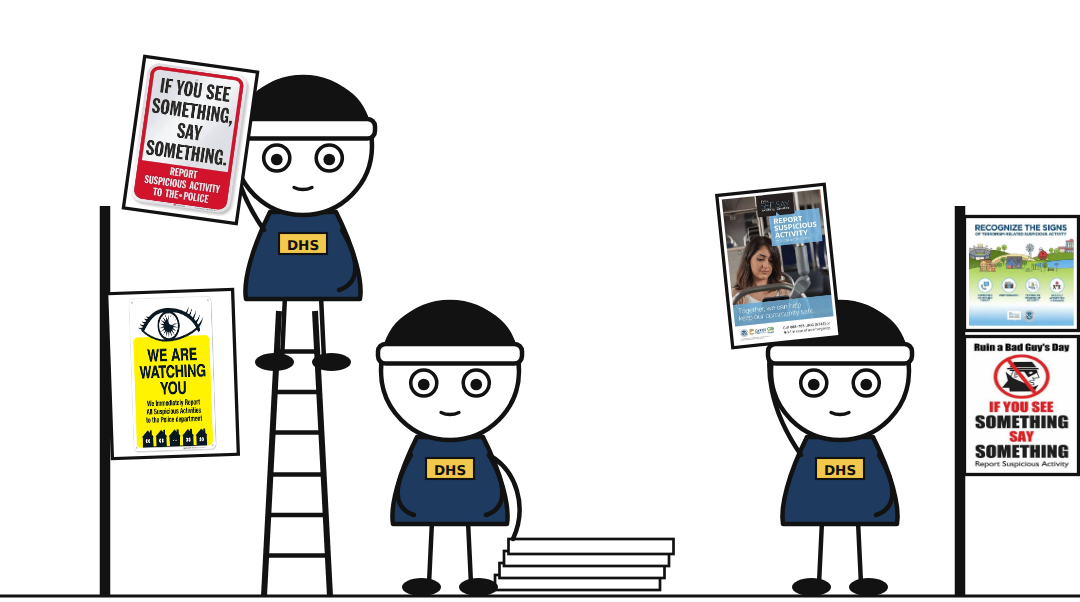
Posters and signs: U.S. Department of Homeland Security; New Jersey Office of Homeland Security and Preparedness; Louisiana State Analytical and Fusion Exchange; Los Angeles Joint Regional Intelligence Center; Kansas school-safety hotline; municipal police departments; and neighborhood-watch and private-property signs as sold. Drawing: Surveillance Today.
Sources: ISE-SAR Functional Standard v. 1.0 (Jan. 25, 2008) and v. 1.5.5 (Feb. 23, 2015); PM-ISE privacy analysis (2008), in the 2014 federal lawsuit, Govt. Supplemental Excerpts of Record, vol. 2; U.S. Court of Appeals for the Ninth Circuit, No. 17-16107 (Jan. 29, 2019), opinion and court staff summary; USA Today, 2008, and The New York Times, 2011, as quoted in Cato Institute, Jan. 24, 2012; U.S. District Court, N.D. Cal., No. 3:14-cv-03120, Complaint, July 10, 2014; Excerpts of Record (plaintiff declaration, Ex. 1); GAO-23-105310; GAO-13-233; Bureau of Justice Assistance, SAR Support and Implementation Project, Oct. 2008 (LAPD Special Order 11); LAPD Counterterrorism and Criminal Intelligence Bureau paper (Washington Institute); LAPD Office of the Inspector General, Review of Suspicious Activity Reports, FY 2013/2014, Jan. 23, 2015; Stop LAPD Spying Coalition; Behind the Badge, May 7, 2016; ACLU of Northern California, Sept. 19, 2013; NPR, Sept. 19, 2013, and Sept. 8, 2011 (with the Center for Investigative Reporting); PetaPixel, Sept. 20, 2013; Attorney General, Implementing NSPM-7, Dec. 4, 2025; FEMA Information Bulletin No. 589, Oct. 9, 2026; Executive Order 14159; EFF, March 2019 (ICE records on OCIAC); LASD Board letter, May 21, 2019, Exhibit C; Cal OES FY25 HSGP allocations; OC Board of Supervisors, Axon amendment, May 19, 2026; City of Laguna Woods, Connect Orange County incentive program, 2026; Inadvertent/CALÓ News, July 8, 2026; Fullerton Observer, Oct. 6, 2026; CalMatters, Sept. 3, 2026; Max Huntsman, letter to the Board, Dec. 9, 2025; KWCH, Apr. 5, 2023 (Kechi); CBS Los Angeles, 2026 (Costa Mesa); California DOJ, CLETS Advisory Committee meeting summary, Apr. 8, 2025; Spectrum News, Jan. 5, 2026 (Louisville); Senate Select Committee on Intelligence, June 7, 2017, transcript; DHS, “If You See Something, Say Something” Campaign Overview; NSI training catalog (sar-training.ncirc.gov) and BJA NCIRC, NSI Line Officer Training; DHS, NSI Public Safety Telecommunications (2023); Boston Regional Intelligence Center, Tips and Leads SOP (rev. 2014); Utah Division of Emergency Management, SHSP Activities and Allowable Costs (2018); FEMA, FY2026 Transit Security Grant Program NOFO; John Mueller, “Terror Tipsters,” Cato Institute, Jan. 24, 2012; Brennan Center, “FBI: Fact or Fiction” (2011), on the 2008 Attorney General’s Guidelines; The New York Times, Aug. 24, 2011 (FBI assessment data, Mar. 2009–Mar. 2011); FBI v. Fazaga, 595 U.S. 344 (2022); Christian Science Monitor, Nov. 20, 2007; Elhady v. Kable (E.D. Va. Sept. 4, 2019), rev’d, 993 F.3d 208 (4th Cir. 2021); AP/Courthouse News, Feb. 20, 2019 (1,441 private entities); DHS, About the NSI; House Homeland Security Subcommittee on Counterterrorism and Intelligence, Sept. 13, 2017 (Robin Taylor written statement); Senate PSI staff report, Oct. 3, 2012; Los Angeles County OIG, Deputy Gangs, Feb. 26, 2024. U.S. DHS, “If You See Something, Say Something®” Rules and Restrictions, dhs.gov/see-something-say-something/rules-and-restrictions; DHS, About the Campaign, dhs.gov/see-something-say-something/about-campaign; DHS, See Say Campaign Partnership Guide (2018), as posted by the Florida Fusion Center, fdle.state.fl.us; DHS press release, “DHS Launches ‘If You See Something, Say Something’ Campaign at Walmart,” Dec. 6, 2010; MuckRock, “When Homeland Security came to Walmart,” Aug. 1, 2016 (DHS emails released under FOIA); Federal Times, Dec. 9, 2010.; U.S. District Court, N.D. Cal., No. 3:14-cv-03120, Complaint, July 10, 2014, and order of Feb. 20, 2015 (Seeborg, J.); Attorney General, Implementing NSPM-7, Dec. 4, 2025 (House Judiciary record, Feb. 11, 2026); FEMA Information Bulletin No. 589, Oct. 9, 2026; Executive Order 14159; ISE-SAR Functional Standard v. 1.0 (Jan. 25, 2008) and v. 1.5.5 (Feb. 23, 2015); GAO-23-105310; U.S. Court of Appeals for the Ninth Circuit, No. 17-16107 (Jan. 29, 2019); Stop LAPD Spying Coalition on the 2015 OIG audit; ACLU of Northern California, “The Government is Spying on You,” Sept. 19, 2013; NPR, Sept. 19, 2013; PetaPixel, Sept. 20, 2013; Bureau of Justice Assistance, Findings and Recommendations of the SAR Support and Implementation Project, Oct. 2008, App. B (LAPD Special Order 11); LAPD Counterterrorism and Criminal Intelligence Bureau paper (Washington Institute); LAPD Office of the Inspector General, Review of Suspicious Activity Reports, FY 2013/2014, Jan. 23, 2015; Behind the Badge, May 7, 2016; GAO-13-233, App. V; FBI eGuardian Privacy Impact Assessment, 2022; Orange County Sheriff’s Department, Network Audit logs, Mar. 1–June 30, 2026, released Oct. 16, 2026, in response to a Public Records Act request (2,144,138 rows), and cover letter of the same date; Fullerton Observer, Oct. 6, 2026; Inadvertent/CALÓ News, July 8, 2026 (OCSD Flock network audit); CalMatters, Sept. 3, 2026 (SB 1013); Senate Select Committee on Intelligence, Open Hearing on FISA Legislation, June 7, 2017, transcript; The Markup/CalMatters, June 18, 2025; CALÓ News/Inadvertent, Aug. 20, 2026; ODNI Annual Statistical Transparency Report, CY2025; American Prospect, May 11 and Sept. 24, 2026; House Judiciary letter to DNI Clapper, April 2016; New America, June 12, 2017.
The Orange County Sheriff Says Its Cameras Are “Not Used to Track Protesters.” Its Logs Show Protest Searches, Searches During the No Kings Rally, and Searches Run for ICE
The Orange County Sheriff’s Department runs a network of license plate cameras sold by Flock Safety. Every car that passes is photographed and logged. Any of 334 police agencies, including the Northern California fusion center, can search those logs, along with hundreds of other agencies’ cameras at once, by typing a plate or a description and a reason. No warrant is required, and the reason is free text. Issue No. 1 promised the queries: who gets looked up, and on what justification. The Sheriff’s own audit logs for March to June 2026, released in response to a Public Records Act request, answer it. They show protest searches by a Sheriff’s Department that says it does not track protesters, and 599 searches logged as run for the FBI, Homeland Security Investigations and other federal agencies that state law bars from the data, among 2,144,138 searches in all.
1 · The Sheriff says its cameras are not used to track protesters. Its own logs show protest searches.
What the Sheriff’s Department said · by email to the reporter Ben Camacho of Inadvertent, published July 8, 2026
“Flock is not used to track protesters.”
≠
What its own audit log shows · March 3, 2026 · searches by the Sheriff’s Department
The first swept 712 camera networks at once, the second 13.
2 · During the No Kings rally, police searched the cameras under “Disturbing Public Peace/Riot”
On Saturday, March 28, 2026, Orange County’s largest No Kings rally ran from 2 to 5 p.m. at La Palma Park in Anaheim. At 4:17 and 4:18 p.m., Anaheim police ran four searches of the Sheriff’s plate cameras in about a minute and a half. The log records each the same way:
Disturbing Public Peace/RiotAnaheim police · 850 camera networks · 4:17:01 p.m.
Disturbing Public Peace/RiotAnaheim police · 850 camera networks · 4:17:05 p.m.
Disturbing Public Peace/RiotAnaheim police · 850 camera networks · 4:17:09 p.m.
Disturbing Public Peace/RiotAnaheim police · 850 camera networks · 4:18:25 p.m.
Nothing is typed after the category: no case number, no description. Anaheim used that category 19 times in the four months, and four that afternoon is the most it used it on any day. The log does not say what the searches were for. Every other search that day, 10,499 in all across 334 agencies, gave a reason that named no protest. [Records request to Anaheim PD for the incident or case numbers behind the four searches: to be filed.]
3 · The law: no sharing with federal agencies
“A public agency shall not sell, share, or transfer ALPR information, except to another public agency, and only as otherwise permitted by law.”
California Civil Code § 1798.90.55(b), enacted by SB 34 in 2015. ALPR is automated license plate recognition. Federal agencies, including ICE, are not public agencies under that law, and the state Attorney General has told police so.
4 · How they get around it
No federal agency appears in the logs as a searcher. The federal agent asks; a local officer runs the search and types the agency into the reason box. 599 times in four months.
Drugs/Narcotics - Locating suspect on behalf of hsiLos Angeles police · 502 networks · March 9
Drugs/Narcotics - drug trafficking vehicle for HSI caseIrvine police · 1,458 networks · March 26
Drugs/Narcotics - narcs asst dea/cbpthe Sheriff’s Department · 729 networks · May 11
LAPD wrote 87 of these, the Sheriff 85, and the Northern California fusion center 62; that fusion center searched the Sheriff’s cameras 33,978 times. It is routine, on request, and the system runs every one. No warrant is required.
Above
Fourteen reports: someone saw a person and wrote it down.
+
Here
Two million queries: someone typed a search and a reason, and the system ran it.
The fourteen are more than a decade old. What follows is four months of this year, from one county’s cameras, in the police’s own words. Then the count no one will produce.
The record
Orange County Sheriff’s Department · Flock network audit logs · March 1–June 30, 2026
2,144,138rows, one per search
Oct. 16, 2026released in response to a Public Records Act request
Every rowread by Surveillance Today
What one search looks like
Each row is one search by one officer of the Sheriff’s cameras, usually along with hundreds of other networks at once. These are real rows, as released. The officer’s name and the plate are blacked out by the vendor before the county ever sees the export.
Agency
Officer
Plate
Networks searched
Reason, as typed
Time (UTC)
Orange County SO
***
***
712
Disturbing Public Peace/Riot - Protest security research
03/03/2026 2:16 PM
Orange County SO
***
***
13
Trespass - Protest security research
03/03/2026 2:54 PM
Los Angeles PD
***
***
502
Drugs/Narcotics - Locating suspect on behalf of hsi
03/10/2026 12:36 AM
Irvine PD
***
***
1,458
Drugs/Narcotics - drug trafficking vehicle for HSI case
03/26/2026 7:56 PM
Orange County SO
***
***
729
Drugs/Narcotics - narcs asst dea/cbp
05/11/2026 10:55 PM
Ontario PD
***
***
965
Robbery - *Stop and ID everyone in vehicle* Develop Own PC*All Black Tinted windows* suspects for 211 chain snatching near Chaffey High School.
04/08/2026 7:48 PM
Upland PD
***
***
757
inv
03/29/2026 12:45 PM
Orange County SO
***
—
13
Assault/Battery Offenses - 242 · typed search: “people in black clothing in san clemente” · allowed
05/26/2026 10:04 PM
*** = removed by Flock on export. HSI is Homeland Security Investigations, ICE’s investigations arm. “PC” is probable cause.
Two million searches
2,144,138
searches in four months
334
agencies
657
camera networks swept by the typical search; the Sheriff’s cameras are one stop in a statewide sweep
Rising every month
March510,237
June574,186
Who searched most
California Highway Patrol190,680
Riverside County175,590
San Francisco123,606
OC Sheriff, its own cameras88,376
Northern California fusion center33,978
5 · “Develop own PC” ×183
From 16 agencies: run the search, then find the probable cause. Irvine: “registered to address known to be related to SATG - develop own PC.” Fresno: “Stop and ID (develop RS/PC).” Eighty-one more give as the whole reason “inv” or “investigation.”
6 · Searching for people
The system takes typed descriptions. 74 searches described a person: “BLACK MAN BALD” (Riverside County, a missing-person search), “hispanic male, 5’9”” (Bakersfield), “white person” (Santa Rosa), “people in black clothing in san clemente” (the Sheriff). Flock’s filter blocked 15 of 668 typed searches, most naming a race. The vendor is the only check.
7 · No one can check any of it
Flock strips names, plates, case numbers and filters on export. Asked to run one plate to see whether it had ever been searched, the Department declined, citing “government resources” and the owner’s privacy. Two million rows, and no way to learn whether you are in them.
What the logs cannot show is whether any one search was improper: the reasons are written by the searcher, there are no usernames, and the window is four months. [CHECK: the date of the Sheriff’s email to Inadvertent is not given in the published story.]
It is not only Orange County
Immigration ProtestEscondido police · 3 searches across 414 networks, no case number · Feb. 2, 2025 · Fullerton’s logs
ICE PROTESTSan Bernardino County Sheriff · Fullerton’s logs
10851 association, develop PC and stop, there is no wantsNapa County Sheriff · 10851 is vehicle theft; “no wants” means the car was wanted for nothing
gene autry protestAnaheim police, matching a protest on Gene Autry Way · one of 145+ protest searches in 19 months of the OC Sheriff’s network, obtained by a local organizer with Oakland Privacy
64,000+
of 491,000 California plate searches in one month of 2025 gave reasons that vague (CalMatters). Ten agencies searched for ICE; the OC Sheriff for the Border Patrol. State law forbids both.
27,000+
Northern California fusion center searches of Santa Ana’s cameras, at least 80 for the FBI, ATF, Marshals and DEA, three for the Orange County fusion center
SB 1013
would have limited plate data and required a warrant for archived data. Passed the Senate. Held by the Assembly majority leader on the session’s final day. Nearly 40 police agencies and unions opposed it.
The FBI’s version
The same structure runs at the top. A “query” is an FBI employee typing an American’s name, email or phone number into communications already collected, with no warrant.
278,000+
improper FBI queries documented by the FISA Court around 2021: protest arrestees, about 19,000 campaign donors, crime victims, people named in police reports
7,413
FBI search terms for Americans in 2025, the government’s new count. A name searched a hundred times counts once. Filter-tool searches are not counted. A March 2026 FISA Court opinion reportedly ordered those tools re-engineered; it has not been released, though the deadline passed Sept. 13.
The number no one will produce
2011
Senator Ron Wyden asks how many Americans’ communications are collected under Section 702. The NSA says counting would itself violate their privacy.
2016
Fourteen House Judiciary members, both parties: “We are not asking you for an exact count.” The Director of National Intelligence promises an estimate.
2017
His successor, Dan Coats, takes the promise on at his confirmation hearing.
June 7, 2017
Coats drops it. “Infeasible.” Counting would take “intense identity verification research on potential U.S. persons who are not targets of an investigation.” “From a privacy and civil liberties perspective, I find this unpalatable.”
The Post-Huntsman Era: In Place of a Privacy Review, a Fake Privacy Chief
The Fusion Center has never had a privacy review. In its place is a privacy officer who is a General Dynamics IT manager. The position requires project-management experience. No familiarity or training in privacy law or the U.S. Constitution is mentioned in the contract. The Sheriff’s Joint Regional Intelligence Center runs on contract. General Dynamics IT supplies the contract IT technicians who decide which suspicious activity reports go on to the FBI and Homeland Security. The Sheriff’s contract sets out what each must have. Privacy law, civil liberties and the Constitution are not on the list.
Audit Veritas staff · Sources: LA County Auditor-Controller; Board of Supervisors; Office of Inspector General; LASD; California State Auditor; Office of Inspector General, City of Los Angeles
The Fusion Center that sorts suspicious activity reports on Los Angeles County residents, the Sheriff’s Joint Regional Intelligence Center in Norwalk, carries the County’s name. Its work is done on contract. Palantir Technologies built the system its technicians search. General Dynamics Information Technology, the computer-services arm of the defense contractor that builds Abrams tanks, nuclear submarines and Gulfstream jets, supplies the technicians. InfraGard Los Angeles, a private partnership affiliated with the FBI, pays for its chair. And the person charged with protecting the privacy of the people in its files is a manager at the company that supplies the technicians, hired for operations and project management, not privacy law.
Who decides, and what the contract asks of them
At a fusion center, “an analyst determines whether the SAR meets certain behavioral criteria and has a potential nexus to terrorism,” the Ninth Circuit wrote in Gill. A yes sends the report into eGuardian, the FBI’s database, open to federal, state, local and tribal law enforcement agencies across the country, and into the FBI’s classified system and Homeland Security’s intelligence office. The Ninth Circuit calls that reviewer an analyst. At the Fusion Center in Norwalk, 21 to 28 of the people doing that work are not County employees; they are contract IT technicians. They are supplied by General Dynamics Information Technology, the government computer-services and staffing arm of General Dynamics, which builds Abrams tanks, nuclear submarines and Gulfstream jets, under a contract capped at $39,500,248.96. The contract it replaced, with SRA International, was $19.7 million.
The Sheriff’s statement of work for that contract, RFP 707-SH, Exhibit A, sets out who may hold the jobs.
The technicians (the contract calls them “Intelligence Analysts”)
Experience: “a minimum of two years of experience conducting intelligence analysis” in a federal agency, the military or a police intelligence unit. Training: “a Federal Emergency Management Agency (FEMA) approved Intelligence Analyst training course,” completed “within the first six months of employment.” Education: a bachelor’s or associate’s degree “is desirable.” Clearance: at minimum an interim Secret clearance. After that: up to 24 hours of training a year.
The privacy officer
The contract assigns the duty of “Serving as the Privacy Policy Officer for JRIC” to the Operations Intelligence Analyst Manager (§5.4.3), who also handles “reports of errors and violations of the privacy policy.” Required: “a bachelor’s degree in a relevant field to include Criminal Justice Management”; ten years in law enforcement or intelligence, including “five years of business operations management.” Desired: “Project Management Professional (PMP) certification.” No legal training, privacy credential or civil liberties experience is required.
What the contract never mentions
“Civil rights.” “Civil liberties.” The Constitution. 28 CFR Part 23, the federal rule that protects people not suspected of a crime. The Functional Standard itself, the rule the technicians apply. Privacy appears three times: the privacy officer title, the duty to handle violation reports, and a manager’s duty to develop “privacy protection policies and procedures.”
The federally approved course the technicians need can be short. One widely taught course whose cost Homeland Security grants reimburse, the Foundations of Intelligence Analysis Training, runs five days, 40 hours, for $750; “Legal Issues” is one topic on its list. The contract does not say which approved course they take.
California’s policy requires each fusion center to have a “trained privacy official.” The Fusion Center names no one. A General Dynamics IT posting for Norwalk, “Senior Intelligence Manager,” describes the top job as “Executive Director of the Joint Regional Intelligence Center,” at $142,792 to $184,000 a year; it lists no privacy duty. In twenty years, no one has reviewed the center’s privacy practices.
General Dynamics IT, Fusion Center technicians, 2023
$39.5 million cap · 21 to 28 technicians · and the privacy officer
Required to judge privacy
A degree “in a relevant field,” ten years in law enforcement, five in business operations. A PMP certificate “desired.”
Every dollar of the Palantir system was federal grant money
The County did not buy Palantir with its own money. A $250,000 pilot in 2009 grew into a $9.3 million sole-source contract in 2016, approved after eight months of work had already been done without one, and $23.9 million by 2019, all from federal homeland security grants. Palantir built 29 applications for the center. One, Tips and Leads, “automatically submit[s]” every tip to eGuardian, the FBI’s national database, open to agencies across the country. Others search 911 calls, jail visits, DMV records, confidential informants, warrants, tattoos, and license plates by plate or by location.
In December 2023, the Board gave $6.3 million to Pat V. Mack, Inc., a Palantir reseller and the only bidder, to keep the system running “while the Department seeks a replacement platform.” A replacement was solicited in October 2025. No award has been found. The bridge ends November 30.
2009
$250,000
pilot
2016
$9,324,643
sole source, after eight months of work with no contract
2019
$23,919,737
Dec. 2023
$6,334,888.50
bridge to Pat V. Mack, Inc., the only bidder. Ends November 30, 2026.
The details: Palantir, Pat V. Mack, General Dynamics IT, InfraGard, and the plate readers
Palantir, bought after the fact
Approved March 29, 2016, effective August 1, 2015, “the start of Work,” with $2,027,096 in retroactive payments. The county’s own analysis: “unknown at this time if there are other alternatives.” The servers turned out to be off-the-shelf hardware. In 2019: “Palantir does not train, certify, license, or otherwise endorse any third party.”
The bridge
Six Palantir resellers notified; three attended; one bid. Pat V. Mack, Inc., a Navy-veteran-owned Palantir partner that moved to Florida in 2020, got $6.3 million to keep Gotham running. A replacement was solicited in October 2025; no award found. The bridge ends November 30.
The chair
InfraGard Los Angeles, an FBI-affiliated private partnership, has held a sole-source agreement with the Fusion Center since 2007, now $5.4 million through 2028. It pays for the “JRIC Chairperson Consultant.”
The plate readers
The department’s vendor is Motorola’s Vigilant. In 2017, as Long Beach chief, Robert Luna bought Vigilant with homeland-security grant money. He is now the Sheriff. Flock cameras ran through “a single shared account for all LASD stations”; in West Hollywood fourteen outside agencies reached the data for two years unnoticed.
The lobbyists
At the City, Arnie Berghoff & Associates lobbied for both Motorola and Axon. Flock’s city lobbyist is Ballard Partners, whose registered lobbyists include former councilmember and LAPD officer Joe Buscaino; Ballard also lobbies for Palantir in Washington. Whether any lobbied the County on these contracts is in filings requested below.
$826M → $1.855B
Palantir U.S. government revenue, 2022 to 2025
$13B → $500B
Palantir market value, end of 2022 to October 2026 (about)
$744M
Los Angeles–Long Beach UASI grants, FY2015–2026 (about)
“We are the single worst technology to use to abuse civil liberties.” “We are monetizing the fact that these decisions are difficult.”Alex Karp, Palantir chief executive
The chorus
The sentence the County’s auditor wrote in 2022, that it did not review privacy, has been written by others about the same system for fourteen years.
U.S. Senate PSI · 2012
No terrorist plot found disrupted by fusion-center reporting; spending “between $289 million and $1.4 billion.”
FISA Court · 2022
FBI query violations “persistent and widespread.”
DHS Inspector General · 2023
“DHS Privacy did not follow or enforce its own privacy policies” on location data. ICE kept buying it.
GAO · 2023
Its call for DHS intelligence privacy audits remained open as of July 2026.
California State Auditor · 2020
“Los Angeles has not developed an ALPR policy at all.”
LAPD Inspector General · July 10, 2026
Recommended suspending new plate readers. Ten weeks later the Police Commission approved a $235 million Axon contract.
Every body that looked either looked only at the money, found the oversight missing, or found the program served little purpose. Each time, the program continued and grew.
Coming: the records this story asks for
Sheriff and Board: the June 1, 2022 report-back; the Sheriff’s response to the audit; any privacy audit, review or privacy-officer designation since 2006; the Pat V. Mack contract and what follows it; the GDIT scope of work; every federal agency housed at JRIC and its access agreements.
County lobbyist registry: every filing since 2013 by Palantir, Motorola, Axon, Flock, General Dynamics and their firms.
Registrar: contributions from those companies, officers and lobbyists to the last three Sheriffs and the five Supervisors.
Sheriff: gift and travel disclosures of JRIC’s command staff.
Sources: Los Angeles County Auditor-Controller, Report No. K22FL, “Validation of the Sheriff’s June 1, 2022 Report-Back on Activities Related to the Joint Regional Intelligence Center,” Oct. 19, 2022; Board of Supervisors, Statement of Proceedings, Apr. 19, 2022, Item 27, File 22-1163; LASD Board letter, May 21, 2019, Exhibit C (file.lacounty.gov/SDSInter/bos/supdocs/135540.pdf); LASD RFP 707-SH, Exhibit A, Statement of Work, §§ 2.1.3, 5.4.3 (Mar. 2023); LASD contract 79474, General Dynamics Information Technology (supdocs/185455.pdf); Public Safety Cluster agenda, Nov. 8, 2023 (Pat V. Mack contract); Los Angeles County Office of Inspector General, quarterly report, Feb. 26, 2026, pp. 15–17; Max Huntsman, letter to the Board of Supervisors, Dec. 9, 2025; LAist, Oct. 7, 2022 (Inspector General barred); NBC Los Angeles, Sept. 14, 2022 (searches); California Attorney General, press release, Aug. 7, 2024; LA Public Press, Oct. 12, 2024 (Commission hearing); Joint Legislative Audit Committee hearing, Mar. 24, 2026; Sen. Cervantes, audit request letter, Feb. 11, 2026; Los Angeles Police Department Office of the Inspector General, “Review of Suspicious Activity Reports 2016–2017,” June 11, 2019; GAO-13-233, App. V (eGuardian retention); California STAS Information Privacy Policy; JRIC website; MuckRock, Joint Regional Intelligence Center agency page; Palantir Technologies Form 10-K, fiscal 2022 and 2025; U.S. Senate Permanent Subcommittee on Investigations, Oct. 3, 2012; DHS OIG-23-61; GAO-23-105475; California State Auditor, Report 2019-118 (2020); LAPD OIG, July 10, 2026.
Checked: the limitation paragraph and the contract figures against the Auditor-Controller’s report as extracted; the privacy-officer clause against the RFP text; the February 2026 findings against the Inspector General’s report text.
The Gutting of OIG · Oversight · Los Angeles County
Sheriff Bans Inspector General from Fusion Center, Slashing Staff Amid Deputy Gang Investigation
In April 2022, the Board of Supervisors sent its Inspector General, Max Huntsman, to monitor the Sheriff’s Fusion Center, the Joint Regional Intelligence Center. Then the office was taken apart. In October 2022, twelve days before the County’s audit of the Center came back, Sheriff Alex Villanueva barred Huntsman from the department’s records and from every department building. His office subpoenaed the department for records of its surveillance of the office; Huntsman wrote that it never turned them over. In September 2025, while he was asking for three more positions, the Board cut ten, a third of his staff by his count. When the cut came, the office had three things open on the department: the Fusion Center, the deputy gangs state law bans, and the surveillance of the office itself. Huntsman told Surveillance Today: “the gutting of OIG and the aggressive actions against oversight were related to our investigation and reporting on LASD.”
Audit Veritas staff · Sources: LA County Chief Executive Office; Board of Supervisors; Sheriff Civilian Oversight Commission; LASD
Piece by piece: how the watchdog was taken apart
In April 2022, the Board of Supervisors sent its Inspector General, Max Huntsman, to “monitor” the Sheriff’s Fusion Center, the Joint Regional Intelligence Center. Over the next three years, his office was taken apart, one piece at a time.
September 14, 2022
Sheriff’s investigators search the homes of Supervisor Sheila Kuehl and Civilian Oversight Commissioner Patti Giggans. The state Attorney General takes the case six days later and closes it in August 2024 with no charges.
October 7, 2022
Sheriff Alex Villanueva bars Huntsman from “all internal records” and from “entering any department building,” twelve days before the County’s audit of the Fusion Center comes back.
December 2022
Sheriff Robert Luna restores access. The monitoring stays limited to contracts.
September 18, 2025
Huntsman tells the Civilian Oversight Commission he opposes the proposed cuts to his office’s staff. Members of the public speak against them.
September 30, 2025
The Board adopts the cuts: ten positions, a third of the office’s staff by Huntsman’s count. He had asked for three more.
December 9, 2025
Huntsman announces his retirement. His letter to the Board: “Even after receiving an official subpoena, the Sheriff’s Department has failed to turn over records” of its surveillance of his office. “What you do about it is up to you.”
Before the ordered report came back, the Sheriff locked out the watchdog
The lockout came three weeks after the Sheriff’s investigators searched the homes of a Supervisor and an oversight commissioner. It left the office the Board had sent in to monitor the Fusion Center unable to see inside the department that runs the center. The County’s audit came back twelve days later. It said it had not looked at privacy.
“The gutting of OIG and the aggressive actions against oversight were related to our investigation and reporting on LASD.”Max Huntsman, to Surveillance Today, Oct. 14, 2026
The line that cut it
The cut is one line in Attachment I of the Chief Executive Officer’s supplemental budget letter, September 30, 2025, under Board of Supervisors, item 4:
“Office of Inspector General: Reflects the deletion of 1.0 Assistant Inspector General, 3.0 Deputy Inspector General, 4.0 Inspector OIG, and 2.0 Investigator II positions as part of the Department’s proportional share of countywide curtailments.”CEO supplemental budget letter, Sept. 30, 2025, Attachment I
1 Assistant Inspector General
3 Deputy Inspectors General
4 Inspectors
2 Investigators II
$3,028,000
the ten positions
$332,000
more from the office’s money for consultants and services
$322,000
the Civilian Oversight Commission’s communications manager
What “proportional” meant
Sheriff’s Department84 of about 17,500 · 0.5%
Inspector General10 positions · a third, by his count
The countywide rule in September was a further 5.5 percent cut in each department’s county-funded budget. In April, the first round of cuts, the Sheriff’s Department had been exempt. The county’s posted budget does not give the Inspector General’s office its own line, so his total cannot be checked against the county’s paper. [CHECK: get the office’s budgeted positions for 2024-25 and 2025-26.]
What went unwatched: the three things the office had open when it was cut
When the County deleted the ten positions on September 30, 2025, the Office of Inspector General had three lines of work open on the Sheriff’s Department.
The deputy gangs
California’s Penal Code 13670 bans law enforcement gangs. In February 2024, the office reported that the department “remains out of compliance,” and that it had never run an investigation to identify all the members of any such group. In February 2026: “To the knowledge of anyone at OIG, the Department has not identified any group that would qualify.”
The surveillance of the office
The office had subpoenaed the department for records of its surveillance of the Inspector General’s own office. Huntsman, in his December 9, 2025 letter: “Even after receiving an official subpoena, the Sheriff’s Department has failed to turn over records.”
The Fusion Center
The office the Supervisors ordered in 2022 to “monitor” the Fusion Center. Its monitoring, Huntsman told us, “was limited to reviewing contracts.”
For 2025-26 the office had asked for three more positions, at $1.23 million; the Civilian Oversight Commission asked for three of its own. The Board’s Executive Office listed both requests as “unmet needs.” The budget record we have does not say what the three positions were for. [CHECK: obtain the OIG’s 2025-26 budget request narrative for the purpose of the three positions.] Instead of three more, the office lost ten: one Assistant Inspector General, three Deputy Inspectors General, four Inspectors and two Investigators, a third of its staff by Huntsman’s count. “Most of those people they simply took away,” he said.
The County’s answer came from its Chief Executive, Fesia Davenport: countywide, only seven or eight people would lose their jobs, because “most of the positions are vacant.” The County’s budget letter marks some deleted positions as vacant. For the Inspector General’s ten, it does not say.
The watchdog, in his own words
Max Huntsman was Los Angeles County’s first Inspector General, from 2013 until his retirement in December 2025. He answered Surveillance Today’s questions in writing. This is his answer, in full.
“OIG monitoring of JRIC was limited to reviewing contracts to advise the Board of Supervisors of any mission creep they might not hear about. Because of the inter agency nature and federal nature of JRIC, additional monitoring would have required aggressive county action and the Board did not pursue it.
“The subpoena we served on LASD regarding surveillance was for documentation of LASD surveillance of OIG and was unrelated to JRIC. Similarly, the gutting of OIG and the aggressive actions against oversight were related to our investigation and reporting on LASD. I do not believe they had any connection to JRIC’s surveillance and Palantir, matters which remain quite secret.”
Max Huntsman, to Surveillance Today, Oct. 14, 2026
What his answer establishes
The only office ordered to watch the Fusion Center could look at its contracts and nothing else. Going further needed the Board, and the Board did not act. He does not believe the attacks on his office had any connection to the center’s surveillance and Palantir, “matters which remain quite secret.”
We report his distinction as his. The record puts both in the same hands: the department that turned its investigators on its overseers runs the center. We have asked Mr. Huntsman for further comment. If it comes, it runs here.
What the county said, and what he said
The county
Only seven or eight people countywide would lose their jobs, because “most of the positions are vacant.”
Fesia Davenport, Chief Executive Officer
District Attorney Nathan Hochman testified that departments had been advertising to fill those vacancies when the cuts came. The letter marks some deletions “vacant and filled positions.” For the Inspector General’s ten, it says neither.
The Inspector General
“Most of those people they simply took away.” It was done “without any consultation, and without any discussion.”
Max Huntsman, to WitnessLA, December 2025
What else was on the Board’s table
Approved for the Sheriff’s systems
$2,887,500 a year: the federal homeland security grant for the Fusion Center, JRIC, “the 12th year” by 2024.
$6,334,888.50 (Nov. 2023): to keep JRIC’s Palantir system running.
$5.75M (Jan. 2024) toward a custody network of up to $22.9M, “a foundation for body-worn cameras and a modernized CCTV system.”
$336.6M more requested for 2025-26, including $33.3M for dispatch and $15.8M for jail body cameras. [CHECK: request tables don’t reconcile; cite as “requested.”]
Asked for by the watchdogs
Inspector General: three positions, $1.23M.
Civilian Oversight Commission: three positions, $1.36M.
“Unmet needs.”
The Board’s Executive Office listing.
Los Angeles County, 2025-26: every department took a “proportional share.” Graphic: Surveillance Today, from county budget documents.Inside Public Protection: the Sheriff is half. The watchdogs have no line of their own. Graphic: Surveillance Today, from 2025-26 department budget presentations.
When the Board asks
The Board asked, 2025
Delete plate-reader data after 60 days.
≠
The Sheriff’s policy, rev. April 22, 2026
“for a period of two (2) years”
It was a request. The Sheriff answers to the voters, not the Board.
Who needs a watchdog
An inspector general checks conduct against rules→At the Fusion Center the rule is a contract IT technician’s discretion→Nothing to check it against
The court that upheld the Functional Standard said that discretion is why it needed no public process. A watchdog can count the Fusion Center’s reports; it has no rule to measure them against. Seen from there, cutting the watchdog by a third is consistent. (See: Take a picture.)
What stays true
Ten positions cut from the one office whose job was to see inside the Sheriff’s Department.
Called proportional. The Sheriff: half a percent.
The surveillance systems kept their money.
The county cannot say from its own budget how large the office was, or whether the ten were empty chairs or people.
Coming: the records this story asks for
The Inspector General’s budgeted and filled positions, 2024-25 and 2025-26.
Which of the ten were filled on September 30, 2025, and what happened to the people in them.
How the office’s “proportional share” was calculated.
LASD’s report back on the 60-day request.
Sources: OIG quarterly report, Feb. 26, 2026, p. 23; CEO, 2025-26 Supplemental Budget letter, Sept. 30, 2025, Attachment I (file.lacounty.gov/SDSInter/bos/supdocs/207904.pdf); CEO, Sept. 30, 2025 budget presentation and Supplemental Budget Fact Sheet; CEO, 2025-26 Recommended Budget release, Apr. 2025; CBS Los Angeles, Apr. 15, 2025; Bond Buyer, Oct. 3, 2025; Sheriff Civilian Oversight Commission minutes, Sept. 18, 2025; WitnessLA, Dec. 17, 2025; LAist, Dec. 9, 2025; Max Huntsman, letter to the Board, Dec. 9, 2025; LASD Board letters, Mar. 2024 (JRIC grant), Nov. 2023 (Pat V. Mack), Jan. 23, 2024 (custody network); LASD and Executive Office 2025-26 budget presentations; LASD ALPR Privacy Policy, rev. Apr. 22, 2026; CalMatters, Oct. 2025.
The $314,000 Ring of Surveillance: Rich Neighborhood Cheviot Hills and the City Partner to Track Every Entrance and Exit
Residents of Cheviot Hills, a West Los Angeles neighborhood, raised more than $200,000 for Flock Safety license plate cameras on its perimeter and gave them, through the private Los Angeles Police Foundation, to the LAPD on one condition: police could use them only inside the neighborhood. The Police Commission approved the gift and the City Council accepted it, so it skipped the city’s bidding and vendor review. Councilmember Katy Yaroslavsky arranged $114,000 in public money to install them. What the cameras record joins the networks police search statewide, the same kind of search the Orange County logs in this issue show 2,144,138 times in four months.
Audit Veritas staff · Sources: Cheviot Hills Neighborhood Association; Los Angeles Police Commission; City Council; LAPD
The perimeter
“strategic locations around the perimeter of the greater Cheviot Hills area”Cheviot Hills Neighborhood Association, on where the cameras stand
Illustrative: the number and locations of the cameras are not in the record we have. Population figures: Mapping L.A. and Census. [CHECK: update Cheviot Hills to current Census survey; confirm camera count and poles.]
What they do
They “could alert LAPD when a vehicle with flagged plates enters or exits the neighborhood.” A car with no plates can be picked out by make, model, bumper stickers, markings or damage: Flock’s “Vehicle Fingerprint.”
Who chose the spots
The LAPD, Flock Safety and “others with law enforcement experience.” The association first chose Motorola’s Vigilant, then switched to Flock.
Who owns them
Given to the Los Angeles Police Foundation, a private nonprofit. In five years they become LAPD property. Then the department may pay to run them, or they “return to the community.”
Who paid
$200,000+
raised by residents
$114,000
public money, approved by the City Council in 2025 and moved to the Police Foundation, arranged by Councilmember Katy Yaroslavsky
The Police Commission approved the donation; the Council accepted it. Because it came as a gift, it skipped the city’s normal bidding and vendor vetting.
What it was for
Burglaries in Cheviot Hills
202322
202445
LAPD and the association. Other crime there is low for the city.
Being proactive “far outweighed” privacy.
Cindy Kane, association board member
Who objected
The department’s own tech chief
Deputy Chief John McMahon objected to the location limit and to the push to buy Flock. LAPD should “retain full control” of its data. “Right now individual companies are trying to monopolize the business.” In December 2024, a Police Foundation board member, Jeffrey Neu, filed an internal complaint accusing him of bias. [CHECK: outcome]
The Commission
President Erroll Southers asked whether donors influence where cameras go. The commission said it wanted to avoid crime-fighting technology going only to wealthy areas, and asked for a citywide plan.
The coalition
“Who gets surveilled?”
Tiff Guerra, Stop LAPD Spying Coalition
The other side of the same line
Cheviot Hills
Owners paid for cameras around themselves.
↔
New York public housing
The city wired about 20,000 housing-project cameras into the NYPD’s central system through Big Apple Connect, its $100 million free-internet program, without the disclosures city law requires, two tenant associations allege in an August lawsuit. The residents are nearly 90 percent Black or Latino.
The line is the same. It is drawn from both sides.
From Issue No. 1
Watched.Owns the watching.Wants it.
Watched. Owns the watching. Wants it. Cheviot Hills is the third card, with a receipt.
Who looks
Every car that crosses the line is photographed, its plate read, its make, color and dents logged. The police may use what the cameras see only inside the line. But a record, once made, does not stay where it was made.
Cheviot Hills camera→LAPD shares plate data with five agencies→Flock’s national network: departments search one another’s cameras→In five years, LAPD property
When LAPD let its Flock contract lapse in July, privately owned Flock cameras across the city kept recording. In San Francisco, a lawsuit filed in February alleges federal and out-of-state agencies searched Flock data more than 1.6 million times in seven months.
The cameras record every car. The federal suspicious-activity program asks residents to report the people: in the one year LAPD’s Inspector General audited, 81 percent of the department’s reports were started by community members. (See: Take a picture.)
The residents of Cheviot Hills decided where the cameras would point. They did not decide who would look.
Sources: Cheviot Hills Neighborhood Association, “ALPR Camera Update,” Oct. 7, 2024; Los Angeles Times, Apr. 10, 2025; LAist, July 8, 2025; Spectrum News, Aug. 15, 2025; Knock LA, July 29, 2026; Mapping L.A.; U.S. Census Bureau, ACS 2019–23; American Prospect, Aug. 7, 2026; SFist, Feb. 28, 2026.
Every figure in this issue is tied to a named source, listed at the foot of its story. A finding belongs to the body that made it: when this paper says a Senate committee, a court, or an inspector general found something, it means exactly that, and where a government, department, or company disputes a finding, the dispute is printed beside it.
Where the evidence stops, the story says so. Claims in circulation that we have not yet traced to a primary source — on any side of this subject — are held out of print until we can. When we get something wrong, the correction is listed in this page's Corrections box, with the date we found it.