Front page · November 3 · The ballot and the budget
Eighteen months of cuts, one department that grew, and a ballot measure to make the next contract binding
Seven clinics in underserved communities closed. More than 1,100 frontline County jobs vanished. The Sheriff still ran $98 million over budget—even after the Board handed him a $244 million cushion. This November 3, voters will decide if his deputies get the last word on their pay.
Since April 2025 Los Angeles County has cut $220 million from Health Services, Probation, the Public Defender and the District Attorney, deleted 1,125 positions, closed seven of its thirteen public health clinics and begun spending Health Services’ reserves to keep the rest open. In the same months the Sheriff’s Department spent $4.48 billion in a year, $458 million of it on overtime; drew a $243.9 million reserve for its overruns and still fell $98.2 million short; cost the County $112 million in legal defense; and in August won a contract with raises back-dated to July 1. Measure A would move the final say on the next one from the Board of Supervisors to three arbitrators. The money that built the cameras, the fusion center and the watch center is not on the ballot. It never has been.
Audit Veritas staff · Sources: County of Los Angeles, FY 2025–26 and 2026–27 budgets and CEO letters; County Counsel, Litigation Cost Report FY 2024–25; Auditor-Controller, Measure A fiscal impact statement; Registrar-Recorder/County Clerk; LAPD Office of the Inspector General; Department of Public Health
What is on the ballot
Measure A, binding arbitration for the Sheriff’s and Fire unions. Measure E, a County ethics commission. The sheriff’s race, Robert Luna against Alex Villanueva. In the City of Los Angeles, Measure EE, which would stop the Police Commission from blocking its Inspector General’s audits, and Measure LA, which would let the city buy a maker’s software without bidding.
What is not
The Sheriff’s 931 plate readers and how long they keep what they read. The fusion center’s contracts, every dollar of them federal. The $235 million Axon contract the Police Commission approved ten weeks after its Inspector General said to stop. The reserve the Board holds for the Sheriff’s overruns. None of it has ever been put to a vote, and no candidate has been asked.
The New Examination: Money Leaves the Clinics. It Goes to the Sheriff.
Taken outSeven of 13 Public Health clinicsLancaster · Inglewood · Pomona · Torrance · Hollywood · downtown · South L.A.
1,125 County jobs deletedHealth, Probation, DA, DCFS, Public Defender, Public Health
$220 million cut from four departmentsthen $784 million of Health’s reserves spent
→
Pooled at the Sheriff$4.48 billion spent in one year$458 million of it overtime
$243.9 million held for its overrunsstill $98.2 million short
$112 million to defend it in court49% of the County’s lawsuit bill
A retroactive raise, then Measure Athe Board’s last word on pay, removed
→
What it runsPlate-reader camerasLancaster 50 · Palmdale 75 · Pomona 80 · Inglewood $6.28 million for readers and drones
210.6 million plate reads in two monthsLAPD, Aug.–Sept. 2025; 161 false stolen-car alerts
A 24-hour watch center1,591 cameras registered to the Sheriff; 931 Sheriff plate readers; fusion-center analysts paid with federal terrorism money
Drawn to scale
Red is money taken out of other departments. Black is money that went to or through the Sheriff’s Department. Each bar is one fiscal year’s figure; the clinic shortfall is the figure Public Health gave at closing.
The County’s final adopted budget for FY 2025–26 was $52.5 billion. Most of it is state and federal money that arrives with instructions. About $13 billion is local, from property tax, sales tax and fund balance, and that is the money the Board of Supervisors votes on. The Sheriff’s Department is budgeted for $1.92 billion of it, more than the County spends locally on all of its health and sanitation services, and it spent $2.24 billion of it last year. The Board’s own budget note puts the practice plainly: it sets money aside “in reserve for the Department’s operating budget,” to be “transferred to the Department during the course of the year consistent with past practice.” This year that reserve was $243.9 million. After it, the Department projects a $98.2 million deficit.
The cuts fell elsewhere. In April 2025 the County took $165 million from Health Services, $35.5 million from Probation, $13.7 million from the Public Defender and $5.7 million from the District Attorney, erased 310 vacant positions and told every department to find 3%. The Sheriff’s budget rose $9.5 million. In October the County deleted 1,125 positions, 275 of them “in preparation for federal funding cuts.” On Feb. 27, 2026, Public Health closed seven of its thirteen clinics, in Lancaster, Inglewood, Pomona, Torrance, Hollywood, downtown Los Angeles and South Los Angeles, citing a cut of more than $50 million in federal, state and local funding. The clinics gave vaccinations, tested for sexually transmitted infections and treated tuberculosis. This year Health Services is spending $784.5 million of its reserves to keep services level after a $662 million revenue loss; the Chief Executive Officer writes that the reserve is gone by 2028–29, and that “further curtailments and layoffs are possible.”
Where the clinics closed, the cameras are up. Lancaster runs 50 Flock plate readers and Palmdale 75, with footage only the Sheriff’s Department can see. Pomona bought 80 and a plate-reading van on a state grant. Inglewood took $6.28 million in April for readers, drones and body cameras ahead of the World Cup. Torrance logged 48 million vehicle scans in a year and is one of fifteen agencies that receive the LAPD’s plate data. South Los Angeles has the Sheriff’s stations and the LAPD’s 1,500 in-car readers, and the fusion center that sorts reports on its residents is staffed by analysts paid with federal terrorism money under a Board letter of Sept. 16, 2025, that accepted the grant: “There is no matching fund requirement or impact on net County cost.” Nobody buys a net without plans to cast it. The clinic-by-clinic record is here.
The rest of the country is moving the other way. More than fifty towns dropped their plate-reader vendor in the past year. Florida barred the cameras from state highways. The Senate held a hearing on them in September that Flock, Axon, Motorola and Verkada declined to attend. In Los Angeles, the Police Commission approved a $235 million Axon contract ten weeks after its own Inspector General counted 161 false stolen-car alerts and said to stop, and is now putting readers on streetlights. The Board ordered a privacy check of the County’s fusion center in April 2022; the audit that came back said it did not look at privacy. Its privacy officer is an IT technician from a defense contractor, General Dynamics IT.
None of that is on the ballot. The plate readers, the phone tools, the fusion center and its contracts came in through federal grants, sole-source agreements and Board letters, not through a vote. The one question on Nov. 3 is who gets the last word on the pay of the deputies who run it. In short: the public pays for the machine, the machine watches the public, and the public has never been asked. Measure A, the money behind it, and the subpoenas the same unions ended, follow.
The County’s money goes into the tank. The tank feeds the fusion center. The fusion center watches the neighborhoods the County stopped serving, with tools built by Palantir and Israeli surveillance firms and paid for with federal terrorism grants. The bill for what deputies do comes back to the County. Read the inventory, the money and the training →
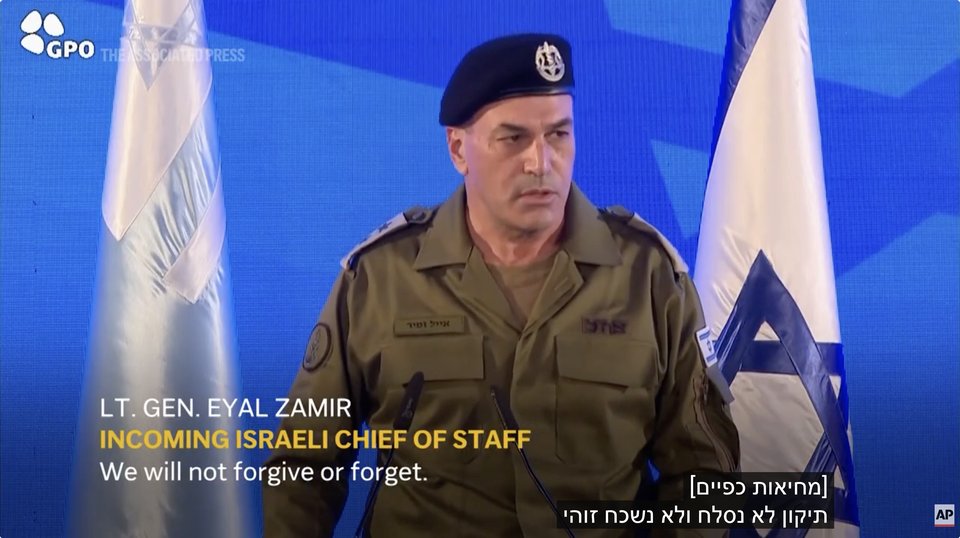
▶Israel: Lt. Gen. Eyal Zamir, taking over as chief of staff of Israel’s military in March 2025: “We will not forgive or forget.” Footage: Israel Government Press Office, via the Associated Press. Watch the AP video on YouTube →Los Angeles County: the homepage of JRIC, the Sheriff’s fusion center in Norwalk, this fall. “WE WILL NEVER FORGET!” over its seal and a coin: “Commemorating 25 years, 2001–2026, 9/11, Never forget.” Screenshot: jric.ca.gov.
“We will not forgive or forget.”
Lt. Gen. Eyal Zamir, chief of staff, Israel Defense Forces, March 2025. Echoed by Ofir Akunis, Israel’s Consul General in New York, in Times Square, Sept. 30, 2026: “We will not forget, and we will not forgive.”
“We will never forget!”
Joint Regional Intelligence Center, the Sheriff’s fusion center in Norwalk, homepage, 25 years after Sept. 11
Inside the building: JRIC, the Sheriff’s fusion center in Norwalk. Federal agencies and private firms under one roof. Palantir’s system is carried on a $6.3 million bridge contract held by Pat V. Mack, Inc., ending Nov. 30. Sources: County contracts and Board letters; Bloomberg, Jan. 12, 2024.Read the analysis →
The fusion center · In its own words
Crowdsourcing the Watchlist: How JRIC Recruits Everyday Citizens to Spy on Each Other as Suspected Terrorists
“Please note: Note all suspicious activity will neatly fit into these categories, therefor please submit any activity that you find suspicious regardless of the 16 NSI criteria.”
JRIC’s Suspicious Activity Reporting page, spelling as published. The 16 criteria are the national standard for what counts as suspicious. JRIC asks for reports outside them.
The page offers three ways in: a “Law Enforcement and Public Safety Report,” a “Private Sector Report” and a “General Public Report.” Under the heading “SEE THIS, SAY SOMETHING,” it lists what it wants reported, word for word at right. Highlighted: the entries that describe belief, protest, health or ordinary life, not a crime.
Who they train to watch
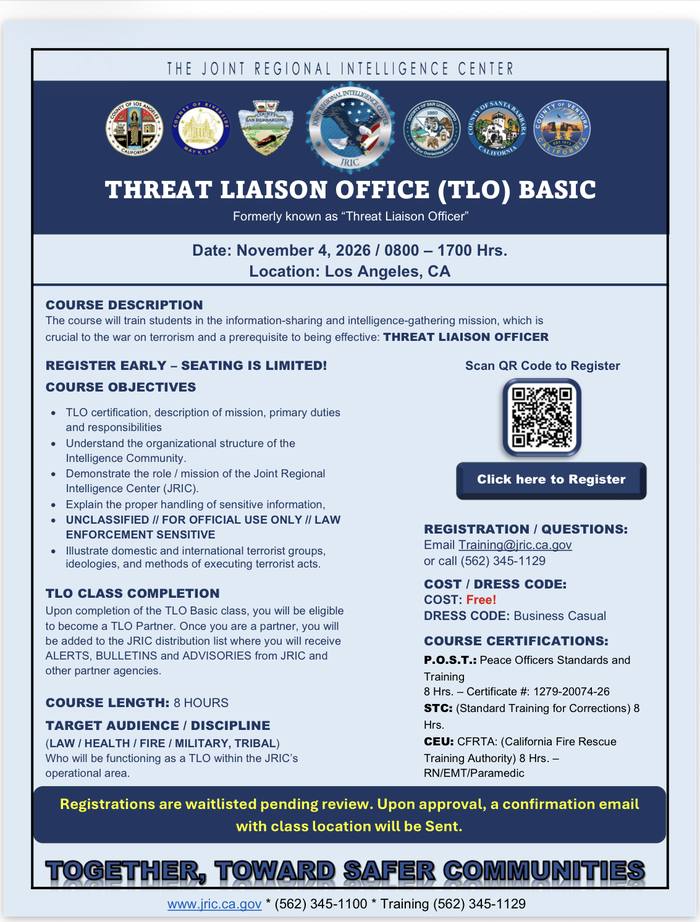
TLO Basic: “LAW / HEALTH / FIRE / MILITARY, TRIBAL”
Sovereign Citizen Extremists: “Law Enforcement, Military, fire Service Personnel and Healthcare Professionals”
OSINT; Physical Security: “Law Enforcement, Fire, EMS, Military and critical infrastructure personnel”
School vulnerability: school resource and school district police
Free, certified, and on JRIC’s list afterward for “ALERTS, BULLETINS and ADVISORIES.” The firefighter at your door, the EMT in your kitchen and the nurse at your clinic are on the audience list.
“Threat groups/actors”
Abortion-related Extremists
Anarchist Extremists
Animal Rights Extremists
Cybercriminals
Environmental Extremists
Foreign Terrorist Organizations (FTOs)
Hacktivists
Homegrown Violent Extremists (HVEs)
Incel (Involuntary Celibate) Extremists
Malicious Insiders
Mexico-Based Transnational Criminal Organizations
Militia Extremists
Nation-State Cyber Actors
Organized Criminal Groups
Outlaw Motorcycle Gangs
Prison Gangs
RMVE - Black Identity Extremists
RMVE - White Supremacist Extremists
Sovereign Citizen Extremists
Street Gangs
Unaffiliated Lone Offenders
Unintentional Insiders
“Threat issues”
Behavioral Health Issues
Contraband Trafficking (e.g., Bulk Cash, Weapons)
Critical Infrastructure Disruption
Cyberattacks (e.g., Disruptions, Data Breaches, Ransomware)
Source: jric.ca.gov, Suspicious Activity Reporting page and course flyers, as captured October 2026.
The fusion center · The flyers
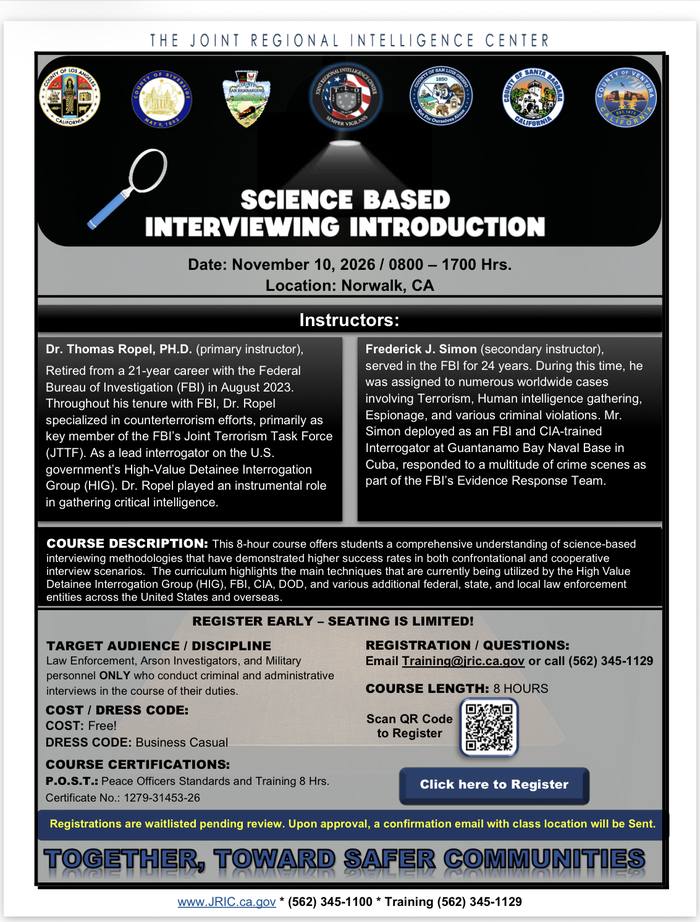
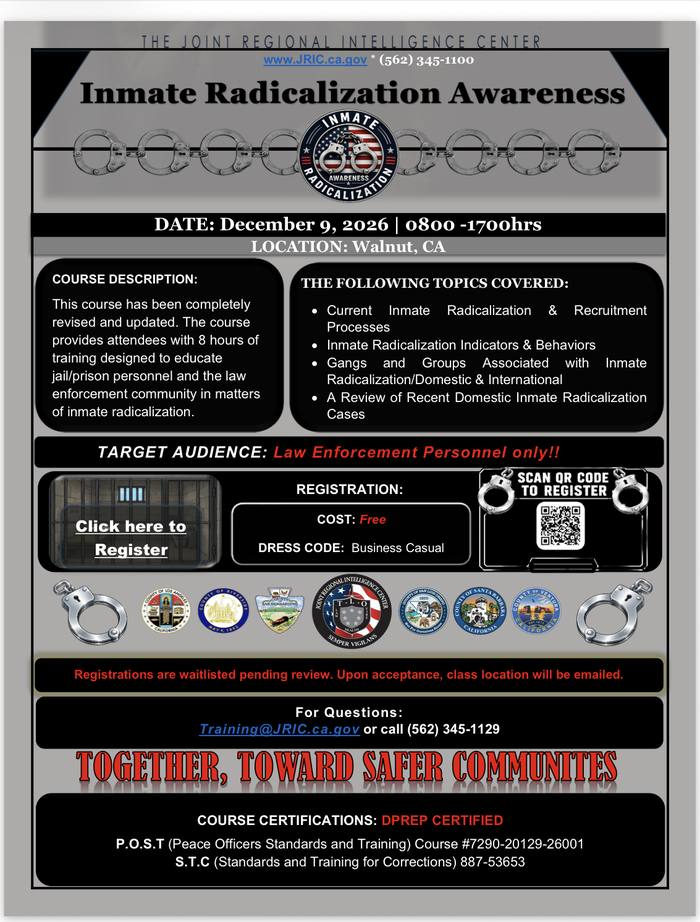
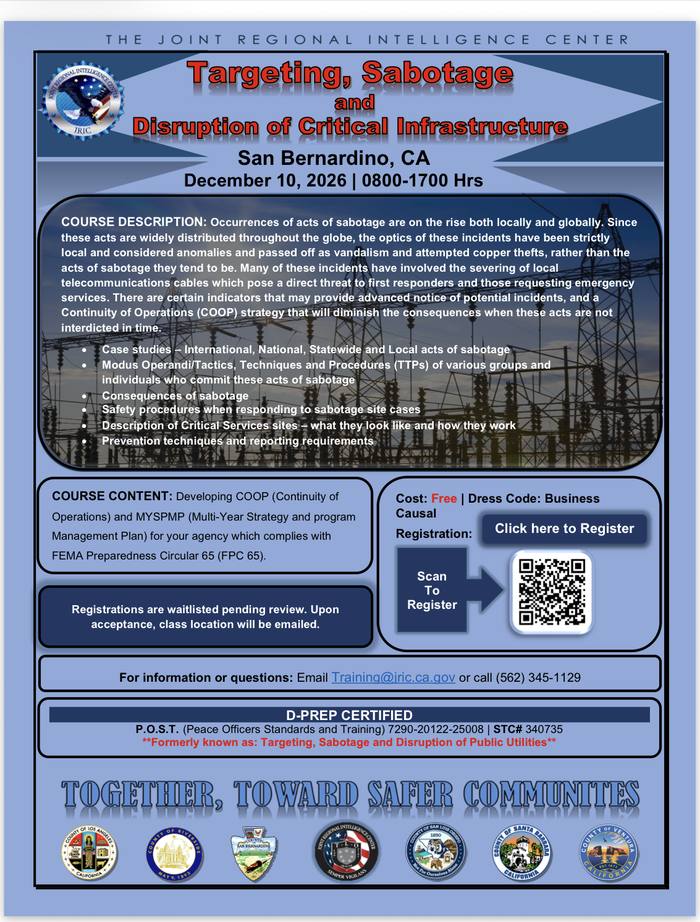
JRIC’s Fall Courses: Covert Social Media Accounts, Lock Bypassing, and Antifa on the Terror List
JRIC posted these flyers for courses running Nov. 4 to Dec. 10, 2026, all free, all within driving distance of Los Angeles. Surveillance Today saved each one from jric.ca.gov on Oct. 23 and 24. Tap any flyer to read it full size.
The diagram · Budget to bulletEvery source pays in. What comes out is used on the public and ends in the FBI’s database.The Budget-to-Bullet Pipeline, the diagram. Every source pays in, the County general fund, the state, federal grants and money off the record. It becomes the tools and the training, drops into the machine, comes out as plate reads, cell-site sweeps, cracked and located phones, face matches, camera feeds, Palantir searches and Suspicious Activity Reports, goes past the four checks, onto the public, and ends in the FBI’s eGuardian database. Sources at the foot of the drawing.
Where the clinics closedSeven Clinics Closed. The Cameras Did Not.
What feeds the Sheriff’s machine, what it burns, and what its arms hold down. The money comes in from federal security grants, private money and the deputies’ unions; it burns in court costs, overtime, deputy-gang cases and punitive damages; its arms hold down Public Health, Health Services, Probation and the Public Defender. Every label is a figure from the County’s own record or from this paper’s earlier reporting; sources run along the foot of the drawing.
Lancaster: 50 Flock readers, $150,000 a year. Pomona: 80 and a van. Inglewood: $6.28 million for readers and drones. Torrance: 48 million scans a year. Hollywood and South L.A.: the LAPD’s 248 pole cameras, 140 roof cameras and 1,500 in-car readers, the Sheriff’s stations, and the fusion center.
Coming in Issue No. 4: It’s Not the AI. It’s the User.
AI does what its user tells it to do. The user is the Pentagon, Palantir, Israel’s Defense Ministry and the Sheriff’s fusion center. Issue No. 4 names them and what they do with it.
The Pentagon. When Anthropic refused mass surveillance of Americans and fully autonomous weapons, the Pentagon branded it a “supply chain risk” and signed OpenAI, Google and xAI for “any lawful” use.
Palantir. It runs the Sheriff’s fusion center. In January 2024 it entered a “strategic partnership” with Israel’s Defense Ministry “in support of war-related missions.” Its Maven system was in the strikes on Iran.
Gaza. AI systems reported as Lavender and The Gospel generated target lists at a scale no human team could.
Los Angeles. The same tools, training and partners, pointed at the city: clinics closed, cameras in their place, a list that reports health and protest, in the hands of a department with documented deputy gangs.
Why you are told to fear the machine. Fear of the machine keeps your eyes off the user. Once mass surveillance is built, it does not come down, and whoever holds it holds everyone else.
Disclosure: Surveillance Today is produced with the help of Claude, an AI system made by Anthropic.
The machine · Los Angeles · What is not on the ballot
“Never-Forget” Money, Zero Oversight: Inside the Sheriff’s Unreviewed, Secretive Surveillance Hub
Plate readers are the part on the pole. The Sheriff’s Department also asked for a $1.4 million phone-tracking system, took federal money for Israeli phone-cracking and phone-locating tools, and runs a fusion center whose one audit did not look at privacy.
Los Angeles argues about plate-reader cameras because they are the part anyone can see. They are the smallest part. Behind them the Sheriff’s Department and the LAPD hold tools that impersonate cell towers, copy phones past the passcode, map phones by the advertising data they leak, search nearly nine million mugshots by face, and feed every tip to a federal database, on contracts written by an American defense-software company and Israeli surveillance firms, paid for with federal terrorism grants and the County budget that closed seven clinics. None of it is on the ballot.
Audit Veritas staff · Sources: LASD, Cellular Site Simulator transparency page and request to the Board, Mar. 7, 2023; Board letter, Sept. 16, 2025 (2024 UASI); LAPD Office of the Inspector General, BPC #26-184 (July 10, 2026) and BPC #26-018 (Jan. 28, 2026); Reveal, Aug. 7, 2015; Vice, Nov. 29, 2023; KTLA; Brennan Center for Justice; Engadget, Sept. 21, 2020; Bloomberg, Jan. 12, 2024; LASD, Police Diplomacy; City & State NY, Aug. 21, 2026; Brown University, Costs of War, Oct. 7, 2025; Issues No. 1 and 2 of this paper
The siphon. Every label is a figure or event from the public record. Drawing: Surveillance Today.
You don’t budget millions for surveillance gear to leave it in the box. The gear is in use. How it is used is written in two sets of records: the ones the agencies have been made to release, and the ones they have not.
Nine Tools, From Plate Readers to Drones, and What the Record Shows
Tool
What it does
What the record shows
Plate readers
Photograph every passing car and log the plate, time and place.
The Sheriff runs 931. The LAPD has 248 on poles, 140 on roofs and readers in about 1,500 patrol cars: 210.6 million reads in two months of 2025, kept five years, shared with fifteen outside agencies, 161 false stolen-car alerts. A $235 million Axon contract adds 1,600 more cars.
Cell-site simulator
Poses as a cell tower, so every phone nearby connects to it and gives up its identity and location.
On March 7, 2023, the Sheriff’s Homicide Bureau asked the Board for one system, about $1,375,453, with a 5G add-on, “vehicular geo-location software” and two vehicles. Its policy requires a warrant except in emergencies. It publishes no count of uses. The LAPD has owned such devices since 2005, bought with a homeland security grant; a 2013 lawsuit showed 21 uses in four months of 2012.
Phone cracking
Copies a phone’s messages, photos, contacts and location history, often past the passcode.
Cellebrite, headquartered in Petah Tikva, Israel, with Graykey and Magnet Axiom, on the Sheriff’s 2024 federal grant list. The Department has not answered a 2017 records request for its Cellebrite contracts.
Phone locating
Maps phones from the advertising data apps leak, with “live data updates” and “real-time alerts.”
Cobwebs Technologies, founded in Israel by veterans of the Israel Defense Forces, on the Sheriff’s 2024 grant list. The LAPD signed for it in October 2022, paid from a Homeland Security grant. Meta banned Cobwebs accounts as “surveillance-for-hire.”
Social-media scoring
Scores people by their posts and their friends.
The LAPD tried Voyager Labs, which offered a color-coded score of a person’s “ties to or affinity for Islamic fundamentalism or extremism,” with no human review, and pulled one man’s 4,000 Facebook friends into a “searchable, monitorable dataset.”
Face search
Matches a photo against booking photos.
LACRIS, run by the Sheriff’s Department, holds nearly 9 million mugshots. The LAPD searched it nearly 30,000 times between 2009 and 2020.
Cameras
Live feeds from public and private cameras.
The Sheriff’s Real-Time Watch Center, opened Sept. 27, 2024: 1,591 cameras registered, 428 on a 24-hour live feed, including private cameras at businesses, churches and homes.
The fusion center
Collects reports and searches on residents and sends them to federal agencies.
Palantir’s 29 applications search 911 calls, jail visits, DMV records, informants and plates; one sends every tip to the FBI’s eGuardian. $23.9 million in federal money through May 2025. Technicians and the privacy officer supplied by General Dynamics IT. Privacy review: the 2022 audit did not look at privacy.
Drones
Fly to calls ahead of officers.
The LAPD’s drone-first-responder program, Skydio aircraft, expanded with a $2.1 million Police Foundation gift in February 2026.
You do not buy it to leave it in the box
Where an agency has been made to count, the counts are large. The LAPD’s plate readers took 210.6 million reads in two months, and 161 of its alerts named cars that were not stolen. Orange County’s cameras were searched 2,144,138 times in four months, protest searches among them, as Issue No. 2 reported. The LAPD ran its cell-site simulators 21 times in four months of 2012, and searched faces nearly 30,000 times in eleven years.
Where no one has made it count, there is nothing. The Sheriff publishes no count of cell-site simulator uses, no count of phones copied, no count of Cobwebs searches and no list of the agencies that receive his plate data. The Board’s grant letter names the Israeli tools without prices. The fusion center has acknowledged none of ten public records requests filed on MuckRock. The only office ordered to watch it was locked out in 2022 and cut by a third in 2025.
Who Builds It, and Who Trains the People Who Run It
The supply line. Drawing: Surveillance Today.
Palantir, founded after September 11 with early CIA venture money, built the fusion center’s system. In January 2024 it entered a strategic partnership with Israel’s Ministry of Defense to supply technology for “war-related missions.” Cellebrite is headquartered in Petah Tikva. Cobwebs was founded by Israeli army veterans. Paragon, whose zero-click spyware ICE certified for “operational use” in April, was co-founded by a commander of Unit 8200, the Israeli army’s signals-intelligence unit; Israel remains its research hub.
The people who run the tools have been trained there. Private groups have taken American police officials to Israel since at least 2002, when the Jewish Institute for National Security of America ran its first law-enforcement exchange, Aug. 19–23, with ten senior officers. The Anti-Defamation League runs its own. Federal grants paid $480,466 for police travel abroad from 2015 to 2022, by one count, more than 80 percent of it to Israel. The Jewish Journal quoted Sheriff Lee Baca from Israel in January 2003, during the Israel Police seminar “Police and Law Enforcement in the Era of Global Terror,” and in 2009 called that year’s trip his fourth since 2003. The LAPD’s Inspector General was able to uncover at least 18 employees sent to nine training activities in Israel between 2014 and 2024. Past that, it said, it was “unable to assess the full nature and extent of the training activities.” The costs topped $87,000, and outside groups paid most of them.
Washington is deepening the tie. The House’s 2027 defense bill would create a U.S.–Israel cooperation initiative on artificial intelligence and cyber, Section 219; it is stalled in the Senate until after the election. Separately, the United States sent Israel $21.7 billion in military aid between October 2023 and September 2025.
The Agencies’ Answer: Not Against Protesters, Only Criminals
The Sheriff’s policy says the cell-site simulator “shall not be used to target First Amendment activities, such as protests and gatherings at places of worship.” Cobwebs says it tracks only criminals and terrorists. JINSA says its trips focus on management and policy, not tactics. Palantir’s chief executive, Alex Karp: “We are the single worst technology to use to abuse civil liberties.” None of these statements comes with a count, an audit or a log that a resident can check.
Other Cities Are Pulling Back. Los Angeles Is Expanding.
The rest of the country is pulling back. More than fifty towns dropped their plate-reader vendor in the past year. Florida barred plate readers from its state highways. San Francisco’s own audit found 299 improper federal searches of its plate data, run through its fusion center. The Senate held a hearing in September that Flock, Axon, Motorola and Verkada declined to attend.
New York built its tie to Israel in the open. The NYPD has posted an officer in Israel since 2007, at the Israel National Police headquarters in Kfar Saba since 2012, and he is still there under the city’s new mayor; the department contracts with Terrogence, founded by veterans of the Israeli army’s intelligence corps. Los Angeles built its version on grants, sole-source contracts and a fusion center whose files no one outside it has read.
Four Records the County and City Have Not Published
What the County has paid in total for Israeli-made tools; how many times the Sheriff has used the cell-site simulator, and on whom; what replaces the $6.3 million Palantir bridge contract, held by Pat V. Mack, Inc., when it ends Nov. 30; and how many LAPD officers trained in Israel, and what they were taught. Each is a record the County or the City holds. None has been published.
Procurement is an act of intent: no agency buys this equipment to let it gather dust. Who it is pointed at is split between the records forced into the light and the ones still withheld.
Measure A Would Let Arbitrators Set Deputy Pay. Neither the Board Nor the Voters Could Change It.
Measure A would send any deadlock between the County and the Sheriff’s and Fire unions to a three-member arbitration panel whose decision, under the ordinance, takes effect with no further action “by the Board of Supervisors or by the electorate.” A Feb. 10, 2026, motion told County Counsel to draft it. The Board adopted the ordinance calling the election in March, 4–1, with Supervisor Holly Mitchell voting no (Ordinance No. 2026-0005), and replaced it with a new ordinance on Aug. 4. No argument against was filed.
Audit Veritas staff · Sources: Board of Supervisors, motion of Feb. 10, 2026 and ordinance calling the election; CEO letter to the Board, Feb. 10, 2026; Auditor-Controller, fiscal impact statement; Registrar-Recorder/County Clerk, impartial analysis; PPOA, Star & Shield, Oct. 2026; two members of Congress, letter of Jan. 8, 2026; County Counsel, Litigation Cost Report FY 2024–25; CEO, correction to the FY 2026–27 Recommended Budget, May 1, 2026
Measure A’s text, set against the checks on the Sheriff that came before it. Sources at the foot of the drawing.
The campaign is funded by the two unions it would benefit most. The Association for Los Angeles Deputy Sheriffs gave the Yes on A committee $2.75 million in cash and $94,887 in goods and services between Jan. 1 and Sept. 19, 2026, by CityHallPass’s count of the committee’s Form 460 filings. The Professional Peace Officers Association, listed at $1.5 million, represents sergeants, lieutenants and custody staff; it tells its members on the cover of its October magazine to vote yes “so that future wage negotiations for our public safety personnel are not bogged down and prolonged by politics.”
The Deputies Got Their Contract in August, With the Board’s Final Say Intact
ALADS worked without a contract from Jan. 31, 2025. In January 2026 the County was offering 0% through 2026 with a clause letting it claw back raises in a shortfall, and two members of Congress wrote to both sides urging a deal. By early August, ALADS had ratified one. PPOA’s newsletter describes the terms the County put on every table this round: a cost-of-living adjustment and a “critical shortage” pay-range adjustment, both retroactive to July 1, 2026; further adjustments on July 1, 2027, and 2028; and signing cash, $5,000 in year two and $2,000 on Board approval. PPOA credits Sheriff Luna with securing the shortage adjustment. The County has not published the percentages or the contract’s cost. The LAist voter guide still says the County is “currently bargaining.”
So the union is asking voters to take the Board’s final say on deputy pay away two months after it won a retroactive contract with that final say in place.
$4.48 Billion Spent, $98.2 Million Still Over
The Sheriff’s Department spent $4.48 billion in FY 2024–25, $458 million of it on overtime; calendar 2025 was on pace to pass $500 million. The Board held $243.9 million in reserve this year to cover its overruns, and the Department still projects a $98.2 million deficit. The County spent $112 million defending it in court, 49% of everything it spent on lawsuits. Since April 2025 the County has cut $220 million from Health Services, Probation, the Public Defender and the District Attorney, deleted 1,125 positions and closed seven of its thirteen public health clinics. The Chief Executive Officer told the Board in February that binding arbitration “could, among other things, materially and detrimentally increase the County’s day-to-day costs,” that it “has caused significant financial disruption and even prompted bankruptcy” elsewhere, and that the Board might have to cut “policy priorities or safety net services to pay for the arbitrators’ decision.” The Board put it on the ballot anyway.
The Auditor-Controller’s fiscal statement says arbitration itself would cost “tens of thousands to millions of dollars,” and that the “more significant” effect is the transfer of final authority over covered employees’ pay, benefits and conditions to a board of arbitrators. Salaries and benefits for all County employees were budgeted at $20.8 billion this year; the covered units are about 17% of the workforce.
The Same Unions Used Labor Charges to Kill Oversight Subpoenas
On Feb. 27, 2025, the Civilian Oversight Commission subpoenaed records on the death of A.G., 18, and the beatings of E.B. and J.P. Sheriff Luna sued to block the subpoenas. ALADS and PPOA filed unfair-labor-practice charges. In April 2026 the County settled by stipulating that it had committed a labor violation, and the subpoenas were withdrawn. Nothing in Measure A touches the Commission’s subpoena power on paper. Nothing in the labor charges did either.
What an arbitration panel could not decide matters as much as what it could. It would rule on wages, hours and benefits. Not on who the fusion center watches, how long plate scans are kept, who the Department shares its 931 readers with, or whether the Commission will ever get the A.G., E.B. and J.P. records. Those stayed with the Board, which has never voted on them, and with the Sheriff, whom no one in this campaign has asked.
Two documents a voter would want before Nov. 3 are the Auditor-Controller’s full fiscal statement and the Board letter approving the August contract, with its percentages and cost. The first is in the voter guide. The second has not been posted.
The Surveillance Omertà: What the Sheriffs Won’t Say
While Luna went to court against the Commission’s subpoenas and Villanueva barred its watchdog from headquarters, the surveillance build-out grew, and neither has said a word about it.
In the June primary Sheriff Robert Luna took 44.2% and former Sheriff Alex Villanueva 21.7%. The runoff is between the man who locked the Inspector General out of the Department and the man who kept him away from the shootings. On the systems that watch County residents, the two campaigns are identical: silent.
Audit Veritas staff · Sources: Registrar-Recorder/County Clerk, June 2, 2026 primary results; Office of Inspector General; Civilian Oversight Commission; Board of Supervisors; Sheriff’s Department; PPOA, Star & Shield, Oct. 2026; LAist and La Defensa voter guides
The runoff · Nov. 3Two sheriffs, one record on the watchdogs
Robert Luna
44.2%
June primary · Sheriff since 2022
Went to court to block the Oversight Commission’s subpoenas in the A.G., E.B. and J.P. cases.
Under a June 2025 Board memo, the Inspector General stopped going to deputy shootings.
931 plate readers. The fusion center’s Palantir contract ran through May 2025, with no public record of renewal.
Alex Villanueva
21.7%
June primary · Sheriff 2018–2022
Barred Inspector General Max Huntsman from Department records and buildings in October 2022.
Denied the deputy gangs; the Banditos case alone settled for $8 million.
Opened investigations of his critics, including a member of the Board of Supervisors.
Neither has said what the fusion center collects, how long plate scans are kept, or who receives them. Sources: Registrar-Recorder/County Clerk; Office of Inspector General; Civilian Oversight Commission.
Villanueva
In October 2022, twelve days before the County’s audit of the fusion center came back, Sheriff Villanueva barred Inspector General Max Huntsman from Department records and buildings, as Issue No. 2 reported. The Department’s deputy gangs, which a state law now bans, grew under his watch and his denials; the Banditos case alone settled for $8 million. His Public Corruption Unit opened investigations of his critics, including a member of the Board of Supervisors, the Inspector General and a Los Angeles Times reporter; the state Attorney General took the matter over. He refused the Oversight Commission’s subpoenas and was ordered to appear. He says the cost of litigation against the Department is the fault of the Board and the oversight bodies for an “extensive campaign to falsely claim deputy gangs were running roughshod.”
Luna
Sheriff Luna ran in 2022 as the reformer. In February 2025 the Oversight Commission subpoenaed the A.G., E.B. and J.P. records; he sued to block the subpoenas, and after the unions filed labor charges the County withdrew them. Under a June 2025 Board memo the Inspector General stopped responding to the scenes of deputy shootings; the office went to none of the four shootings in the first quarter of 2026. In September 2025 the Board cut a third of the Inspector General’s staff. The Department runs 931 plate readers; the Board’s request that it delete scans after sixty days is advisory, and the Sheriff’s report on it has not been published. The fusion center’s Palantir contract ran through May 2025, and there is no public record of a renewal. The deputies’ unions credit Luna with winning them the “critical shortage” raise in August.
No Voter Guide Has Asked Either Candidate About Surveillance
No voter guide this paper has read, LAist’s and La Defensa’s among them, mentions the fusion center, the plate readers, the Real-Time Watch Center or the Department’s data sharing. Neither candidate has volunteered a position. The five questions a voter could put to either are here.
The Police Commission Approved $235 Million for Axon After Its Inspector General Said Pause. The Streetlight Deal Wires Into “Fusion Centers.”
On July 10, 2026, the LAPD’s Inspector General reported 161 alerts in two months for cars that were not stolen, 210.6 million plate reads in the same two months, fifteen outside agencies receiving the data, and one audit since 2022, and recommended that the Department “suspend the deployment of new ALPR cameras and the execution of new ALPR-related contracts pending public input.” On Sept. 22 the Police Commission approved two Axon agreements.
Audit Veritas staff · Sources: LAPD Office of the Inspector General, BPC #26-184, July 10, 2026; Board of Police Commissioners, Sept. 22, 2026; Council File 26-1394 (Chief’s memo of Aug. 20, 2026 and the Lightpost MOU); City Clerk, public comments; San Francisco Police Department audit, June 17, 2026; Civ. Code § 1798.90.55; Attorney General Bulletin 2023-DLE-06
What the Inspector General found, July 10, 2026Two months of plate readers, by the numbers
161alerts for cars that were not stolen, in two months
210.6Mplate reads in the same two months
15outside agencies receiving the data
1audit since 2022
$235MAxon contract approved Sept. 22, ten years, 1,600+ patrol cars
Source: LAPD Office of the Inspector General, BPC #26-184, July 10, 2026; Board of Police Commissioners, Sept. 22, 2026.
The Contracts: 1,600 Patrol-Car Readers, and Streetlight Readers at “[TBD]”
The first is a ten-year, $235 million renewal that puts Axon cameras able to read plates in more than 1,600 patrol cars. The second is a three-month pilot, at no cost to the city, of Axon readers mounted on streetlights. The pilot’s memorandum lists its camera locations as “[TBD].” It sets no retention period; “LAPD’s retention schedule governs.” Deletion does not apply to data “held within another Axon product,” and Axon must keep “raw image or video frames.” Section 7.9 gives Axon an “unconditional right to share” with “authorized governmental or private bodies” and requires it to connect the data to “fusion centers and joint task force systems.” California’s plate-reader law, Civil Code section 1798.90.55(b), permits sharing only with other California public agencies, and the Attorney General’s 2023 bulletin says no private, federal or out-of-state sharing. The usage policy the law requires is to be written “before activation.”
San Francisco shows what the fusion-center clause produces. Its police department’s own audit, released June 17, 2026, found 299 improper queries of its plate-reader data by federal agencies, the DEA, the IRS and the U.S. Marshals among them, run through the Bay Area fusion center. Two lawsuits followed; one alleges 1.6 million out-of-state searches.
The Council Took Over the Pilot; Its Final Vote Is Oct. 27
On Oct. 2 Councilmembers Hugo Soto-Martínez and Marqueece Harris-Dawson moved to take the streetlight pilot under the Council’s review, under Charter Section 245. On Oct. 6 the Council adopted the motion, 10–4, with one member absent. On Oct. 20 the Public Safety Committee voted to recommend a veto of the Commission’s action. On Oct. 21 the Council continued the item to Oct. 27, 10–0, the last day it can act under the Charter (Council File 26-1394). Every public comment in the file opposed the memorandum, including the League of Women Voters of Greater Los Angeles, the Black Alliance for Just Immigration, Alliance for a Better Community and the California Immigrant Policy Center. If it does not act by then, the Commission’s approval stands.
Measure LA Would End Bidding for Axon’s Software; Measure EE Would Protect the Audits
Measure LA would let the city buy a maker’s own software without competitive bidding. Axon’s body cameras, evidence system and plate readers are one maker’s software. Measure EE would end the Police Commission’s power to stop its Inspector General’s audits. The Inspector General’s plate-reader audit was the one the Commission voted against ten weeks after reading it.
The County Paid $112 Million to Defend the Sheriff in One Year, Covered Punitive Damages, and a Deputy Who Shot a Colleague Was Promoted
In FY 2024–25 the County spent $112 million on lawsuits against the Sheriff’s Department, 49% of its $229 million legal bill and more than five times the next department. Six of the County’s eight costliest settlements were the Sheriff’s.
Audit Veritas staff · Sources: County Counsel, Annual Litigation Cost Report FY 2024–25; Board of Supervisors, 2017 resolution under Gov. Code § 825; Office of Inspector General, deputy-gang settlement count; Special Counsel to the Civilian Oversight Commission, 2023 report; CEO, FY 2026–27 budget
FY 2024–25 · County Counsel litigation reportThe Sheriff’s share of the County’s legal bill
Defending the Sheriff’s Department$112MEvery other County department combined$117.3M
The largest payouts
Deputy-gang settlements, total$54M+Family of an autistic man shot in his home by deputies$25MA crash caused by a speeding deputy$17.2MA garage shooting that left a man paralyzed$7M
The Sheriff’s $112 million is 49% of the County’s $229.3 million lawsuit bill, more than five times any other agency. Bars within each chart are drawn to the same scale.
The three largest: $25 million to the family of an autistic man shot in his home by deputies; $17.2 million for a crash caused by a speeding deputy; $7 million for a garage shooting that left a man paralyzed. Settlements tied to deputy gangs exceed $54 million by the Inspector General’s count. None of these figures include the nearly $5 billion the County has agreed to pay for decades of sexual abuse in its foster homes and juvenile halls, $1.2 billion of it this year.
Punitive damages are the law’s way of punishing an individual for malicious conduct, and a public entity may not be made to pay them. Under Government Code section 825(b) a county may choose to pay them for an employee only if its governing board finds that the employee acted within the scope of employment, in good faith, without actual malice and in the apparent best interests of the county, and that paying is in the county’s own best interest. In 2017 the Board made those findings and paid the punitive damages a jury had assessed in 2013 against deputies for a 2009 jail beating it found “malicious, oppressive or in reckless disregard” of the victim’s rights.
The Department promotes anyway. A deputy who shot a colleague in 2015 was made a sergeant in 2021. A witness told the Oversight Commission’s special counsel that fifteen of the twenty-five known members of the Regulators had been promoted. The record a voter would want is every Board resolution paying punitive damages for Department members since 2015, set beside the Department’s promotion lists for the same years. Neither list has been published.
On Feb. 27, 2026, the Department of Public Health ended services at seven of its thirteen clinics, citing a shortfall of more than $50 million in federal, state and County money. The clinics gave vaccinations, tested and treated sexually transmitted infections and tuberculosis, and served people without a regular doctor. The table sets each closure beside the surveillance already running in the same place.
Audit Veritas staff · Sources: Department of Public Health, Feb. 13, 2026; Lancaster City Council, July 23, 2024; Palmdale City Council, Nov. 2024; Pomona Police Department and Board of State and Community Corrections, 2023; City of Inglewood, April 2026; California State Auditor, Feb. 13, 2020; LAPD Office of the Inspector General, July 10, 2026; Sheriff’s Department, Real-Time Watch Center, Sept. 27, 2024; Board of Supervisors, Sept. 16, 2025 (UASI)
Clinic closed Feb. 27, 2026
Policed by
On the street
Antelope Valley Public Health Clinic, Lancaster
Sheriff’s Lancaster station
50 Flock plate-reader cameras, city-owned, $150,000 a year, renewed July 2024; footage deleted after 30 days. Next door, Palmdale runs 75 on a five-year, $1.13 million contract; only the Sheriff’s Department can see the footage.
Curtis R. Tucker Public Health Clinic, Inglewood
Inglewood Police
$6.28 million state grant, April 2026, for plate readers, drones and body cameras, ahead of the World Cup and the Olympics.
Pomona Public Health Clinic, Pomona
Pomona Police
80 Flock cameras and a plate-reading van, bought on a state corrections grant applied for in 2023.
Torrance Public Health Clinic, Torrance
Torrance Police
More than 48 million vehicle scans in a single year, by the State Auditor’s count. One of fifteen agencies that receive the LAPD’s plate-reader data.
Hollywood-Wilshire Public Health Clinic, Hollywood, and the Center for Community Health (Leavy), 522 S. San Pedro St., downtown Los Angeles
LAPD
248 pole cameras, 140 roof cameras and readers in about 1,500 patrol cars; 210.6 million plate reads in two months; data kept five years; a $235 million Axon contract adding readers to 1,600 more cars; a drone-first-responder program expanded in February 2026.
Dr. Ruth Temple Health Center, South Los Angeles
LAPD and the Sheriff’s South L.A. stations
The LAPD systems above, with eight pole cameras in the 77th Street Division. The Sheriff’s 931 plate readers, a 24-hour Real-Time Watch Center with 1,591 cameras registered to it, and the fusion center in Norwalk whose analysts, database and training are paid from a $10.45 million federal terrorism grant that also bought Cellebrite, Graykey, Chainalysis and Cobwebs.
For either candidate for sheriff, for the Board of Supervisors, and for anyone asking you to vote yes on Measure A.
Audit Veritas staff
What does the fusion center collect about County residents, and where does it send it? The Board ordered a privacy review in April 2022. The audit that came back said it did not look at privacy. No one has since.
Was the Palantir contract renewed after May 31, 2025? If so, for how much, and who approved it. If not, what the fusion center’s technicians are searching now.
How long does the Department keep what its 931 plate readers record, who can search it, and which agencies receive it? The Board asked for sixty days and a report by January. The report has not been published.
Will the Civilian Oversight Commission get the A.G., E.B. and J.P. records? The subpoenas were withdrawn in April. The records were not produced.
If Measure A passes and an arbitration panel sets deputy pay, what will the Board cut to pay for it? The CEO named the choices in February: “policy priorities or safety net services.” Seven clinics are already closed.
Never Forget, Never Forgive: Los Angeles Has Been Recruited Into Israel’s War of Vengeance
Israel’s leaders named the war’s purpose in their own words: avenge, no forgiveness. Their government carried the slogan to American streets. Israel’s police trained Los Angeles officers, the Defense Ministry’s war-missions partner runs the Sheriff’s intelligence hub, and Israeli companies’ tools are in the Sheriff’s hands. No one here voted for any of it.
Audit Veritas staff
▶Israel: Lt. Gen. Eyal Zamir, taking over as chief of staff of Israel’s military in March 2025: “We will not forgive or forget.” Footage: Israel Government Press Office, via the Associated Press. Watch the AP video on YouTube →Los Angeles County: the homepage of JRIC, the Sheriff’s fusion center in Norwalk, this fall. “WE WILL NEVER FORGET!” over its seal and a coin: “Commemorating 25 years, 2001–2026, 9/11, Never forget.” Screenshot: jric.ca.gov.
Start with the signs, because they are the plainest evidence there is.
On the homepage of the Joint Regional Intelligence Center, the Sheriff’s fusion center in Norwalk, four words mark twenty-five years since Sept. 11: “We will never forget!”
On Sept. 30, Israel’s Consul General in New York, Ofir Akunis, opened a display in Times Square, run with Israel’s Foreign Ministry, and said: “We will not forget, and we will not forgive.” A year earlier, Israel’s Prime Minister’s Office put “Remember October 7” on dozens of billboards and trucks around the United Nations and Times Square, timed to the prime minister’s speech to the General Assembly.
In Israel the same words run from the top of the state to the street. At the state memorial on Mount Herzl in October 2025, the prime minister said: “There will never be forgiveness for the human beasts who attacked us.” At the third-anniversary ceremony this October he said it again: “no forgiveness.” The head of Israel’s army said it on taking command in March 2025: “We will not forgive or forget.” In February 2025, a man in northern Israel held up a hand-lettered sign for the cameras: “will not forgive and we will not forget.”
“Never forget” is memory. “Never forgive” is a sentence. Put together, by a government at war, they are a creed. And that creed now sits, in nearly the same words, on the homepage of the agency in Norwalk where Los Angeles County’s intelligence is gathered.
Israel’s Leaders Called It Vengeance, in Their Own Words
No one has to infer the purpose. Israel’s leaders stated it.
Oct. 7, 2023, the prime minister: “We will cripple them mercilessly and avenge this black day they have brought upon Israel and its citizens.”
Oct. 9, the defense minister: “We are fighting human animals and we are acting accordingly.”
Oct. 12, the president: “It’s an entire nation out there that is responsible.”
Oct. 28, the prime minister, as the ground war began: “Remember what Amalek has done to you. We remember, and we are fighting.”
March 2025, the new chief of staff of Israel’s military, Lt. Gen. Eyal Zamir, on taking command: “We will not forgive or forget.”
The Shin Bet formed a unit to hunt down every person who took part in Oct. 7. It named the unit NILI, for “Netzach Yisrael Lo Yeshaker”: the Eternity of Israel will not lie.
Each of these has an official defense, and this paper prints them. The prime minister’s office says Amalek meant Hamas, not Palestinians. The president says his words were twisted and that “there is no excuse” for killing innocent civilians. Some commentators attribute the rhetoric to grief. Take every one of those defenses at its word. What remains is a war whose own leaders called it vengeance and promised there would be no forgiveness. That is not an interpretation. It is the record.
Netanyahu on America: “A Thing You Can Move Very Easily”
He has said how he sees us. In 2001, sitting in the home of a bereaved family in the West Bank settlement of Ofra, apparently unaware he was being recorded, Benjamin Netanyahu said: “I know what America is. America is a thing you can move very easily, move it in the right direction. They won’t get in the way.” On the same tape he described how he would “interpret the accords in such a way” as to “put an end to this galloping forward to the ’67 borders.” Israel’s Channel 10 aired the tape in July 2010. He was prime minister then, and he is prime minister now.
Read the rest of this record with that sentence in mind. A country is moved by the slogans put in front of it, by the trips its police are given, by the contractors placed inside its agencies and by the money that never comes to a vote.
How the Slogans and the Methods Came to Los Angeles
The slogans did not cross the ocean by accident. Israel’s government put them in front of Americans itself: the Prime Minister’s Office’s billboards and trucks around the U.N. in September 2025; the consulate and Foreign Ministry’s Times Square display this September, opened with “we will not forget, and we will not forgive.”
The methods came the same way, through police exchanges. The Jewish Institute for National Security of America runs the Law Enforcement Exchange Program, which brings American police executives to Israel. Its own records say the trips are hosted by the Israel National Police with the Israel Defense Forces and the Israel Security Agency, with briefers from the Shin Bet and the Mossad; that more than 100 U.S. law-enforcement executives have gone, and more than 11,000 have attended its conferences at home. The LAPD was there early: on the January 2004 trip, the head of the department’s Critical Incident Management Bureau was one of fourteen police commanders.
From 2014 to 2024 the LAPD sent at least 18 employees to nine Israel training activities, the most its Inspector General could document: JINSA homeland-security programs in 2018, 2019 and 2022, the JINSA exchange, an Israeli police bomb-squad exchange, and a “Command and Control Counter-Terrorism” delegation paid with a $52,470 federal grant. Outside entities paid most of the more than $87,000. In 2003, Sheriff Lee Baca came home from an Israel Police seminar on “Police and Law Enforcement in the Era of Global Terror” and said: “the heroes of the world are here in Israel.”
What were they taught? The LAPD’s Inspector General looked and was “unable to assess the full nature and extent of the training activities.” The department says it adopted no tactics from the trips. It kept no record that would let anyone check that claim.
Israel’s War-Missions Partner, Inside the Sheriff’s Fusion Center
Palantir runs the fusion center’s system in Norwalk: $23.9 million in federal grants through May 2025, 29 applications that search 911 calls, jail visits, DMV records, informants and license plates, one of which sends every tip to the FBI’s eGuardian database.
In January 2024, three months into the Gaza war, Palantir and Israel’s Defense Ministry agreed to a strategic partnership. Palantir’s executive vice president described its purpose: “Both parties have mutually agreed to harness Palantir’s advanced technology in support of war-related missions.” Its leaders held the company’s board meeting in Tel Aviv that week. The same company stayed in Norwalk.
Around it, the building is filled with private firms. General Dynamics IT supplies the technicians; the privacy officer is one of its IT technicians. InfraGard, sole-source since 2007, pays the fusion center’s chair: $5.4 million through 2028. Palantir’s system is now carried on a $6.3 million bridge contract held by Pat V. Mack, Inc., ending Nov. 30. The FBI, CBP, ICE and Homeland Security Investigations sit with them. What the County has paid in total, who is searched and what is kept: none of it is published. The one audit, in 2022, did not look at privacy.
Israeli Tools in the Sheriff’s Hands, and the Public Drafted to Report
The Sheriff’s 2024 federal grant list includes Cellebrite, the Israeli phone-cracking system, and Cobwebs, the Israeli-founded software that locates phones from advertising data. Meta banned Cobwebs from its platforms in 2021 as one of seven surveillance-for-hire companies.
The fusion center teaches its investigators an interview method “currently being utilized by the High Value Detainee Interrogation Group,” from an instructor whose flyer bio reads “an FBI and CIA-trained Interrogator at Guantanamo Bay Naval Base.”
And it enlists the public. “See something, say something” turns neighbors into informants. No crime is required. Their reports go to eGuardian and are kept thirty years, even when “later determined to be unfounded.” The person reported is not told.
That is what recruitment looks like. Our officers are trained in the creed’s country by its police and intelligence services. Its Defense Ministry’s war-missions partner runs our intelligence hub. Its companies’ tools sit in our Sheriff’s hands. Our neighbors are drafted to feed reports into a federal database. And the money moves through federal grants, private sponsors and sole-source contracts, so that no one in Los Angeles is ever asked to vote.
The Rebuttals, and Why They Fail
“Never forget is Holocaust memory.” It is, and no one should touch that. The words on the record here go further: “avenge,” “no forgiveness,” “we will not forgive.” Memory does not need a hunting unit.
“Amalek meant Hamas.” Accept it. The war is still described by its own leaders as vengeance, and its methods and its contractor are still here.
“The LAPD brought back no tactics.” Then the records will show it. The Inspector General could not find them, and the department kept none.
“This is counterterrorism cooperation that saves lives.” Then it can survive a public hearing and a vote. It has had neither.
“Palantir is just software.” Palantir’s own executive called its Israeli partnership support for “war-related missions.”
“This is antisemitism.” It is not. A government is not a people, and a faith is not a police budget. Most Israelis are not their leaders’ slogans; on the third anniversary of Oct. 7, many of them filled the streets protesting their own government. Criticizing what Israel’s leaders said, and what Los Angeles bought from Israel’s security establishment, is no more an attack on Jews than criticizing the Sheriff is an attack on Angelenos. Jewish Voice for Peace has campaigned against these police exchanges since 2017. Its critics called that antisemitic too. The charge is used to keep exactly this question off the record.
Four Unpublished Records That Would Settle It
Four records the County and the City hold and have not published: every foreign training record for the LAPD and the Sheriff’s Department, with who paid; the Palantir contract that replaces the bridge deal ending Nov. 30; the fusion center’s full budget, public and private; and the privacy review the Board ordered in April 2022. None of it is on the Nov. 3 ballot. Ask the candidates for sheriff why.
Every figure in this issue is tied to a named source, listed at the foot of its story. A finding belongs to the body that made it: when this paper says a Senate committee, a court, or an inspector general found something, it means exactly that, and where a government, department, or company disputes a finding, the dispute is printed beside it.
Where the evidence stops, the story says so. Claims in circulation that we have not yet traced to a primary source, on any side of this subject, are held out of print until we can. When we get something wrong, the correction is listed in this page’s Corrections box, with the date we found it.
This issue takes no position on any candidate or measure. It reports what the County’s own budgets, audits and contracts say, and what the ballot does and does not ask.