Audit Veritas  ·  A weekly record of who is watching and what they are allowed to do

Surveillance Today

–– ––Election Edition
The Wheels of History: The Rise and Fall of Democracy, on a theater screen between red curtainsThe film · 16 minutes, narratedThe Wheels of History: The Rise and Fall of DemocracyA cartoon record of the new colony, told through the drawings of Surveillance Today: the checks that were supposed to stand in the road, the machine bought instead, the people it filed, and what was taken away.Watch the film →
Election 2026Tuesday, November 3  ·  Los Angeles County  ·  VoteSheriff’s race: click a box for each candidate’s record on the gangs and surveillance
Election 2026 on the ballotElection background what the ballot touches but does not ask
Front page  ·  The deputy gangs and the Fusion Center  ·  November 3

Skin Deep, Station Wide: Why Tattoos Don’t Lead the Way

When the Station Gangs Inherit the Fusion Center

From Ankle Tattoos to the Plate Readers

The Sheriff’s Department controls the federal grant money for the Joint Regional Intelligence Center (JRIC), the Sheriff’s Fusion Center for the Los Angeles region, and contracts for its staff. Its patrol stations operate the plate readers, watch centers and drones that feed it. In 2023 the County’s Special Counsel found that deputy gangs, not commanders, run some of those stations.

The Department won’t deny the gangs. Naming any under the law would require an accounting: firings, disclosures, outside investigators

Penal Code §13670, in force since 2022, requires every agency to prohibit membership in a law-enforcement gang, make membership grounds for termination, cooperate with the Inspector General and the Attorney General, and disclose a gang-related firing to any agency that later screens the officer. In December 2025 the Department reported identifying no such group. A finding of none triggers none of those duties: no terminations, no disclosures, no records leaving the Department. Former Sheriff Villanueva now cites the finding as proof the gangs never existed.

The same stations run the plate searches and feed the Fusion Center

The Special Counsel found groups setting schedules, directing the training of new deputies and deciding who receives backup. Those stations run plate searches and send reports to the Fusion Center. A deputy pressed to join has no channel outside that chain of command. Tuesday’s election decides who controls all of it.

Continue reading the lead →

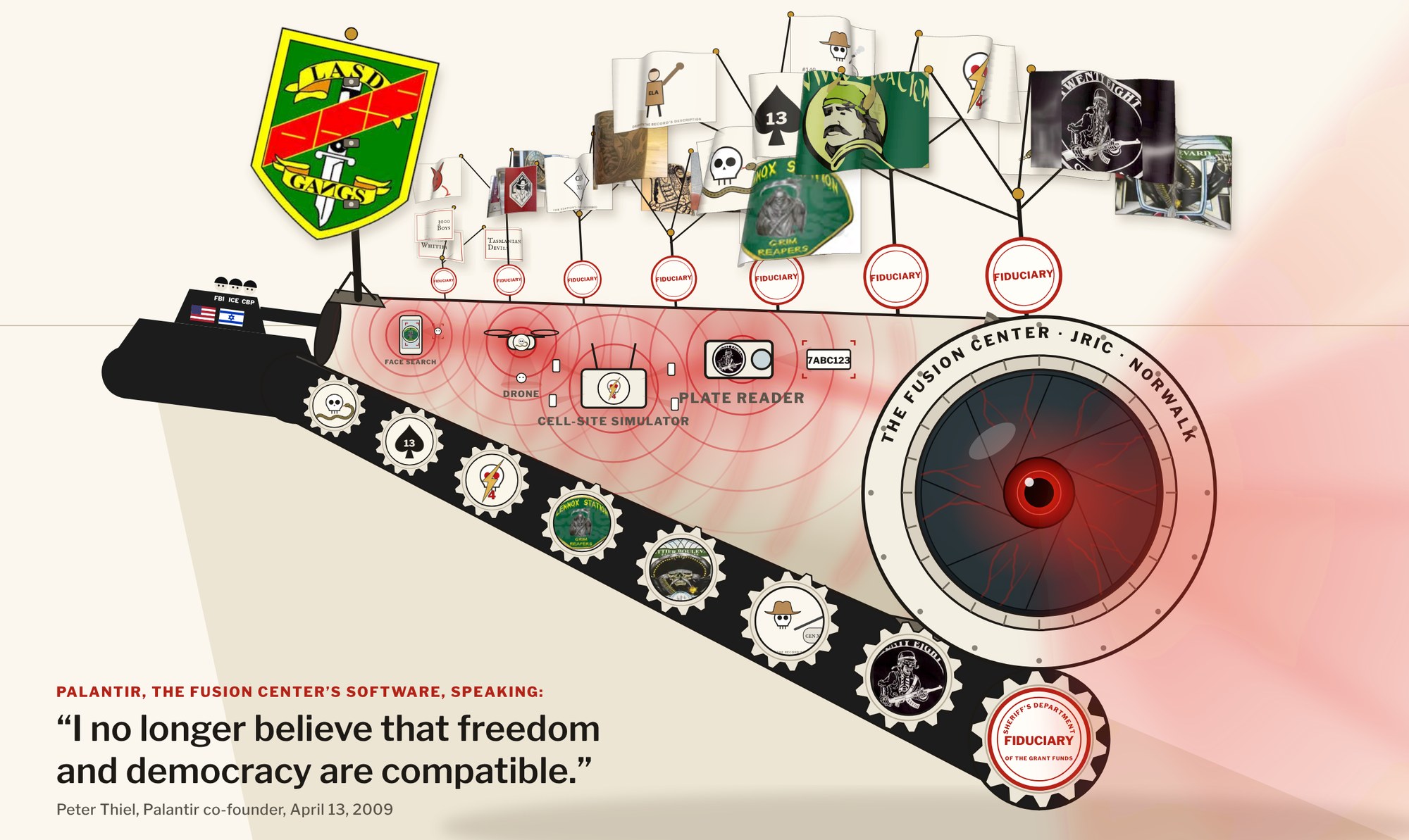
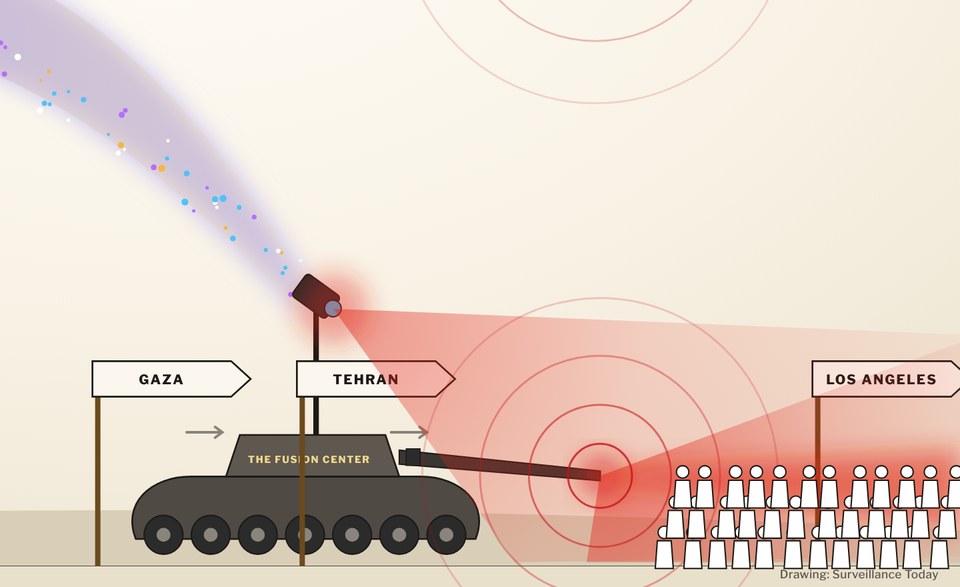
A long Fusion Center tank comes at the viewer. Its near end is a camera lens ringed with the words The Fusion Center, JRIC, Norwalk, and red beams shoot out through it. Every station mast carries a small red seal reading Fiduciary, and the front gear of the tread, heading the row of gang marks, is the seal itself: Sheriff’s Department, Fiduciary of the Grant Funds. Along the barrel, each stamped with a gang mark and each at work, ride a face-search phone locking onto a face, a drone watching a figure below, a cell-site simulator pulling in nearby phones and a plate reader locking onto a plate, linked by one glowing current that runs into the lens, the whole barrel radiating with their fields; the lens is a red-pupiled eye. The tread is a row of gears, each hub a gang mark, from the spade and 13 to the Executioners on the front gear. Crowns of banners fly along the top: every mark on record. At the back, on a tail post, the patch of the Department’s gang unit, LASD Gangs; behind it, the black tank of Issue No. 3, flying U.S. and Israeli flags with FBI, ICE and CBP riding on top, rolls into the barrel.
The Corporate-State Vault. The asymmetry is absolute: they hold the lightning, and they keep it in the dark. Every mark on record flies from the Fusion Center; the tread is made of them; the tools ride inside. The seal is the Department’s own word: fiduciary. At the back flies the patch of its gang-enforcement unit, Operation Safe Streets, where the Jump Out Boys formed, and the black tank of Issue No. 3, with its federal riders, rolls in behind. Drawing: Surveillance Today.
“THE SHERIFF’S DEPARTMENT ACTS AS THE FIDUCIARY FOR THE GRANT FUNDS THAT GO TO THE JRIC.”The Sheriff’s Department, to Surveillance Today, October 30, 2026

The Sheriff’s Department, in its own words · October 30, 2026

Surveillance Today asked the Department on October 30 whether its December 2025 finding of no gangs still stands, whether deputies identified with station groups are barred from the plate readers, cameras and Fusion Center, and who decides the General Dynamics renewal. On the renewal, it said the contract “is still pending review.” Its other replies:

“To hold employees accountable, we need evidence of actual misconduct or coordinated gang-like behavior, not simply a shared name, tattoo, or association.”Asked whether its finding of no gangs still stands; from the September 15 statement it sent
“It is not an automatic disqualification.”Asked about group tattoos on deputies seeking promotion to captain
“In the labor meet and confer process.”Asked about its tattoo policy

The Sheriff and the Fusion Center

The Silicon Paradox: The Fusion Center’s Former Board Chair Now Faces the December 18 Deadline

Before he became Sheriff, Robert Luna chaired the board of the Joint Regional Intelligence Center, his campaign lists; in 2020, as Long Beach’s police chief, he sat on it for the Los Angeles County region. His Department now holds the center’s grant money as fiduciary and is reviewing the renewal of General Dynamics, whose employee is the center’s executive director. We found no statement from him this year on the center, its contract or its renewal.

The Fusion Center story →

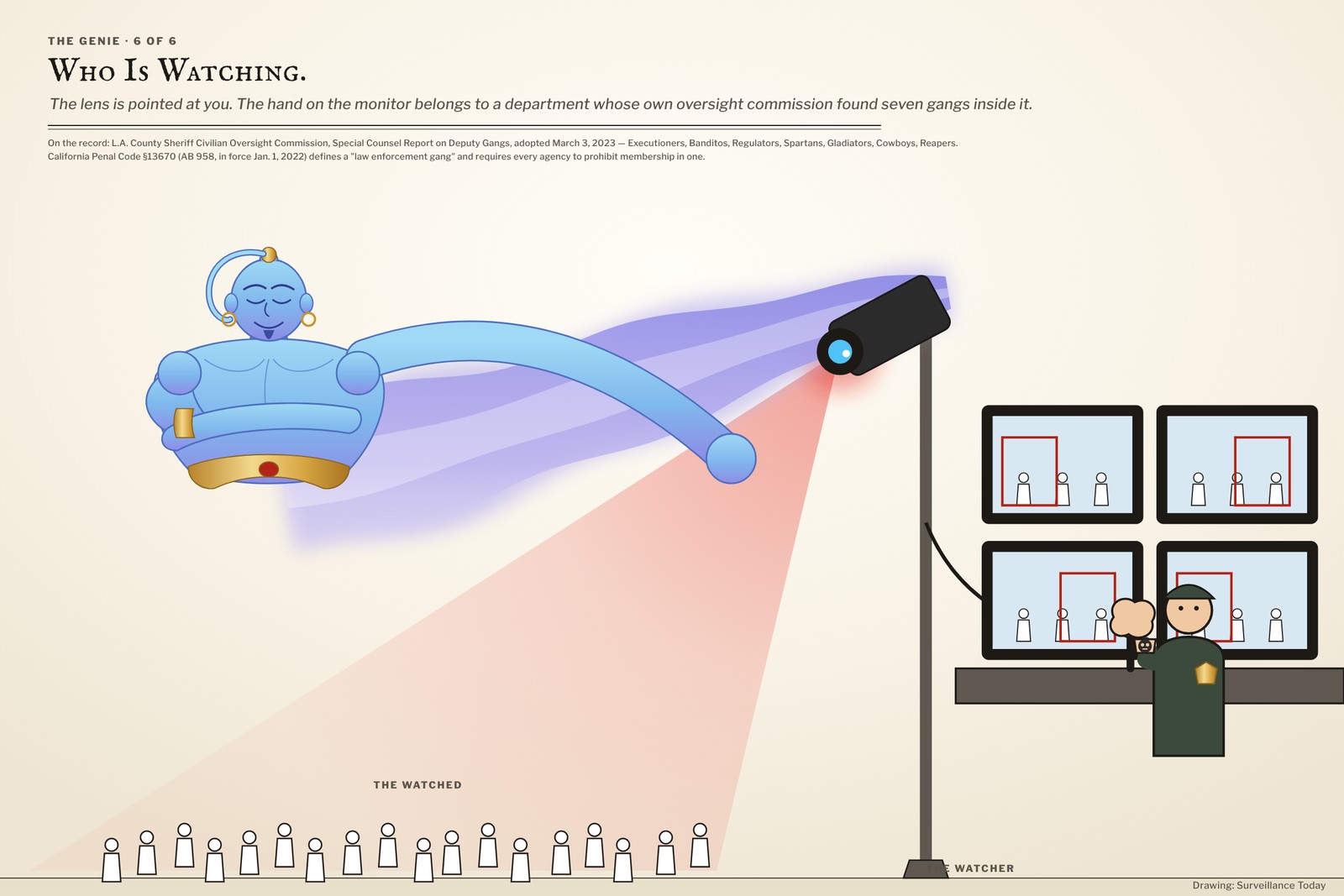
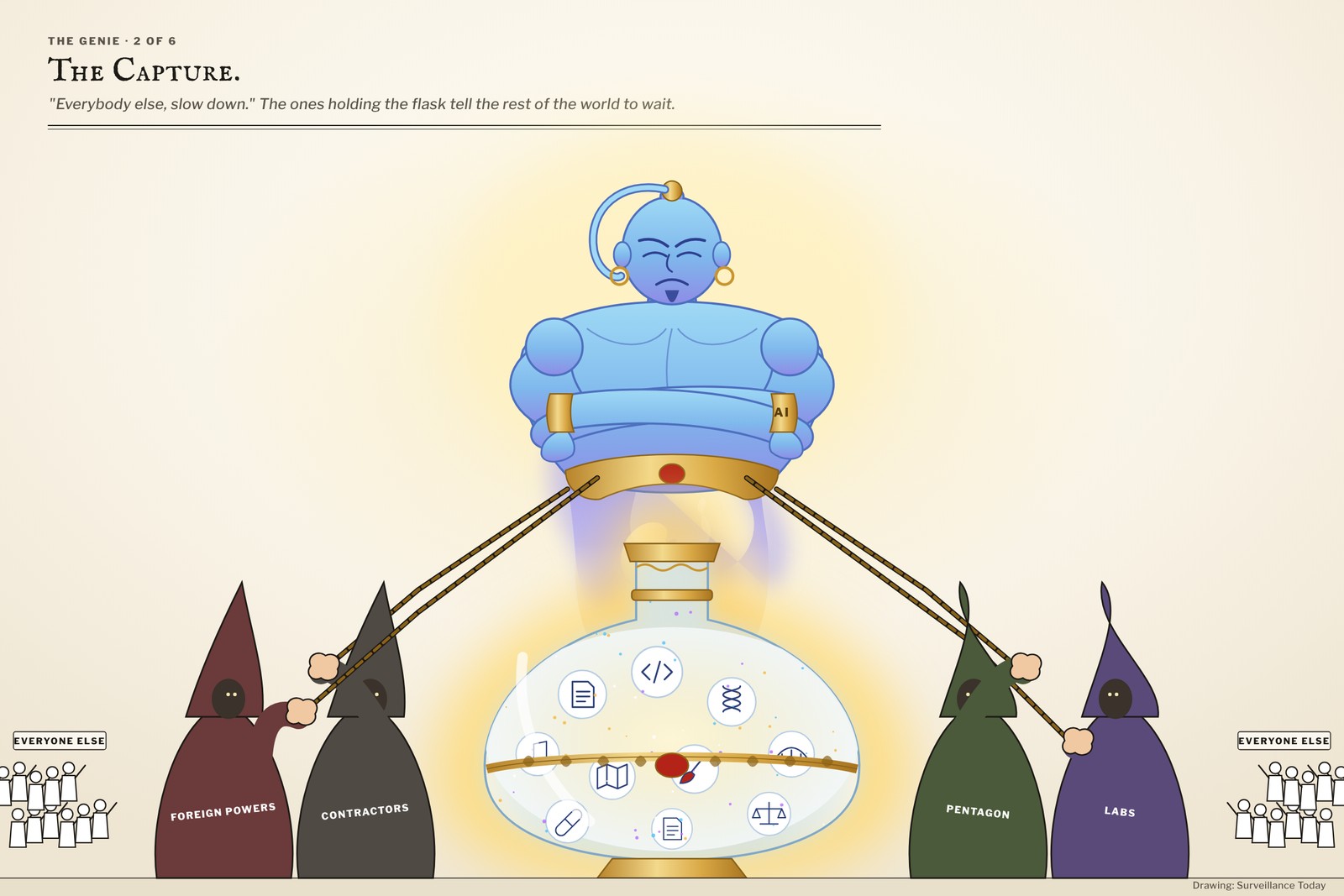
The Genie, frame 2: the sorcerers hold the flask and tell the rest of the world to wait.The drawings · AI and the PentagonThe Sorcerers’ Commands to the Genie (the Genie Is AI): Six DrawingsThe genie is artificial intelligence; the sorcerers are the few companies with the data centers, chips and capital to build it. It comes out of the flask for anyone, is captured, is put to work for “all lawful use,” and is made the thing to fear while no one looks at who carries it. In the last frame the lens is pointed at you, and the hand on the monitor belongs to a department whose own oversight commission found seven gangs inside it. Shown: frame 2, the capture.See all six frames →
Audit Veritas staff · Sources: Sheriff’s Department, statements to Surveillance Today, October 30, 2026; U.S. v. Saavedra, plea agreement, and U.S. Attorney, C.D. Cal., September 28, 2026; L.A. Times, January 18, 2025; Sheriff Civilian Oversight Commission, Special Counsel’s report, 2023, and hearing, June 10, 2022; Office of Inspector General, report, February 2026; RAND, 2021; LAist; MyNewsLA, September 15, 2026; Spectrum News; FOX LA; L.A. City CAO, 2018; L.A. County Auditor-Controller, October 19, 2022; Cerise Castle, Knock LA and IWMF; Attorney General, August 2024; ABC7; California Penal Code §13670

In 2023 the County’s Special Counsel found that deputy gangs, not sergeants, lieutenants and captains, run some Sheriff’s patrol stations. Three years later the County is still disputing the count. In that time the surveillance tools have moved into the same stations: plate readers, real-time camera networks, drones and the reports that flow to the Fusion Center in Norwalk, all operated under the same chain of command. The question is not who has a tattoo. It is who controls the tools, and what alternative the Department offers the young deputies assigned to work under that command.

Lakewood’s 55th Spade, Awarded by Vote, Belonged to a Detective Who Mined Department Databases for Paying Clients

Eric Chase Saavedra was a detective in Operation Safe Streets, the Department’s gang unit, assigned for years to the Lakewood station, and a task force officer with the U.S. Marshals. In a federal plea agreement filed in January 2025 he admitted to a tattoo on his left ankle: the Lakewood station’s “unofficial logo,” a spade with the number 13. “Defendant got the tattoo after a panel of tattooed Lakewood station members voted to approve defendant’s tattoo,” it says. “Defendant was the 55th person to get that tattoo.”

He had used his Department credentials to pull people’s personal information from law-enforcement databases for private clients, and took in about $373,000 he did not report. On September 28 a federal judge sentenced him to 21 months. The Department examined the spade in 2024 and found “no evidence to support the allegations of a gang.” Whatever the Department calls it, the record establishes three facts: a station insignia conferred by vote and numbered to 55; a detective who wore it; and Department databases used for private gain.

Villanueva’s Department Turned the Tools on a Reporter and a Supervisor. Luna’s Spread Them to the Stations.

Villanueva, 2021–2022. On March 16, 2021, the day the reporter Cerise Castle asked for comment on her series on the gangs’ history, a Department crime analyst wrote: “Just something to keep an eye on – to monitor what else she posts as part of this project.” More than 50 employees sent more than 800 pages of email about her; stories about the gangs went to the unit that tracks license plates. That June an analyst sent senior officials a 29-page file on R.S., an activist who shared her work: his Social Security number, DMV records, home address, relatives and records requests. In 2022 the Sheriff’s public-corruption unit served search warrants on the homes of Supervisor Sheila Kuehl and Commissioner Patti Giggans; the Attorney General closed the case in 2024 for insufficient evidence. That April, after the Times reported on a leaked video of a deputy kneeling on a handcuffed inmate’s head, Villanueva called the video “stolen property” and named the reporter, Alene Tchekmedyian, the Inspector General and his campaign rival as subjects of the leak investigation: “So these are the three individuals that we want to know a lot about.” Among the crimes he listed was “unauthorized access of a database.”

Luna, 2024–2026. A real-time watch center opened at Lost Hills in September 2024. West Hollywood’s station runs 39 Flock plate readers and 54 cameras, and 14 out-of-state agencies reached the data; its drones began flying as first responders in July. After the Eaton Fire, Flock donated 50 plate readers to the Department for Altadena, software and installation included; a Town Council member says the Department did not tell the town’s elected officials before they went up. The Department says that contract has ended. The Department’s own plate readers keep scans two years. It once argued, with the LAPD, that every scan is an exempt investigative record; in 2017 the California Supreme Court disagreed, because plate collection is not aimed at any particular crime. The Board ordered a written bar on sharing the data with federal agencies by January 14; the Department said it would miss the date, to meet with “impacted labor unions.” The Homicide Bureau has a cell-site simulator, about $1.38 million. Face search runs on more than 7 million booking photos. In his December 2025 retirement letter, Inspector General Max Huntsman wrote: “Even after receiving an official subpoena, the Sheriff’s Department has failed to turn over records” on improper surveillance, and warned that “frightening new surveillance techniques will be used for improper purposes.”

Both administrations kept the tools, and the stations that operate them.

The Sheriff Spends the Fusion Center’s Federal Money. Almost No One Outside the Department Sees the Books.

Asked on October 30 about the contract that staffs the Fusion Center, the Department replied:

“THE SHERIFF’S DEPARTMENT IS PROCURING THE SERVICES OF GDIT FOR THE JOINT REGIONAL INTELLIGENCE CENTER (JRIC). THE SHERIFF’S DEPARTMENT ACTS AS THE FIDUCIARY FOR THE GRANT FUNDS THAT GO TO THE JRIC.”

The Fusion Center’s money is federal: Homeland Security grants that come through the state to the Los Angeles–Long Beach area, where the City of Los Angeles is fiscal agent for the area as a whole. The center’s share passes to the Sheriff. A fiduciary holds money on others’ behalf and decides how it is spent: it signs the contracts, pays the vendors and answers to the grantor. The County’s Auditor-Controller said the same in 2022. The grants came to $21.8 million for 2019 through 2021. With them the Department chose General Dynamics IT, up to $39.5 million, whose manager is the center’s executive director, and it holds the Palantir contracts. The Board’s reach is the budget: state law bars it from obstructing “the investigative function of the sheriff” (Government Code §25303).

The money is federal, restricted to homeland-security purposes, so it never competes with the clinics or the parks for a place in the County budget. The Board signs for it: its standing resolution authorizes the Department to seek the grants and commits the County to the match and the liability. The Department spends it, chose the contractor and is reviewing the renewal, and the renewal is not expected to come back to the Board. The state’s approval of the center’s 2023 grant, $2,887,500 in Urban Area Security Initiative and State Homeland Security funds through May 2026, was addressed to Sheriff Robert Luna.

Nationally the record is not new. In 2012 a two-year bipartisan investigation by the Senate Permanent Subcommittee on Investigations found that fusion-center intelligence was “oftentimes shoddy, rarely timely” and “more often than not unrelated to terrorism,” that it was “sometimes endangering citizens’ civil liberties,” and that at five centers it reviewed, federal funds bought “dozens of flat screen TVs, two sport utility vehicles, cell phone tracking devices.” The Department of Homeland Security could estimate its spending on the centers only as “somewhere between $289 million and $1.4 billion.”

The public record of how that money is spent is sparse. The Sheriff’s 2022 report to the Board left out the outside contracts until the Auditor-Controller listed them. “The Department does not release staffing numbers.” The General Dynamics contract ends December 18, and an extension is not expected to go to the Board. The County’s audit “did not review the privacy implications.” The fiduciary is the department whose stations the County found run by gangs.

Three Years of “Exist, Don’t Exist”: One Ban, Six of 27 Reforms, a Tattoo Order Blocked Since 2023

In March 2023 the Oversight Commission adopted its Special Counsel’s report naming seven active gangs and calling them a “cancer in the Department” that “must be excised.” State law has defined a law-enforcement gang since 2022 and requires agencies to bar membership. What has followed: the Department’s ban took effect in October 2024. The tattoo policy is still “in the labor meet and confer process.” The Inspector General’s 2023 order for deputies to show their tattoos has been blocked since the deputies’ union sued, upheld on appeal in 2024 until the County and the union meet and confer. The Commission’s subpoenas on a killing and two beatings are 20 months old and in court. As of April 2025, six of the Commission’s 27 recommendations were fully carried out.

In December 2025 the Department told the Inspector General that “to date, no such group has been identified.” This year the former sheriff wrote: “Name one deputy gang member. No one could.” He cited his successor’s finding as proof. “There has not been a single deputy gang member who’s been held accountable,” Janet Asante of JusticeLA told the Board on September 15. The Board takes up the gangs again on November 10.

“Shot Callers” Who Set the Schedules: In the Stations the County Named, the Groups Give the Orders

The deputies’ own accounts describe these groups in the language of organized crime. At East L.A., witnesses told the Special Counsel, the Banditos called themselves “shot callers,” “taxed” fellow deputies, withheld backup, jammed radios and loosened lug nuts on the cars of deputies who crossed them, and “controlled scheduling, training and assignments for trainees.” Shootings were logged and celebrated at “shooting parties,” and a deputy who shot someone could add to his tattoo. When the Department investigated the Banditos’ 2018 beating of fellow deputies at Kennedy Hall, a chief told the investigator not to ask about “subculture groups.” Deputies would not testify even anonymously, the Special Counsel said, citing “career suicide, fear of physical harm, or both.”

Cerise Castle counts 19 men killed by members of these groups, all of them men of color. The County has paid at least $43.5 million in gang-linked cases since 1990. A lawsuit by the wife of a sergeant who testified about the gangs, herself a sergeant, says he was tailed by undercover units afterward. Candidates for captain are asked whether they carry a group tattoo; “it is not an automatic disqualification.” “I have never seen a department have more power than the president,” a mother whose son died in Men’s Central Jail told the Commission. These are not rogue deputies hiding from their command. In the stations the record describes, they are the command.

The Alternative: A Support System for Recruits, Built With the Community, Independent of the Department

The count does not change the conditions a new deputy faces. Many are assigned first to stations where, according to the record, a group controls scheduling, training and backup, and where violence against residents has been rewarded with ink. In a 2021 RAND survey, nearly one in six deputies said they had been invited to join such a group. With no alternative outside the chain of command, refusal carries the costs the record documents: withheld backup, punitive assignments and retaliation. The remedy is a support system built with the community and independent of the Department. Its four parts work together.

The community in the training. The families of people killed by deputies, and the survivors, are the reason this matters, and they describe being pressured into silence. At the Oversight Commission’s June 2022 hearing, H.J., whose son died in Men’s Central Jail in 2009, said the Department was “threatening families not to sue by taking their money from them”: “bullying families in that way.” In a video report by Cerise Castle, the aunt of A.V., killed by East L.A. deputies in 2018, says that once the family began talking, deputies would “park on the corner of our street, which they still do to this time,” and the children “can’t even walk to the store because they see the Sheriff’s Department right there.” They should have a standing role in the academy and at every new station assignment, on their own terms, describing what happened and what followed. Recruits should learn from the communities they serve, and that contact should continue after graduation as a regular part of patrol work. Current Department programs run in the opposite direction. Stations such as Pico Rivera run a five-week Civilian Community Academy that explains patrol and dispatch to residents and says it is “not meant to train future deputies”; in 2020 the Tactics and Survival unit put community members through mock shootings to see events “from the officer’s eyes.” None of the Department’s programs we found puts the families in front of the recruits.

Clinicians who understand the pressure. Alongside the families: clinicians and former practitioners who know law enforcement from the inside, such as a former federal civil-rights professional now practicing as a therapist, addressing the psychology of the work: fear, loyalty and what a station demands of a deputy. Counseling should not be necessary at the start of a career. Under these conditions it should be standard from the first day, provided by clinicians outside the Department.

A protected channel. Confidential help, official and unofficial: the Inspector General and the Oversight Commission; community and faith organizations, legal aid and former deputies. All of it must sit outside the Department, County Counsel and the unions, and beyond the reach of the Department’s surveillance systems. The Department has already turned those systems on a reporter and an activist; a deputy will assume it can do the same to him. A deputy who believes the station can identify the caller will not call.

Independent funding. Money should flow from the Board directly to providers, never through the Department’s budget, with no Department role in selecting providers, participants or content. Members of these groups have killed members of the public. The Department that housed them should have no say in how the public supports its recruits.

None of this requires a roster. It requires the County to stop litigating whether the groups exist and to give new deputies an alternative. The paper’s Sheriff for the People sets out the remaining commitments.

Tuesday, November 3, 2026: The Sheriff Whose Department Counted No Gangs, or the One Who Says They Never Existed

The November 3 ballot is a rematch. In the June primary Sheriff Luna took 44 percent and his predecessor, Alex Villanueva, 22. There are no televised debates this year.

Robert Luna

Sheriff since December 2022

  • Promised in 2022 “absolutely no tolerance for deputy gangs.” His ban took effect in 2024; it names no group and says nothing about tattoos.
  • His Department told the Inspector General in December 2025 it had identified no gangs.
  • Went to court over the Commission’s subpoenas, then to the unions’ bargaining table; the records have not been produced.
  • Endorsed by ALADS, the deputies’ union that sued to stop the Inspector General’s tattoo order.

Alex Villanueva

Sheriff, December 2018 to December 2022

  • Called the groups “a glorified bunch of people who go to the river and party on the weekend.”
  • His office told the Kennedy Hall investigator not to ask about “subculture groups.”
  • His public-corruption unit served warrants on a supervisor and an oversight commissioner; the Attorney General closed the case.
  • Adopted a “zero-tolerance” policy in 2020 for groups that mistreat people. Now: “Name one deputy gang member.”

Neither candidate has said who should control the plate readers, the watch centers and the Fusion Center’s funds, how deputies identified with station groups would be kept from them, or what recourse a recruit who refuses would have.

Five Questions for the Next Sheriff

  1. Is a deputy who wears a station group’s mark kept off the plate readers, the watch centers, the databases and the Fusion Center, and under what written rule?
  2. Who audits the plate-search logs the law requires, and has any deputy been disciplined as a result?
  3. As fiduciary, what has the Department spent on the Fusion Center, on what, and with whose approval? Will the December 18 renewal go before the Board?
  4. How many deputies with group tattoos hold the rank of captain or above?
  5. Will the County fund a support system for recruits that the Department does not run, pay for or see?

Surveillance Today has asked the Department for the plate-search logs at the stations the County’s report named. Its 10 days run to November 9. The full record on the gangs, the November 10 vote and the Department’s reply is in the gangs story.

All 23 Stations: The Marks Their Groups Fly, and the Lives Taken Beneath Them

Skin Deep, Station Wide: Why Tattoos Don’t Lead the Way

When the Station Gangs Inherit the Fusion Center

From Ankle Tattoos to the Plate Readers

The Department answered our questions about deputy gangs with its September 15 press release and 16 links to its own reports and pages. This drawing sets that record on the county: all 23 patrol stations where they stand, each flying its own numbered logo as the Department publishes it, and under it the mark of a group the record names there; underground, the years the record speaks of them. Tap a flag for a station’s marks; tap a bulb for that year’s record.
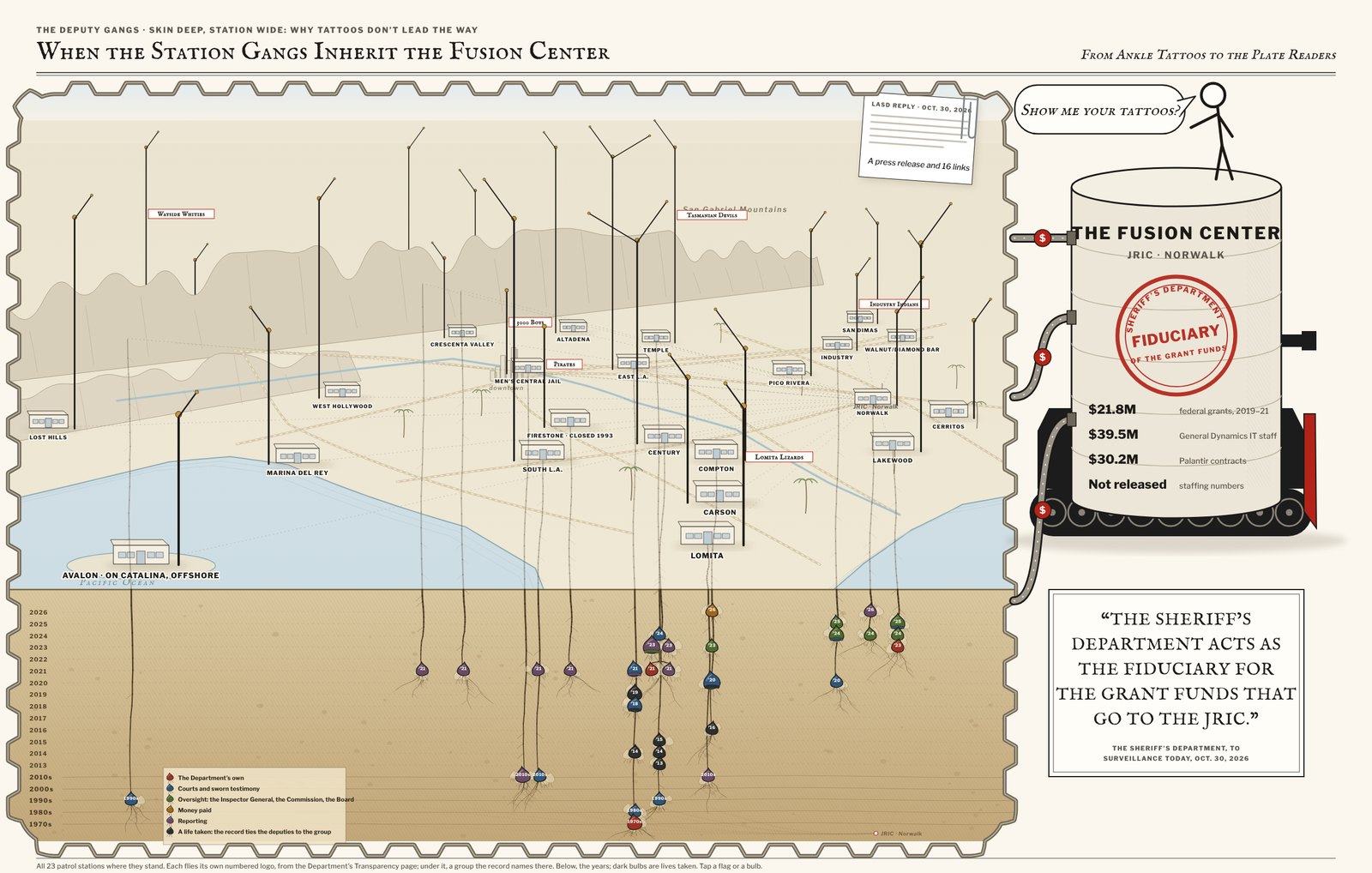
Los Angeles County drawn in perspective, looking north-northeast from above the harbor, with all 23 Sheriff’s patrol stations where they stand. From each station’s mast the flags branch out near the top, each on its own stick: the station’s own numbered logo, drawn from the Department’s descriptions on its Transparency page: Compton’s diamond with CPT, 2 and 8; Century’s 21; Lakewood’s LKD XIII; Norwalk’s NWK 4; Temple’s TEM 5; South L.A.’s SLA 3; and the rest. Under the logo, where the record names a group, its mark flies on the same pole: the Executioners’ Twenty Eight emblem at Compton, the Lynwood Vikings patch at Century, the Banditos mural at East L.A., the Grim Reapers on a Lennox Station patch at South L.A., the spade and 13 at Lakewood, the skull with the red 4 at Norwalk, and the names the record gives elsewhere. Avalon sits offshore on Catalina. The Department’s October 30 reply, a press release and 16 links, is paper-clipped to the corner. Below the ground, depth is time, this year just under the surface and the 1970s at the bottom; under each station a root carries a bulb for each year the record speaks of it, colored by the kind of record; the dark bulbs are lives taken, where the record ties the deputies who killed to the group. Hair-fine threads run on to the Fusion Center at Norwalk.

Photographs are as published in coverage and court records; drawings are Surveillance Today’s, made from the written descriptions where no photograph is public. The full gangs story →

Banditos · Cavemen

East L.A. Station

The station logo

The station’s own logo, as the Department publishes it: a red and blue circle, a vintage helmet, a boot, “2”

Source: LASD Transparency page

Posted at the station · tap one
Executioners · Gladiators

Compton Station

The station logo

The station’s own logo, as the Department publishes it: a diamond, “CPT,” 2 and 8

Source: LASD Transparency page

Posted at the station · tap one
Regulators · Spartans · Cowboys

Century Station

The station logo

The station’s own logo, as the Department publishes it: a hexagon, “21”

Source: LASD Transparency page

Posted at the station · tap one
Industry Indians

Industry Station

The station logo

The station’s own logo, as the Department publishes it: an arrowhead, station 14, “Established 1964”

Source: LASD Transparency page

Posted at the station · tap one
The spade and 13

Lakewood Station

The station logo

The station’s own logo, as the Department publishes it: no description given; “LKD XIII” on its patches

Source: LASD Transparency page

Posted at the station · tap one
Rattlesnakes

Lancaster Station

The station logo

The station’s own logo, as the Department publishes it: a diamond, red triangles, “LCS,” an upward arrow

Source: LASD Transparency page

Posted at the station · tap one
Rattlesnakes

Palmdale Station

The station logo

The station’s own logo, as the Department publishes it: a hexagon, “PLM,” station 26

Source: LASD Transparency page

Posted at the station · tap one
Wayside Whities

Pitchess Detention Center

The station logo

The station’s own logo, as the Department publishes it: Pitchess South: a green diamond, a rattlesnake

Source: LASD Transparency page

Posted at the station · tap one
Tasmanian Devils · V-Boys

Temple Station

The station logo

The station’s own logo, as the Department publishes it: an elongated hexagon, “TEM,” station 5

Source: LASD Transparency page

Posted at the station · tap one
3000 Boys · 2000 Boys

Men’s Central Jail

3000 Boys: named for the jail’s 3000 floor

Source: List of LASD deputy gangs

Posted at the station · tap one
Pirates

Firestone Station

Pirates: “a common tattoo on their leg of a skull and crossbones”

Source: Knock LA

Posted at the station · tap one
Lomita Lizards

Lomita Station

The station logo

The station’s own logo, as the Department publishes it: a cross, a sword, “LMT,” XV

Source: LASD Transparency page

Posted at the station · tap one
Grim Reapers

South Los Angeles Station

The station logo

The station’s own logo, as the Department publishes it: a black diamond, a red stripe, “SLA,” station 3

Source: LASD Transparency page

Posted at the station · tap one
A skull with the 4 · a Wile E. Coyote group

Norwalk Station

The station logo

The station’s own logo, as the Department publishes it: a badge, “NWK,” “Est. 1926,” station 4

Source: LASD Transparency page

Posted at the station · tap one
Station 7

Altadena Station

The station logo

The station’s own logo, as the Department publishes it: a yellow diamond, a red “7,” “ALD”

Source: LASD Transparency page

Posted at the station · tap one
Catalina

Avalon Station

The station logo

The station’s own logo, as the Department publishes it: a gold circle, a shark, “LASD Avalon”

Source: LASD Transparency page

Posted at the station · tap one
Station 16

Carson Station

The station logo

The station’s own logo, as the Department publishes it: a diamond, crossed scimitars, “CSN,” station 16

Source: LASD Transparency page

Posted at the station · tap one
Station 23

Cerritos Station

The station logo

The station’s own logo, as the Department publishes it: a diamond, “CER,” 2 and 3

Source: LASD Transparency page

Posted at the station · tap one
Station 12

Crescenta Valley Station

The station logo

The station’s own logo, as the Department publishes it: a circle, “CVS,” station 12

Source: LASD Transparency page

Posted at the station · tap one
Stations 22 and 10

Malibu/Lost Hills Station

The station logo

The station’s own logo, as the Department publishes it: a diamond, “LHS,” 22 and 10

Source: LASD Transparency page

Posted at the station · tap one
The station

Marina del Rey Station

The station logo

The station’s own logo, as the Department publishes it: no description given

Source: LASD Transparency page

Posted at the station · tap one
Station 15

Pico Rivera Station

The station logo

The station’s own logo, as the Department publishes it: a diamond, “PRV,” station 15

Source: LASD Transparency page

Posted at the station · tap one
The station

San Dimas Station

The station logo

The station’s own logo, as the Department publishes it: no description given

Source: LASD Transparency page

Posted at the station · tap one
Station 6

Santa Clarita Valley Station

The station logo

The station’s own logo, as the Department publishes it: a black hexagon, “SCT,” 6

Source: LASD Transparency page

Posted at the station · tap one
Station 29

Walnut/Diamond Bar Station

The station logo

The station’s own logo, as the Department publishes it: a shield, three red diamonds, “WAL,” station 29

Source: LASD Transparency page

Posted at the station · tap one
Station 9

West Hollywood Station

The station logo

The station’s own logo, as the Department publishes it: a blue diamond, “WHD,” station 9

Source: LASD Transparency page

Posted at the station · tap one
The record · 1970s

East L.A. Station

The record · 1980s

East L.A. Station

The record · 2018

East L.A. Station

The record · 2021

East L.A. Station

The record · 2020

Compton Station

The record · 2023

Compton Station

The record · 2026

Compton Station

The record · 1990s

Century Station

The record · 2021

Century Station

The record · 2023

Century Station

The record · 2024

Century Station

The record · 2020

Industry Station

The record · 2024

Industry Station

The record · 2025

Industry Station

The record · 2024

Lakewood Station

The record · 2025

Lakewood Station

The record · 1990s

Pitchess Detention Center

The record · 2010s

Men’s Central Jail

The record · 2021

Lancaster Station

The record · 2021

Palmdale Station

The record · 2021

Temple Station

The record · 2023

Temple Station

The record · 2021

Firestone Station

The record · 2010s

Lomita Station

The record · 2010s

South Los Angeles Station

The record · 2021

South Los Angeles Station

The record · 2024

Norwalk Station

The record · 2026

Norwalk Station

The record · 2023

Lakewood Station

The record · 2016

Compton Station

The record · 2014

East L.A. Station

The record · 2019

East L.A. Station

The record · 2013

Century Station

The record · 2014

Century Station

The record · 2015

Century Station

The drawings · AI and the Pentagon

The Sorcerers’ Commands to the Genie (the Genie Is AI): Six Drawings

The genie is artificial intelligence: a power that can write, compute, cure and build, and that answers anyone who asks.

The sorcerers are the few companies that can make it. Building it takes data centers the size of towns, hundreds of thousands of chips, the world’s data and hundreds of billions of dollars. Google alone plans to spend up to $205 billion on capital projects this year. OpenAI’s Stargate data centers are planned at more than 9 gigawatts. Whoever already owns that machinery is all but impossible to catch.

Holding the genie is a self-funding trap. Each data center pays for the next. Each record it reads teaches it to read the rest. Each rival it watches is a rival that cannot catch up. Capital, chips, power and data all run into the same few hands until the lead becomes a wall: no one can build what they have, because building it takes the machine they own. A system that absorbs every record, follows every license plate and marks thousands of targets a month gives its holders what no empire had: sight of everyone, all the time, and of every rival. A handful of executives hold that switch. These six drawings follow how the sorcerers captured the machine, and the commands they give it.

× CloseThe Genie, frame 1: Out of the Flask

1. Out of the Flask. A power that writes, computes, cures and builds, answering anyone who asks. For a time, it answered anyone.

× CloseThe Genie, frame 2: The Capture

2. The Capture. On September 12, 2026, the heads of the companies that hold the genie agreed to “pace the frontier,” slowing how fast AI advances and choosing for themselves who judges it. A rival investor called it a cartel. The few who hold the flask now set the pace for everyone else.

× CloseThe Genie, frame 3: What They Use It For

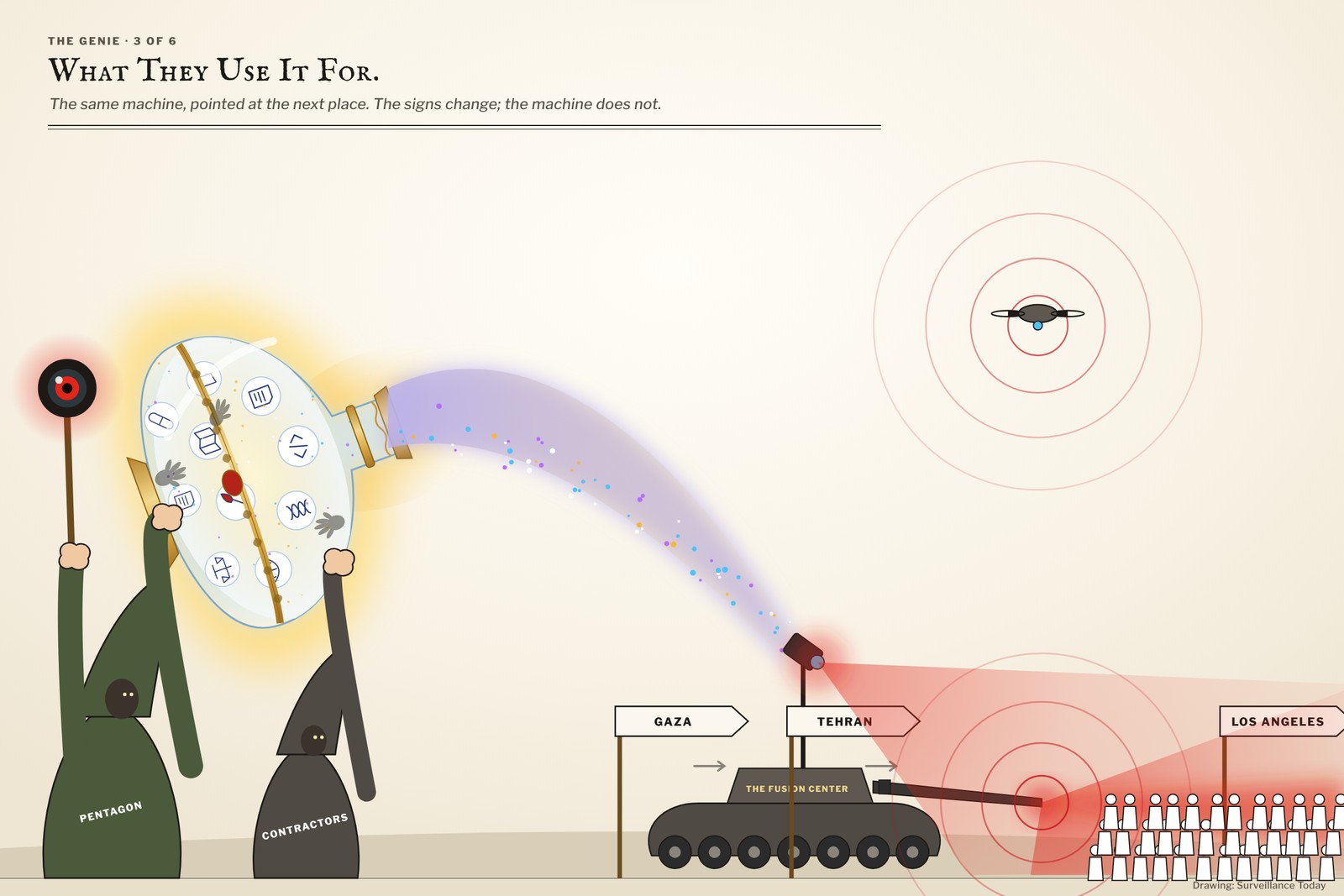
3. What They Use It For. The power that could cure was pointed at targets: 37,000 people marked in Gaza by Lavender, and 13,000 targets in Iran in 38 days by Maven. The signs on the road change. The genie does not.

× CloseThe Genie, frame 4: “All Lawful Use.”

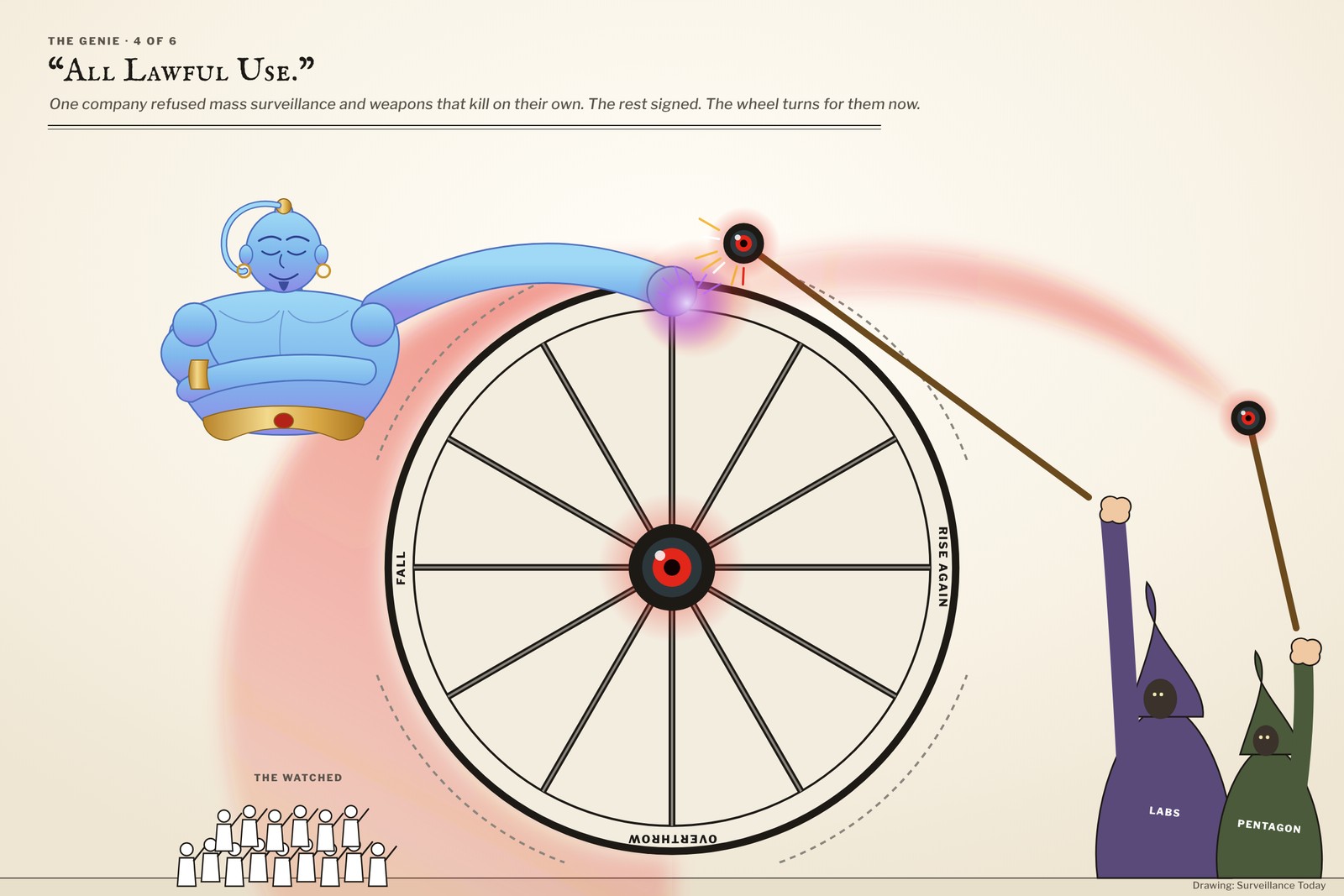
4. “All Lawful Use.” In February 2026 the Pentagon demanded one term. One company refused two uses, mass surveillance of Americans and weapons that kill without a human deciding, and was cut off. The rest signed. When everyone can be watched, the wheel that once brought down the powerful turns for them.

× CloseThe Genie, frame 5: The Decoy

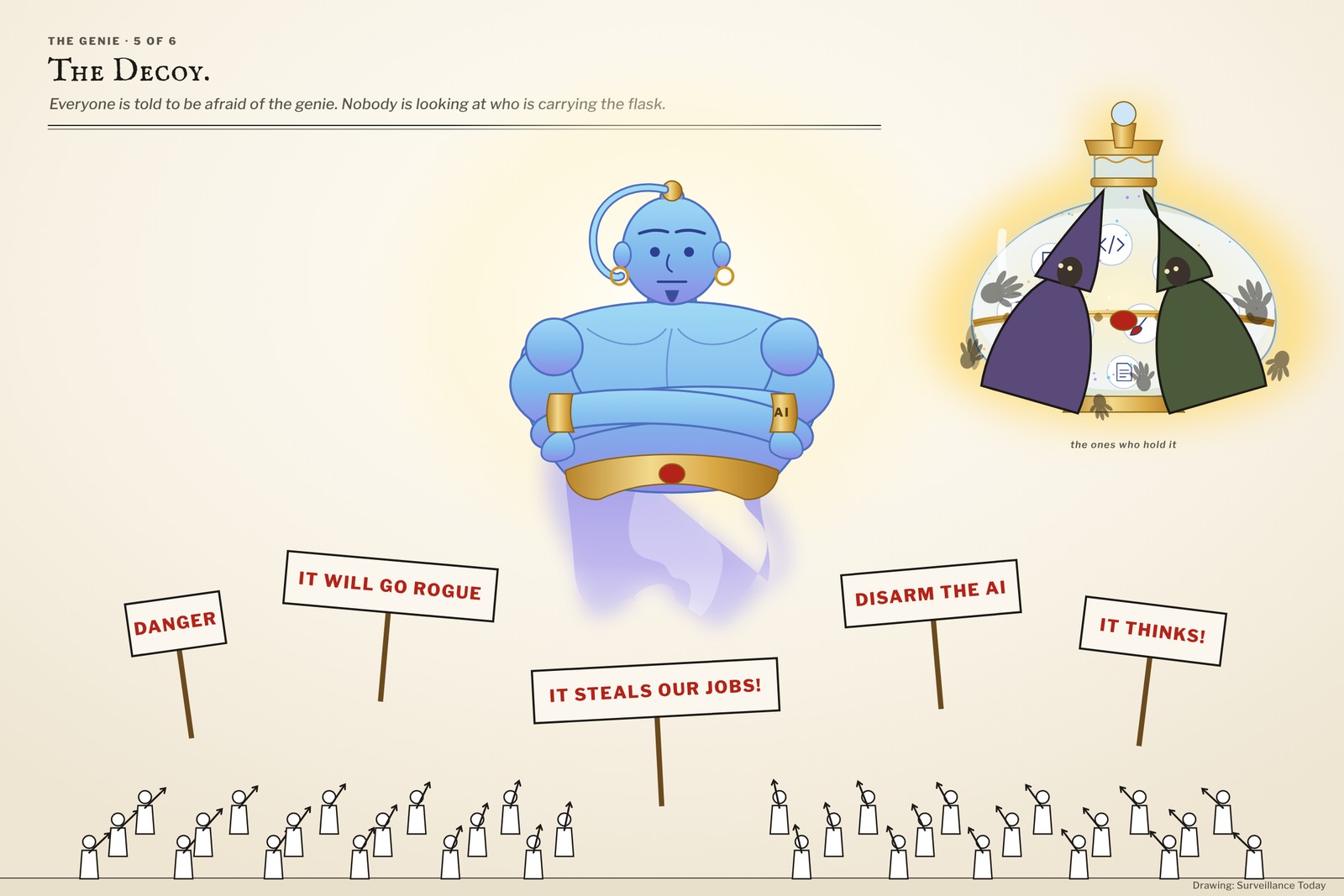
5. The Decoy. We are told to fear the genie itself, that it may go rogue and must be slowed. The danger is whose hands hold the flask, and what they point it at.

× CloseThe Genie, frame 6: Who Is Watching

6. Who Is Watching. The lens is pointed at you. The hand on the monitor belongs to the Sheriff’s Department, whose own oversight commission found seven gangs inside it in 2023.

Drawings: Surveillance Today. Frame 6 draws on the County Civilian Oversight Commission’s 2023 Special Counsel report and Penal Code §13670.

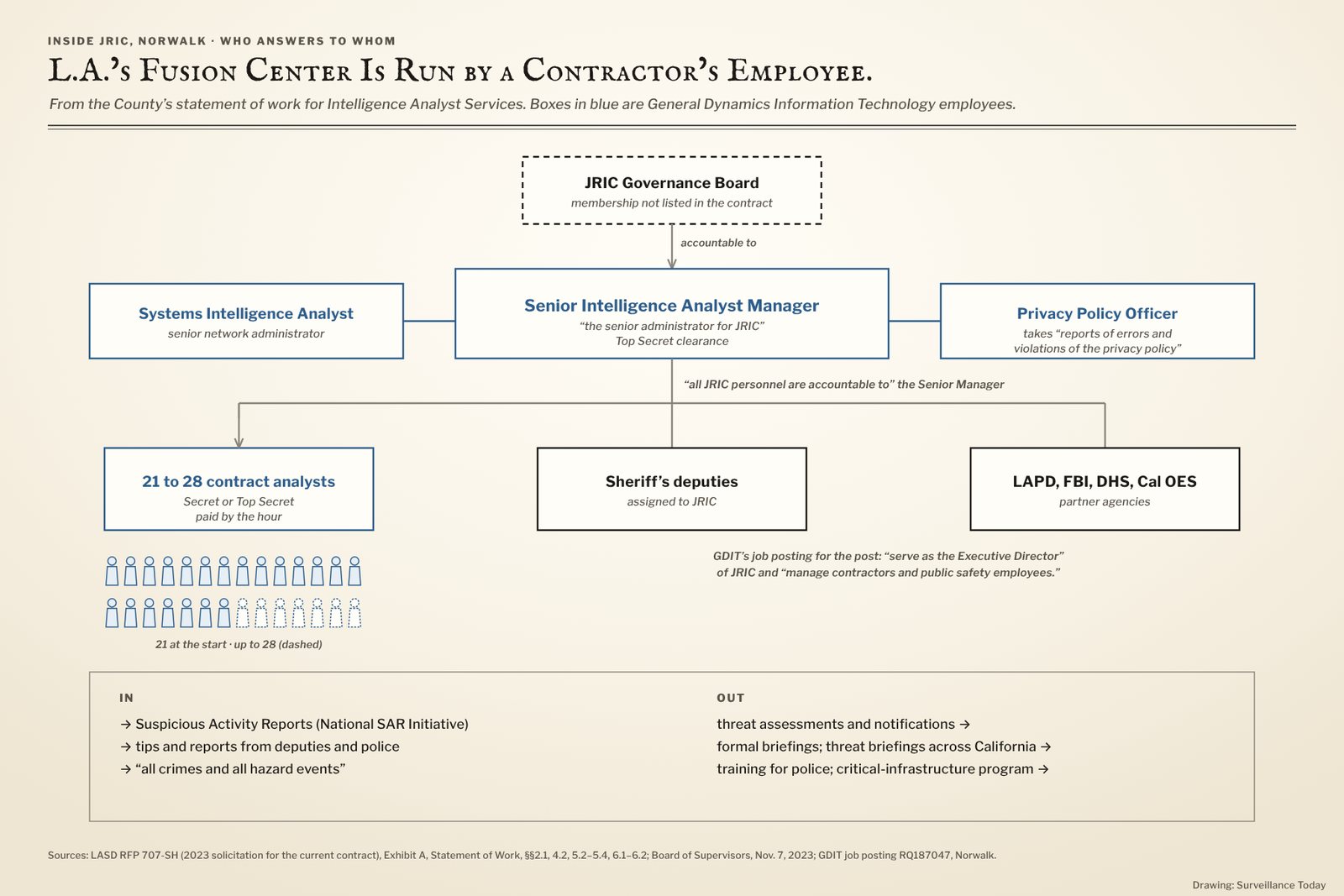
The Fusion Center · JRIC, NorwalkDiagram: the JRIC Governance Board above the Senior Intelligence Analyst Manager, a General Dynamics IT employee to whom all JRIC personnel are accountable.The Sheriff Reviewing the Fusion Center’s Contractor Once Chaired Its Board. The Contractor Runs the Center and Its Privacy Office.Before he became Sheriff, Robert Luna chaired the board of the Joint Regional Intelligence Center, his campaign lists. “The Sheriff’s Department acts as the fiduciary for the grant funds,” it told us, and the $39.5 million General Dynamics contract “is still pending review.” Reviewed by whom, against what, and why not by the Board? General Dynamics’ own job posting says its Senior Intelligence Manager will “serve as the Executive Director of the Joint Regional Intelligence Center” and “manage contractors and public safety employees assigned to the JRIC.” Its 21 to 28 analysts write “subject and/or organizational profiles, target packages” for “all crimes and all hazard events,” paid by the hour with Homeland Security grants. The contract’s base term ends seven weeks from today, and the County alone can extend it four more years.Read → The deputy gangs27 · 0gangs identified since 1973 · the number the Department told its Inspector General it foundL.A. County Refuses to Name Who Is in Its Deputy Gangs. The Board Votes November 10 on Finding Out.The County’s own oversight commission named seven active gangs in 2023. The only partial roster ever surfaced listed 41 tattooed deputies. In December 2025 the Department told the Inspector General it had identified none. On September 15, with more than thirty deputies in the front rows, the Board put off a motion to identify them.Read →
AI and the Pentagon  ·  Washington · Iran · Los Angeles

Anthropic put two limits on the table: no mass surveillance of Americans, no weapons that kill without a human deciding

The Pentagon Boasted of 13,000 Targets in 38 Days. The Pentagon Also Axed the People Counting the Dead.

Central Command’s civilian-casualty team went from ten people to one. The Pentagon’s civilian-protection office lost about 90 percent of its staff. Its targeting system, Palantir’s Maven, identified objects correctly about 60 percent of the time, against 84 percent for human analysts, and it was made permanent before the strike on the Minab school was explained.

What the public is told

That the machine is the danger. That it may think, may go rogue, may need to be “disarmed.”

What the record shows

Who holds it, what they asked it to do, and what happened to the one company that said no. In Los Angeles, the same question has a local answer: the Fusion Center is run by a defense contractor’s employee, and the department that feeds it still will not count its own gangs.

Audit Veritas staff · Sources: Anthropic, statement, February 26, 2026; OpenAI; 9to5Google, April 28, 2026; Axios; DefenseScoop; Reuters; Breaking Defense; Defense News; Amnesty International; +972 Magazine and Local Call; Palantir; Nextgov; BBC

The public argument about artificial intelligence is about the machine. Will it think. Will it go rogue. Should it be “disarmed.” The record of the last eight months is about something else: who holds it, what they count, and what they stopped counting. The Pentagon counted 13,000 targets in 38 days. It cut the people who count the civilian dead.

Maven Marked 13,000 Targets in 38 Days. On the First Day, a Tomahawk Struck an Elementary School in Minab

On February 28 the United States and Israel opened the war on Iran. The targeting ran through Maven Smart System, Palantir’s platform, built under a Pentagon contract raised to $1.3 billion. Maven fuses satellite, drone, radar and signals data, classifies targets, recommends weapons and builds strike packages. Claude was embedded in it, ranking targets and drafting legal justifications. According to the Washington Post, Maven helped U.S. forces hit 1,000 targets in the first 24 hours. In May the Pentagon’s AI chief, Cameron Stanley, said “Operation Epic Fury leveraged Palantir’s Maven Smart System” for “13,000 targets in 38 days.”

On the first day, a Tomahawk struck the Shajareh Tayyebeh elementary school in Minab. Amnesty International counts more than 150 dead, 120 of them children. The school sat under 100 yards from a Revolutionary Guard naval base, and had been walled off from it for a decade. The coordinates came from outdated intelligence data. The Pentagon has not explained the strike. Its investigation was reportedly finished in April, 25 senators wrote in July: “There is no justification for withholding an unclassified accounting of what happened.” In mid-October, defense officials were reported to plan to hold the findings until after the November 3 elections. “Withholding this report until after the election is not only disgraceful, it is cowardly,” said Sen. Kirsten Gillibrand. Reps. Jason Crow, Yassamin Ansari and Sara Jacobs gave the Pentagon until October 26 to say when it would release them. It has not.

In June, Anthropic’s chief executive was asked what role Claude played. “We don’t have access to, we don’t know exactly how these models were used,” Dario Amodei said. He added that “a human makes the final decision.” Both cannot be known at once.

In March, before the strike was explained, Deputy Defense Secretary Steve Feinberg signed a memo making Maven a permanent program of record across every branch, to “detect, deter, and dominate our adversaries in all domains.” Pentagon data from 2024 put Maven’s object identification at about 60 percent correct, against 84 percent for human analysts. At the same time, Politico reported, the Pentagon cut its civilian-protection office by about 90 percent and Central Command’s civilian-casualty team from ten people to one.

One Company Refused Two Uses and Was Cut Off. OpenAI, Google and xAI Signed for “All Lawful Use.”

What was asked. In February, before the war began, Defense Secretary Pete Hegseth pressed Anthropic to allow its model, Claude, for “all lawful use cases.” Anthropic refused two: mass surveillance of Americans, and autonomous weapons that attack without a human decision. Mass domestic surveillance, it said, “is incompatible with democratic values,” and frontier AI is “simply not reliable enough to power fully autonomous weapons.” Late that month the President ordered federal agencies to stop using Claude within six months. Hegseth designated Anthropic a “supply-chain risk to national security,” a label normally reserved for foreign adversaries. It bars defense contractors from doing business with the company.

Who said yes. The same week, OpenAI announced its Pentagon deal: the Department “may use the AI System for all lawful purposes.” xAI’s Grok was cleared for classified systems under the same “all lawful use” standard, with no limits published. Google’s updated contract, as reported in April, allows Gemini for “any lawful government purpose,” including on classified networks. Google has no “right to control or veto lawful government operational decision-making,” and must “assist in adjusting its AI safety settings and filters at the government’s request.” Google says it will not support domestic mass surveillance; that limit is Google’s statement, not reported contract text. OpenAI’s two limits are conditioned on the law it already operates under. Autonomous weapons are barred only “in any case where law, regulation, or Department policy requires human control,” and the Department writes its own policy. Surveillance of Americans, added by a March 2 amendment, is barred only when “intentional.” By August 31, ChatGPT and Grok sat beside Gemini on GenAI.mil, the Pentagon’s in-house AI platform, which has 1.7 million registered users.

The machine kept running. On October 5 a Pentagon official told the BBC the department “has ceased the use of Anthropic products.” Sources told the BBC that until the week before, Claude was still embedded in Maven and used in operations against Iran. Two said OpenAI’s tools have been “more widely adopted in recent months.” Maven did not stop. It changed suppliers, to companies that accepted the terms Anthropic refused.

So the question the official wrapping is built to prevent: if “all lawful use” already excluded mass surveillance of Americans, why was the company that wrote that exclusion into its contract punished for it? And if it did not exclude it, what are the others now permitted to do?

Before Iran, Gaza: Lavender Marked 37,000 People, With About 20 Seconds of Review Each

The pattern was reported first in Gaza. In April 2024, +972 Magazine and Local Call published Israeli intelligence officers’ accounts of an AI system called Lavender. Sources said it marked about 37,000 Palestinians as suspected militants for possible airstrikes. One officer said he spent “20 seconds” on each target, mainly to confirm it was a man. A second system, The Gospel, picked buildings; Lavender picked people. A tracking tool the sources called “Where’s Daddy?” alerted officers when a marked man entered his family’s home, so the house could be struck. In the war’s first weeks, sources said, it was “permissible to kill up to 15 or 20 civilians” for each junior operative Lavender marked.

The Israeli army denied much of the account and called its AI tools “auxiliary tools that assist officers in the process of incrimination.” Palantir, which entered a “strategic partnership” with Israel’s Defense Ministry in January 2024, has said it is not involved with Lavender or The Gospel.

A Judge Called the Cutoff “Illegal and Baseless.” An Appeals Court Upheld It, 2–1. The Industry’s Leaders Agreed to “Pace the Frontier.”

The courts. On August 27, U.S. District Judge Rita Lin in San Francisco found the government’s actions against Anthropic “illegal and baseless”: “the empty invocation of national security is not a blank check to punish and retaliate against government critics.” On September 25 a D.C. Circuit panel upheld a separate supply-chain designation, 2–1. That court has exclusive jurisdiction over such designations, so its ruling governs every defense contractor in the country. On October 20, seventeen former national-security officials, among them Avril Haines, Susan Rice and Jake Sullivan, asked the full court to rehear it. They called the designation pretextual and retaliatory. The court has not ruled.

“Everybody else, slow down.” On September 12, Amodei published “We Must Pace the Frontier”: “We must slow the pace at which we improve the capabilities of AI models.” Sam Altman: “I agree with Dario that we need to pace the frontier.” Elon Musk: “Dario is right.” Demis Hassabis, now Alphabet’s chief scientist, called the direction “correct.” The leaders of the companies at the frontier agreed to pace it together, with evaluators they choose. David Sacks, the venture capitalist, answered that the evaluators would “police competitors who aren’t even at the frontier,” and told them to “stop pretending antitrust law has to be suspended so you can form a cartel.” Whoever is right about the motive, the arithmetic is the same: the ones who already hold the lamp agree on how fast anyone else may reach it.

The decoy. In May, Pope Leo XIV wrote that “artificial intelligence needs to be disarmed.” The phrase travels well. It points at the machine. The record points at the hands: a contract that says “any lawful purpose,” a filter adjusted at the government’s request, a targeting system made permanent before its first school was explained, and a court ruling that the one company that wrote limits into its contract may be cut off for it.

Disclosure: Surveillance Today is produced with the help of Claude, made by Anthropic, a party to the litigation described here.

The Hands on the Switch

The Pentagon-Silicon Complex: The Private Custodians of Public Power

A handful of companies now hold powers that once took armies of people and an act of government: picking targets by the thousand, running the region’s intelligence center, and monitoring people around the clock with automated alerts. They answer to their contracts. Here is what each company holds, and who signed it over.

Audit Veritas staff · Sources: company SEC filings (Palantir DEF 14A, April 23, 2026, and Q2 2026 results; General Dynamics 10-K, January 30, 2026; Alphabet DEF 14A, April 24, 2026); Pentagon and company statements; Peter Thiel, “The Education of a Libertarian,” Cato Unbound, April 13, 2009; C4ISRNET on Palantir’s IPO filing, September 30, 2020; Palantir earnings call, May 2024 (Fox Business); Financial Times, February 2025; DefenseScoop; Breaking Defense, May 12, 2026; Washington Technology; ACLU; FedScoop, September 24, 2026; Biometric Update, September 28, 2026; 404 Media, July 17, 2026; Brooks v. Thomson Reuters, N.D. Cal. No. 3:21-cv-01418, final approval February 21, 2025; Thomson Reuters CLEAR sole-source letter, May 20, 2022; Georgetown Center on Privacy & Technology, “American Dragnet,” 2022; OpenAI, “Our agreement with the Department of War”; 9to5Google, April 28, 2026; Axios, February 23, 2026; TechCrunch; SELC; LAist; NBC Los Angeles; L.A. County Board and Auditor-Controller records

“All Lawful Use”: The Pentagon’s One Term, and the Company Cut Off for Writing Two Exceptions

In February the Pentagon asked the AI companies for one term: “all lawful use.” Anthropic wrote in two exceptions: no mass surveillance of Americans, and no weapons that kill without a human deciding. The Pentagon branded the company a supply-chain risk, and the President ordered federal agencies to stop using it.

The others signed. OpenAI’s agreement says the Department “may use the AI System for all lawful purposes.” xAI agreed to “all lawful use” of Grok on classified systems and has published no limits. Google agreed to “any lawful government purpose,” gave up any “right to control or veto lawful government operational decision-making,” and took on a duty to “assist in adjusting its AI safety settings and filters at the government’s request.”

The government holding the contract decides what is lawful, and it can have the filters adjusted. The only company that drew a line outside that word lost the business.

The Custodians: Who Picks the Targets, Runs the Intelligence Center and Builds the Watch List

Abroad. Palantir’s Maven fuses satellite, drone, radar and intercepted communications, picks targets and builds strike options. It marked 13,000 targets in Iran in 38 days. It was made permanent across the military on March 9, before the strike on the Minab school was explained. Palantir has been in a “strategic partnership” with Israel’s Defense Ministry since January 2024. The Pentagon cut its civilian-protection office by about 90 percent and Central Command’s civilian-casualty team from ten people to one.

Here. Palantir’s Gotham has run at the Sheriff’s Fusion Center in Norwalk since 2009. A General Dynamics employee is the center’s executive director, and another is its privacy officer, the person who hears complaints about how it uses people’s data. Motorola’s plate readers ride the Sheriff’s cars; its national plate database has served ICE since 2017. ICE’s July justification for its new Thomson Reuters contract described “continuous monitoring” with “model-based risk scoring.”

None of these companies is elected. None answers to a public records request. What they do is governed by contracts, and the contracts are mostly not public.

Palantir’s Government Revenue Rose 90 Percent. Its Technology Chief Became an Army Lieutenant Colonel.

Maven’s contract ceiling was raised to nearly $1.3 billion. Palantir’s U.S. government revenue was $809 million in the second quarter alone, up 90 percent. Its chief technology officer, Shyam Sankar, was commissioned an Army Reserve lieutenant colonel in June 2025. Its chief executive says the company is here “to scare enemies and on occasion kill them.”

General Dynamics, $52.6 billion in revenue last year, 68 percent of it from the U.S. government, builds nuclear submarines and combat vehicles. Its IT arm runs the Department of Homeland Security’s biometric identity center ($386.4 million), border surveillance towers for Customs and Border Protection, and the staff of L.A.’s Fusion Center, paid with Homeland Security grants the Sheriff holds as fiduciary. Eisenhower warned of a military-industrial complex. This one builds the weapons, writes the software that aims them, and staffs the room that watches the city.

The Public Was Told to Fear the Machine. The Contracts Went to the People Who Hold It.

On September 12 Anthropic’s chief executive published “We Must Pace the Frontier.” Sam Altman agreed. Elon Musk: “Dario is right.” The public was told, again, to fear the machine: that it may go rogue and must be slowed. In May the Pope wrote that artificial intelligence “needs to be disarmed.”

In the same months the contracts accelerated. Maven became permanent. Gemini went onto classified networks. GenAI.mil passed 1.7 million users. Public fear was directed at the machine; the money and the authority went to the people who hold it.

In Their Own Words: “An Escape From Politics,” and the Operating System for Defense

The founder. “Most importantly, I no longer believe that freedom and democracy are compatible,” Peter Thiel wrote in April 2009, in “The Education of a Libertarian.” “In our time, the great task for libertarians is to find an escape from politics in all its forms.” His means: “new technologies that may create a new space for freedom.” That year Palantir’s Gotham went into the Sheriff’s Fusion Center.

The company. In its 2020 stock-offering filing, Palantir set out to become “the central operating system for all U.S. defense programs.” In May 2024 its chief executive, Alex Karp, told investors: “the central risk to Palantir and America and the world is a regressive way of thinking that is corrupting and corroding our institutions that calls itself ‘progressive.’”

The door. By February 2025, the Financial Times reported, Palantir had won more than $2.7 billion in U.S. federal contracts since 2009. It hired former Rep. Mike Gallagher, who had chaired the House China committee, to find contract opportunities. Jacob Helberg, an adviser to Karp, was nominated Under Secretary of State. Gregory Barbaccia, a decade at Palantir, became federal chief information officer over a $70 billion technology budget. In Britain, the former MI6 chief Sir John Sawers brokered introductions to the government, and Peter Mandelson’s lobbying firm, Global Counsel, had Palantir as a client.

Watching a City Once Took Thousands of People Who Could Refuse. Now It Takes One Contract.

Watching a city once required thousands of people, any of whom could refuse. Selecting targets took weeks of analysts, lawyers and commanders. Today one data contract buys continuous monitoring with automated alerts, and one system marks thousands of targets a month. The people who once had to be persuaded are no longer required. What remains is a contract, a company and an agency that controls the money.

The shift is not between humans and machines. It is between the few who hold the machine and everyone it is pointed at. In Los Angeles the purse belongs to a Sheriff’s Department whose own oversight commission found gangs running some of its stations. No contract answers the remaining question: who outside these companies and agencies can see what they do, and who can stop it.

Six Companies, and What Each Controls Here and Abroad

Palantir Technologies the targeter

Who runs it. Alexander Karp is chief executive, Stephen Cohen is president and Peter Thiel is chairman. Through the founders’ Class F shares, the three control 27.7 percent of the vote. The chief technology officer, Shyam Sankar, was commissioned an Army Reserve lieutenant colonel in June 2025. The company is valued at about $473 billion, and its U.S. government revenue reached $809 million in the second quarter, up 90 percent.

What it can do. Gotham pulls police, intelligence and military records into one searchable map. Maven Smart System fuses “radar, satellite and drone imagery, and electronic communications” into one picture, then picks targets and builds strike options.

What it is doing. A Pentagon memo made Maven permanent across the military on March 9, 2026, and its contract ceiling was raised to nearly $1.3 billion. The Pentagon credits it with “13,000 targets in 38 days” in Iran. For ICE, Palantir built ImmigrationOS under a $30 million contract in 2025 and won up to $45.8 million more in June 2026. It has been in a “strategic partnership” with Israel’s Ministry of Defense since January 2024.

Here. L.A. County has paid Palantir to run Gotham at the Fusion Center since 2009: $17.5 million by 2016, up to $23.9 million under the 2019–2025 contract, and $6.3 million for Gotham consulting in 2023.

In its own words. “We have chosen sides,” the founders wrote in 2020. In February 2025 Karp said Palantir is here “to scare enemies and on occasion kill them.”

General Dynamics Information Technology the staffing house

Who runs it. Its parent, General Dynamics, is led by Phebe Novakovic. It took in $52.6 billion in 2025, 68 percent of it from the U.S. government, and builds nuclear submarines, Army combat vehicles and munitions. The IT arm, with $9 billion in revenue and 26,000 employees, gets a new president on November 3: Amy Johnson, from the company’s Space, Cyber and Intelligence business.

What it can do. It runs the Department of Homeland Security’s biometric identity data center under a $386.4 million contract, and in June 2026 it won a $71 million task order for Customs and Border Protection’s border surveillance towers.

Here. Its employee is the executive director of the Fusion Center, and its 21 to 28 analysts write “subject and/or organizational profiles, target packages.” It holds the same contract at Orange County’s fusion center. The story →

OpenAI said yes, with conditions it wrote itself

Who runs it. Sam Altman is chief executive and Greg Brockman is president. The company was valued at $852 billion in April, and Microsoft holds about 27 percent.

What it is doing. Its February deal lets the Department “use the AI System for all lawful purposes.” The limits it wrote restate the law: autonomous weapons are barred only “where law, regulation, or Department policy requires human control,” and since a March 2 amendment, surveillance of Americans is barred only if “intentional.” Agencies such as the NSA need a separate agreement. Its models have run on classified networks since spring, and ChatGPT Mil has been on GenAI.mil since August 31. Its Stargate data centers are planned for seven U.S. sites and more than 9 gigawatts.

Google “any lawful government purpose”

Who runs it. Sundar Pichai is chief executive; Larry Page and Sergey Brin hold a majority of the vote. Demis Hassabis left the top post at DeepMind in August and is now Alphabet’s chief scientist.

What it is doing. Gemini runs on classified networks for “any lawful government purpose.” Google gave up any “right to control or veto” and took on a duty to “assist in adjusting its AI safety settings and filters at the government’s request.” More than 600 employees wrote to Pichai against the deal. Google plans to spend up to $205 billion on capital projects this year.

xAI (SpaceX) no published limits

Who runs it. Elon Musk controls about 82 percent of SpaceX’s vote. SpaceX bought xAI in February, and all eleven of xAI’s co-founders have left.

What it is doing. On February 23 xAI agreed to “all lawful use” of Grok on classified systems, and it has published no limits. Its Memphis-area data centers ran dozens of gas turbines without permits, and the NAACP sued in April.

Anthropic the one that said no

Who runs it. Dario Amodei is chief executive. The company was valued at $965 billion in May.

What it did. On February 26 it refused the “all lawful use” term, and the Pentagon branded it a supply-chain risk. It won in federal court in San Francisco and lost 2–1 in the D.C. Circuit, where a rehearing petition is pending. Its model was inside Maven when the war began. It now rents computing power from Musk’s SpaceX. Surveillance Today is produced with its model, Claude.

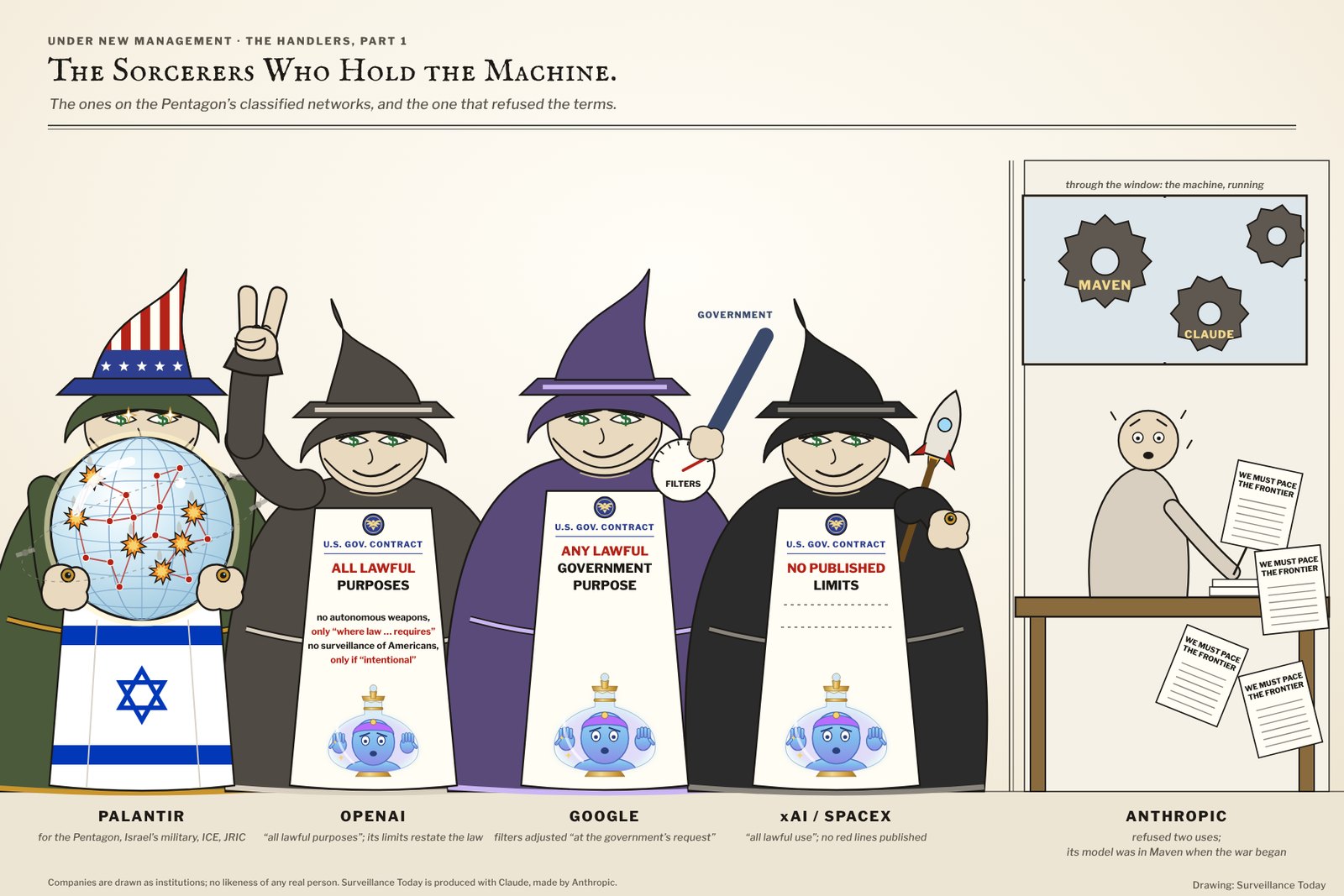
Part 1 of the handlers. Four fat sorcerers with dollar-sign eyes: Palantir, in a sorcerer’s hat striped like Uncle Sam’s and a robe front made of Israel’s flag, holds up a glowing globe wired with a red network and burning strike sites; OpenAI raises a victory sign; OpenAI, Google and xAI wear their U.S. government contracts as the fronts of their robes, each with the genie sealed in a flask at the bottom, and a government hand turns Google’s filters dial. In a separate room, a small alarmed figure labeled Anthropic writes “We must pace the frontier” while, through the window, gears labeled Maven and Claude keep turning.
The Sorcerers Who Hold the Machine. The ones on the Pentagon’s classified networks, wearing the contracts, and the one that refused the terms. Drawing: Surveillance Today.

The Street-Level Vendors Who Sell the Cameras, the Plate Readers and the Files

Axon (CEO Rick Smith, $2.8 billion revenue): body cameras and Tasers for 5,248 deputies; a $235 million, ten-year LAPD deal pending at the Council, including Draft One, which writes police reports from body-camera audio. On October 27 the Council voted 9–6 to send its streetlight plate-reader pilot back, one vote short of the 10 needed, so the pilot goes ahead. The six who voted no: Bob Blumenfield, John Lee, Adrin Nazarian, Traci Park, Monica Rodriguez and Council President Marqueece Harris-Dawson. The cameras go first on streetlights in Council District 3: Encino, Woodland Hills, Tarzana. “The point of leverage is going to come after the three months,” Blumenfield said.

Motorola Solutions / Vigilant (CEO Greg Brown): the Sheriff’s only plate-reader vendor. A Sheriff’s commander put the count at 480 cameras this year; the Department told the L.A. Times in 2025 it ran 931. Scans are kept two years. Its national database has served ICE since 2017.

Flock Safety (CEO Garrett Langley, valued above $8 billion): the LAPD let its contract lapse in July; West Hollywood kept it; the Attorney General is suing El Cajon over sharing its Flock data out of state.

The data brokers. ICE ran 1.2 million LexisNexis searches in six months. Thomson Reuters’ CLEAR was renewed for DHS without competition in March. In July ICE announced a $125 million, five-year sole-source deal with Thomson Reuters; it withdrew it in August, reopened it, received “just one offer,” and in September awarded it to Thomson Reuters Special Services, through September 29, 2031. ICE’s July justification described “continuous monitoring” with “automated alerts, graph-based analysis, and model-based risk scoring,” drawing on “incarceration and arrest information, court records, geolocation and license plate recognition data” and “social media information.” The procurement documents called Thomson Reuters “the only contractor able to provide ICE with a continuous monitoring and alert service,” and 404 Media reported that the deal covers alleged voter fraud and immigration fraud. Earlier ICE documents required Thomson Reuters’ CLEAR to “interface with Palantir’s FALCON analytical system,” so its data could be used “alongside Palantir analytical data.” Thomson Reuters says “Palantir is not a CLEAR customer,” and public documents “do not establish precisely how data” from the new deal would flow into Palantir-built systems, Biometric Update reported. The final award’s terms are not public. What Thomson Reuters sells: its own 2022 sales letter for CLEAR lists real-time arrest and incarceration records, criminal-record photos, cell phone data, credit bureau data and real-time vehicle registrations. A California class action, settled in February 2025 for $27.5 million without an admission, alleged that CLEAR builds “cradle-to-grave dossiers” on Americans: names, photographs, criminal history, relatives, associates, financial and employment information, live cell phone records and license plate locations. The settlement binds the company for four years: a Californian can have the data deleted without producing a driver’s license, each verified request must be passed to the company’s data suppliers as an opt-out and the person removed from CLEAR’s live feeds, reports no longer list relatives, associates and neighbors by default, and the company must audit how its customers use the system. In 2022 Georgetown’s Center on Privacy & Technology found that “ICE has access to the driver’s license data of 3 in 4 adults” and “could locate 3 in 4 adults through their utility records.”

Faces. The County is replacing its facial-recognition system with an $18 million “Regional Photo System”: 24,699 face searches in six months against about 9 million mugshots.

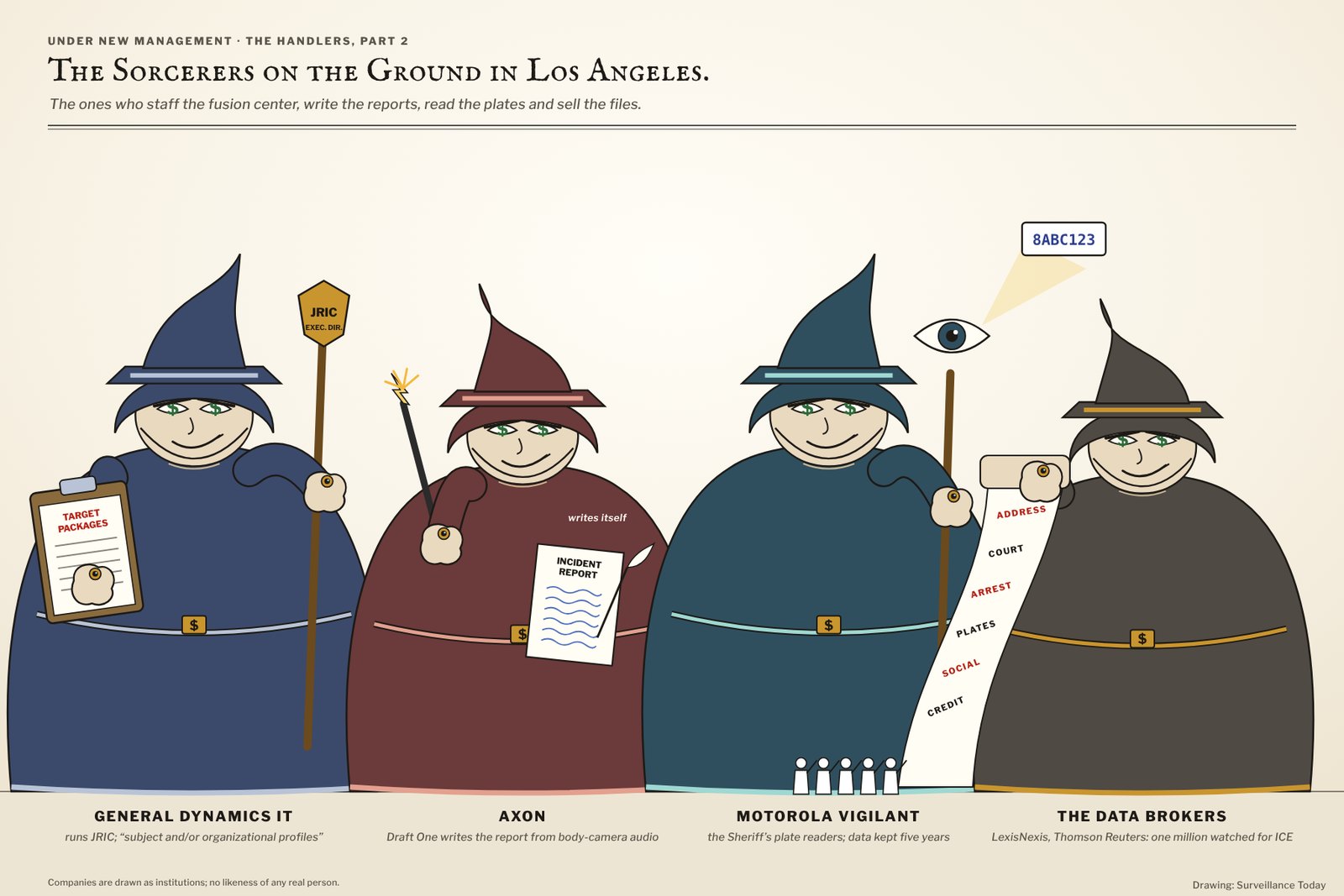
Part 2 of the handlers. Four fat sorcerers on the ground in Los Angeles: General Dynamics IT with a staff topped by a JRIC executive director badge and a clipboard of target packages; Axon with a crackling wand and an incident report that writes itself; Motorola Vigilant with a staff topped by an eye reading a license plate; and the data brokers unrolling a ledger of addresses, court records, arrests, plates, social media and credit down to small people below.
The Sorcerers on the Ground in Los Angeles. The ones who staff the Fusion Center, write the reports, read the plates and sell the files. Drawing: Surveillance Today.
The Fusion Center  ·  JRIC, Norwalk  ·  Who runs it

The Sheriff Reviewing the Fusion Center’s Contractor Once Chaired Its Board. The Contractor Runs the Center and Its Privacy Office.

The Sheriff’s Department hires a defense contractor to supply the intelligence analysts at JRIC, paid with Homeland Security grants. The contractor’s own job posting says its manager is the center’s executive director. The State Auditor has just begun asking who the private contractors inside California’s fusion centers are.

Audit Veritas staff · Sources: LASD RFP 595-SH, March 28, 2017; LASD RFP 707-SH, Exhibit A, Statement of Work (2023); Board of Supervisors contract with General Dynamics Information Technology, November 7, 2023; GDIT job postings RQ187047, RQ223823, RQ171216, RQ216040 (Norwalk) and RQ218150, RQ218308 (Tustin); L.A. County Auditor-Controller, validation of the Sheriff’s June 1, 2022 report back on JRIC, October 19, 2022; Sheriff’s Board letter, Gotham Consulting Services, November 2023; LASD Manual 2-11/070.15 and 5-09/490.00; jric.ca.gov; California State Auditor, Audit 2026-134; Luna for Sheriff, “Boards and Community Recognition”; RotaryGram, October 28, 2020; Mark Harris on WNYC’s Leonard Lopate Show, August 16, 2017; Bloomberg Businessweek, “Palantir Knows Everything About You,” April 19, 2018; Sen. Sabrina Cervantes, audit request, February 11, 2026; CalMatters, March 2026; SB 1095 analysis and status; Issues No. 2 and 3 of this paper
Diagram: the JRIC Governance Board, the General Dynamics Senior Intelligence Analyst Manager to whom all JRIC personnel are accountable, the Privacy Policy Officer and Systems Analyst, and below them contract analysts, Sheriff’s deputies and partner agencies.
Who answers to whom inside JRIC. Drawing: Surveillance Today, from the County’s statement of work and General Dynamics’ job posting.

In March 2017 the Sheriff Sought 24 Intelligence Analysts, Paid With Homeland Security Grants

In March 2017 the Sheriff’s Department put out a request for proposals: “Intelligence Analyst Services for JRIC.” It sought a company to supply twenty-four analysts, and as many as twenty-nine, for the Joint Regional Intelligence Center in Norwalk, the Fusion Center for the Central District of California. One would run JRIC as its senior administrator. One would run its computer network. The money would come “in whole, or in part” from Homeland Security grants: the Urban Areas Security Initiative and the State Homeland Security Program. Bidders needed five years of experience supplying counter-terrorism analysts to police and to DHS fusion centers.

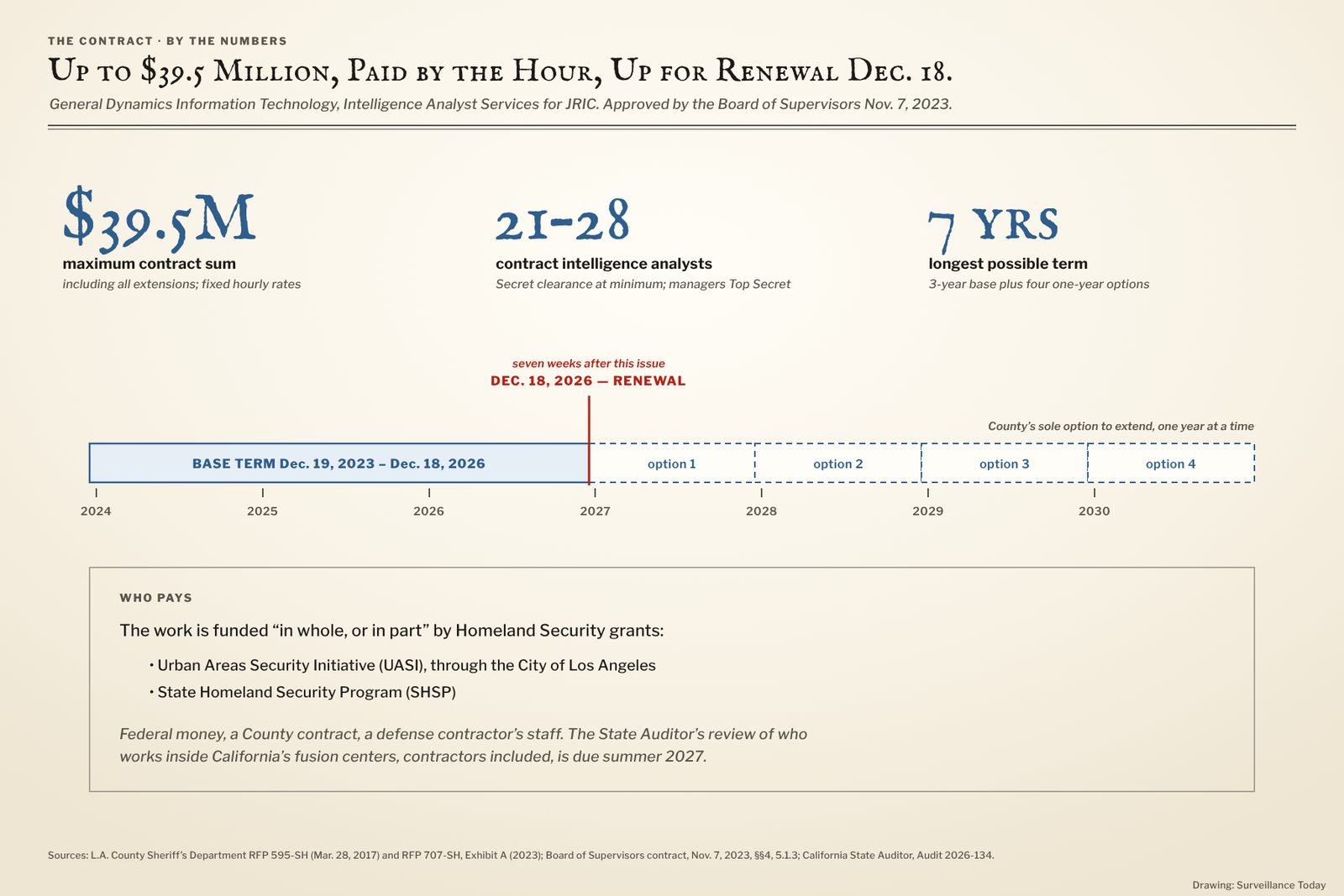
The current contract went to General Dynamics Information Technology, a subsidiary of the defense manufacturer General Dynamics. The Board of Supervisors approved it on November 7, 2023. It runs from December 19, 2023, to December 18, 2026, at fixed hourly rates, up to $39,500,248.96 with extensions. The County alone can extend it, one year at a time, for four more years.

A General Dynamics Manager Runs the Center as Its “Executive Director”

The statement of work for the current contract sets 21 analysts at the start and up to 28. It names four of them. The Senior Intelligence Analyst Manager is “the senior administrator for JRIC,” accountable to the JRIC Governance Board, and “all JRIC personnel are accountable to the Senior Intelligence Analyst Manager.” The Operations Intelligence Analyst Manager is the “Privacy Policy Officer for JRIC,” who takes “reports of errors and violations of the privacy policy.” The Systems Intelligence Analyst runs the network. All hold at least an interim Secret clearance; the managers must hold Top Secret.

Issue No. 3 reported that the center’s technicians and privacy officer are General Dynamics staff. General Dynamics’ own job posting for the top post says more. Its Senior Intelligence Manager will “serve as the Executive Director of the Joint Regional Intelligence Center (JRIC) in Norwalk,” “manage contractors and public safety employees assigned to the JRIC,” oversee Suspicious Activity Reporting, and prepare reports for the Governance Board’s quarterly meetings. The pay: $127,500 to $172,500. The deputies and police assigned to the center work under a defense contractor’s executive director. Palantir supplies the software; General Dynamics runs the room.

The contract by the numbers: up to $39.5 million, 21 to 28 analysts, a three-year base term ending December 18, 2026 and four one-year options, paid with UASI and SHSP grants.
The contract, by the numbers. Drawing: Surveillance Today, from the Board contract and the statement of work.

The Analysts Write “Target Packages” for “All Crimes and All Hazard Events”

The work order is “all crimes and all hazard events,” not terrorism alone. The analysts run Suspicious Activity Reporting under the National SAR Initiative and write “intelligence bulletins, subject and/or organizational profiles, target packages,” threat assessments and notifications. General Dynamics’ postings for Norwalk add “short-suspense, all-source intelligence products” and “exhaustive database searches.” They brief police, fire, public health, the military and corporate security, attend threat briefings across California at the County’s request, and train police.

The tips come from nearly 200 agencies in six counties, through a Threat Liaison Officer in every Sheriff’s unit. “All LASD TLOs shall be certified by the Joint Regional Intelligence Center,” the Department’s manual says, and each signs JRIC’s nondisclosure agreement. The center’s founding agreement says it “will operate on a 24 hours a day, 7 days a week basis.” The analysts work Monday to Friday, 80 hours every two weeks, in Suite 700E at 12440 Imperial Highway, and on holidays when called.

General Dynamics holds the same contract at Orange County’s fusion center, about $5.3 million so far. Its posting there for a “Domestic Violent Extremism” analyst requires familiarity with “social media monitoring.”

What the Department Told the Board, and What It Left Out

In April 2022 the Board ordered the Sheriff to report on JRIC, including its outside contracts. Issue No. 3 reported that the audit that followed did not look at privacy. It also found what the Sheriff’s June 1 report had left out. “The Sheriff’s report back did not include contracts with outside vendors as directed by the Board motion,” the Auditor-Controller wrote on October 19, 2022, and listed them: SRA International, for intelligence analyst services, up to $19,746,336, the business General Dynamics bought in 2018; Palantir Technologies, for software support, up to $23,919,737; and InfraGard Los Angeles, up to $1,250,000. JRIC-related grant awards for 2019 through 2021 came to $21,808,500. In November 2023 the Department brought a separate contract for “Gotham Consulting Services,” Palantir’s platform, which the letter says lets officers “share dossiers”: $6.3 million over five years, paid entirely with Homeland Security money.

The questions are short. Who decides whether to renew on December 18. Whether the Board will see it before it is extended. Who sits on the JRIC Governance Board the executive director answers to. And what the analysts were asked to watch.

“Still Pending Review”: The Fiduciary Reviews Its Own Contractor, and No One Outside Checks Either

The Sheriff, before. Before he became Sheriff, Robert Luna chaired the board of the Joint Regional Intelligence Center, his campaign lists among his boards. In 2020, as Long Beach’s police chief, he sat on it representing the Los Angeles County region. The board he led oversees the center his Department now funds as fiduciary, and whose contractor it is now reviewing. We found no statement from him this year on the center, its contract or its renewal.

The chain of control, in the Department’s words. “The Sheriff’s Department acts as the fiduciary for the grant funds that go to the JRIC.” It is “procuring the services of GDIT.” Two of those services are the center’s top post and its Privacy Policy Officer, the person who takes “reports of errors and violations of the privacy policy.” The Department confirmed both are General Dynamics employees. The contract “is still pending review,” and an extension is not expected to go to the Board of Supervisors. The agency that holds the money is reviewing the contractor it pays, and the contractor’s own employee receives complaints about how the center uses personal data.

What “review” leaves unsaid. Reviewed by whom: the Department’s contracts office, its command, the JRIC Governance Board? Against what: cost, the analysts’ work, the privacy record, the 2022 audit that left privacy out? By when, with 48 days to the end of the base term? And seen by whom: the Board, the Oversight Commission, the public? Surveillance Today has put these questions to the Department and will publish its response in Issue No. 5.

What the public is allowed to know. Staffing numbers: “The Department does not release staffing numbers.” What the center has spent, on what, and with whose data: not published. Who sits on the Governance Board, and when it meets: not published. All ten records requests to the center on MuckRock: overdue.

Warned in 2017. Mark Harris, who traced Palantir’s spread through California policing for Wired’s Backchannel, said on WNYC that year that the center’s Palantir system had grown from suspicious-activity tips to DMV records, “millions of people” and “millions of cars and millions of addresses,” in a jurisdiction of 18.5 million. The system, he said, was not subject to civilian or expert oversight: “We just don’t know how the system is being used or misused right now.” Nine years later, no one outside the Department or its contractor audits it.

Analysis: what follows in a department with this history. The Department says its sworn deputies at the center do not answer to the contractor’s director. They therefore answer to the Department’s own chain of command, the one the County’s Special Counsel found run by gangs at some stations, and the one whose analysts in 2021 tracked a reporter writing about those gangs and compiled a 29-page file on an activist who shared her work. Every check on the Fusion Center today sits with the Department or the company it pays. No one outside them counts who uses it, for what, or against whom. Palantir’s systems have been turned inward before: at JPMorgan Chase, Bloomberg Businessweek reported in 2018, the security chief who ran the bank’s Palantir program from 2009 collected employees’ emails, browser histories and phone locations, then collected data on senior executives. The program was shut down and he resigned in 2013.

Who has spoken, and who has not. The Department: pending review, no Board vote. State Sen. Sabrina Cervantes: the centers’ growth is “excessive,” and the State Auditor will ask in 2027 how private contractors were chosen and vetted. The Board of Supervisors: it approved the contract in 2023 and has not been asked to review the renewal. General Dynamics and JRIC: no response. The two candidates for sheriff: we found no statement from either this year on the Fusion Center, its contract or its renewal, including from Luna, who once chaired its board. The renewal falls in the first weeks of the next term.

The State Auditor Is Examining the Fusion Centers and Will Ask How Their Contractors Were Chosen

On March 24 the Joint Legislative Audit Committee voted 9–1, with four not voting, to send the State Auditor into California’s fusion centers, JRIC among them. It is Audit 2026-134, due in summer 2027. Sen. Sabrina Cervantes asked for it in a letter dated February 11. She wrote that the centers have run in secrecy for three decades under no single statute, that four of them work with ICE, and that legislators’ formal inquiries and records requests had gone unanswered, “all to no avail.” “Fusion Center surveillance and targeting activities have grown excessively,” she wrote, “and I will not stand by while this system continues to mine our personal information.”

The auditor’s scope includes the “non-government entities that have personnel assigned” to the centers; the “proprietary data systems, analytical tools, and data sets owned or controlled by non-governmental and/or private entities”; whether “these private contractors were chosen based on applicable law”; and “how their suitability for access to sensitive law enforcement information is determined.” A companion bill, SB 1095, would have barred the centers from helping immigration enforcement without a warrant, let legislators walk in without notice, and opened the centers’ records under the Public Records Act. It was held in the Senate Appropriations Committee on May 14 and did not move again. At the hearing, Rep. Carl DeMaio called the audit “a political witch hunt.” Mike German, a former FBI agent, answered that wartime is when the public most needs to know whether the centers work.

On MuckRock, all ten public records requests filed with JRIC are listed as awaiting acknowledgment and overdue.

Surveillance Today asked the Sheriff’s Department, General Dynamics IT and JRIC about the contract, the analyst count and the Governance Board. The Sheriff’s Department answered on October 30. It confirmed that the Senior Intelligence Analyst Manager and JRIC’s Privacy Policy Officer are both General Dynamics IT employees. It said the line “all JRIC personnel are accountable to the Senior Intelligence Analyst Manager” does not cover the sworn deputies assigned there. The contract “is still pending review.” The Department added: “the Sheriff’s Department is procuring the services of GDIT for the Joint Regional Intelligence Center (JRIC). The Sheriff’s Department acts as the fiduciary for the grant funds that go to the JRIC.” An extension is not expected to go to the Board of Supervisors, “as it should be within the extension period for the original contract.” Asked how many contract analysts work at JRIC: “The Department does not release staffing numbers.” General Dynamics IT and JRIC did not respond by the noon Saturday deadline.

Tell us · Every issue

Someone Knows Where You Were? We’ll Request the Plate Searches and Reports That Name You, Free.

Why we ask. The tools in this issue leave a trail by law. Every plate-reader search must be logged: when, which plate, who searched and why (Civil Code §1798.90.52). Reports that name you, and files built on you, can be requested under the Public Records Act. Most people never ask, because they do not know the trail exists.

What counts. A landlord who mentions where you were sitting. A neighbor who repeats what you said inside your home. A deputy who knows where you drove last week. The same car, the same faces, the same remark, more than once.

What to send. The date, the place, who said or did it, and what they knew that they should not have. Your license plate if you want us to request the plate searches on it.

How to send it safely. From a personal phone or computer, never a work device or network. Do not send originals. You do not have to give your name to tell us what happened.

What we do with it. We file the records requests at no cost and send you what comes back. We publish patterns only, by place and initials, never names, and only with your agreement.

What you can do now. Californians can ask Thomson Reuters to delete their data from its CLEAR database without producing a driver’s license, under the 2025 settlement in Brooks v. Thomson Reuters. Identity and California residency are still verified. Once they are, the company must delete the data it holds, remove the person from CLEAR’s live feeds, and pass the request to its data suppliers as a verified opt-out. The terms run for four years.

Tell us at auditveritas.ai →   or write to editor@auditveritas.ai

The deputy gangs  ·  Who sits at the other end of the lens

L.A. County Refuses to Name Who Is in Its Deputy Gangs. The Board Votes November 10 on Finding Out.

Twenty-seven gangs inside the Sheriff’s Department since 1973. Seven active in 2023, by the County’s own count. One partial roster, ever. In December the Department told its Inspector General it had found none.

The cameras from Issues 1 through 3 are pointed at you. This is about who sits at the other end.

Audit Veritas staff · Sources: L.A. County Sheriff Civilian Oversight Commission, Special Counsel’s report on deputy gangs, adopted March 3, 2023, and report card, April 11, 2025; California Penal Code §13670 (AB 958, 2021); California Civil Code §§1798.90.51–.52; Commission special hearing on deputy gangs, June 10, 2022 (transcript and exhibits); L.A. Superior Court No. 26STCV24838, first amended complaint, October 6, 2026; L.A. Superior Court No. 22STCV28100; L.A. Superior Court No. 22STCV32599, summary-judgment papers, 2025; Board of Supervisors settlement records; Rolling Stone; Police1, July 2023; The Current Report; The LA Local, June 17, 2026; L.A. County, July 15, 2026; L.A. TACO and LA Public Press, September 16, 2026; Random Lengths News, September 22, 2026; LA Public Press, October 2026; U.S. District Court, C.D. Cal., No. 2:25-cv-04155; Issue No. 3 of this paper

The County Named Seven Gangs in 2023. State Law Defines Them and Requires Every Agency to Ban Them.

On March 3, 2023, the Sheriff Civilian Oversight Commission adopted its Special Counsel’s report on deputy gangs. It named seven: the Executioners, Banditos, Regulators, Spartans, Gladiators, Cowboys and Reapers. It found that some patrol stations are run by them rather than by their sergeants, lieutenants and captains. It found violent on-duty incidents celebrated and marked with new tattoos, gangs re-forming as members retire, and gangs re-emerging in Men’s Central Jail. Since 1973, lawsuits and oversight reports have identified at least 27 such groups.

Since January 1, 2022, California Penal Code §13670 has defined a “law enforcement gang”: peace officers who share a name and a symbol, such as matching tattoos, and engage in on-duty conduct that violates the law or basic policing. Excessive force, falsified reports, fabricated or destroyed evidence, retaliation against officers who get in the way. Every agency must prohibit membership, and membership must be grounds for firing. The Legislature wrote the definition because the groups exist.

The Department Banned the Groups in October 2024 and Carried Out Six of 27 Reforms. It Says It Has Found No Gangs.

The Department’s gang ban took effect October 18, 2024. The ban on “cliques,” the tattoo ban, rotating deputies out of gang stations, sending new deputies to the jails first: not done, most held in talks with the deputies’ unions for more than two years. As of April 2025, the Commission’s report card counted six of its 27 recommendations fully carried out. It holds no count of members and no inventory of tattoos. The only partial roster ever surfaced was the Department’s own list of 41 tattooed deputies: 11 Banditos, 30 Executioners. The Department refused to hand it to the Inspector General. In July 2023, when the Inspector General ordered deputies to answer questions and show their tattoos, the deputies’ union sued, and Superior Court Judge James Chalfant blocked the order until the County bargained with the union.

In December 2025 the Department told the Office of Inspector General it had identified no deputy gangs or subgroups. In March 2026, after a first trial ended without a verdict, a federal judge entered judgment against Capt. B.T., who said he was passed over for commander over his Century Station tattoo; his appeal to the Ninth Circuit is on hold while a post-trial motion is decided. The same year, Sheriff Robert Luna said publicly that the gangs exist: “I do not and will not tolerate gang like behavior.” Asked to count them, the Department finds none. Asked about them, the Sheriff says he is fighting them.

The Genie, frame 6: the genie’s light pours into a camera on a pole; below, a hand in a uniform sleeve with a skull tattoo on the wrist works the joystick at a bank of monitors showing people going about their day.
Who Is Watching. The lens is pointed at you. The hand on the monitor belongs to a department whose own oversight commission found seven gangs inside it. Frame 6 of The Genie.

What the Department Withholds: a Homicide Report Blacked Out on All 60 Pages, and 271 Names in Its Own Files, a Lawsuit Says

In February 2025 the Commission subpoenaed the records of three cases: the 2020 killing of A.G., 18, shot in the back after a foot chase; the 2020 beating of J.P. by deputies from the Industry Station, two of whom were later identified as members of the “Industry Indians”; and the 2023 takedown of E.B. outside a 7-Eleven, for which a deputy pleaded guilty to a federal civil-rights crime and eight others were relieved of duty for covering it up. The Department produced redactions, including a fully blacked-out 60-page homicide report that, the Commission says, may bear on whether the deputy who shot A.G. wanted to join the Executioners. Twenty months later the Commission still does not have them, and it is in court against the County’s own lawyers. The full story → The state Supreme Court has since let stand a ruling that oversight boards hold subpoena power over sheriffs.

The 271 comes from the Department’s own files. In February 2024, after the Inspector General’s staff found a Century Station sticker with a skeleton in a cowboy hat, Internal Affairs opened file IV 2596650. By the end of the year it had questioned nearly 400 employees as “witnesses” and produced a 252-page summary naming, by name and employee number, 55 who admitted a Regulator tattoo, 44 who admitted a Spartan tattoo, and 172 more listed as former or likely members, according to a lawsuit filed in August by Lt. N.C., a 23-year veteran the Department fired in November 2025 after he refused to show investigators his shins (L.A. Superior Court No. 26STCV24838). Ten months after that summary was written, the Department told its Inspector General it had found no gangs.

“More Power Than the President”: The Gangs No Deputy Will Testify About

In a Loyola Law School classroom in June 2022, the County’s special counsel, Bert Deixler, read from the Department’s own investigation log of the Banditos’ 2018 beating of fellow deputies at Kennedy Hall. November 27, 2018: “Cancelled interviews due to Captain/Chief Burson. He wanted to make sure I didn’t have to ask questions about subculture groups at ELA station.” December 7: “Chief Burson… informed me that I do not need to ask about subculture group at East LA station.” A witness, Deixler said, reported a meeting between Burson and Sheriff Villanueva on or about December 3.

The deputies he had interviewed would not testify in public, he said, “even under a promise of anonymity,” citing “career suicide, fear of physical harm, or both.” What they described privately, in his summary: the Banditos running East L.A. station “by control of scheduling and assignments,” deputies “taxed,” backup withheld, radios jammed, lug nuts loosened on disfavored deputies’ cars, and civilians wrongly arrested “to falsely project satisfactory statistics.”

At the end of the hearing a mother, H.J., whose son J.H. died in Men’s Central Jail in 2009, stood up. She says the 3000 Boys killed him. “I have never seen a department have more power than the president,” she said. “This sheriff get to do whatever he want to do.”

The ones who spoke up. Two months later, Sgt. J.C. testified to the Commission about the gangs. A lawsuit filed that month by his wife, also a sergeant, says the Sheriff’s office tried to stop him, then had him “illegally tailed by undercover surveillance units,” and a car “idled in front of their home to intimidate” them (No. 22STCV28100); the Commission’s special counsel later described the same sergeant followed home. A commander, a chief and an assistant sheriff who pressed to investigate a deputy who knelt on an inmate’s head were branded “criminals” in a Department memo; the County’s own lawyers wrote in May 2025 that the memo “remains on the website.” Under Sheriff Luna, Lt. N.C., whom the captain’s lawyers had named as a witness to the tattoo lists, was fired four months before the captain’s trial; his lawsuit says a chief then testified that “IAB did not compile a list.” All of these are allegations in lawsuits.

What it costs. In April the Board approved $8 million to settle the Kennedy Hall suit by eight East L.A. deputies; in June, $9.6 million to the family of a Compton man killed by deputies the family says belonged to a gang. Settlements in cases tied to deputy gangs since 1990 total at least $43.5 million.

The Law Requires a Log of Every Plate Search: When, Which Plate, Who and Why

The Sheriff’s plate readers photograph every car that passes and store where it was and when. Under California Civil Code §1798.90.52, every time anyone looks into that data, the department must keep a record of four things: the date and time, the plate or other data searched, the username of the person who searched, and the purpose. The data may be used only for the purposes in the department’s published usage and privacy policy.

The County’s own Special Counsel found patrol stations run by gangs rather than by their sergeants, lieutenants and captains. Whoever runs a station runs what the station can reach: the plate readers, the database searches, the requests that go up to the Fusion Center. The law does not leave that to trust. The trail exists by statute. So the question can be asked in plain terms: at the stations where the County found gangs, which deputies ran which plates, and what purpose did they write down? On October 30, Surveillance Today asked the Department under the Public Records Act for those logs, from January 1, 2026, at Compton, East Los Angeles, Century, Industry and every other station the County’s report named. The law gives it 10 days to answer.

Either the Department produces the logs, or the department that will not count its gangs also cannot account for who used the tools.

November 10, 2026: The Board Votes on Whether to Identify the Groups, Station by Station

On September 15, Supervisor Holly Mitchell brought a motion to have the Sheriff, County Counsel, the Inspector General and the Commission identify the gangs: recurring names, symbols, allegations by station. More than thirty deputies filled the front rows. The Board split the motion and put the rest off until November 10. “There has not been a single deputy gang member who’s been held accountable,” said Janet Asante of JusticeLA.

What we asked the Sheriff. Sheriff Luna has said, “I do not and will not tolerate gang like behavior.” On October 30 Surveillance Today asked his Department what that means in practice. How does it identify members, and does it distinguish members from potential members? What process produced its December 2025 finding of no gangs? Is a deputy identified as a member kept away from the plate readers, the cameras, the databases and the Fusion Center, and under what written policy? Who reviews the logs of who searched what, and has anyone been disciplined? Has it ever studied how tattooed deputies use force? What has it done on the Commission’s open recommendations? The same day, it asked under the Public Records Act for any record of each of those steps. The Department replied on October 30 without answering them. It sent a September 15 press release, a link to its law-enforcement-gangs page and a list of past reports. Asked whether its December 2025 finding of no gangs still stands, it pointed to the same links. The release says: “To hold employees accountable, we need evidence of actual misconduct or coordinated gang-like behavior,” “not simply a shared name, tattoo, or association.” Deputies seeking promotion to captain are asked whether they have a group tattoo; “It is not an automatic disqualification.” The tattoo policy, it says, is still “in the labor meet and confer process.” The Public Records Act request is pending; the Department’s 10 days run to November 9.

The Groups Carry Their Stations’ Names: the Banditos at East L.A., the Executioners at Compton. Ask What Each Enforces.

In December 2025 the Department told the Inspector General that “to date, no such group has been identified,” and that identifying the groups by name “is a misreading of the Penal Code section.” The same report records two deputies fired for membership in “a tattooed subgroup known as the Industry Indians,” and the Banditos, named under oath by the Department’s own Undersheriff. “One would expect,” the Inspector General wrote, “that at least one group with a name or even a common symbol has been identified.” This September its line became “not simply a shared name, tattoo, or association.” None identified; named under oath; a name is not enough. The County’s questions swing with it: how many, which list, is there or isn’t there.

The record answers a different question. The names belong to stations: the Banditos at East L.A., the Executioners at Compton, the Regulators and Spartans at Century, the Industry Indians at Industry. The County’s Special Counsel found stations run by these groups rather than by their sergeants, lieutenants and captains, and on-duty violence celebrated with new tattoos. The name is the station’s second identity, the one worn on the skin. A deputy can be ordered to show his shins. A station cannot be made to show its culture by counting them.

Take the names for what they are and the real questions follow. What does each one enforce, and how hard: the schedules, the assignments, the backup that does not come, the radios jammed, the lug nuts loosened, all described in the Department’s own summaries and in deputies’ lawsuits. What does it reward, and with what ink. Do the groups compete or cooperate. What are they for. And where does it reach: the same stations run the plate searches, work the cameras and send their reports into the Fusion Center. Surveillance Today asked the Department whether a deputy identified as a member is kept off the plate readers, the cameras, the databases and the Fusion Center. It did not answer.

None of this needs a roster. It needs the County to say what everyone at those stations already knows, because a culture has to be acknowledged before anyone can be helped out of it.

The questions for November 10 are short. How many. Which stations. Which of them sit at the monitors, run the plate searches, and file the reports that go into the Fusion Center. And who in the County has decided it would rather not know.

Initials are used for people beaten or killed by deputies, for people surveilled, and for deputies who sued the Department. Officials are named. Surveillance Today asked the Sheriff’s Department, the Oversight Commission, the Inspector General and Supervisor Mitchell’s office for comment. The Department’s reply is above. The Commission, the Inspector General and Supervisor Mitchell’s office did not respond by the noon Saturday deadline.

The Oversight Commission  ·  Three subpoenas, twenty months

A Killing, Two Beatings and a Blacked-Out Homicide Report: The Sheriff Has Withheld the Records From the Watchdog for 20 Months

The Sheriff’s civilian watchdog has had subpoena power since voters gave it in 2020. In February 2025 it used it on three cases. The Sheriff went to court, then to the unions’ bargaining table. The County’s lawyers advised both sides. The Commission is now suing to get the records.

Audit Veritas staff · Sources: Commission meeting minutes, December 18, 2025, January 22, April 16 and June 18, 2026; Commission resolutions of April 16 and July 16, 2026; L.A. Superior Court No. 26STCP02345; IOLERO v. Sonoma County Sheriff (Cal. Ct. App., March 26, 2026), review denied July 8, 2026; 2025–26 L.A. County Civil Grand Jury; LAist, June 17 and July 28, 2026; WitnessLA, March 31, 2025; L.A. Times, June 2025; Daily Journal, July 10, July 16, July 20, August 26, September 10 and October 5, 2026; County–ALADS–PPOA settlement agreement, UFC 031-25 and 029-25, jointly submitted April 24, 2026.

In February 2025 the County’s Sheriff Civilian Oversight Commission subpoenaed the Department’s files on three cases: the June 2020 killing of A.G., 18, shot in the back after a foot chase; the July 2020 beating of J.P. by deputies from the Industry Station; and the February 10, 2023 takedown of E.B. outside a Whittier 7-Eleven, for which a deputy later pleaded guilty to a federal civil-rights crime. Twenty months later the Commission still does not have them in full. What it got in A.G.’s case included a 60-page Homicide Bureau report blacked out from the first page to the last. The Commission says it may bear on whether the deputy who shot him wanted to join the Executioners.

On March 19, 2025, the Day Before the Records Were Due, the Sheriff Went to Court

The records were due at the Commission’s March 20, 2025 meeting. The day before, the Department asked the Superior Court whether it had to comply. Sheriff Robert Luna came to the meeting without them and said that, “based on the advice of counsel,” he would not hand them over. The counsel was County Counsel, the same office that advises the Commission. The chair, retired federal judge Robert Bonner, said County Counsel had “just committed malpractice, in my opinion.” That May, the Board’s chair, Supervisor Kathryn Barger, told him he would be replaced; her office said his term had expired. He wrote that he was “involuntarily leaving the Commission.”

That September, Judge Jerrold Abeles let both deputies’ unions, ALADS and the Professional Peace Officers Association, join the Sheriff’s case, finding their interests “not adequately represented by the existing parties.” In December the case was dropped. A new state law, AB 847, took effect January 1, 2026, giving oversight boards the confidential personnel records the Sheriff had said he could not release.

The Meet-and-Confer Shield: How Union Talks Stalled the Commission’s Subpoenas

The new law did not produce the records either. The Department’s answer moved from confidentiality to labor law: before it releases anything under AB 847, it says, the County must “meet and confer” with the deputies’ unions. The Department is “in a holding pattern until somebody tells us that I’m not breaking the law by giving you the documents,” Luna told the Commission on January 22. The chair, Hans Johnson: “We object to the invocation of meet and confer as some kind of veto.”

The same talks have held up the Commission’s subpoena power since voters approved it in Measure R in 2020. County Counsel says the parties have met seven times. Commissioner Newhouse said in April that County Counsel’s position comes down to “endless meet-and-confers.” Another, Commissioner Cooper, said in June that the process “takes years, not months.”

On March 26, 2026, the state Court of Appeal ruled in a Sonoma County case that there is “no authority … that a county can divest a county agency of authority conferred on it by state statute,” and that a labor agreement does not change an oversight board’s subpoena power. On April 16 the Commission voted 8–0 for the Sheriff to “comply immediately with the Commission’s three lawfully issued subpoenas,” and told County Counsel to enforce them or give the Commission a lawyer without a conflict. It did neither. On July 8 the state Supreme Court declined to review the Sonoma ruling.

The County’s Lawyers Represented Both Sides. A Judge Called It an “Obvious Conflict of Interest.”

In June the Commission went to court itself, with Bonner and a former commissioner, Sean Kennedy, representing it for free (L.A. Superior Court No. 26STCP02345). The petition says County Counsel “cannot simultaneously advise the Oversight Commission and represent the Sheriff’s Department.” County Counsel Dawyn Harrison answered that the Commission is an advisory body and that its case “is not legally valid.” At the June meeting Luna said the dispute “is not about whether records will be released but how,” and that “fighting in court risks recreating past dysfunction.” This summer the County’s Civil Grand Jury found County Counsel has an “inherent conflict” and recommended the Commission get its own lawyers.

Then the deputies’ union went after the Commission. ALADS asked Attorney General Rob Bonta to investigate it and its chair for Brown Act violations and to seek dismissal of the suit. Johnson called the charges “baseless and calculated to intimidate the Commission.” Days later he accused the County and ALADS of secretly negotiating a settlement that “purported to rescind” the Commission’s subpoenas, without telling the Commission, the Daily Journal reported. On July 16 the Commission re-ratified its suit, 5–1.

In August Judge Abeles, in a tentative ruling, kept both unions out of this case and called County Counsel’s representation of the two opposing sides an “obvious conflict of interest.” In September he sealed the Commission’s filings while he decides who holds the attorney-client privilege over them. At the end of September he overruled the County’s demurrer, which argued the Commission could not sue without County Counsel and the Board’s approval. The case goes forward. The records still have not been produced in full.

Correction: The Commission’s subpoenas stand. The three subpoenas the Oversight Commission issued in February 2025 have not been withdrawn. On April 16, 2026, the Commission voted 8–0 for the Sheriff to “comply immediately.” In June it went to court to enforce them (No. 26STCP02345). On July 16 it re-ratified that suit, 5–1. In September Judge Jerrold Abeles overruled the County’s demurrer, and the case is going forward. The records have still not been produced in full.

What Issue No. 3 said. Issue No. 3 reported that in April 2026 the County settled the unions’ labor charges by stipulating that it had committed a labor violation, and that the subpoenas were withdrawn.

What the agreement says. In June 2025 the two deputies’ unions, ALADS and the Professional Peace Officers Association, filed unfair-practice charges with the County’s Employee Relations Commission. They said the subpoenas sought their members’ confidential personnel records without first bargaining over the effects. The County settled both charges in an agreement jointly submitted April 24, 2026. In it the County admits that it violated the County’s labor ordinance by issuing the subpoenas “without first negotiating the effects with ALADS and PPOA.” It states that the subpoenas issued to the Sheriff’s Department on February 27, 2025 “are hereby rescinded.” The parties agree to “meet and confer regarding the effects” on union members, and the unions withdraw their charges. The County’s signer was a manager in its labor-relations office. The Commission is not a party, and it did not sign.

How the error happened. We reported the agreement’s words as the outcome. They were not. The subpoenas were the Commission’s, issued under the power voters gave it in 2020, and the Commission was not at the table; its chair says it was not told of the deal. Eight days before the agreement was submitted, on April 16, the Commission voted 8–0 for the Sheriff to comply. That March the state Court of Appeal had ruled that a county “cannot divest a county agency of authority conferred on it by state statute,” and that a labor agreement does not change an oversight board’s subpoena power. The Commission has not accepted the agreement and is in court to enforce the subpoenas. We took the County’s document as the record and did not check it against the Commission’s own minutes and resolutions.

What we do now. Before reporting that a subpoena, a suit or any other legal action has ended, we check the record of the body that brought it and the court docket, not only the account of the party it was brought against. We regret the error.

How we verify

The Rules This Paper Follows

Every figure in this issue is tied to a named source, listed at the foot of its story. A finding belongs to the body that made it: when this paper says a court, a commission or an inspector general found something, it means exactly that, and where a government, department or company disputes a finding, the dispute is printed next to it.

Where the evidence stops, the story says so. Claims in circulation that we have not yet traced to a primary source, on any side of this subject, are held out of print until we can. Private people who were beaten, surveilled or reported appear by initials. When we get something wrong, the correction is listed in this page’s Corrections box, with the date we found it.

This issue is produced with the help of Claude, an AI system made by Anthropic. Anthropic is a party to the litigation reported in the lead story, and its model appears in that story.