Front page · Election 2026 · Counts as of Friday night, November 6, 2026
Democrats Took the Senate, the House and Most Governorships. The Court Approvals Behind Section 702 of the Foreign Intelligence Surveillance Act Run Out About Two Months After They Take Office.
On November 3, 2026, Democrats won control of the Senate, the House and most governorships, including Senate seats in states Donald Trump carried by double digits two years earlier. The party ran on the cost of living. House Minority Leader Hakeem Jeffries summed up its strategy the next day: “We ran on affordability, we won on affordability.”
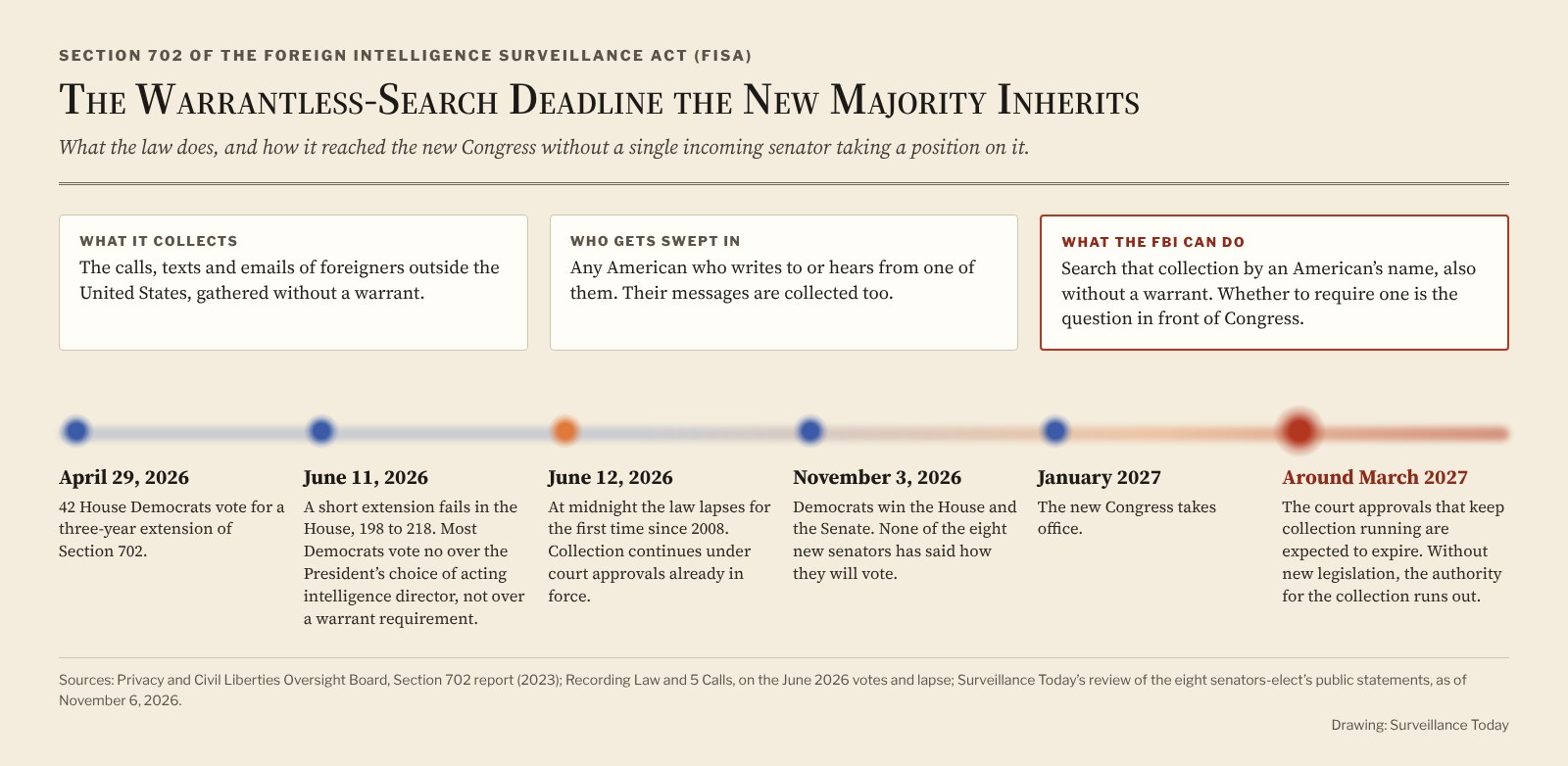
The new Congress also inherits three decisions about how far the government reaches into Americans’ private lives. The first is Section 702 of the Foreign Intelligence Surveillance Act (FISA). It lets intelligence agencies collect the communications of foreigners abroad, and Americans’ calls, texts and emails to and from them are collected with them. The FBI can then search that collection by an American’s name without a warrant. The law lapsed in June; the court approvals that keep collection running are expected to expire around March 2027.
The second is ICE’s use of local police to search Flock Safety’s national plate-reader network, more than 4,000 times, without a contract. The third is the Pentagon’s order that AI vendors accept “any lawful use” of their models. Each reaches anyone who sends a text or drives a car, in either party. None appears in the House Democrats’ first-100-hours plan, and not one incoming senator has said how they will vote on Section 702.
In Los Angeles, City Councilmember Nithya Raman unseated Mayor Karen Bass, and Sheriff Robert Luna won a second term. The Joint Regional Intelligence Center (JRIC), the Sheriff’s Fusion Center in Norwalk, where the Department shares intelligence with the FBI and Homeland Security, was on no ballot.
54+Senate seats for Democrats, up from 47. Mississippi and Alaska are still counting.
250+House seats Democrats are on track for, the largest House majority since 2008.
29+Governorships led by Democrats. Kansas is still counting.
Around March 2027When the court approvals that keep Section 702 collection running are expected to expire.
Still being countedMississippi Senate. Colom (D) leads Hyde-Smith (R) by 2,574 votes, by the AP’s count; affidavit and mailed ballots remain. Mailed ballots are due November 10, 2026, and counties certify by November 13.Alaska Senate. Peltola (D) leads Sullivan (R) by about 600 first-choice votes with about a quarter of ballots uncounted. The count closes November 18, 2026; ranked-choice tabulation follows if no one has a majority.Kansas governor. Holscher (D) leads Masterson (R) by just over 7,000 votes; provisional ballots remain, and the AP has not called the race.
Front page · Election 2026 · Washington · Los Angeles
Democrats Won the Senate, the House and Most Governorships on Prices. Not One of the Eight New Senators Has Said How They Will Vote on Section 702 of the Foreign Intelligence Surveillance Act, Whose Court Approvals Expire Around March 2027.
You Voted on Gas and Groceries. Did You Also Decide Whether the FBI Can Search Your Texts Without a Warrant?
Audit Veritas staff · Published Sunday, November 8, 2026 · Sources linked in the text and listed at the end
Democrats Took the Senate, the House and Most Governorships
On November 3, 2026, Democrats took the Senate, the House and a majority of governorships. They won Senate seats in states Donald Trump carried by double digits two years earlier. Counts below stand as of Friday, November 6, 2026; races still being counted are marked.
Office
Result
Flipped to Democrats
Still uncalled
Called by
Senate
Democrats hold at least 54 seats, up from 47
7 seats: Texas, North Carolina, South Carolina, Ohio, Kansas, Iowa, Maine
Democrats at 29, Republicans at 20, by MultiState’s count on November 5; on November 7 the AP projected Democrat Jonathan Kreiss-Tomkins the winner in Alaska
5 called: Texas, Georgia, Ohio, Iowa, Nevada
Kansas: Cindy Holscher leads Ty Masterson by just over 7,000 votes (KCTV5)
Where Democrats took seats from Republicans, as of Friday night, November 6, 2026. Drawing: Surveillance Today.
The Senate seats that changed hands. CBS News projected all seven on election night or early Wednesday:
Texas: James Talarico defeated Ken Paxton, who had taken the seat’s Republican nomination from John Cornyn.
North Carolina: Roy Cooper defeated Michael Whatley for the seat Thom Tillis left open.
Ohio: Sherrod Brown defeated the appointed senator, Jon Husted.
Maine: Troy Jackson unseated Susan Collins.
Kansas: Adam Hamilton unseated Roger Marshall.
Iowa: Josh Turek defeated Ashley Hinson for Joni Ernst’s open seat.
South Carolina: Annie Andrews defeated the appointed senator, Darline Graham.
In Mississippi, Democrat Scott Colom led Senator Cindy Hyde-Smith by 2,574 votes Friday evening, November 6, by the AP’s count, with affidavit and mailed ballots outstanding; mailed ballots are due November 10 and counties certify by November 13 (Democracy Docket). In Alaska, Mary Peltola led Senator Dan Sullivan by about 600 first-choice votes with about a quarter of ballots uncounted; the count closes November 18, and ranked-choice tabulation follows if no one has a majority (Reason).
The House. Republicans redrew maps in Missouri, Florida and Ohio to hold seats. Democrats won several of those seats anyway, including Missouri’s 2nd (Fred Wellman) and Ohio’s 9th (Marcy Kaptur). California’s mid-cycle redistricting moved seats such as the 48th toward Democrats. The New York Times reported on its November 4, 2026, front page that Democrats “overcame the Republicans’ House redistricting effort” and that President Trump told the paper he would accept the results.
The governors.
Gina Hinojosa defeated Governor Greg Abbott in Texas, outspent about five to one on ads.
Keisha Lance Bottoms defeated Rick Jackson in Georgia, who spent more than $200 million of his own money.
Amy Acton defeated Vivek Ramaswamy in Ohio.
Rob Sand won in Iowa.
Aaron Ford unseated Governor Joe Lombardo in Nevada.
California. The Associated Press called the governor’s race for Xavier Becerra, a former U.S. health secretary and state attorney general. With nearly half the vote counted he led Steve Hilton, a former Fox News host, about 65% to 34%, per CalMatters.
Los Angeles. City Councilmember Nithya Raman unseated Mayor Karen Bass. The AP projected Raman the winner on Thursday, November 5, and Bass conceded that day; Raman led 52.1% to 47.9% in the county’s Thursday count and will be the city’s first Asian American mayor, per ABC7. Sheriff Robert Luna won a second term over former Sheriff Alex Villanueva, about 69% to 31% in election-night results, per NBC Los Angeles.
The state propositions. Voters approved Proposition 1, $11.25 billion in housing bonds, and rejected Proposition 39, a voter ID requirement, per CBS Los Angeles. Proposition 40, a one-time tax on billionaires’ wealth, was trailing, and the union behind it said it would try again in 2028, per CalMatters.
Democrats Ran Against the Iran War as a Gas Price and Promised Each Voter Group Lower Costs
Democrats won the seats on prices. House Minority Leader Hakeem Jeffries put it in one line on November 4, 2026: “We ran on affordability, we won on affordability and now it is our job to govern on affordability” (Northeastern).
The party turned the Iran war, which the United States and Israel opened on February 28, 2026, into a price at the pump. Michigan’s Abdul El-Sayed said: “the cost of gas, the cost of groceries, it all really goes back to this war in Iran.” Senator Chris Murphy told voters: “If you want the war to end, if you want prices to come down, then vote for Abdul El-Sayed” (Al Jazeera).
Each promise was addressed to the voters it would move:
Voters
What they were promised
Who carried it
Drivers, truckers, farm states
Lower gas and diesel prices, through ending the Iran war
El-Sayed, Murphy and Senate candidates in Trump states, per CBS News
People who lost insurance subsidies
Restore the Affordable Care Act tax credits that expired in 2025; reverse the Medicaid cuts and work requirements
Jeffries: “We need to lower the cost of groceries and gas.”
Latino voters
Cost of living first; an end to enforcement that, in NBC’s reading of the Latino electorate, has “gone way too far”
Talarico and Hinojosa in Texas; Becerra in California, who pledged to challenge the deportation campaign (CalMatters)
Voters angry at corruption
Investigations of the President, his family and his administration
Jeffries: “hold the crooks accountable”; Schumer: “legislative razor wire”
The Latino vote moved the furthest. NBC News exit polling put Latino support for Democratic House candidates at 62% to 35%. In Pew’s survey, 86% called the economy very important to their vote; immigration ranked fifth. And 52% feared that they, a relative or a close friend could be deported, up from 42% at the start of the term (Latin Times).
The CBS News exit poll shows what voters carried into the booth. Trump’s approval stood at 38%, the lowest for a president at a midterm on that measure. Roughly nine in ten called government corruption a major factor. Most said inflation had caused hardship for their families (CBS News).
In California, Becerra made almost no promises. He emphasized his experience, said he did not want to overstate what he could do, and ran on one line: “Deliver a California we can afford, and defend a California we can’t afford to lose.”
How Will the Eight New Senators Vote on Warrantless Searches? None Has Said, and They Split on Gaza and ICE
All eight have questioned or opposed the Iran war; Troy Jackson wants Congress to cut off its funding, and Abdul El-Sayed urged a war powers resolution. On Israel they range from Roy Cooper, who opposes withholding aid, to Troy Jackson and Abdul El-Sayed, who say they will not vote for military aid at all. On ICE they range from abolishing it (Jackson, El-Sayed) to enforcing the laws already on the books (Annie Andrews) and a vote for Iowa’s state reentry law (Josh Turek).
On Section 702 of the Foreign Intelligence Surveillance Act (FISA), the law that lets the government collect foreigners’ communications abroad, including Americans’ messages to and from them, and search that collection for Americans without a warrant, none has said how they will vote when it comes back in 2027. Only Sherrod Brown has a record. He voted against the law in 2008, against its renewal in 2012, 2018 and 2024, and in April 2024 for Senator Dick Durbin’s amendment “to prohibit warrantless access to the communications and other information of United States persons,” which failed 42 to 50 (Congressional Record, April 19, 2024). El-Sayed has not addressed Section 702, but he ran against Flock plate-reader cameras and wants the government barred from using AI to “conduct warrantless surveillance” (Common Dreams, August 11, 2026).
Senator-electIran warIsrael and Gaza: arms and aidICE and deportationsSection 702 warrantless searchesSurveillance in the state
Opposed it as a “forever war”Would not vote to send weapons to the Netanyahu government; would condition aid; says AIPAC’s influence has “a chilling effect”Against abolishing ICE; calls it “a secret police force”; voted no on Texas SB 4None stated17,524plate-reader cameras mapped7 fusion centersNo plate-reader law; Senate Bill 8 (2025) puts jail sheriffs into ICE agreements54,267 ICE arrests, January 20 to October 15, 2025. Deaths in ICE custody: 8 in 2025, 7 in 2026.
Questioned the reasons for it; tied it to rising costsOpposes withholding aid to Israel; urged other pressure for food aid to GazaVetoed the 2019 and 2024 bills requiring sheriffs to work with ICE; says more ICE funding “must come with immediate reforms”None stated3,962plate-reader cameras mapped1 fusion centerPlate data kept no more than 90 days; House Bill 318 (2025) expands ICE jail holds3,389 ICE arrests, January 20 to October 15, 2025. No deaths in ICE custody found in 2025 or 2026.
Opposes it: “Ohio taxpayers have already spent a billion dollars on this war”Voted against the November 20, 2024 resolutions to block arms sales to IsraelSays ICE makes communities “less safe”; does not back abolishing itVoted against the law in 2008, 2012, 2018 and 2024, and for a warrant requirement in 2024. No 2026 statement.6,990plate-reader cameras mapped3 fusion centersNo plate-reader law and no consumer data-privacy law2,662 ICE arrests, January 20 to October 15, 2025. No deaths in ICE custody found in 2025 or 2026.
Says the U.S. should “never have gotten into” it; wants Congress to cut its fundingCalls it genocide; pledged never to vote for U.S. military aid to Israel“I think ICE needs to be abolished”None stated106plate-reader cameras mapped1 fusion centerPlate data deleted within 21 days; limits on police facial recognition225 ICE arrests, January 20 to October 15, 2025. No deaths in ICE custody found in 2025 or 2026.
Called it unnecessary and illegal; wants it ended quicklyEnd offensive weapons to Israel, keep defensive aid; rejects the word genocideSays ICE is “militarized and politicized”; backs targeted removals and year-round farm-worker visasNone stated2,098plate-reader cameras mapped1 fusion centerNo limit on how long plate data is kept, and it is closed to public-records requests1,881 ICE arrests, January 20 to October 15, 2025. No deaths in ICE custody found in 2025 or 2026.
Opposed the February 28, 2026 strikes without Congress; end it and return to diplomacyBacked a failed Iowa House amendment tying support for Israel to humanitarian lawVoted for Iowa’s 2024 reentry law; called ICE actions in Minneapolis “unacceptable”None stated876plate-reader cameras mapped1 fusion centerPlate data deleted within 30 days1,260 ICE arrests, January 20 to October 15, 2025. No deaths in ICE custody found in 2025 or 2026.
Opposes it; attacked Graham’s votes to continue itBacks peace for Israelis and Palestinians; no position found on arms aid“Enforce the immigration laws that we have”; against “masked ICE agents”None stated2,170plate-reader cameras mapped1 fusion centerNo plate-reader law and no consumer data-privacy law3,098 ICE arrests, January 20 to October 15, 2025. No deaths in ICE custody found in 2025 or 2026.
Called it illegal; urged a War Powers ResolutionCalls it genocide; opposes all U.S. arms sales and military aid to IsraelPledged to “lead the effort to abolish ICE” in the SenateNo statement on Section 702. Opposes warrantless AI surveillance and ran against Flock plate-reader cameras.3,668plate-reader cameras mapped2 fusion centersNo plate-reader law; the state lets Border Patrol put plate readers on state roads2,406 ICE arrests, January 20 to October 15, 2025. Deaths in ICE custody: 1 in 2025, 0 in 2026.
“No position found” and “None stated” mean Surveillance Today found no public statement or vote as of November 7, 2026. Click a name for the full record, with sources.
Surveillance in the state: plate-reader counts are cameras of every vendor mapped by volunteers on OpenStreetMap, the data DeFlock displays, as of November 3, 2026; they are a minimum, not a full count. Fusion centers: U.S. Department of Homeland Security list. ICE arrests: Prison Policy Initiative from Deportation Data Project records. Deaths in ICE custody: American Immigration Lawyers Association (2025) and National Immigration Project (2026, through October 27, 2026).
Photos: Talarico: Antonioaesparza / Wikimedia Commons, CC BY-SA 4.0; Cooper: via Ballotpedia; Brown: U.S. Senate, public domain, via Wikimedia Commons; Jackson: ArenLeBrun / Wikimedia Commons, CC0; Hamilton: Working Preacher / Wikimedia Commons, CC BY 4.0; Turek: via Ballotpedia; Andrews: via Ballotpedia; El-Sayed: U.S. Senate Committee on Health, Education, Labor and Pensions, public domain, via Wikimedia Commons.
Seven New Governors Decide Whether State Police and State Data Work With ICE, and Five Ran on Plate-Reader Cameras
The governors decide something the senators do not: whether state police, state jails and state records work with ICE. The same victory produced a governor who promises to keep working with federal agents (Amy Acton in Ohio) and one who vows never to offer her state “as a staging ground” for ICE operations (Gina Hinojosa in Texas).
Surveillance reached these races in one form: the license-plate camera. Hinojosa ran ads against the “10,000 Flock cameras across Texas,” “reading your license plate, logging where you sleep, where you pray, and where you go. All without a warrant” (San Antonio Current, August 2026). Aaron Ford in Nevada said: “Until Nevadans have these protections, I do not support the use of Flock cameras” (FOX5 Las Vegas, September 8, 2026). Acton, Keisha Lance Bottoms in Georgia and Rob Sand in Iowa each called for limits. Bottoms added Flock cameras to Atlanta’s network as mayor in 2021; as a candidate she said people are “rightfully so” concerned “about an invasion of a right to privacy” (Atlanta News First, September 4, 2026). None of the seven has said whether state driver’s license, Medicaid or benefits records will be kept from ICE, except Ford, who joined a suit as attorney general in July 2025 to stop the federal Medicaid agency from sharing enrollees’ data with Homeland Security for immigration enforcement.
Governor-electState police, jails and ICEState records and ICEPlate readers and surveillanceNational Guard and the Iran warSurveillance in the state
Vows to “never offer up Texas as a staging ground” for ICE operations; voted against Texas SB 4No position foundRan ads against “10,000 Flock cameras” reading plates “without a warrant”; says state police should take them downNo position found17,524plate-reader cameras mapped7 fusion centersNo plate-reader law; Senate Bill 8 (2025) puts jail sheriffs into ICE agreements54,267 ICE arrests, January 20 to October 15, 2025. Deaths in ICE custody: 8 in 2025, 7 in 2026.
Ended Atlanta’s ICE jail contract as mayor; will “support lawful and responsible collaboration”No position foundAdded Flock cameras to Atlanta’s network as mayor in 2021; now calls for a “comprehensive review” and state safeguardsWill keep the Georgia Guard “focused on protecting and serving the people of Georgia”10,307plate-reader cameras mapped1 fusion centerPlate data kept up to 30 months; most mapped plate readers per resident of these 12 states8,742 ICE arrests, January 20 to October 15, 2025. Deaths in ICE custody: 2 in 2025, 5 in 2026.
Will keep working with federal agents: “We always work with the federal law enforcement, and we will do so”No position foundHer campaign promised “strict guardrails”; she backs bipartisan plate-reader bills, including a possible Flock banNo position found6,990plate-reader cameras mapped3 fusion centersNo plate-reader law and no consumer data-privacy law2,662 ICE arrests, January 20 to October 15, 2025. No deaths in ICE custody found in 2025 or 2026.
No commitment: “I’m happy to cooperate in doing good things”No position foundCalls Flock privacy concerns “reasonable”; would be “happy to sign” safeguardsNo Guard position found; called the Iran war “a bad idea to begin with”876plate-reader cameras mapped1 fusion centerPlate data deleted within 30 days1,260 ICE arrests, January 20 to October 15, 2025. No deaths in ICE custody found in 2025 or 2026.
As attorney general, issued model policies limiting police help to ICESued to stop Medicaid data going to Homeland Security (2025) and over 17 million truckers’ license records (2026)“Until Nevadans have these protections, I do not support the use of Flock cameras”Opposed the Nevada Guard’s support for ICE: “I don’t agree with it”996plate-reader cameras mapped2 fusion centersNo plate-reader law and no consumer data-privacy law2,376 ICE arrests, January 20 to October 15, 2025. No deaths in ICE custody found in 2025 or 2026.
No position foundCalled the federal demand for Alaska’s voter rolls a “red line”Pledges to “protect privacy from mass-surveillance technology”No position found31plate-reader cameras mapped1 fusion centerNo plate-reader law; the Mat-Su Borough banned plate readers in September 202651 ICE arrests, January 20 to October 15, 2025. No deaths in ICE custody found in 2025 or 2026.
Defended the state’s sanctuary law as attorney general; pledges “We will police the immigration police”No position foundAs attorney general, cut off statewide access to LAPD’s CalGang entries in 2020; backs a ban on facial recognition in body camerasNo position found21,671plate-reader cameras mapped6 fusion centersSenate Bill 34 bars police from sharing plate data with federal agencies19,914 ICE arrests, January 20 to October 15, 2025. Deaths in ICE custody: 3 in 2025, 4 in 2026.
“No position found” means Surveillance Today found no public statement or record as of November 7, 2026. Click a name for the full record, with sources.
Surveillance in the state: plate-reader counts are cameras of every vendor mapped by volunteers on OpenStreetMap, the data DeFlock displays, as of November 3, 2026; they are a minimum, not a full count. Fusion centers: U.S. Department of Homeland Security list. ICE arrests: Prison Policy Initiative from Deportation Data Project records. Deaths in ICE custody: American Immigration Lawyers Association (2025) and National Immigration Project (2026, through October 27, 2026).
Photos: Hinojosa: via Ballotpedia; Bottoms: via Ballotpedia; Acton: via Ballotpedia; Sand: via Ballotpedia; Ford: Office of U.S. Sen. Michael Bennet, public domain, via Wikimedia Commons; Kreiss-Tomkins: via Ballotpedia; Becerra: U.S. House of Representatives, public domain, via Ballotpedia.
The House Democrats’ First-100-Hours Plan Leaves Out Warrantless Searches, ICE’s Camera Access and AI Weapons
The House Democrats’ first-100-hours plan, as reported by the AP, lists health care, Medicaid, tariffs, five affordability working groups, investigations and votes against the Iran war (PBS/AP). It does not mention Section 702, ICE’s access to local camera networks, the Pentagon’s rules for AI weapons or Gaza. Each of the first three reaches anyone who sends a text or drives a car, in either party. The CBS News exit poll did not ask voters about surveillance, policing or Gaza.
What Section 702 does, and the deadline the new majority inherits. Drawing: Surveillance Today.
Issue
Where it stands now
What the winners said
The Iran war
The United States and Israel began attacking Iran on February 28, 2026. Trump has called it one of his administration’s greatest achievements and has suggested he may resume full-scale fighting after the midterms (Al Jazeera).
Democrats ran against it mostly as a gas price. House Democrats plan war powers votes.
Section 702 warrantless surveillance
The law lets intelligence agencies collect the communications of foreigners abroad without a warrant, and Americans’ messages to and from them are collected with them. The FBI can search that collection by an American’s name, also without a warrant (PCLOB, 2023). The law lapsed at midnight on June 12, 2026, for the first time since 2008. On June 11 an extension failed in the House, 198 to 218. Collection goes on under court-approved certifications reported to run to about March 2027 (Recording Law; 5 Calls).
Most House Democrats voted no over Trump’s installation of Bill Pulte as acting intelligence director, not over a warrant requirement. Earlier, on April 29, 2026, 42 House Democrats voted for a three-year extension.
ICE and local camera networks
ICE has reached Flock Safety’s national license-plate network through local police, without a contract. Reporting cited by the lawmakers found more than 4,000 police searches for federal or immigration purposes.
35 House Democrats wrote to the acting ICE director on October 23, 2026, and asked for answers by November 20 (Krishnamoorthi). It is a letter, not a bill, and it was not a campaign issue.
AI and autonomous weapons
Secretary Hegseth’s January 9, 2026, directive requires AI vendors to accept “any lawful use” of their models. On June 5, Trump ordered the Pentagon’s autonomy directive rewritten. The Senate Armed Services Committee’s defense bill requires “ultimate human responsibility over the use of force” and bars AI from any decision to launch a nuclear weapon. The same text tells the Pentagon to “maximize uses” of AI (Arms Control Association).
Reed, Coons and Kelly wrote the limits. Voters’ AI concern in the exit poll was data centers: majorities in the Senate battlegrounds opposed one in their community (CBS News).
Gaza
Israel’s reputation has been “badly damaged” by the wars in Gaza, Lebanon and Iran, and 8 in 10 Democratic-leaning voters view Israel unfavorably, per Pew (Christian Science Monitor).
Michigan’s El-Sayed was the exception. He ran on it and won: “we don’t want our money sent to an apartheid or a genocidal war” (The Intercept). AIPAC’s United Democracy Project spent about $20.1 million against him in the primary (Newsweek).
The surveillance deadline is the clearest test. The new Congress takes office in January 2027 with Section 702’s court certifications reported to expire about two months later. Whatever the majority does with warrantless searches of Americans’ communications, it will do in its first season.
In California, Becerra’s campaign, as CalMatters reported it, said nothing about policing, surveillance or Gaza. The state budget has become dependent on the AI industry’s fortunes; neither candidate’s position on AI was reported.
The Winners Promised Each Voter Group Its Own Relief, and the Exit Polls Never Asked About Surveillance
The 2026 sweep was built from promises made one voter group at a time. Issues that cut across every group never had to be answered.
1. The war entered as a price, not a question of war. Democrats won Trump states by tying the Iran war to diesel and groceries. Republicans in trouble did the same from the other side: Husted, Hinson and Mike Rogers all called for the war to end quickly. Both parties met the war at the pump. Neither campaign put to voters whether the country should be at war with Iran at all.
2. The caucus that will rewrite Section 702 is split on it. In April 2026, 42 House Democrats voted to extend Section 702 for three years. In June, most voted against a short extension, largely because of who was running intelligence, not because of warrantless searches. The same caucus will decide the law’s future in early 2027.
3. “Democrats” won, but not one kind of Democrat. Abdul El-Sayed won Michigan on Medicare for All and an end to arms for what he called a genocidal war. Roy Cooper won North Carolina and Xavier Becerra won California promising little beyond competence and lower costs. Political scientist Costas Panagopoulos warned that keeping the coalition together will be hard, given “significant differences in policy, approach and ideology” (Northeastern).
4. Where candidates named the hard issue, they did not lose for it. El-Sayed ran on Gaza against about $20 million in primary spending and won. Troy Jackson, whom Newsweek counts among Israel’s critics, beat Susan Collins in Maine. Brad Lander, another, unseated Dan Goldman in a New York primary. The sweep does not show that voters punish candidates who take on issues beyond prices.
5. The exit polls asked about prices, corruption, democracy and AI data centers, not surveillance, policing or Gaza. Headlines counted seats and terms. With no question asked, no result was reported, and the win reads as a mandate on prices alone.
Los Angeles Re-Elected Its Sheriff Without a Vote on the Fusion Center’s Palantir Software or the Department’s Plate Readers
Coverage of the ICE raids in Los Angeles showed the arrests. It did not show the county’s own intelligence and data systems, which federal money helps pay for. Many of them sit in Norwalk, at the Joint Regional Intelligence Center (JRIC), the Sheriff’s Fusion Center, which the Sheriff’s Department runs with the FBI and the Department of Homeland Security under one roof.
The Sheriff’s Department bought the Fusion Center’s analysis engine sole-source. In a March 29, 2016, letter, the Department asked the Board of Supervisors to approve a $9,324,643 sole-source contract with Palantir for JRIC’s Gotham software and 29 applications built on it, effective retroactively to August 1, 2015 (County of Los Angeles).
The Sheriff’s Department reads license plates across the county. It reported 931 plate readers in September 2025; the 2025–2026 Civil Grand Jury counted about 1,200 fixed cameras run by its plate-reader unit, plus mobile readers on up to 90 patrol cars. That month the Board of Supervisors passed a motion requesting yearly privacy training; whether to follow it is the Sheriff’s call. In October 2025 Governor Newsom vetoed SB 274, the state bill to limit the use of plate-reader data (CalMatters).
ICE reaches local cameras through local police. On October 23, 2026, 35 House Democrats wrote that ICE used local departments to search Flock Safety’s national plate-reader network, with no contract, in more than 4,000 searches for federal or immigration purposes (Rep. Krishnamoorthi).
None of it reached a ballot. The sheriff’s race and the county measures were decided while the Fusion Center’s budget, contracts and data sharing stayed off the record. The new majority in Congress now controls the federal side of that roof: the budget of the Homeland Security Department, which gives fusion centers “funding, personnel, and access to federal intelligence” (Brennan Center), and Section 702, whose results may be “shared with domestic and foreign law enforcement and intelligence partners” (Privacy and Civil Liberties Oversight Board, 2023). Whether 702-derived reports reach JRIC is not public. It is a question for the records.
Six Questions for the New Majority, Starting With a Warrant Requirement for Section 702 Searches
Section 702’s court certifications are reported to expire around March 2027. Will the new majority require a warrant before the government searches Americans’ communications collected under it? Will each incoming member say how they will vote?
Jeffries promised war powers votes. Will the majority use the power of the purse to end the Iran war, or only vote to disapprove of it?
ICE’s answers to the Flock letter are due November 20, 2026. Will the 35 signers turn the letter into a bill that limits federal access to local camera networks?
The Senate’s defense bill bars AI from launching nuclear weapons but tells the Pentagon to “maximize uses” of AI everywhere else. Will the majority write domestic-surveillance limits into the final text?
Will the majority hold hearings on the arms sales that El-Sayed ran against? Will it vote on the Block the Bombs Act?
Becerra pledged to “defend” California against the deportation campaign. Will that defense include the state’s license-plate and camera data that federal agents reach through local police?
The Department’s own bid requires its new Fusion Center system to connect to Thomson Reuters CLEAR. Its budget asks $2.8 million a year for software to “share dossiers.” ICE is paying Thomson Reuters up to $125 million for the same dossiers, with “continuous monitoring” and “model-based risk scoring.”
Thomson Reuters Sells a “Cradle-to-Grave Dossier” on You. The Sheriff Wants It Joined to Your Car, Your Phone and Your Posts.
Audit Veritas staff · Published Sunday, November 8, 2026 · Sources linked in the text and listed at the end
The Sheriff Bought a Tool That Finds Phones Through the Location Data Apps Collect for Advertising
Your dossier, what feeds it, where it is joined and who else buys it, from the Department’s own records. Drawing: Surveillance Today.
On February 27, 2026, the Sheriff’s Department placed a sole-source order with Pen-Link, Ltd. for $227,500, covering March 1, 2026 to February 28, 2027 (purchase order PO-SH-26007730). The order buys Tangles, a platform that searches the open web, social media and the dark web, with 20 named users, 1,200 searches and 600 “analysis requests” a month. It adds one license for “Advanced Face Search,” modules that read text, objects and landmarks in photographs, a “dark web data feed,” a blockchain module, and one user of Webloc (County purchase order, via Govly).
Webloc locates phones using the location data that apps collect and sell for advertising. Citizen Lab, which examined it in April 2026, called it “a global geolocation surveillance system that monitors hundreds of millions of people” (Citizen Lab, April 9, 2026). Citizen Lab named the LAPD as a customer. The County’s own purchase order shows the Sheriff is one too. The order was placed through the Department’s Special Operations Division, and its project code, HSGUASI24, matches the 2024 Homeland Security Urban Area Security Initiative grant.
The Department also owns a cell-site simulator, a device that imitates a cell tower so nearby phones connect to it. Its Homicide Bureau asked the Board on March 7, 2023, to approve “one cell site simulator system,” with “one 5G enabler, vehicular geo-location software, two vehicles” and three years of support, for about $1,375,452.98; the Department lists the request as adopted. Its policy requires a warrant except in emergencies and says the device “shall not be used for immigration enforcement purposes” (LASD, cell-site simulator records).
What this means for a reader: ordinary apps share a phone’s location with advertisers. A tool built on that market can show where a phone has been from data bought on it, not from records demanded of a phone company.
Your Car: Motorola’s Vigilant and Flock Read the Plates, and the Department’s Own Counts Do Not Agree
The Sheriff’s Department buys its own plate readers from one company, Motorola Solutions’ Vigilant, Commander Ernest Bille told LAist: 480 cameras, 42 on patrol cars and more than 430 fixed (LAist, May 7, 2026). Vigilant’s national plate database has served ICE since 2017 (Surveillance Today, Issue No. 4).
Contract cities buy more. Santa Clarita, Palmdale, Lancaster and Lakewood pay for Flock Safety cameras whose reads go to the Sheriff’s stations that police them; Lancaster approved 50 in November 2022 for $142,500 the first year. In September 2025 the Department told the Los Angeles Times it “owns 476 Flock cameras in contract cities and unincorporated areas,” after telling a records requester in July 2025 that it operated none (Daily Bruin, February 3, 2026).
The Department has given at least four totals: 480 Vigilant cameras (May 2026), 931 readers (September 2025), “more than 1,000 fixed” plus 44 on patrol cars, scanning about 3 million plates a week (the Inspector General), and about 1,200 fixed cameras plus readers on up to 90 patrol cars (the 2025–2026 Civil Grand Jury). It keeps every read for two years.
On federal use, the Department’s answer is on record. It told the Board on December 11, 2025 that “no current memoranda of understanding or data-sharing agreements permit ALPR disclosures” for civil immigration enforcement, and the Board’s September 16, 2025 motion states that “LASD was not one of the law enforcement agencies that conducted searches on behalf of ICE.” The same motion found that “among the ten law enforcement agencies that conducted searches on behalf of ICE, six are in Los Angeles County,” searching Flock’s network. The Sheriff’s contract-city cameras are Flock cameras: Santa Clarita’s 2024 contract shared its data with other agencies, with reciprocal access for the Sheriff (The Signal, November 2024). In 2026 the Department said: “We do not blanket-share with any law enforcement agency” (The Signal, September 2026).
Your Street: Axon Links 2,999 Business and Home Cameras Through Fusus
The Department’s camera program, Connect Los Angeles County, runs on Axon Enterprise’s Fusus platform. A camera’s owner can register it, so investigators know it exists, or integrate it with a FususCORE device, giving the Department “a real-time option” to view it under conditions the owner sets (Connect Los Angeles County). On November 6, 2026, the program’s website showed 2,999 integrated cameras. It grew out of the Real Time Watch Center the Department opened at its Malibu/Lost Hills station on September 27, 2024, paid for with more than $500,000 in private money, the Civil Grand Jury reported; The Acorn reported that Steve Soboroff, a Malibu developer and former Los Angeles police commissioner, partnered with the station’s captain to raise it (The Acorn, December 1, 2023) (Civil Grand Jury report).
Axon’s chief executive, Rick Smith, told investors on February 24, 2026 (earnings call transcript): “Through Fūsus, we now power more than 1,000,000 monthly live streams, with more than 300,000 community cameras connected.”
Your File: Palantir Joins the Records at the Fusion Center, and the Sheriff Wants Dossier Services Plugged In
The Department’s own bid to replace Palantir’s Gotham software at the Joint Regional Intelligence Center (JRIC), the Sheriff’s Fusion Center in Norwalk, lists what Gotham joins today (RFP 730-SH, Statement of Work Attachments, October 30, 2025):
Suspicious activity reports, through an intake form named “Suspicious Activity Report (SAR) Intake (Netsential).” Netsential is the Texas web firm whose servers were breached in the 2020 “BlueLeaks” hack of 251 law-enforcement sites (The Intercept, July 15, 2020).
The Department’s crime records, including “Field Interviews,” the stops deputies record on the street.
“Millions of 911 call records.”
Jail bookings, inmate movement and jail video-visit scheduling.
Citations, warrants, the state’s law-enforcement network (CLETS), probation records, LAPD fingerprint and crime-mapping data, and Burbank police citations.
Automated license plate reader data.
“SAR export to e-Guardian,” the FBI’s system, and “JANUS,” described as a “confidential citizen informant database.”
The replacement, the bid says, “must connect” to three more sources as they become available: Thomson Reuters CLEAR, LexisNexis Accurint and the Department of Motor Vehicles. CLEAR is the database a California class action said builds “cradle-to-grave dossiers” on Americans, settled for $27.5 million in 2025 without an admission; ICE is paying Thomson Reuters $125 million through 2031 for “continuous monitoring” drawing on “geolocation and license plate recognition data” (Issue No. 4). Proposals were due April 10, 2026. No award has been announced.
The Department already gives its people LexisNexis. Its Field Operations Directive 03-002, “Access to LexisNexis Online,” says the County contracts for LexisNexis access for approved Department personnel, with content that includes “public records” (LASD policy manual).
The Department Asked for $2.8 Million a Year for Software to “Share Dossiers” at the Fusion Center
Item 13 of the Department’s budget priorities for fiscal 2026–2027 asks for $2,794,000 a year, ongoing, for Peregrine. In the Department’s words, “The Peregrine toolset facilitates secure and efficient collaboration and sharing of highly sensitive information,” “allowing law enforcement personnel to exchange data, analyze results, and share dossiers that are finished or in process.” Without it, the request says, personnel “would need to log in to several different databases.” And: “This toolset will be used by the Joint Regional Intelligence Center (JRIC)” (LASD Budget Request, Priorities and Unmet Needs, fiscal 2026–2027).
Peregrine Technologies of San Francisco was co-founded by Nick Noone, who left an executive role at Palantir, where he spent years in the Middle East working with the U.S. military on intelligence data used to help identify ISIS members in Syria. Its search reaches court records, arrest reports, police interviews and body-camera transcripts, and connects mobile location data, license plate reads and surveillance camera footage. Founders Fund, co-founded by Palantir’s chairman Peter Thiel, is among its investors, and the LAPD signed a $2.8 million deal for it (Forbes, August 13, 2024).
In Florida, Peregrine gave $225,000 between February 2025 and January 2026 to a political committee run by one of its lobbyists. The state’s Immigration Enforcement Board then paid more than $16 million to more than two dozen agencies to buy Peregrine software. The company says it “is not a surveillance platform and does not collect data” (Orlando Sentinel, via Yahoo News, July 5, 2026). Peregrine is not registered to lobby Los Angeles County.
The FBI Sets the Fusion Center’s Policy, General Dynamics Runs It, and Customs and Border Protection Has People Inside
The County’s Inspector General has described the room. JRIC works out of “an FBI provided office space in Norwalk,” with “representatives from the Sheriff’s Department, the LAPD, the FBI, and U.S. Customs and Border Protection, among others,” and the Department “maintains JRIC’s databases.” The Inspector General wrote that “data collected by the Sheriff’s Department is sometimes accessed by or provided to the federal government upon request and such data may have the effect of assisting immigration authorities without the intent to do so,” and that it had not identified any data used to assist immigration enforcement (Inspector General, October–December 2025). In an earlier report it wrote that the Department “has not used Palantir for ALPR storage or access for the past five years.” The Department’s own 2025 bid lists plate-reader data among Gotham’s connections. Both cannot be current.
Two companies run the center today. General Dynamics Information Technology holds the $39,500,248.96 analyst contract (no. 79474), whose base term ends December 18, 2026; its own job posting says its hire “will serve as the Executive Director” of JRIC. Pat V. Mack, Inc., of San Diego, “one of the only six certified Palantir-registered Gotham suppliers,” maintains Gotham under a $6,334,888.50 contract (no. 79477) that runs to November 30, 2026, with options that renew automatically. Pat V. Mack was the only bidder: “The Department received one proposal in response to the RFP,” the Board letter says. And the Department told the Board in 2023 that “the overall policy and direction of the JRIC rests with” an FBI assistant special agent in charge or program manager (Board letter, October 4, 2023; November 8, 2023).
Homeland Security Grants Pay, So the County’s Budget Shows “Zero Net County Cost”
The Palantir maintenance, the analyst contract and the Pen-Link order are charged to federal Homeland Security grants, which reach the County through the state and the City of Los Angeles. The Board letters describe the contracts as “zero net County cost.” The money is federal, the contracts are the Sheriff’s, and the County budget shows none of it as a County expense.
Three of the Companies Lobby the County
Axon has been a registered lobbyist employer with the County since January 25, 2016; Flock Safety since January 23, 2025; Motorola Solutions is registered as well. In 2022 Axon paid its lobbying firms $130,375 and Motorola paid $46,267 (County lobbyist employer registry, May 21, 2026; payments report). Palantir, General Dynamics, Thomson Reuters and LexisNexis are not on the registry.
The Second Term: A Ban on Deputy “Cliques” That Names No Members
Sheriff Robert Luna won a second term on November 3, 2026, about 69% to 31% over former Sheriff Alex Villanueva. Within days the Department finalized a policy barring members from joining a “prohibited clique” and requiring them to cooperate with investigations of such groups (Yahoo News, November 6, 2026). The policy bars membership. It does not identify members. The Department has told the Board it found no gangs. Without names, no deputy can be kept off the plate records, the Fusus cameras, Tangles or the Fusion Center for belonging to one. On Tuesday, November 10, 2026, the Board takes up a motion to compel the Department to identify its deputy gangs.
Before he became Sheriff, Luna chaired JRIC’s board. He has made no public statement this year on the center, its contractors or the December 18 renewal.
Five New Governors Ran Against Plate-Reader Cameras. In Los Angeles, No Candidate Asked.
In Nevada, Aaron Ford said: “Until Nevadans have these protections, I do not support the use of Flock cameras.” In Texas, Gina Hinojosa ran ads against “10,000 Flock cameras” reading plates “all without a warrant.” Ohio’s Amy Acton, Georgia’s Keisha Lance Bottoms and Iowa’s Rob Sand called for limits. Los Angeles re-elected its Sheriff without a debate question on any of the systems above.
California’s next governor has a record on this. In 2020 the State Auditor found that the LAPD and three other agencies did not audit their staff’s plate-reader searches and recommended a state policy template. Xavier Becerra’s Justice Department replied: “DOJ currently has no program in place to provide policy template and guidance,” and “Express authority from the Legislature and funding is needed to implement the recommendations” (State Auditor, Report 2019-118).
Since November 2, the Sheriff’s Press Office Has Sent Our Questions to a Contact Form and a Records Page
On October 30, 2026, the Sheriff’s Information Bureau answered Surveillance Today’s questions on the General Dynamics contract by email. On Monday, November 2, its automatic mailbox returned our follow-up under the heading “Message Undelivered,” with this: “All public inquiries can now be submitted directly through our contact form at LASD.org/contact-us/.” On November 6, it answered six questions about Connect Los Angeles County with one line: “Please send your request through our portal and we will handle it accordingly.” The portal is a page of officer-misconduct files released under SB 1421, with a drawing of a laptop that opens an email to prarequest@lasd.org. Surveillance Today has sent the records portions there and asked the bureau whether it will answer the questions by November 20.
Four Dates, and the Records Requested
November 9, 2026. The Department’s answer is due on our request for the plate-search logs at the stations the County named.
November 10, 2026. The Board takes up the motion to identify the deputy gangs.
November 20, 2026. The reply date on Connect Los Angeles County and Fusus.
December 18, 2026. General Dynamics’ base term at the Fusion Center ends; Pat V. Mack’s contract ends November 30.
Requested next: the cell-site simulator’s vendor and use logs; the Peregrine request and the RFP 730-SH award; which is current, the Inspector General’s statement on Palantir and plate data or the bid’s; the Pen-Link order’s approval and use records, including any Webloc searches and the policy governing them; any Department subscription to Thomson Reuters CLEAR or LexisNexis Accurint; and the names of the JRIC Director, its Governance Board and the FBI official over it.
Correction to Issue No. 4. Issue No. 4 reported that the November 2023 $6.3 million “Gotham Consulting Services” contract went to Palantir. It went to Pat V. Mack, Inc., a Palantir-registered supplier; Palantir’s own contract with the Department ended November 30, 2023. We read the Board letter’s description of the services, which names Palantir’s software, as naming the contractor. The letters, read in full, name Pat V. Mack.
USCIS has a quota of 100 to 200 referrals a month. ICE bought Thomson Reuters dossiers with “risk scoring.”
The Denaturalization Program Is On
Audit Veritas staff · Published Sunday, November 8, 2026 · Sources linked in the text and listed at the end
Since June 2025, the Government Has Built a Program to Strip Citizenship
The Justice Department set the priority in June 2025. USCIS received a quota in February 2026. Prosecutors filed at least 105 denaturalization lawsuits in the first seven months of 2026, close to the 125 filed in the 18 years from 2008 through 2025. In the same months ICE bought Thomson Reuters dossiers built for “risk scoring.” If you became a citizen, this section covers who decides whether your citizenship is reopened, and what your dossier has to do with it.
The Justice Department Made Stripping Citizenship a Priority on June 11, 2025
Assistant Attorney General Brett A. Shumate of the Civil Division issued a memo on June 11, 2025, directing the Department to prioritize denaturalization cases. It listed ten categories, starting with fraud or misrepresentation in the naturalization process and extending to national security grounds such as cartel affiliation (Source: Migration Policy Institute, 2026). Legal scholars cited by the Institute argue the categories reach beyond what the law allows and could punish protected speech.
Denaturalization is a civil lawsuit. The government does not need a criminal conviction, and the person sued has no right to a government-appointed lawyer.
USCIS Was Told to Refer 100 to 200 Cases a Month
NBC News reported on February 12, 2026, that U.S. Citizenship and Immigration Services had been instructed to meet “a quota of 100 to 200 case referrals each month,” with staff reassigned to find cases (as reported by the Migration Policy Institute). The New York Times reported on April 23, 2026, that the administration had identified 384 potential cases, and CNN reported on June 18, 2026, a plan to file 250 cases by October 2026 (same source).
The Filings Arrived
Prosecutors filed at least 105 civil denaturalization lawsuits in federal court in the first seven months of 2026, 50 of them in July, according to TRAC data reported by Newsweek on September 10, 2026. From 2008 through 2025, about 125 such lawsuits were filed nationwide in total (same source).
For comparison, the government averaged about 15.8 civil denaturalization filings a year under President Obama and about 4 a year under President Biden (Source: Migration Policy Institute).
What the Government Must Prove
The Supreme Court has held since Schneiderman v. United States (1943) that the government must prove its case for revoking citizenship by “clear, unequivocal, and convincing” evidence, a standard it repeated in Fedorenko v. United States (1981). In Kungys v. United States (1988), the Court held that a misrepresentation counts only if it was material, meaning it could have affected the decision to grant citizenship, and in Maslenjak v. United States (2017) it held that a criminal conviction for unlawfully obtaining citizenship requires proof that the false statement played a role in getting it. A dossier score cannot meet that burden in court. It can decide whose file gets reopened.
The Court Standards Came Before the Program. The Program Sets the Practice, and Congress Could Change the Law
Every Supreme Court standard above was set before June 2025. The program decides how those standards meet real cases.
The memo reaches past its own list. The Justice Department’s June 11, 2025 memo directs the Civil Division to “prioritize and maximally pursue denaturalization proceedings in all cases permitted by law.” National security heads its categories, and the last category takes in “any other cases referred to the Civil Division that the Division determines to be sufficiently important to pursue” (Source: Lawfare, July 14, 2025). The civil route the program uses has no jury, no statute of limitations and no right to a lawyer (same source).
Cases end without a defense. NPR reviewed 34 announced cases through May 2026 and found many defendants had no lawyer. A judge revoked V.V.’s citizenship on March 23, 2026, after neither V.V. nor an attorney appeared. The government sued E.D. while E.D. was in federal prison; E.D. said they could not get a lawyer or travel to the hearings, and a judge revoked citizenship about four months later (Source: NPR via WUNC, June 2, 2026). The clear-and-convincing standard binds a judge who hears a contested case. A case nobody contests never tests it.
The filings are hard to see. TRAC counted at least 50 denaturalization complaints in July 2026, in 23 states, seven of which had never had one. The Justice Department announced 29. Only two of the 50 could be found through a search of court records (Source: TRAC, August 21, 2026).
Congress could change the law itself. Sen. Eric Schmitt’s Stop Citizenship Abuse and Misrepresentation (SCAM) Act would add grounds for denaturalization: “substantial fraud” against federal, state or local welfare or assistance programs, affiliation with a designated foreign terrorist organization, and aggravated felonies or espionage. Stephen Miller, the White House deputy chief of staff: “We applaud Senator Schmitt for his leadership” (Source: Office of Sen. Schmitt, January 19, 2026). At a Senate Judiciary subcommittee hearing on June 3, 2026, “Protecting American Citizenship III,” Sen. Dick Durbin described a House bill, the MAMDANI Act of 2026 introduced by Rep. Chip Roy, as aiming to “denaturalize individuals who advocate for socialism” (Source: Office of Sen. Durbin, June 3, 2026). The Supreme Court held in Afroyim v. Rusk (1967) that Congress cannot take away a citizen’s citizenship without the citizen’s consent; since then, revocation has rested on citizenship that was unlawfully procured in the first place. A ground built on conduct after naturalization would be tested against that line in court.
The welfare-fraud ground runs through state records. The SCAM Act’s first new ground is fraud against state and local assistance programs. Those records sit with the states. Among the seven new governors, only Aaron Ford has acted on state records reaching federal agents: as Nevada’s attorney general he sued in 2025 to stop Medicaid data going to Homeland Security (see the governors chart in the election story).
Who will vote on it. The new Senate takes office in January 2027. Surveillance Today found no public statement on denaturalization from any of the eight Democratic senators-elect as of November 7, 2026. Each will be asked where they stand on the SCAM Act and on the Justice Department’s program.
How Enemies Get Made: A Critic First, a File Second
Open-ended categories do not pick their own targets. People do. The record shows the same order in Los Angeles and in Washington: a person becomes a critic or a public enemy first, and the file comes after.
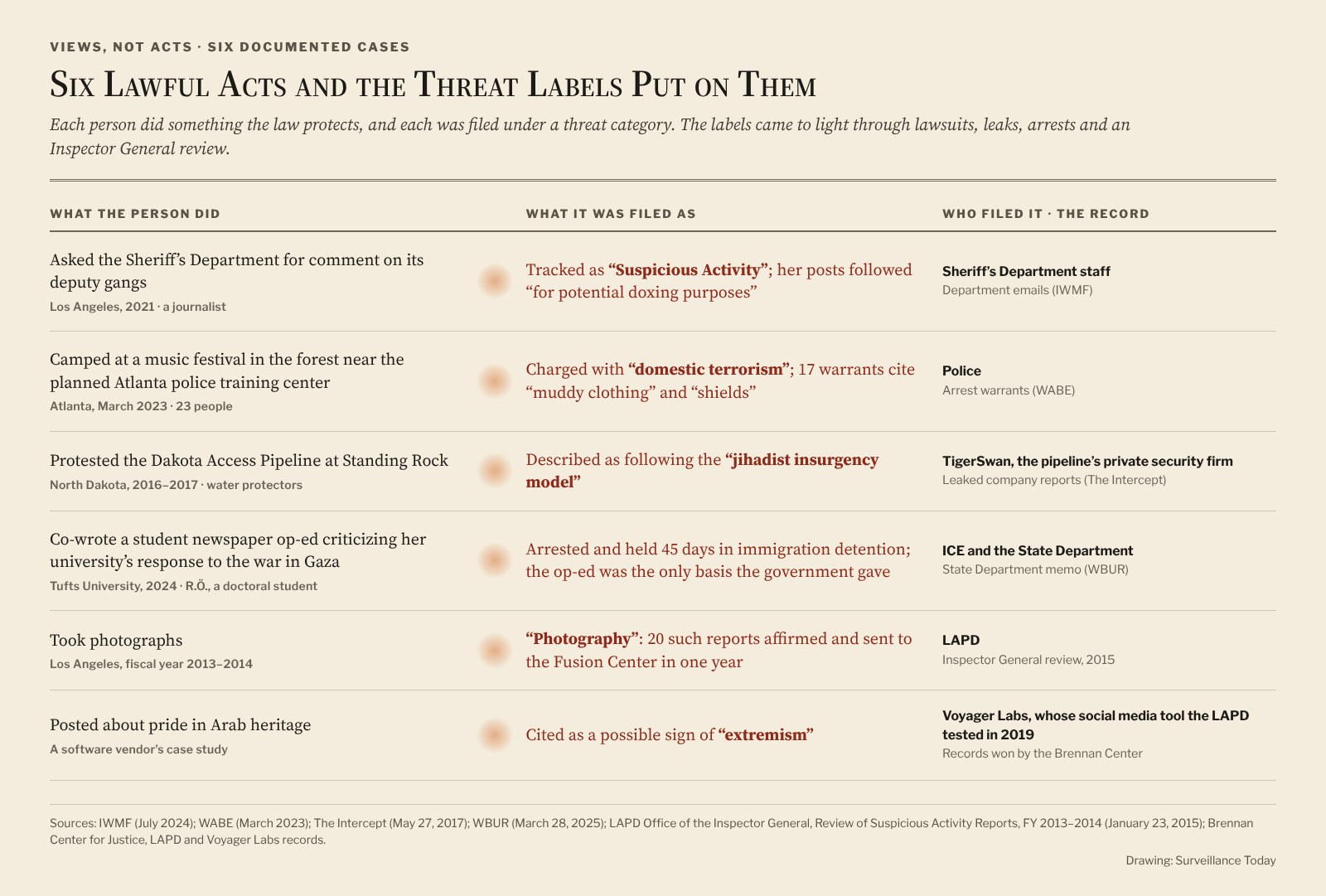
The activist. After Cerise Castle’s series on deputy gangs ran in 2021, a Sheriff’s Department crime analyst compiled a 29-page file on R.S., an activist who shared her work: his Social Security number, DMV records and home address, and the same for his relatives and roommates (Source: Castle, International Women’s Media Foundation, July 2024).
The reporter. A deputy filed a “Suspicious Activity – Person” tip on Castle herself with the Department’s intelligence unit (same source). Suspicious-activity reports are a feed the Fusion Center takes in. See What Have the Deputy Gangs Cost Los Angeles?
The ideology. The MAMDANI Act of 2026 aims, in Sen. Durbin’s description, to “denaturalize individuals who advocate for socialism” (Source: Office of Sen. Durbin, June 3, 2026).
The country of birth. The December 30, 2025 review sorted naturalized citizens by 19 “countries of concern,” naming Somalia (above).
The member of Congress. Rep. Ilhan Omar of Minnesota was born in Somalia and became a U.S. citizen in 2000. In July 2019 President Trump told her and three other congresswomen of color to “go back” to the countries they came from. In January 2026 he said the Justice Department was investigating her over discrepancies in her financial records. On September 13, 2026, border czar Tom Homan said she was being examined for “immigration or naturalization fraud,” including a “sham marriage to enable someone to acquire citizenship illegally” (Source: Arab News, September 15, 2026). On or about October 12, 2026, weeks before the election, federal investigators searched her home and seized her phone, notebooks, computers and passport. The Wall Street Journal reported on October 14 that the investigation aims to build a case to strip her citizenship. Investigators are examining whether her age was altered on a citizenship application, and Vice President JD Vance said the Justice Department is examining whether she married her brother so he could gain U.S. residency (Source: Washington Examiner via Colorado Politics, October 15, 2026). Omar has denied wrongdoing: “Make no mistake: this is an attempt to target political enemies and weaponize federal law enforcement” (same source). No charge or denaturalization case has been filed. On November 3, 2026, voters in Minnesota’s Fifth District re-elected her to a fifth term (Source: CBS News projection via Valley News Live, November 4, 2026).
Every element of the program meets in her case: a country on the review list, the fraud ground the memo lists first, the civil route with no jury and no time limit, and a public campaign against her that began years before any file was opened. If the government can open that case against a sitting member of Congress, the question for every naturalized citizen is what it takes to open one against them, and whether their dossier supplies the ground.
The Score Does Not Travel Alone
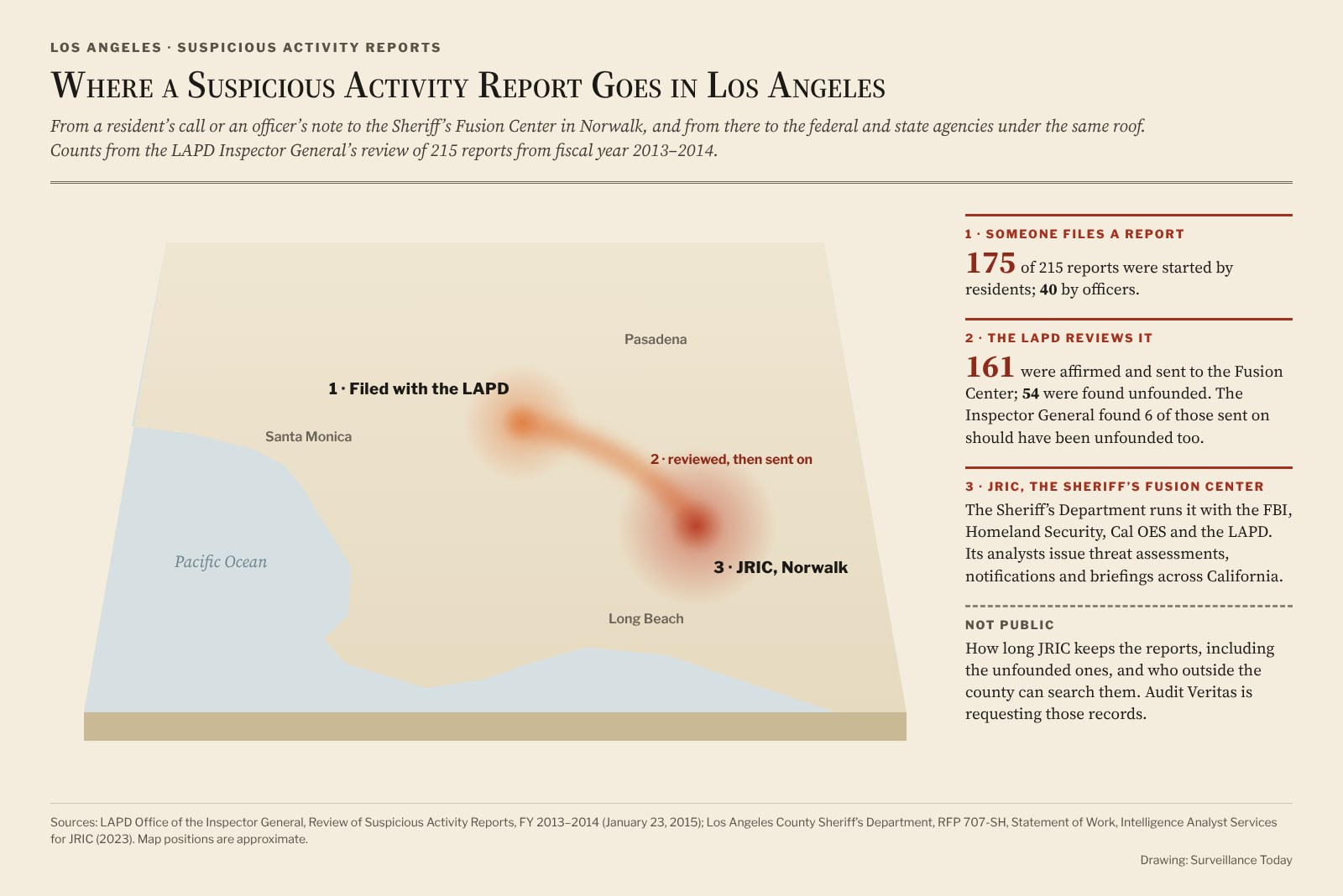
A score is one entry in a dossier that people write. An analyst reads the dossier and labels it. An officer fills out a field interview card. A neighbor’s report becomes a suspicious activity report; in Los Angeles, residents start 81% of them, and the LAPD sends most to the Fusion Center (see When a Neighbor Reports You to the LAPD for Taking Photos, Where Does the Report Go?). Each label is written once and then travels with the dossier, and the score built on top of it reads as evidence.
Los Angeles has a record of labels made up by the people writing them. In 2020 the Los Angeles County District Attorney charged six LAPD Metropolitan Division officers with falsifying field interview cards that identified people as gang members; a judge dismissed the charges against three for lack of probable cause in February 2022, and charges against the other three remained pending (Source: KNX News, February 9, 2022). More than 750 criminal cases came under review (Source: CBS Los Angeles). On July 14, 2020, Attorney General Xavier Becerra cut off statewide access to LAPD-generated entries in CalGang, the state gang database: “CalGang is only as good as the data that is put into it” (Source: California Department of Justice, July 14, 2020). Becerra is now California’s governor-elect.
How USCIS Finds the Cases
USCIS’s Fraud Detection and National Security Directorate investigates the cases. USCIS centralized the work, reopens previously approved files when a person applies for any other immigration benefit, and invested in technology that “can identify connections among names, identities, fingerprints, and immigration records” (Source: Newsweek, September 10, 2026). The method has a precedent. In President Trump’s first term, Operation Janus matched about 315,000 old fingerprint records against citizenship files to find cases (Source: Migration Policy Institute).
The Reviews Sort Citizens by Where They Were Born
On December 30, 2025, the Department of Homeland Security announced it was reviewing the immigration and naturalization files of U.S. citizens from 19 countries it calls “countries of concern,” naming Somalia, for fraud such as marriage fraud or false statements. Assistant Secretary Tricia McLaughlin said: “Under U.S. law, if an individual procures citizenship on a fraudulent basis, that is grounds for denaturalization” (Source: Fox News, December 30, 2025; Minnesota Lawyer, December 31, 2025). The Department did not say how many files it opened or how it chose them.
ICE Bought the Dossiers, With “Risk Scoring”
In September 2026 ICE awarded Thomson Reuters a five-year agreement worth up to $125 million, running through September 29, 2031. ICE’s justification asked for “continuous monitoring of as many as one million people or entities,” “automated alerts” and “model-based risk scoring” (Source: Biometric Update, September 28, 2026).
The contract calls for “screening and vetting of individuals and entities for immigration, criminal and national security risks,” and reporting by The Guardian and 404 Media tied it to “immigration fraud” and “voter fraud” (Source: The Week, July 27, 2026). The data includes names, addresses, Social Security numbers, social media posts, geolocation and “credit header data,” the identifying details a person gives a bank to open an account (same source).
Fraud is the first ground in the Justice Department’s list. Fraud is what the ICE contract screens for. The contract buys a score on up to one million people. The documents do not yet say whether those scores feed USCIS’s referrals. That is the question Surveillance Today will put to both agencies.
On Monday, November 9, 2026, Surveillance Today will file Freedom of Information Act requests asking:
USCIS: every data source the Fraud Detection and National Security Directorate uses to select naturalization files for denaturalization review, including any Thomson Reuters CLEAR or LexisNexis product.
USCIS: the instruction setting the monthly referral quota, the number of referrals made each month since February 2026, and the list of 19 “countries of concern” used in the December 2025 review and how files were selected.
ICE: whether “model-based risk scoring” under the Thomson Reuters agreement covers naturalized citizens or lawful permanent residents, and whether any score has been shared with USCIS or the Justice Department.
The Justice Department: the June 11, 2025 Civil Division memo and the number of denaturalization referrals received from USCIS in 2026.
If You Are a Naturalized Citizen
You can request your own immigration file, the A-file, from USCIS under the Freedom of Information Act and the Privacy Act. It shows what the government holds on your naturalization. Surveillance Today’s records desk will help you file the request for free.
Schneiderman v. United States, 320 U.S. 118 (1943); Fedorenko v. United States, 449 U.S. 490 (1981); Kungys v. United States, 485 U.S. 759 (1988); Maslenjak v. United States, 582 U.S. 335 (2017)
At least $62 million in settlements the County ties to the gangs, 911 calls left waiting in a slowdown, no gang-based alerts to prosecutors, force falling hardest on Black residents at the gang stations, and, today, 77,562 plate searches with 300 checked and no rule keeping members off the systems.
What Have the Deputy Gangs Cost Los Angeles, and Who Among Them Can Open Your Dossier?
Audit Veritas staff · Published Sunday, November 8, 2026 · Sources linked in the text and listed at the end
The Record Shows What the Gangs Did, Not Only That They Exist
What the deputy gangs cost, what residents faced, and what the same Department can reach now. Drawing: Surveillance Today.
Every official question about the Sheriff’s deputy gangs points inward: is this deputy a member or not? The Department answers that it has identified none. The record answers a different question, the one that matters to everyone outside the station: what happened to residents, to criminal cases and to the County’s budget because the gangs were there, and what the same Department can reach now. Cerise Castle’s “A Tradition of Violence,” the history this paper follows, counts at least 24 gangs inside the Department. This story does not ask whether they exist. It adds up what they have done.
The County Has Paid at Least $62 Million in Settlements It Ties to the Gangs
The County’s own Inspector General counts more than $54 million in settlements on 59 legal claims tied to deputy gangs since the early 1990s, drawn from a County Counsel list produced on August 18, 2020 (Source: Office of Inspector General). The Civilian Oversight Commission’s Special Counsel put the figure “upwards of $55 million,” plus “seven-figure legal bills from outside litigation counsel” (Source: Special Counsel report, February 2023, p. 13).
The bill kept growing after that list. On April 7, 2026, the Board of Supervisors approved $8 million to settle the suit by eight East Los Angeles deputies who said the Banditos knocked one of them unconscious and choked another unconscious at a September 2018 party at Kennedy Hall, and ran the station by “taxes,” denied backup, forced unpaid overtime and blocked promotions (Source: MyNewsLA, April 7, 2026). Supervisor Kathryn Barger: “There is no question in my mind that we’re settling here falls under the category or a gang.” The County’s count plus that payment comes to at least $62 million. That is a floor built from the County’s own figures, not a total. Castle puts litigation in these cases at “just over $100 million over the past 30 years” (Source: Knock LA, April 5, 2021).
The largest payments the record ties to a named gang:
Case
Paid
Station and gang
What happened
D.T., killed in a foot chase, 2016
$7,000,000 (2019)
Compton, Executioners
Deputies said he had a handgun; none was found
Lynwood class action (Thomas v. County)
$7.5 million to $9 million, by source (1996)
Lynwood, Vikings
A federal judge wrote in 1991 that a “neo-Nazi, white supremacist gang” of deputies existed
Kennedy Hall deputies
$8,000,000 (2026)
East L.A., Banditos
Beatings at a party; “taxes,” denied backup, blocked promotions
A.W., 16, killed, 2018
$3,750,000 (2019)
Century
Castle lists it among killings by gang members
J.M., killed, 2014
$2,500,000
Century, Regulators
The deputy, Jason Zabala, bore a Regulators tattoo and was later promoted to the gang detail
Loyola Law School found that “the county has spent over $4 million settling cases related to a single deputy with a Regulators tattoo” (Source: Loyola Center for Juvenile Law and Policy, January 2021). Two more settlements involve deputies whom witnesses or families tie to a gang, which the County has not conceded: $8 million for A.G., 18, shot five times in the back in Compton in 2020, and $9.6 million, approved June 30, 2026, for S.H., killed in a dawn raid in Compton (Sources: CBS Los Angeles; LAist, June 30, 2026). They are not added to the floor.
The Department’s whole legal bill. County Counsel’s annual reports put the Sheriff’s Department’s litigation costs, all cases, at $73,240,650 in fiscal 2021–22, $150,500,566 in 2022–23, $99,902,321 in 2023–24 and $112,002,405 in 2024–25, nearly half of all County litigation that year (Source: County Counsel, Annual Litigation Cost Report, February 3, 2026). Four years: $435,645,942.
Against the Fusion Center. The two contracts that run the Joint Regional Intelligence Center (JRIC), the Sheriff’s Fusion Center, total $45,835,137.46: General Dynamics IT, $39,500,248.96, and Pat V. Mack, Inc., $6,334,888.50, for Palantir’s Gotham. Federal Homeland Security grants pay for them; the Board letters call them “zero net County cost.” The gang settlements, and the $112 million legal bill, come out of County money. The County pays for what the gangs did. Washington pays for the system they now have access to.
When the Executioners Fought Over a Schedule, Compton’s 911 Calls Waited
In March 2019, Compton’s lieutenant refused to give the station’s scheduling post to an Executioner. The gang’s shot caller, Deputy Jaime Juarez, told him, “we are going to initiate a work slowdown.” It lasted about a month. The lieutenant testified that reported crime rose sharply and arrests fell (Source: LAist, May 24, 2022). The Special Counsel found “arrests dropped precipitously, citizen calls were responded to slowly” (p. 16). At East L.A., the Banditos “directed work slowdowns that resulted in increased response times to calls” (p. 22).
The gangs decided more than schedules. The Special Counsel found they “exercise influence over and often decide assignments and shifts, training, and overtime,” and “give orders not to provide backup to disfavored deputies” (pp. 11–12, 16). Witnesses described pressure to “get numbers up” and to write “reports to make problematic arrests appear legal” (p. 25). A training officer demanded “good imagination on reports” (p. 22). Loyola’s report records Executioners’ “ghost gun reports,” which falsely claimed a suspect had a gun to justify force.
Prosecutors Were Never Told
A deputy’s gang membership bears on whether a jury should believe that deputy. The Inspector General found in February 2024 that the Department had made no disclosures to prosecutors, known as Brady alerts, based on gang membership, and that its policy “will not, as things currently stand, result in the disclosure of any deputies’ connections to subgroups.” Sheriff Robert Luna’s own letter acknowledged “there will be no Brady alerts for pre-2021 conduct” (Source: Inspector General, “Legal Compliance: Deputy Gangs”, February 26, 2024). The District Attorney’s Office “does not require Deputy District Attorneys to ask prosecution witnesses whether they belong to a Deputy Gang”; the Special Counsel wrote that this “raises significant constitutional issues under Brady v. Maryland” (p. 42).
No agency has published how many criminal cases rested on the testimony of gang-linked deputies. Surveillance Today is requesting that count from the Public Defender, the Alternate Public Defender and the District Attorney.
Investigations Were Steered Away From the Gangs
The FBI jail investigation. Undersheriff Paul Tanaka, “a tattooed member of the Vikings,” was sentenced on June 27, 2016, to 60 months for obstructing a federal grand jury investigation of Men’s Central Jail. Deputies hid an FBI informant under a false name, and two sergeants confronted the lead FBI agent at her home and threatened her with arrest (Source: U.S. Attorney, Central District of California, June 27, 2016).
Kennedy Hall, 2018. The Department’s Chief of Staff, “an acknowledged tattooed member of the ‘Grim Reapers,’” relayed an instruction not to ask about the Banditos; the sergeant investigating “was directed not to ask questions about” them, and an unmarked car followed him home after he testified (Special Counsel, pp. 18–20). Inspector General Max Huntsman called it “a cover up, essentially obstruction of justice” (Source: Spectrum News 1, October 6, 2020).
Compton, 2020. The Department asked the coroner to hold A.G.’s autopsy; the coroner released it on July 9, 2020, showing he was shot five times in the back (Source: LAist, July 10, 2020). The Department’s own Executioners inquiry interviewed 129 members “but did not fully examine membership” (Inspector General, February 26, 2024).
The oversight bodies. Former Sheriff Alex Villanueva and his undersheriff refused the Special Counsel’s subpoenas, and “several witnesses who had agreed to testify withdrew, often the night before” (Special Counsel, pp. 7, 38). In July 2023 a court halted the Inspector General’s interviews of 35 deputies identified as Banditos or Executioners until the County bargained with the unions.
The record shows the gangs promoted their own. “At least 15 of the 25 Regulators have been promoted,” the Special Counsel found (p. 32), and Department leadership has included tattooed members of the Vikings, the Cavemen and the Grim Reapers.
At the Stations Where Gangs Are Documented, Residents Were Shot, Searched and Handled With Force More Often
Shootings. Loyola counted 133 deputy shootings from November 1, 2015 to November 1, 2020. The six stations with the most, East L.A. (20), Compton (12), Century (12), South L.A. (11), Lancaster (10) and Palmdale (8), account for 73, or 55 percent. A named deputy gang is on record at every one of the six. The Department runs 23 patrol stations. In the Department’s own list of shootings that wounded or killed someone from January 2024 through September 28, 2026, 22 of 37 (59 percent) were by deputies of the eight stations where Castle or the Special Counsel place a named gang; with Lakewood, where the Inspector General cites “a possible unnamed subgroup,” 29 of 37 (78 percent) (Sources: Loyola; LASD, Deputy-Involved Shootings, retrieved November 7, 2026). Loyola’s caution applies: station size and local crime also drive these numbers, and “correlation is not causation.”
Force and searches. The Center for Policing Equity measured force and stops station by station using the Department’s own data, 2018 to 2023:
Station
Gang on record
Black share of people subjected to force
Black share of residents
Force on Black residents vs. White, adjusted for crime and poverty
A witness told the Special Counsel that joining the Reapers required “a ‘force incident’” and looking “for an opportunity to shoot people” (p. 27). Loyola documented Executioners’ “998 parties” celebrating deputy shootings.
Families Who Spoke Out Were Followed
After East L.A. deputies whom Castle describes as Banditos prospects killed A.V. on August 12, 2018, and P.R., 18, on June 27, 2019, deputies parked outside the families’ homes and followed relatives, according to a report by the National Lawyers Guild Los Angeles and ACLU SoCal. Hours after P.R.’s sister spoke at a town hall with the Sheriff on October 30, 2019, deputies arrested her at her brother’s memorial and held her overnight; “LASD personnel deleted videos” she had recorded. In February 2020 a patrol car followed P.R.’s 14-year-old sister as she walked home from middle school (Source: NLG-LA and ACLU SoCal, 2021). The Inspector General reviewed 690 complaints against 16 stations and two units from February 1, 2018 to November 30, 2019; about 1 percent had any chance of leading to discipline (Source: WitnessLA, December 18, 2020).
False Arrests Are on the Federal Record
On April 13, 2020, Compton Deputies Miguel Vega and Christopher Hernandez detained J.A., 23, without valid reason, had another deputy write him a methamphetamine citation “even though they knew the accusation was false,” and filed false reports. Vega was sentenced to 24 months on December 11, 2023; Hernandez to 18 months (Sources: U.S. Attorney, December 11, 2023; ABC7, January 24, 2024). Two months later, Vega shot A.G. A Compton deputy testified the two were seeking to join the Executioners. In January 2016, the deputies later involved in D.T.’s killing chased and beat S.L., who did not match the suspect description; he was charged with attempted murder, held about seven months, and the charges were dismissed (Castle, April 6, 2021).
The Same Department Now Writes Into Your Dossier, and No Rule Keeps the Gangs Out
The field interview a deputy writes on the street does not stay at the station. The Department’s bid to replace Gotham at the Fusion Center lists the Department’s records system “that contains crime data and Field Interviews (FIs)” among the sources it joins, with plate-reader searches “across the Los Angeles region.” Asked how many people would use it, the Department answered on December 12, 2025: “up to 200” at first; “after go-live this number may grow to 2,000+.” “There are no read-only Users” (Source: RFP 730-SH, Statement of Work attachments; Questions and Answers, December 12, 2025). The stops in the table above, where Black and Latino drivers were searched more often and found with contraband less often, are among the records it joins to your dossier.
Plate searches. On September 23, 2026, the Department sent the Board its first plate-search audit: 77,562 searches from January to June 2026. It reviewed 300 of them, 0.39 percent, and judged each by the reason the deputy typed in. Eight were “insufficient or unclear”; all eight were cleared by asking the deputy. It covers the Vigilant system only, not the 476 Flock cameras the Department owns, and gives no count by station (Source: LASD, ALPR System Use Audit, September 23, 2026).
Who gets access. The plate-reader policy gives “general user-level access” to sworn personnel “whose duties require such access.” No clause addresses membership in a deputy gang. None of the Oversight Commission’s 27 recommendations on deputy gangs addresses database, plate-reader or intelligence access.
Misuse already on the record. Deputy Eric Chase Saavedra, of the Department’s gang unit, who admitted Lakewood’s voted spade-and-13 tattoo, “illegally and regularly used his LASD credentials to access sensitive law enforcement databases” for a crypto businessman and lied to a judge to track a victim’s phone; he was sentenced to 21 months on September 28, 2026 (Source: U.S. Attorney, September 28, 2026). In 2023 the Department reported 6,789 misuses of the state law-enforcement network, the majority of all misuse reported in California that year (Source: Electronic Frontier Foundation, January 28, 2025).
The reporter who documented the gangs. After Castle’s series ran in 2021, Department employees circulated it to “the entire unit responsible for tracking license plates.” A deputy filed a “Suspicious Activity – Person” tip on her. A Department crime analyst compiled a 29-page file on R.S., an activist who shared her work, with his Social Security number, DMV records and home address, and the same for his relatives and roommates (Source: Castle, International Women’s Media Foundation, July 2024). Suspicious-activity reports are one of the feeds the Fusion Center takes in.
The County Still Says It Has Identified No Gang
The Department told the Inspector General on December 26, 2025, that “to date, no such group has been identified,” and on January 6, 2026, that naming groups “is a misreading of the Penal Code section.” In the same response it reported 213 allegations of gang participation referred to the state’s peace-officer licensing commission and 10 open administrative investigations, two of them more than three years old (Source: Inspector General, Reform and Oversight Efforts, October–December 2025, February 26, 2026). The Undersheriff named the Banditos under oath in 2024, and the Department fired two deputies for membership in the Industry Indians.
Days after Sheriff Luna’s re-election on November 3, 2026, the Department finalized a policy that members “shall not participate in, or solicit others to participate in, or join a prohibited clique,” with cooperation in investigations “a condition of employment” (Source: Los Angeles Times via Yahoo News, November 6, 2026). Coverage of the policy describes no provision on assignments, intelligence units or access to the systems above. On Tuesday, November 10, 2026, the Board takes up the motion that would require the Department to identify the gangs.
Questions for the Sheriff and the Board
Which deputies under the 10 open investigations, or among the 213 referrals, hold access to the plate readers, Fusus, Tangles, Webloc or the Fusion Center’s software today?
Will the Department break out its 77,562 plate searches by station, and audit the Flock cameras it left out?
Will the Fusion Center replacement give 2,000-plus users full access with no read-only accounts, and who reviews what they open?
How many criminal cases rested on testimony by deputies the Department has since investigated for gang participation?
Corrections to Issues 3 and 4
Issue No. 3 reported “$112 million to defend the Sheriff in one year.” The $112,002,405 is the Sheriff’s Department’s full litigation cost for fiscal 2024–25, as County Counsel reports it: $69,188,984 in judgments and settlements and $42,813,421 in fees and costs. We described the whole figure as defense spending; only the fees and costs are. Issue No. 4 reported that the Department fully carried out six of the Oversight Commission’s 27 recommendations; the Commission’s 2025 milestones document says four. Issue No. 4 also reported 41 tattooed deputies; the Inspector General’s February 2024 report counts 35 deputies sent interview letters as admitted or identified Banditos or Executioners. Our figure came from a different count we did not reconcile against the Inspector General’s. Issue No. 4 reported that plate data is kept two years; under the May 2026 policy, after two years records are archived and remain searchable by system administrators.
What Surveillance Today Is Requesting
On Monday, November 9, 2026, Surveillance Today will file California Public Records Act requests for: County Counsel’s updated list of deputy-gang cases and payouts since August 18, 2020; the Sheriff’s share of the $89,270,327 the County paid outside law firms in fiscal 2024–25; the 213 referrals and their outcomes; Brady alerts issued since August 2023 that rest on gang membership; the plate-search logs by station and the Flock search logs; user counts by station for the plate readers, Fusus, Tangles, Webloc and Gotham; and overtime, arrest and response-time data for Compton in March 2019.
Who we are handing power to · Palantir · DOGE · ICE
Since 2025 Agencies Have Merged Tax, Social Security and Medicaid Records, and Palantir Builds the Software That Ranks the People in Them. Its Chairman Wrote That Freedom and Democracy Are Incompatible.
If You Have a Social Security Number or Have Filed Taxes, Who Decides What Your Government File Says About You?
Audit Veritas staff · Published Sunday, November 8, 2026 · Sources linked in the text and listed at the end
In 2025 the Government Joined Its Files on Americans and Gave Palantir the Job
In 2025, the federal government tore down the walls between its records on Americans: tax files, Social Security files, Medicaid files, immigration files. It handed the job of joining them to Palantir, the company Peter Thiel co-founded and chairs and Alex Karp runs.
The debate has been about the data: who collected it, whether it leaked. The question it skips is who reads the data once it is joined, and what they are reading for.
The software decides what a file shows: which records sit side by side, which address is likely, which person rises to the top of a list. The men who built it have said, in their own words, how they see democracy, their critics and their enemies. Those words matter now because their software sits between the government’s files and the people the files describe.
Executive Order 14243 Ordered Agencies to Open Their Records, and DOGE Copied Tax, Social Security and Medicaid Files
On March 20, 2025, the President signed Executive Order 14243, “Stopping Waste, Fraud, and Abuse by Eliminating Information Silos.” It ordered agency heads to give officials designated by the President “full and prompt access to all unclassified agency records, data, software systems.” The separation between agencies’ files had protected privacy; the order called it waste.
The Department of Government Efficiency, led by Elon Musk, moved first.
Tax records. In April 2025, DOGE, Palantir engineers and career IRS staff worked to build a “mega API,” “a single API layer above all IRS databases.” It reached names, addresses, Social Security numbers, tax returns and employment records, and could match them against other agencies’ data (Wired, via beSpacific).
Social Security records. In late June 2025, DOGE-affiliated officials at the Social Security Administration copied NUMIDENT, the master file of everyone who has applied for a Social Security card, into a cloud environment they controlled. It holds the names, Social Security numbers, birthdates, birthplaces, citizenship, race and ethnicity, and parents’ names of more than 300 million Americans. A career risk assessment had called unauthorized access “catastrophic.” The agency’s chief information officer, a former DOGE member, wrote that he accepted all risks. Charles Borges, the agency’s chief data officer, reported it to Congress on August 26, 2025 (LAist/NPR).
Medicaid records. ICE and the agency that runs Medicaid signed an agreement giving ICE personal data on nearly 80 million Medicaid patients (Fortune). On January 7, 2026, Medicaid officials sent ICE a dataset on millions of people, including people in the country legally, that ICE was not supposed to have. ICE passed it to Palantir. Federal officials admitted the overshare in court in 2026 (NPR, July 17, 2026).
The judge put it plainly: “If the federal government cannot be sufficiently careful then it can’t use the information, ok?”
ICE Uses Palantir’s ImmigrationOS and ELITE to Pick Targets and Score Their Addresses
Palantir’s software does more than store the joined files. It selects from them.
Contract or tool
Agency
What it does
ImmigrationOS, $29.9 million, awarded without competing bids in April 2025
ICE
“Targeting and enforcement prioritization”; tracks the “immigration lifecycle from identification to removal”; gives “real-time visibility into instances of self-deportation”
Pulls in Medicaid and other government records, builds dossiers and “leads,” maps “potential targets,” and gives each person’s address a “confidence score”
ICE justified the sole-source award by saying “Palantir’s systems are already ingesting and processing data from multiple ICE, DHS” and other sources. Once a company holds the data, it becomes “the only source” for the next contract.
A “confidence score” on an address is a judgment, and the software makes it before any agent knocks. The agent sees the score, not the reasoning behind it. Karp described what the joined data means for his company: “Whatever is good for America will be good for Americans and very good for Palantir.”
Thiel Wrote That Giving Women the Vote Made “Capitalist Democracy” an Oxymoron; Karp Says Palantir Is There to Scare Enemies
The men who built the software have stated how they rank democracy, voters and critics.
Peter Thiel, co-founder and chairman. On April 13, 2009, in Cato Unbound, he wrote that he “no longer believe[s] that freedom and democracy are compatible.” He named the reason: “the vast increase in welfare beneficiaries and the extension of the franchise to women” had “rendered the notion of ‘capitalist democracy’ into an oxymoron” (quoted here).
In 2025 and 2026, Thiel gave private lecture series on the Antichrist in San Francisco, Paris, Rome and Nashville. He said that “in the 21st century, the antichrist is a luddite who wants to stop all science.” He described the danger as “a near totalitarian one-world government with the power to stop all dangerous science” (Gizmodo). He called Greta Thunberg and critics of artificial intelligence “legionnaires of the Antichrist” (AFP via CTV).
Alex Karp, chief executive. On an investor call in early February 2025, he said Palantir is there, “when it’s necessary, to scare enemies and on occasion kill them.” On DOGE’s overhaul of federal agencies, he said: “Some people are going to get their heads cut off” (Gizmodo).
“When it’s necessary, to scare enemies and on occasion kill them.” Alex Karp, Palantir’s chief executive, on what the company is there for, February 2025
Taken together: the chairman doubts that women’s votes and welfare recipients’ votes fit with freedom. He places critics of his industry on the Antichrist’s side. The chief executive speaks of scaring enemies. These are the men whose software decides which records rise to the top.
A 2025 Presidential Memo Lists Beliefs as Terrorism Indicators, and No Public Rule Says Whether the Software Uses Them
In September 2025, NSPM-7 made views into terrorism “indicators”: “anti-Americanism,” “anti-capitalism,” “anti-Christianity,” “extremism on migration, race, and gender,” and “hostility towards those who hold traditional American views on family, religion, and morality” (Klippenstein). The Attorney General’s implementing memo, reported in December 2025, ordered a list of “domestic terrorist” groups, paid tipsters and had the FBI review five years of intelligence (Truthout/Democracy Now). On August 19, 2025, USCIS made having “espoused the views of an anti-American” organization “an overwhelmingly negative factor” and added social media vetting to find it (MIT).
Put the pieces in one line:
The government joins its files on Americans.
Palantir’s software reads the joined files and ranks people as leads, with a score.
The government defines the leads by belief: anti-capitalist, anti-Christian, hostile to traditional views.
The chairman of the company that writes the software says freedom and democracy are not compatible and places technology’s critics on the Antichrist’s side.
No public document shows whether a belief marker feeds a score, or who would set its weight. The person on the list is never told either way.
Five Records Requests Ask ICE, USCIS, Social Security, the IRS and the Sheriff Who Decided What the Software Looks For
The record shows the joined files, the software and the belief markers. It does not show the rules that connect them. These requests ask for those rules:
ICE (FOIA): the ELITE and ImmigrationOS user guides, training materials and the factors behind each “confidence score” and lead ranking; any list of data sources the tools ingest.
USCIS Fraud Detection and National Security office (FOIA): the social media vetting criteria under policy alert PA-2025-16 and any guidance defining “anti-American”; whether Palantir or another vendor performs or scores the review.
Social Security Administration (FOIA): the risk assessment and approval for the NUMIDENT copy, and every agency or contractor given access to it.
IRS (FOIA): the data-sharing agreements and access logs for the “mega API.”
Los Angeles County Sheriff’s Department (California Public Records Act): every Palantir contract and data-sharing agreement for the Joint Regional Intelligence Center (JRIC), the Sheriff’s Fusion Center, and whether NSPM-7 indicators appear in its intake or analyst guidance.
The question to put to each agency is one sentence: who decided what the software looks for?
In the Year the Inspector General Reviewed, Residents Started 175 of 215 Reports and the LAPD Sent 161 to the Sheriff’s Fusion Center in Norwalk. How Long the Center Keeps Them Is Not Public, and the Person Reported Is Not Told.
When a Neighbor Reports You to the LAPD for Taking Photos, Where Does the Report Go, and Who Keeps It?
Audit Veritas staff · Published Sunday, November 8, 2026 · Sources linked in the text and listed at the end
Sheriff’s Staff, Atlanta Police, a Pipeline Contractor and ICE Filed Lawful Speech and Protest as Threats
In each documented case, an official or a contractor decided what a person’s lawful activity meant, then filed it under a threat category. The person learned of the label only through litigation, leaked documents or arrest.
A journalist filed as “suspicious activity.” Cerise Castle asked the Los Angeles County Sheriff’s Department for comment on its deputy gangs on March 16, 2021. Thirteen minutes later, a deputy in the Sheriff’s Information Bureau forwarded her request to command staff. Within about a week, a crime analyst asked colleagues to “keep an eye” on her posts “for potential doxing purposes, as well.” Department members then circulated her photos, social media profiles, and the addresses and phone numbers of people they believed were connected to her. Castle sued for the records. They showed more than 50 department members wrote more than 800 pages of emails about her over seven months. Women Press Freedom described the department “labeling her as ‘Suspicious Activity’ and tracking her social media” (IWMF).
From the Sheriff’s Department’s own emails, released after the reporter sued for them. Drawing: Surveillance Today.
Campers charged as domestic terrorists. On March 5, 2023, police swept a music festival near the planned Atlanta police training center and arrested 23 people on domestic terrorism charges. For 17 of them, the warrants alleged they “wore muddy clothing and carried shields.” The warrants for five others listed no specific details (WABE). A doctoral student among them said: “If I am arrested with domestic terrorism charges for camping in a forest, that’s something I’m willing to go to court for.”
Water protectors modeled as a jihadist insurgency. TigerSwan, the private security firm hired for the Dakota Access Pipeline, wrote in a February 27, 2017, report that the Standing Rock movement “generally followed the jihadist insurgency model while active.” The firm sent daily intelligence updates to local sheriffs and placed a liaison in North Dakota’s joint law enforcement command. An FBI, DHS and local police “Intel Group” viewed a live feed from the company’s helicopter. A county deputy shared “company intel” describing one protester as a “strong Shia Islamic” figure (The Intercept).
A student detained over an op-ed. R.Ö., a Tufts doctoral student, was arrested by immigration agents in March 2025 and held 45 days in Louisiana. The only basis the government gave was a March 2024 student newspaper op-ed she co-wrote criticizing Tufts’ response to Israel’s war in Gaza. An anonymous website that publishes personal information on Israel’s critics had added her to its list in February 2025 (WBUR). An immigration judge terminated her removal case in February 2026. In an April 2026 settlement, the government acknowledged, according to the ACLU, that she had always had lawful status (CP24).
The pattern across all four: a reporter’s question, a camp in a forest, a pipeline protest and a student opinion column were each recorded by police, a contractor or a federal agency as signs of a threat.
Six documented cases, from Los Angeles to Standing Rock, with the record behind each label. Drawing: Surveillance Today.
Who Files the Reports, and Would You Ever Know? In Los Angeles, Residents Start 81%, and the LAPD Sends Most to the Fusion Center
In Los Angeles, most suspicious activity reports start with residents. The city’s own Inspector General counted them.
Neighbors file 81% of the reports. The Police Commission’s Office of the Inspector General reviewed 215 LAPD suspicious activity reports from fiscal year 2013–2014, in a review dated January 23, 2015. Community members started 175 of them, 81%. Officers started 40. The department affirmed 161 and sent them to the Joint Regional Intelligence Center (JRIC), the Sheriff’s Fusion Center. It found 54, a quarter, unfounded (LAPD Office of the Inspector General).
What counts as suspicious includes lawful acts. Among the affirmed reports, “Photography” accounted for 20 and “Observation/Surveillance” for 21. Taking a picture or looking at a building is enough to place a person in a file at the Fusion Center. The Inspector General found that 6 of the reports sent on should have been unfounded. Three were drivers flagged for “misrepresentation” who later showed valid identification. One was a person “espousing violent extremist views” with no specific threat.
Where a suspicious activity report goes in Los Angeles, with the Inspector General’s counts. Drawing: Surveillance Today.
Software that scores belief. The LAPD tested Voyager Labs’ social media tool for four months in 2019. Records the Brennan Center won in a lawsuit show the company claimed to assess whether a person posed a public safety risk based partly on how much “passion” the person showed for an idea. One case study suggested that posting about “pride in . . . Arab heritage” could indicate “extremism.” The company pitched “anonymous,” “traceless” collection and the ability to “reconstruct[] closed profiles.” Meta later alleged Voyager ran more than 38,000 fake accounts to scrape data on more than 600,000 Facebook users (Brennan Center).
Lists of people “most likely” to commit violence. Under Operation LASER, begun in 2011, the LAPD kept lists of the people it judged “most likely to commit violent crimes” in an area. A March 2019 Inspector General audit found officers used inconsistent criteria to label people likely violent offenders, and the department could not measure whether the program worked. The LAPD stopped the lists and ended the program in April 2019 (GovTech).
A federal system for selecting people. In April 2025, ICE gave Palantir a $29.9 million no-bid contract to build ImmigrationOS. It merges ICE, DHS and outside data into one interface for selecting people for removal, and promises “real-time visibility into instances of self-deportation.” ICE justified skipping competition because “Palantir’s systems are already ingesting and processing data from multiple ICE, DHS and external sources” (The Register).
Each layer works the same way: one person reports, another interprets, and the person reported never sees the interpretation or gets to answer it.
In the West Bank, a Camera Reads the Face and a Color Tells the Soldier What to Do
Israel’s systems in the occupied West Bank show the same sequence carried to its end: a camera reads a face, a database supplies the file, and a color tells the soldier what to do with the person.
Blue Wolf. Former soldiers told the Washington Post in November 2021 that the military’s Blue Wolf smartphone app “captures photos of Palestinians’ faces and matches them to a database of images.” The app “flashes in different colours to alert soldiers if a person is to be detained, arrested or left alone.” Units competed to photograph Palestinians, “including children and the elderly, with prizes for the most pictures collected by each unit.” A former soldier called the database a hidden “Facebook for Palestinians” (The Week, summarizing the Washington Post).
Red Wolf. In May 2023, Amnesty International reported that a checkpoint camera system called Red Wolf, in use in Hebron since 2022, “relies on databases consisting exclusively of Palestinian individuals’ data.” Amnesty wrote that it lets Israeli authorities “identify protesters and keep Palestinians under constant observation.” A Hebron activist described the moment of reading: “The soldier scans our faces with the phone camera, and suddenly their behavior towards us changes” (Times of Israel). The Israeli military said it carries out “necessary security and intelligence operations” and would not discuss its capabilities.
The Los Angeles connection. LAPD employees went to Israel to train with Israeli counterterrorism experts on at least nine occasions over the past decade; 18 employees traveled at a total cost of $87,000 since 2014. The Police Commission’s Inspector General found no system recording what they learned or adopted. The department said it had not adopted any “tactics, altered policies, or developed training programs” from the trips; the report’s authors said “the dearth of records made that claim impossible to verify” (Los Angeles Times).
No record yet shows a Blue Wolf or Red Wolf system in Los Angeles. What the record shows is the same sequence assembled here piece by piece: cameras, a central file at the Fusion Center, and officers trained abroad with no record of what they brought back.
Thiel Wrote in 2009 That Freedom and Democracy Are Incompatible, and His Company’s Software Runs in the Sheriff’s Fusion Center
Peter Thiel, Palantir’s co-founder and chairman, put his view of democracy in writing in April 2009, in an essay for the Cato Institute’s Cato Unbound titled “The Education of a Libertarian”:
“I no longer believe that freedom and democracy are compatible.”
He gave his reason in the same essay:
“Since 1920, the vast increase in welfare beneficiaries and the extension of the franchise to women — two constituencies that are notoriously tough for libertarians — have rendered the notion of ‘capitalist democracy’ into an oxymoron.”
The essay argued that the voters, not the tools, are the problem, and that people like him should look for an escape from politics through technology. Thiel has since said his views have changed in some respects since college (New York Magazine, via Cato). He has not withdrawn the essay.
The company he co-founded now builds the systems that decide who is selected and who is flagged:
Where
What Palantir supplies
Source
Los Angeles County Sheriff, JRIC
Gotham analysis software and 29 applications for the Fusion Center, a $9,324,643 sole-source contract requested March 29, 2016
A January 2024 strategic partnership; Palantir’s executive vice president said both sides agreed “to harness Palantir’s advanced technology in support of war-related missions”
The man who wrote that freedom and democracy cannot coexist co-founded the company whose software sits in the Sheriff’s Fusion Center, ICE’s removal system and Israel’s war effort. The paper can put his words beside his contracts and let readers judge.
Five Records Requests Ask the Sheriff Whether JRIC Scores Individuals and How Long It Keeps Unfounded Reports
Proven by the public record:
Agencies and their contractors interpret lawful speech, reporting and protest as threat indicators, and file people under threat categories without notice (Castle, Atlanta, Standing Rock, R.Ö.).
In Los Angeles, residents start 81% of suspicious activity reports; the reports go to the Fusion Center; lawful acts such as photography qualify (Inspector General, 2015).
Police have tested software that scores people’s risk by the “passion” of their beliefs, and kept lists of people judged “most likely” to be violent under inconsistent criteria (Voyager Labs; Operation LASER).
Israel runs face-to-file-to-verdict systems on an entire population; LAPD officers trained there with no record kept of what they learned.
Not yet in the record, and the target of the next requests:
Whether JRIC or the Sheriff’s Department assigns behavioral or psychological assessments, risk scores or threat ratings to individuals, and the written criteria for them.
How long JRIC keeps suspicious activity reports, including the unfounded ones, and who outside the county can search them.
The Sheriff’s current suspicious activity reporting statistics: how many, how many from residents, the share unfounded, and the demographic breakdown.
Any behavioral threat assessment or “pathway to violence” training given to LASD or JRIC personnel, and who provided it.
Records of what LASD personnel learned or adopted from training in Israel.
These go out as California Public Records Act requests from Audit Veritas to the Sheriff’s Department and to JRIC’s county partners.
The First Amendment · Speech · Assembly · Petition
On January 22, 2026, a Federal Judge Voided the Policy Behind the Arrests for Everyone, but Barred Arrests Only for Members of the Two Scholars’ Groups That Sued. Universities and Law Firms Faced the Same Choice: Pay, or Go to Court.
If You Aren’t a Citizen and You Write About Gaza, What Protects You From Arrest?
Audit Veritas staff · Published Sunday, November 8, 2026 · Sources linked in the text and listed at the end
Most Americans Name Only Free Speech; the 2025 Cases Also Reached Assembly, Association and Petition
Ask Americans what the First Amendment protects and most give one answer. In the 2025 Annenberg Constitution Day survey, 79% named freedom of speech. Only 36% named the right of assembly, 34% freedom of the press, and 12% the right to petition the government (Annenberg Public Policy Center).
In the public mind, the First Amendment belongs to journalists and protesters. In 2025 and 2026 the federal government tested it on everyone else: students who wrote an op-ed, professors who joined an association, universities that refused a list of demands, law firms whose clients and hires displeased the President. Courts found again and again that the government had punished speech. Many of the institutions it targeted had already agreed to terms.
The Government Arrested Students for What They Wrote and Said
R.Ö., a Tufts University doctoral student from Turkey, co-wrote an opinion piece in the student newspaper criticizing the university’s response to the war in Gaza. In March 2025, plainclothes ICE agents arrested her on a street in Somerville, Massachusetts, and moved her to Vermont and then Louisiana without telling her lawyers. An unsealed State Department memo dated March 21, 2025, showed officials had no evidence against her beyond the article itself. A federal judge released her on bail about six weeks after the arrest. On February 9, 2026, an immigration judge terminated the removal case, finding the Department of Homeland Security had no legal basis to remove her (Daily Sabah).
M.K., a Columbia graduate student and lawful permanent resident who led campus protests, spent three months in immigration detention until a judge ordered his release in June 2025. On January 15, 2026, a federal appeals court ruled that the judge had “no jurisdiction to order Mr Khalil’s release,” opening the door to his rearrest (The National).
The two cases were not isolated. The American Association of University Professors and the Middle East Studies Association sued over the policy behind them. After a nine-day trial, U.S. District Judge William G. Young ruled in September 2025 that the policy was “viewpoint-discriminatory” and designed to “chill protected speech,” and he found that senior cabinet officials had engaged in a “conspiracy” to “intentionally abridge the constitutional rights” of the groups’ members. On the government’s claim that noncitizens have lesser speech rights, he wrote: “’No law’ means ‘no law.’” On January 22, 2026, he vacated the policy and barred the government from arresting, detaining or deporting the groups’ noncitizen members for pro-Palestinian advocacy (AAUP).
“’No law’ means ‘no law.’” U.S. District Judge William G. Young, rejecting the government’s claim that noncitizens have lesser speech rights, September 2025
The vacated policy is void for everyone. The order’s added shields, the bar on arrests and a presumption that any change to a member’s immigration status is retaliation, cover only the two groups’ members.
Columbia Paid $221 Million. Harvard Sued and Won.
Columbia University settled on July 23, 2025. It agreed to pay $200 million to the federal government over three years and $21 million more to settle an Equal Employment Opportunity Commission investigation, in exchange for the return of about $1.3 billion in federal funding. The deal installed an independent “resolution monitor,” required antisemitism coordinators, and created joint faculty positions tied to the Institute for Israel and Jewish Studies. Columbia admitted no wrongdoing (GBH/NPR). The administration called it a blueprint for other universities.
Harvard University refused the government’s April 2025 demands and sued. In September 2025, U.S. District Judge Allison D. Burroughs found that the freeze of nearly $2.7 billion in research grants was an unconstitutional attempt to retaliate against Harvard for that refusal, and ordered the payments restored. The government appealed. At the First Circuit on October 5, 2026, its lawyer argued that “there’s no First Amendment right to money”; the three-judge panel appeared skeptical (The Harvard Crimson). No decision has issued.
The two universities show the choice every institution faced. One paid and accepted a monitor. The other went to court and won the first round on the First Amendment.
Nine Law Firms Pledged $940 Million in Free Work. Four Sued, and Four Won.
In 2025 the President signed executive orders against law firms over their clients, their political ties and the lawyers they hired. The orders stripped security clearances and told federal agencies to scrutinize government contracts held by the firms’ clients (University of Wisconsin Law School).
Four firms went to court: Perkins Coie, Jenner & Block, WilmerHale and Susman Godfrey. Four federal judges ruled the orders unconstitutional and permanently blocked them.
Nine firms made deals instead, led by Paul, Weiss, Rifkind, Wharton & Garrison. Together they pledged about $940 million in free legal work for causes the administration endorsed (Above the Law).
On March 2, 2026, the Justice Department told the D.C. Circuit it would drop its appeals of all four rulings. The next day it reversed itself and resumed the fight (ABC News). The firms that sued are protected by court orders. The firms that settled are bound by their deals.
The profession whose job is to defend the right to speak and to petition the courts split on whether to defend its own.
The Second Amendment Moves Voters, Money and the Court
The constitutional right that reliably moves voters, money and the Supreme Court is the Second. On June 25, 2026, the Court struck down Hawaii’s law barring licensed gun owners from carrying on private property open to the public without the owner’s express permission. The vote was 6 to 3, in an opinion by Justice Samuel Alito (Faegre Drinker).
The First Amendment cases of the same year moved differently. The students, the professors, the university and the four firms sued separately, won in district courts case by case, and then faced the government’s appeals. Each victory protects the party that won it.
The two rights are argued in different terms. The gun debate is argued largely as a question of what Americans may carry to protect themselves from one another. This year’s speech cases asked what Americans may say without being punished by their own government. The first question fills campaigns. The second barely reached the ballot.
No Kings Drew 2,400 Demonstrations in One Day in March 2026 as Campus and Anti-War Protests Dropped
Americans still turn out by the millions, one day at a time. On March 28, 2026, the third No Kings day produced more than 2,400 demonstrations in every state and Washington, D.C., the most on a single day since ACLED began tracking the United States in 2020; organizers estimated at least 8 million participants. The war in Iran drew a different pattern: anti-war protests spiked above 90 in the first week of March 2026, then fell to fewer than a dozen a week (ACLED).
The protests the arrests were aimed at shrank. By April 2025, a month after R.Ö.’s arrest, Hillel International’s chief executive said that “protest activity is way down this year as compared to last year”; students and administrators cited stricter discipline and the threat of deportation for foreign students (Jewish Insider, via Daily Alert). Palestine Legal reported that protests in 2025 were “smaller and more sparse” than in spring 2024. Its requests for legal help in 2025 still ran 300% above any year before the Gaza war, at 1,131, and immigration-related cases more than tripled from 2024 to 122 (Palestine Legal, via inkl). Fewer people protested; more of those who did needed a lawyer.
Protests that did go forward met the permit system. In July 2025, the LAPD denied Refuse Fascism a permit for “The Disappeared,” an installation planned outside the Federal Building downtown, citing a lack of traffic officers; the ACLU of Southern California called the reasoning apparently “unconstitutional” and threatened suit (L.A. TACO). In Washington, the National Park Service ordered a permitted anti-Trump vigil to remove signs it called “obscene,” and on May 27, 2026, Park Police told the group its “8647” flag violated its permit. On June 29, 2026, a federal judge held that “both sets of materials represent core protected speech” and permanently barred the Park Service from forcing their removal (ACLU of D.C.).
Big Firms Cut Pro Bono Work for Immigrants and Protesters and Filed Fewer Suits Against the Administration
The record shows the bar retreating from the fights the administration dislikes. Reuters interviewed more than 60 lawyers, contacted more than 70 nonprofits and analyzed millions of court records. It reported in July 2025 that “dozens of major law firms, wary of political retaliation, have scaled back pro bono work.” Fourteen civil rights groups said firms were “keeping their representation secret or turning them down altogether” (Reuters, via Reason). A Bloomberg column in March 2026 found immigration groups still short of big-firm help in detention and habeas cases (Bloomberg, via Keker).
Reuters put numbers on it. Of the 50 highest-grossing firms, 46 removed or altered website references to diversity, equity and inclusion, and 17 deleted mentions of immigration and racial justice from their pro bono pages. Those 50 firms handled about 3% of Administrative Procedure Act suits against the administration, down from almost 9% in the first Trump term (Reuters, via Best Law Firms).
The price of the nine deals was set firm by firm. Kirkland & Ellis, Latham & Watkins, A&O Shearman and Simpson Thacher each pledged $125 million; Skadden, Milbank, Willkie Farr and Cadwalader $100 million each; Paul Weiss $40 million (The New York Times, April 11, 2025). The fight is not over. On July 1, 2026, in the American Bar Association’s suit against what it calls the administration’s policy of intimidating law firms, the Justice Department subpoenaed 14 firms, deal-makers and resisters alike, for their communications with the President’s adviser Boris Epshteyn and their negotiations over the deals, and sought depositions of each firm’s leaders (University of Wisconsin Law School).
The retreat is not total. Four of the nine firms that made deals have since sued the administration for paying clients and nonprofits: Latham & Watkins for an offshore wind project, Willkie Farr for two Virginia school districts, Milbank for tariff challengers and two New Jersey cities, and Skadden for an immigrant crime victim denied a visa (The Law Reporters). The firms still sue over money and federal power. The pullback falls on the clients with the least: immigrants and protesters.
Six Questions the Record Leaves Open, From Judge Young’s Conspiracy Finding to the $940 Million in Pledged Work
Judge Young found that senior cabinet officials conspired to abridge constitutional rights. Who were they, and has any of them answered for it?
The order protects members of two associations. What protects a student who belongs to neither?
Columbia’s resolution monitor reports on a campus where speech was the subject of the dispute. What does the monitor review, and who sees the reports?
The nine firms pledged $940 million in free work. Who decides what counts toward it, and where is the accounting published?
The new Congress controls the budgets of the agencies that carried out these actions. Will any winner of November 3, 2026, hold a hearing on them?
How many protest permits for Washington, D.C., and Los Angeles were applied for, denied or withdrawn in 2025 and 2026, and on what grounds? The National Park Service and the city permit offices hold those records.
K-Pop Rap News L.A., live from Norwalk, Sunday morning, November 8, 2026: the Thomson Reuters dossier the Sheriff wants joined at the Fusion Center, who checks the searches, and the Board of Supervisors vote on Tuesday, November 10, 2026. 1 minute 50 seconds. An illustrated broadcast.Earlier this week: K-Pop Rap News L.A., live from Norwalk at rush hour, Friday, November 6, 2026: the election results, the week in Los Angeles, the Fusion Center and Section 702. 1 minute 55 seconds.
Every week, K-Pop Rap News L.A. reports the week’s Los Angeles news from the street. Its two anchors are K-pop artists: Mira, main vocalist of the girl group BYEOLBIT, and Junho, rapper and leader of the band NORTH OF 5. Most weeks they broadcast live from an L.A. location. Some weeks they put the news on stage.
How It Began: A Koreatown Benefit Show, Then the Summer Raids
Mira and Junho met at a Koreatown benefit concert, where BYEOLBIT and NORTH OF 5 shared the bill. When immigration raids swept Los Angeles that summer, they started posting what they saw from the street. Fans kept asking them to explain what was happening, and the posts became a broadcast. The line that started it: “The raids everyone saw, the tank nobody named.”
Mira, main vocalist of BYEOLBIT (별빛, “starlight”). She stepped back from touring to report from Los Angeles; the group reunites with her for special performances.Junho, rapper and leader of NORTH OF 5, named for the 5 freeway. He brings the band in for news concerts, where some of the week’s stories are told in rap.
Mira Grew Up in Seoul Under Her Grandmother’s Palace Manners. Junho Came to L.A. at 11 With a Taekwondo Bag.
Mira was born in Koreatown and raised in Seoul near Changdeokgung by her grandmother, who taught traditional court dance. On air she opens warm and stays steady when a story turns serious. Off camera she is a night person: jazz bars in Little Tokyo, vinyl, old Korean films at 2 a.m., and, when teased, a big laugh and a dance floor at the noraebang.
Junho was born in Seoul and came to Los Angeles at 11. Taekwondo was his anchor in a new country; he is a black belt and teaches a kids’ class on Saturdays. He calls his grandmother in Seoul every Sunday and says it is for her. On air he is quick and bright, and he is the one who teases.
Street Broadcasts Every Week, Concert Episodes When the Bands Come to Town
Street broadcasts, weekly: live from an L.A. location, the week’s news in about two minutes. The full story runs in this paper.
Concert episodes: BYEOLBIT or NORTH OF 5 performs that week’s news on stage.
Releases, monthly: K-pop rap singles about what is happening in L.A., starting with “Clenched.” On TikTok at @kpop.rap.news.la.
Schedule: a new broadcast every week with the Sunday paper. This week’s aired Sunday morning, November 8, 2026, after a special broadcast Friday, November 6, 2026; special broadcasts can come between issues. Follow Mira and Junho on Instagram at @kpop.rap.news.la.
Four-term Texas state representative and former teacher; defeated Attorney General Ken Paxton.
James Talarico, Texas: The Record on the Iran War, Israel, ICE and Section 702
Audit Veritas staff · Published Sunday, November 8, 2026 · Sources linked in the text and listed at the end
James Talarico. Photo: Antonioaesparza / Wikimedia Commons, CC BY-SA 4.0
Background
James Talarico, 37, a Democrat from Austin, is a four-term Texas state representative, a former middle school teacher and a Presbyterian seminarian; he flipped a Republican-held Round Rock House seat in 2018. He won the March 3, 2026, Democratic primary over U.S. Rep. Jasmine Crockett by 6 percentage points. On November 3, 2026, he defeated Republican Attorney General Ken Paxton; the Associated Press called the race shortly after 10 p.m. local time. It was the first Democratic U.S. Senate win in Texas since 1988 and the first Democratic statewide win in Texas since 1994. (Source: James Talarico defeats Ken Paxton, giving Democrats their first US Senate win in Texas since 1988, November 4, 2026)
Iran war
In a March 9, 2026, post on X, Talarico wrote: “But there’s always enough money to bomb people on the other side of the world.” He also wrote: “We can support the democracy movement in Iran without bombing innocent schoolchildren.” (Source: Latin Times, March 10, 2026)
On CBS News, he said “every dollar we spend bombing people in the Middle East is a dollar we’re not spending in our communities at home,” and that “our current leaders are repeating those same mistakes,” referring to the Iraq war. (Source: Latin Times, March 10, 2026)
On MS NOW’s The Briefing with Jen Psaki, responding to the White House’s “short-term pain” framing, he said: “I’d like them to tell that to the parents of the American troops who have lost their lives. ... That is not short-term pain. That is pain that will last forever.” He said voters elected the president in 2024 “to lower costs,” not to “start another forever war.” (Source: San Antonio Current, “Senate hopeful Talarico slams Trump for starting another forever war in the Middle East”, March 13, 2026)
In the same appearance, on the strike on a girls’ school in Iran, he said he is “sick to my stomach” about U.S. foreign policy that takes “the lives of innocent children in Iran and in the Middle East,” and argued the U.S. can stop Iran from getting a nuclear weapon without “bombing innocent school children.” (Source: AOL, “Talarico: Attack on Iran girls school ‘makes me sick to my stomach’”, March 2026)
War powers: No position found. None of the sources opened records a Talarico statement on congressional authorization or a war-powers resolution.
Israel and Gaza
Arms and aid: On The Breakfast Club (Charlamagne tha God and Angela Rye), he said: “I would not vote to send weapons to the Netanyahu government,” and on military aid: “I think all of that needs to be conditioned on ending the death and the destruction in Gaza and the West Bank.” (Source: Jewish Insider, “Talarico reaffirms support for conditioning aid to Israel”, August 9, 2026; also Mediaite)
AIPAC: In the same interview he said: “The influence of AIPAC in our elections has a chilling effect.” (Source: Jewish Insider, August 9, 2026)
AIPAC: He has disavowed AIPAC and pledged not to take its support, and has also vowed not to accept support from J Street. Jewish Insider reported, from a contemporaneous Instagram post, that he attended an AIPAC event in late 2019. No report of AIPAC spending for or against him in 2026 was found. (Source: Jewish Insider, “Talarico, who now disavows AIPAC, attended group’s event in 2019”, January 24, 2026)
Genocide question: He declined to call the war in Gaza a genocide, citing the International Court of Justice case; he said there is “certainly evidence to bring those charges,” that the U.S. should “abide by whatever ruling that the court comes to,” and “My job would not be to litigate what terms are used.” (Source: Jewish Insider, August 9, 2026)
At a CNN town hall on October 14, 2026, he said: “I believe that Israel, like any nation, has a right to defend its people,” and “I don’t believe that Benjamin Netanyahu has a right to wage war against civilians or use collective punishment.” He said he would “use every bit of our nation’s diplomatic and financial leverage to protect the lives of Palestinians,” called October 7 “the deadliest day for the Jewish people since the Holocaust,” and backed “a two-state solution where we have security for Israel and we have freedom and self-determination for Palestinians.” (Source: Times of Israel / JTA, October 16, 2026)
In 2025 he said the Democratic Party lost young voters partly because of “our party’s failure to recognize the moral disaster in Gaza.” Asked then about Sen. Bernie Sanders’ resolutions to block military aid to Israel, he declined to comment, saying he was unfamiliar with them. (Source: Jewish Insider, September 10, 2025)
Block the Bombs Act: No position found.
Ceasefire: No direct statement on a ceasefire found in the sources opened.
Texas House vote: Talarico voted yes on SB 326, which requires Texas public schools and universities, in student-conduct cases, to determine whether a violation was motivated by antisemitism using the definition in Texas Government Code Section 448.001; the House sponsor said on the floor that the definition “is based on the International Holocaust Remembrance Alliance working definition.” The bill passed the House 129–8 on April 30, 2025 (Record 942). (Source: Texas House Journal, 89th Legislature, 53rd Day, April 30, 2025; floor remarks in 52nd Day, April 29, 2025; KSAT / Texas Tribune, April 29, 2025)
ICE and deportations
At a CNN/Jubilee town hall in Fort Worth on October 14, 2026, asked whether he would abolish ICE: “No, and I never have. We need Immigration and Customs Enforcement in this country, but that’s not what we’re seeing.” He added: “What we’ve seen over the last year is a secret police force, and that’s what we don’t want in this country,” and “We don’t want masked men in unmarked vehicles coming through and terrorizing our communities.” He said the Biden administration “failed us” on the southern border. (Source: Texas Public Radio, October 15, 2026)
At a Democratic primary debate with Jasmine Crockett on January 24, 2026, hours after ICE agents killed Alex Pretti in Minneapolis, he called for Congress to “tear down this secret police force” and replace it with an agency focused on public safety; said “We have to haul these masked men before Congress so the world can see their faces”; “We should be cracking down on the cartels, not our communities”; and “ICE shot a mother in the face,” referring to Renee Nicole Good, killed by an ICE agent in Minneapolis on January 7, 2026. He called for “comprehensive immigration reform.” (Source: Courier of Montgomery County, January 26, 2026)
In July 2026 he said: “ICE should be cracking down on the cartels, not on our communities,” and that ICE “should be deporting gang members, not small business owners.” (Source: Texas Public Radio, October 15, 2026)
Section 702 of the Foreign Intelligence Surveillance Act: No position found.
Facial recognition, license-plate readers, ICE data surveillance: No position found.
Texas House vote: Talarico voted yes on HB 4 (2023), the Texas Data Privacy and Security Act, regulating businesses’ collection, use and processing of consumers’ personal data. It passed the House 146–0 on April 5, 2023 (Record 88). (Source: Texas House Journal, 88th Legislature, 35th Day, April 5, 2023)
Governor of North Carolina 2017–2025 and attorney general 2001–2017; won Thom Tillis’s open seat.
Roy Cooper, North Carolina: The Record on the Iran War, Israel, ICE and Section 702
Audit Veritas staff · Published Sunday, November 8, 2026 · Sources linked in the text and listed at the end
Roy Cooper. Photo: via Ballotpedia
Background
Roy Cooper (D) served as North Carolina attorney general (2001–2017) and governor (2017–2025). The Associated Press called the U.S. Senate race for him over Republican Michael Whatley on November 3, 2026, for the open seat of Thom Tillis. (Source: Democrat Roy Cooper wins U.S. Senate race, WUNC, November 3, 2026)
Iran war
At a campaign stop in Fayetteville on April 7, 2026, Cooper said: “I am praying for the men and women—our troops—who are in Iran right now”; “There are differences of opinions on this war”; he is “deeply concerned about what are the reasons that we got in it”; and “When our troops are there, we need to do everything we can to support and protect them.” (Source: Roy Cooper talks Iran war, low prices, health care, data centers in Fayetteville, CityView NC, April 7, 2026)
Cardinal & Pine reported (paraphrase, not a direct quote) that Cooper said in a TV interview a wider conflict “could make life even more expensive” for North Carolina families. (Source: Video: Roy Cooper on Iran war and gas prices, Cardinal & Pine, June 12, 2026)
No statement found on a war powers resolution or congressional authorization for the war.
A Cooper campaign aide said he would “consider the specific text of any bills” but “generally does not believe we should withhold aid from a critical ally like Israel when they have to defend themselves against countries like Iran,” and that “The Governor believes it’s urgent for the United States to use other means of pressure on the Israeli government” to get food into Gaza and return the hostages. (Source: Democrats’ top Senate recruit Roy Cooper rejects effort to block aid to Israel, Jewish Insider, August 3, 2025)
Cooper said he was “grateful” for the DMFI endorsement. No AIPAC endorsement of Cooper was found. (Source: The North Carolina Democrat Holding Out for Israel, The Progressive, opinion by Stephen Zunes, October 23, 2026)
As governor, Cooper signed North Carolina’s anti-BDS law in July 2017, which requires the state to divest from companies that boycott Israel and bars state agencies from contracting with them. (Source: North Carolina governor signs anti-BDS bill into law, Times of Israel, July 30, 2017)
As governor, he signed a 2023 bill adopting the IHRA working definition of antisemitism. (Source: Cooper brings moderate record..., Jewish Insider, July 29, 2025)
No Cooper statement found calling for a Gaza ceasefire or for conditioning offensive weapons sales.
ICE and deportations
On August 21, 2019, Cooper vetoed House Bill 370, which would have required sheriffs to honor ICE detainer requests: “This legislation is simply about scoring partisan political points and using fear to divide North Carolina.” (Source: Gov. Cooper vetoes bill that threatened sheriffs who declined ICE detainment requests, ABC11, August 21, 2019)
After the Minnesota shootings by federal agents, Cooper said: “The federal government should deport violent criminals, but instead they have killed American citizens,” and “Americans deserve answers and any additional funding for these ICE operations must come with immediate reforms.” (Source: Roy Cooper backs conditions on Homeland Security funding after Minnesota shootings, NC Newsline via NC Political News, January 26, 2026)
No position found on Section 702 of the Foreign Intelligence Surveillance Act, warrantless surveillance, license plate readers or facial recognition.
As attorney general, Cooper announced a January 14, 2008 agreement with MySpace in which the company committed to develop age and identity verification tools and to make profiles of 16- and 17-year-olds private by default; he said it “sets a new standard for social networking sites.” (Source: MySpace Agrees to New Safety Measures, WRAL, January 14, 2008)
As attorney general, he backed a 2009 expansion of the state’s 2005 identity-theft law allowing free online credit freezes and requiring businesses and government agencies to report all security breaches to his office. (Source: North Carolina Bill Allows Consumers to Freeze Credit Reports for Free, Insurance Journal, July 22, 2009)
U.S. senator 2007–2025, returning after his 2024 loss; defeated the appointed senator, Jon Husted.
Sherrod Brown, Ohio: The Record on the Iran War, Israel, ICE and Section 702
Audit Veritas staff · Published Sunday, November 8, 2026 · Sources linked in the text and listed at the end
Sherrod Brown. Photo: U.S. Senate, public domain, via Wikimedia Commons
Background
Brown is a former three-term U.S. senator from Ohio who served 32 years across the House and Senate and chaired the Senate Banking Committee when he left at the end of 2024 after losing to Bernie Moreno by less than 4 points (Source: CNN via KRDO, May 17, 2026). He defeated appointed Sen. Jon Husted on November 3, 2026 and will serve the remaining two years of the term JD Vance won in 2022 (Source: AP via OPB, November 4, 2026). As a House member he voted in 2002 against authorizing the Iraq invasion (Source: Signal Ohio, June 4, 2026).
Iran war
At a campaign stop near Columbus: “Ohio taxpayers have already spent a billion dollars on this war. That’s money we’re not spending on schools, money we’re not spending on roads.” Also: “It’s money we’re not spending on public health. It’s money we’re not spending on keeping our rivers and our streams and our lakes clean.” (Source: Signal Ohio, “Sherrod Brown reprises an anti-war message in Ohio’s U.S. Senate race”, June 4, 2026)
May 22, 2026 post on X (as quoted by Signal Ohio): “Jon Husted is voting to spend billions on the Iran war.” To Signal Statewide: “They’re mad about prices. They’re mad about this war.” (Source: Signal Ohio, June 4, 2026)
At Paladin Brewing, Austintown: “It’s clear this war is hurting people financially and in other ways. There’s no end in sight.” On gas prices: “It’s clearly the reason gas prices are up.” On Husted: “Husted hasn’t raised one voice against this war or any idea about how to end it.” He said Republicans “have no idea how to end this war.” The paper reported he said that as senator he would speak out against the war, citing fuel costs and the deaths of 13 U.S. service members. (Source: Tribune Chronicle, “Brown goes after Husted over Iran war, gas prices”, May 1, 2026)
War powers, 2026: No 2026 statement on a war-powers resolution found in sources opened.
War powers, earlier: On January 8, 2020, after Iran’s attack on bases housing U.S. troops: “If this president is going to take us into war, we should have a congressional declaration.” (Source: Ideastream, January 8, 2020)
As Banking Committee chairman after October 7, 2023, he pressed the administration to “re-freeze Iranian funds” (Source: Jewish Insider, August 12, 2025)
Israel and Gaza
November 20, 2024: voted Nay on the motion to discharge S.J.Res. 111 (disapproval of a proposed foreign military sale to Israel); rejected 18-79 (Source: Senate roll call vote 292, 118th Congress, November 20, 2024)
November 20, 2024: voted Nay on the motion to discharge S.J.Res. 115; rejected 17-80 (Source: Senate roll call vote 294, November 20, 2024). His vote on the third resolution (S.J.Res. 113, roll call 293) was not confirmed from a primary source; Jewish Insider says he “voted against Sen. Bernie Sanders’ (I-VT) first efforts to block certain U.S. arms transfers to Israel.”
A Brown spokesperson before that vote: “Senator Brown strongly believes that Israel has a clear and undeniable right to defend itself,” and that “Israel and Hamas must agree to a ceasefire that ends the war, frees the hostages.” Jewish Insider headlined him “a pro-Israel progressive.” (Source: Jewish Insider, August 12, 2025)
2026 campaign: asked by CNN whether he supported abolishing ICE or stopping arms sales to Israel, Brown said: “I don’t – I’m not paying enough attention to know what votes are coming up.” CNN described this as “a more cautious line.” (Source: CNN via KRDO, May 17, 2026)
Money: JTA reported Brown received more than $800,000 from J Street supporters; AIPAC-routed individual contributions (over $544,000) went to his opponent Husted. JTA also reported Brown in 2018 sponsored a bill to authorize military aid to Israel through fiscal year 2028. (Source: JTA via Times of Israel (French edition), November 3, 2026)
Block the Bombs Act: No position found (he was out of office in 2025-2026).
ICE and deportations
At a Columbus campaign stop, on DHS Secretary Kristi Noem: “She should be fired or let go.” On ICE: “But bringing ICE in means these communities are less safe.” “We should fund police departments better.” “Ohio has cut funding for local police, and they’re the ones that make the community safe, not ICE.” Same day he urged Trump to delay revoking legal status for Ohio’s Haitian community. (Source: Signal Ohio, “On ICE, Sherrod Brown goes on offense while Jon Husted urges a reset”, February 5, 2026)
To CNN on abolishing ICE: “I don’t – I’m not close enough to make those decisions. I think for sure we need rules around ICE.” CNN reported he called for body cameras and removal of agents’ masks. (Source: CNN via KRDO, May 17, 2026)
Campaign spokesperson Lauren Chou: “Sherrod Brown does not support abolishing ICE.” The Daily Signal also quoted a 2018 Brown line: “No, you shouldn’t abolish ICE. You should reform ICE and make it work better than it is.” (Source: Daily Signal, “Where Does Sherrod Brown Stand on ICE?”, May 21, 2026)
Conflicting report: the Daily Signal renders the CNN answer as “I don’t. I’m not paying enough attention...” as a direct answer on abolishing ICE; CNN’s own text applies “I’m not paying enough attention to know what votes are coming up” to a combined ICE/Israel arms question.
July 9, 2008: Nay on cloture (72-26) and Nay on passage (69-28) of H.R. 6304, FISA Amendments Act of 2008, which created Section 702 and gave telecoms immunity (Source: Congressional Record, July 9, 2008, roll calls 167-168)
January 18, 2018: Nay on the motion to concur in the House amendment to S. 139, FISA Amendments Reauthorization Act of 2017; agreed to 65-34 (Source: Congressional Record, January 18, 2018, roll call 12). His vote on the January 16, 2018 cloture motion (60-38) was not confirmed.
- Yea on Durbin amendment 1841, “To prohibit warrantless access to the communications and other information of United States persons” (rejected 42-50) - Yea on Lee amendment 1840, on amici curiae in FISA Court proceedings and disclosure in FISA applications (rejected 40-53) - Yea on Wyden-Lummis amendment 1820, “To strike section 25, relating to definition of electronic communication service provider” (rejected 34-58) - Nay on Paul amendment 1828, to prohibit FISA surveillance of U.S. persons and U.S.-person queries (rejected 11-81) - Nay on Paul amendment 1829 (rejected 31-61) and Marshall amendment 1834 (rejected 17-75) - Nay on final passage of H.R. 7888; passed 60-34 (April 20, 2024)
May 2015, on the PATRIOT Act and NSA bulk collection: “I think we’ve erred … against privacy a bit and we need to right that ship.” (Source: WYSO, May 15, 2015)
2026 statement on 702 lapse (June 12, 2026): None found.
Troy Jackson (D), a fifth-generation logger and former Maine Senate president, served about 20 years in the Maine House and Senate, six of them as Senate president; he entered politics helping lead a 1998 blockade of logging-road border crossings protesting the hiring of lower-paid Canadian loggers (Source: GBH, July 27, 2026). He finished third in the June 2026 Democratic primary for governor. He did not win a Senate primary over Gov. Janet Mills: he became the Senate nominee at the Maine Democratic Nominating Convention in Bangor on July 25, 2026, with 566 delegate votes to 5 for Saundra Pelletier. The convention replaced Graham Platner, who withdrew after POLITICO published rape allegations against him, which Platner denied (same source). Jackson defeated Sen. Susan Collins on November 3, 2026; Collins conceded early on November 4, 2026 (Source: KUTV/Sinclair, November 4, 2026).
Iran war
On X: “Susan Collins handed Trump a blank check for his illegal war in Iran, jacking up costs at home. Mainers won’t forget.” His campaign said he would “put diplomacy ahead of open-ended military intervention” and make sure Washington is “not enriching defense contractors or multinational corporations.” (Source: How Troy Jackson differs from Susan Collins on foreign policy, Bangor Daily News, August 5, 2026)
At a town hall in Bath, on heating costs this winter: he did “not know how people are going to heat their homes” and said, “No one’s going to just sit there and freeze to death — they’ll do things to try and heat their home.” The New York Times reported that the war drove up fuel prices and that Jackson blamed Collins for rising costs. The war link is the Times’s description; Jackson’s quoted words do not name the war. (Source: In Maine Senate race, spiking heating oil costs put Susan Collins on defensive, NYT via GV Wire, October 8, 2026)
In the WMTW debate on October 8, 2026, he said of Collins: “She could use her leverage to stop the war, but instead they are making money.” He also said: “They got us into another forever war that we are never gonna get out of.” (Source: Jackson accuses Collins of profiting from Iran war during debate, KUTV, October 9, 2026)
In a Senate debate, he said to Collins, who chairs the Senate Appropriations Committee: “I know very well how appropriations works. If she wants to stop the funding for it, she has the ability to.” (Source: Responsible Statecraft, October 14, 2026)
He said the war is “something that we should never have gotten into, and now we just need to get out of,” and that after the first Trump administration withdrew from the 2015 Iran deal, “now we’re stuck in another war.” On troops: “we have to make sure that our troops are protected, thought of, make sure that we get them home safely.” Jewish Insider reports, without a direct quote, that he said Congress should cut off funding for the war to force it to end. (Source: Maine Senate candidate Troy Jackson says Congress should cut off funding for Iran war, Jewish Insider, October 16, 2026)
The Bangor Daily News reported that he “has pushed for ‘no U.S. tax dollars to Israel’s military.’” Campaign adviser BJ McCollister cited a “staggering loss of civilian life, mass displacement” in Gaza and said Jackson condemns the Hamas attack of October 7, 2023. (Source: Bangor Daily News, August 5, 2026)
In a News Center Maine interview that aired September 30, 2026, he said some Mainers are uncomfortable with the word genocide “only because, you know, they’re Jewish and … you know what that means to them with the Holocaust.” On Prime Minister Benjamin Netanyahu, he said: “I don’t want the United States sending money, a blank check, to him anymore.” He called Israel’s actions under Netanyahu “horrendous.” (Source: Bangor Daily News, September 30, 2026)
His apology, issued the same day: “I believe what’s happening in Gaza is genocide. … I also understand that word carries particular weight for many Jewish families given the Holocaust. … I misspoke and made a generalization about Jewish Mainers’ views that doesn’t reflect what I meant to say. I apologize for the pain that caused.” He said Mainers “hold a range of deeply considered views.” He also said he had “never had to deal with” Middle East policy as a state lawmaker. (Sources: Bangor Daily News, September 30, 2026; Troy Jackson’s Gaza misstep shows him struggling with a big step up to national politics, Bangor Daily News, September 30, 2026, updated October 1, 2026)
Block the Bombs Act, specific arms-sale votes or conditions on aid: No position found. His stated position is to vote against all U.S. military aid to Israel.
ICE and deportations
After an ICE agent fatally shot a man in Biddeford, Maine, on July 13, 2026, he posted “Abolish ICE” on social media. He said he had been calling for the agency to be dismantled for months. (Sources: Fox News, July 13, 2026; Philadelphia Inquirer/AP, July 13, 2026, for the shooting)
At a veterans rally in Biddeford on August 1, 2026, he criticized ICE for operating without enough accountability and said Collins helped expand the agency by voting for more funding. This is a summary; no direct quote was available. (Source: Ground News summary of The Maine Wire, August 2, 2026)
In the October 8, 2026 debate, he tied Collins to the Trump administration’s ICE actions. No direct quote was available. (Source: KUTV, October 9, 2026)
LD 1971 (2025) is confirmed as the Maine bill limiting police cooperation with federal immigration authorities. The Maine Senate gave it initial approval 21-14. The coverage does not name Jackson, and no vote or statement by him on the bill was found. (Source: Maine Public, June 17, 2025)
Section 702 and surveillance
Section 702, warrantless surveillance, data privacy, plate readers and Flock cameras: No position found.
Maine’s 2021 facial-recognition law (LD 1585) “passed unanimously through both bodies of the Legislature” (Source: ACLU, Maine Enacts Strongest Statewide Facial Recognition Regulations in the Country, June 30, 2021). Jackson was a sitting state senator and Senate president in 2021 (GBH puts his time as president at six years), but the release does not name him, and no statement by him on the bill was found.
Founding pastor of the Church of the Resurrection, the largest United Methodist congregation in the country; unseated Roger Marshall.
Adam Hamilton, Kansas: The Record on the Iran War, Israel, ICE and Section 702
Audit Veritas staff · Published Sunday, November 8, 2026 · Sources linked in the text and listed at the end
Adam Hamilton. Photo: Working Preacher / Wikimedia Commons, CC BY 4.0
Background
Adam Hamilton, 61, co-founded Church of the Resurrection in the Kansas City area 36 years ago; it is now the nation’s largest United Methodist congregation. He grew up in Prairie Village, Kansas, has written more than 30 books, hosts the “Making Sense of Faith” podcast, preached at President Obama’s 2013 inaugural National Prayer Service and served on Obama’s Advisory Council on Faith-based and Neighborhood Partnerships (Religion News Service, May 1, 2026). He ran as an “independent-minded Democrat,” said he would not support Sen. Chuck Schumer as Democratic leader, and on November 3, 2026, defeated Sen. Roger Marshall. He is the first Democrat Kansas has elected to the U.S. Senate since 1932 (AP via OPB, November 4, 2026).
“No one wants Iran to have a nuclear weapon. ... But the president assured us last year we had taken care of (their nuclear) capabilities.” The report says he advocated leaving the war as soon as possible to lower fuel prices. (Source: Control of the Senate goes through Kansas: Marshall and Hamilton clash at last debate, KCUR/Kansas News Service via HPPR, October 21, 2026)
Debate transcript: “Then we decided we needed to launch a war, an offensive war, and that violates every principle of international law”; “what we’ve done in Washington, D.C., right now has made the world more dangerous, not more safe”; “the aim is to end the war as quickly as possible.” Asked whether it is time to end the war: “Absolutely.” (Source: Transcript of Roger Marshall – Adam Hamilton Debate, October 21, 2026, Voice For Liberty, third-party transcript)
“I don’t want my tax money being used for weapons that are going to be dropped on hospitals, destroying entire communities.” Asked whether he would vote to stop weapons transfers, he said “not all weapons transfers,” which exempts defensive weapons. (Source: Kansas Democratic Senate candidate wants to cut offensive aid to Israel, rejects genocide label, Jewish Insider, October 2, 2026, citing a Politico interview)
On genocide: “genocide implies an intent to destroy an entire group of people”; the word “stops the conversation. It’s a triggering term.” He said the actions “feel genocidal.” (Same source, October 2, 2026)
“I want to make sure that Israel is safe and I want them to stop dropping bombs on innocent people”; he called the war “irresponsible and unjust”; “Hamas needs to go, I think Hamas is horrible.” He says he has visited Israel and the West Bank “probably a dozen times.” (Same source, October 2, 2026)
In the final debate he said “when you see entire cities flattened in Gaza” and “I care about people on both sides of this great divide.” (Source: KCTV5, October 21, 2026). Per the transcript: “Now, I believe in providing a strong defense for Israel. They are our allies.” and “they’re using our aid to buy our weapons and then dropping them on innocent civilians. ... It’s not who we are as Americans, and so I don’t support that.” (Source: Voice For Liberty transcript, October 21, 2026)
KCUR reported that he would vote to stop some weapons transfers to Israel that he said are being used on “innocent civilians.” (Source: HPPR/KCUR, October 21, 2026)
AIPAC spending: none found. Searches turned up no reporting of AIPAC or United Democracy Project spending in the Kansas Senate race.
Final debate, per the transcript: “We’ve militarized and politicized ICE as opposed to them doing the important job they’re supposed to do”; “people are terrified when ICE shows up”; “There was a preschool teacher arrested in front of her children”; “This is really harming people in the livestock industry, the dairy industry.” On targeted removals: “I absolutely believe they should be taking care of that.” (Source: Voice For Liberty transcript, October 21, 2026)
“I believe in strong and secure borders.” (Source: HPPR/KCUR, October 21, 2026)
At a Topeka event he criticized ICE but did not call for abolishing it: “They were formed to make sure that people didn’t fly airplanes into buildings again ... If they stick to what they were created for, I’m grateful for them.” (Source: Pastor Adam Hamilton ousts GOP Sen. Roger Marshall, AP via OPB, November 4, 2026)
On his podcast on January 22, 2026, discussing the Minneapolis ICE operations, he said: “if that was happening in Kansas City, I would want to be out there with people,” “with great kindness and compassion and appreciation for ICE agents who are trying to do the right thing.” A March 10, 2026, Substack post called for “a path to citizenship for hard-working, law-abiding immigrants” in agriculture. (Source: Kansas Dem Adam Hamilton Would Be ‘Out There with People’ if Minneapolis-Style ICE Protests Came to Kansas City, Breitbart, October 15, 2026)
No position found. The debate transcript, campaign coverage and platform coverage contain no statement on Section 702 of the Foreign Intelligence Surveillance Act, warrantless surveillance or privacy. The closest statement concerns AI: “This is a potential existential threat to the human race. ... We can’t just go with a light touch and hope everybody does their very best.” (Source: HPPR/KCUR, October 21, 2026)
Iowa state representative and two-time Paralympic gold medalist; defeated Rep. Ashley Hinson for Joni Ernst’s open seat.
Josh Turek, Iowa: The Record on the Iran War, Israel, ICE and Section 702
Audit Veritas staff · Published Sunday, November 8, 2026 · Sources linked in the text and listed at the end
Josh Turek. Photo: via Ballotpedia
Background
Josh Turek (D), an Iowa state representative from Council Bluffs (District 20) since 2023, defeated Republican U.S. Rep. Ashley Hinson on November 3, 2026, in a race called by the Associated Press, for the seat vacated by Sen. Joni Ernst. He is a two-time Paralympic gold medalist in wheelchair basketball who uses a wheelchair because of spina bifida, which he attributes to his father’s exposure to Agent Orange in Vietnam. He won the June 2026 Democratic primary over former state Senate minority leader Zach Wahls and calls himself a “prairie populist” and a “proud moderate.” (Sources: Democrat Josh Turek wins the Senate seat in Iowa, NPR via KPBS, November 3, 2026; Democrat Senate candidate says Trump did ‘better job’ than Biden on border, Newsweek, October 25, 2026)
Iran war
On February 28, 2026, the day the U.S.-Israel strikes began, Turek said: “The American people deserve transparency from their government, and the power to declare war rests with Congress.” He added that “bombing Iran is not the same thing as bringing lasting change to the country” and “an attack that could drag the U.S. into a long, costly conflict should not happen without Congressional approval.” He also said: “Americans were promised an end to ‘forever wars’ and costly foreign entanglements. ... This is another example of a betrayal of that promise.” (Source: Iowa elected officials and candidates respond to U.S.-Israel attack on Iran, The Gazette, February 28, 2026; campaign statement, February 28, 2026)
On February 16, 2026, Turek introduced HF 2462 in the Iowa House, “A bill for an act relating to circumstances necessary prior to deployment of state military units,” as primary sponsor with Republican Rep. Jeff Shipley as cosponsor. It was referred to the House State Government Committee and died there with no roll call. (Source: HF 2462, LegiList)
OnTheIssues, citing his campaign site (March 11, 2026), describes him as lead Democratic sponsor of bipartisan legislation barring deployment of the Iowa National Guard into active combat without a congressional declaration of war, and into another state without that governor’s permission. (Source: Josh Turek on War + Peace, OnTheIssues)
At the May 5, 2026 primary debate: “We’re spending $1 billion a day in this conflict with Iran,” and “A real America first approach — a real Iowa first approach is — let’s take care of our citizens here.” (Source: Josh Turek, Zach Wahls debate, Iowa Public Radio, May 6, 2026)
On July 23, 2026, his campaign criticized Hinson for voting a sixth time to continue the Iran war, citing gas near $4 a gallon and higher farm input costs, and pledged to end “forever wars.” (Source: New Josh Turek statement on Hinson voting to continue Iran war again, July 23, 2026)
At the October 7, 2026 Iowa PBS debate: “I think we need to end this war in Iran. And let’s get back to diplomacy.” He also said the U.S. should not let Iran obtain a nuclear weapon. (Source: Josh Turek on War + Peace, OnTheIssues, citing Iowa PBS, October 7, 2026)
Israel and Gaza
In the Iowa House in 2025, Turek voted for a failed amendment to a pro-Israel resolution (HR 3) that would have made U.S. support for Israel’s right to act against terrorist threats “conditioned upon the State of Israel’s adherence to international humanitarian law.” He then voted for the resolution in its original form, which supported Israel, condemned antisemitism and expressed solidarity with victims of October 7, 2023. He also voted for a failed amendment condemning President Trump’s pardons of antisemitic January 6 extremists. (Source: Leading Democratic Senate recruit in Iowa backed conditions on U.S. support for Israel, Jewish Insider, September 4, 2025)
His campaign “declined to comment” on his position on efforts to suspend U.S. arms sales to Israel. (Same source, September 4, 2025)
Gaza ceasefire, offensive military aid, AIPAC: No position found.
ICE and deportations
On March 19, 2024, Turek was one of three Iowa House Democrats, with John Forbes and Kenan Judge, who voted for SF 2340, the law making illegal reentry by previously deported people a state crime; it passed 64-30. (Source: Iowa House sends illegal immigration bill to governor’s desk, Iowa Torch, March 20, 2024)
On January 24, 2026, about ICE operations in Minnesota: “Families like mine are living in fear of the government. This is the United States of America, and this is unacceptable.” And: “We should not be pulling toddlers and U.S. citizens off the street and kidnapping people.” And: “They need to let the local authorities handle this and protect the community of Minneapolis.” (Source: Josh Turek releases video statement on ICE activity in Minnesota, January 24, 2026)
At the May 5, 2026 primary debate, defending his SF 2340 vote against Wahls: the bill “firstly took place during the Biden administration” and “only applied to individuals that had come here illegally and had already been deported,” adding it is “fundamentally different what we’re seeing [with] the Biden administration and Trump administration with ICE.” (Source: Iowa Public Radio, May 6, 2026)
Iowa Starting Line headlined a May 15, 2026 video “Josh Turek on ICE: ‘Fundamentally wrong and un-American’” and reported he called for ICE reforms at a debate. (Source: Iowa Starting Line, May 15, 2026)
On ABC’s This Week (October 2026): “I agree with Trump. He’s done a better job on the border than Biden, for sure.” In an ad: “I’ll work with anyone to fix it, including President Trump, to secure the border.” (Source: Democrat Senate candidate says Trump did ‘better job’ than Biden on border, Newsweek, October 25, 2026)
His legislative newsletter carried a “Know Your Rights as an Immigrant” section citing “recent policy changes enacted by the Trump administration on both legal and illegal immigrants” and linking to the ACLU. (Source: Breitbart, August 26, 2026)
Hinson’s campaign said Turek voted to restrict Iowa law enforcement from working with ICE; the bill was not identified. The 2025 Iowa House bill requiring police to partner with ICE stalled in the House Judiciary Committee with no floor vote. (Sources: Newsweek, October 2, 2026; Iowa Public Radio, March 4, 2025)
Section 702 and surveillance
No statement found on Section 702 of the Foreign Intelligence Surveillance Act, warrantless surveillance or license plate readers.
Iowa’s consumer data privacy law, Senate File 262, passed both chambers unanimously (March 6 and March 15, 2023) during Turek’s first House term; the source gives no individual roll call, so his vote is not confirmed by name. (Source: Iowa House and Senate unanimously vote to approve comprehensive privacy legislation, Hunton Andrews Kurth, March 2023)
Pediatrician at the Medical University of South Carolina; defeated the appointed senator, Darline Graham.
Annie Andrews, South Carolina: The Record on the Iran War, Israel, ICE and Section 702
Audit Veritas staff · Published Sunday, November 8, 2026 · Sources linked in the text and listed at the end
Annie Andrews. Photo: via Ballotpedia
Background
Annie Andrews (D), a pediatrician and professor of pediatrics at the Medical University of South Carolina who lives in Mount Pleasant, lost the 2022 SC-1 House race to Nancy Mace, 42.5% to 56.5%, on November 8, 2022. (Source: Annie Andrews (physician) – Wikipedia))
She launched her Senate campaign against Lindsey Graham on May 29, 2025, and won the Democratic nomination on June 9, 2026. (Source: Wikipedia))
She also defeated Libertarian Kasie Whitener and Constitution Party candidate Mark Hackett. WTOC calls her the first Democratic U.S. senator from South Carolina since Fritz Hollings retired in 2005. (Source: Annie Andrews wins Senate election in South Carolina – WTOC, November 3, 2026)
Her campaign platform, as recorded by OnTheIssues on May 1, 2026, includes “End reckless, open-ended wars,” “Require Congress to approve use of military force” and “Put diplomacy and accountability first.” (Source: OnTheIssues – Annie Andrews on War & Peace). Her January 21, 2026, policy release lists “No More Endless Wars” as a priority. (Source: Dr. Annie Andrews Unveils Policy Priorities – campaign site, January 21, 2026)
At the October 11, 2026, debate at SCETV in Columbia, she said: “I do not support the war with Iran.” She also said: “Already 21 American service members have been killed” and “we spent $50 billion of taxpayer’s money on this war.” (Source: OnTheIssues – War & Peace, C-SPAN debate transcript, October 11, 2026)
At campaign stops in fall 2026, she said: “This reckless war in Iran has helped drive fuel prices to record highs.” She also said: “Darline Graham has voted multiple times to continue this war that is directly responsible for the six-dollar diesel.” (Source: The American Conservative, October 16, 2026)
Israel and Gaza
At the October 11, 2026, debate, she said: “Israelis deserve a safe place to live and Palestinians also deserve to live in peace.” She also said: “What’s happening in the region is devastating. It is a humanitarian crisis.” (Source: SC Public Radio, October 12, 2026). OnTheIssues’ transcript adds: “We need to find an expedited path to peace.” (Source: OnTheIssues – Annie Andrews on Foreign Policy)
She is endorsed by JACPAC (Joint Action Committee for Political Affairs). JACPAC backs candidates who support “strong US-Israel relations.” Its page on Andrews does not mention Israel. (Source: JACPAC – Annie Andrews)
No position was found on offensive arms sales or military aid to Israel, a Gaza ceasefire or AIPAC, in 2022 or 2026. (iSideWith’s “Yes” on a Gaza ceasefire is inferred from party data. The candidate gave no answer, so it is not used here.)
ICE and deportations
At a campaign stop in Marion, she said: “My position on immigration is, of course, we need to have a secure border to be a secure nation. We also need to enforce the immigration laws that we have on the books.” She continued: “What I’ve seen happen over the past couple of years with masked ICE agents ripping families apart, walking around hospitals and schools unbadged, throwing people into vans. It’s so deeply unamerican, and I know we can do better.” (Source: Annie Andrews discusses affordability, immigration and abortion during Marion stop – ABC News 4, September 12, 2026)
At the October 11, 2026, debate, she said: “I believe that I.C.E. needs to enforce our immigration laws.” OnTheIssues reports that she said ICE should focus on dangerous criminals, traffickers and fentanyl, and should respect “the human dignity and due process of everyone who is here right now.” (Source: OnTheIssues – Annie Andrews on Immigration, October 11, 2026)
No position was found on Section 702 of the Foreign Intelligence Surveillance Act, warrantless searches or surveillance.
OnTheIssues lists “Establish a national digital bill of rights” under Technology in her 2026 platform. The underlying page could not be opened, and no details of what it would cover were found. (Source: OnTheIssues – Annie Andrews)
Physician and former Detroit and Wayne County health director; defeated Mike Rogers for Gary Peters’s open seat.
Abdul El-Sayed, Michigan: The Record on the Iran War, Israel, ICE and Section 702
Audit Veritas staff · Published Sunday, November 8, 2026 · Sources linked in the text and listed at the end
Abdul El-Sayed. Photo: U.S. Senate Committee on Health, Education, Labor and Pensions, public domain, via Wikimedia Commons
Background
Abdul El-Sayed, 42, a physician and Michigan native, ran the Detroit and Wayne County health departments and lost the 2018 Democratic primary for governor. He beat Rep. Haley Stevens by about one point in the August 4, 2026 primary and defeated Republican Mike Rogers by about 7 points on November 3, 2026, per the AP race call, for the open seat left by Sen. Gary Peters. He is the son of Egyptian immigrants and will be the first Muslim senator. (Sources: NPR via KUOW, November 3, 2026; Al Jazeera, November 4, 2026)
Iran war
On March 1, 2026, the day after U.S. strikes began, his campaign statement said: “Trump has made no justification for this war to the American people or their representatives in Congress.” It also said: “This war must end. This aggression must stop.” It called the war an “illegal act of war” committing “billions of our taxpayer dollars in yet another war with no aim.” (Source: El-Sayed: Trump Promised to End Endless Wars — Instead, He Started One, March 1, 2026)
On Fox News’s “America’s Newsroom,” he called it “a war we don’t need to be fighting,” questioned “whether or not its worth $31 billion of our taxes and counting a billion dollars a day,” and called Khamenei a “bad man” while saying that does not justify “breaking of international law and unilateral action.” (Source: Fox News, April 1, 2026)
At an event on September 23, 2026: “I also don’t believe that we were in the right to go to war to topple the government of Iran.” He said it is the “responsibility of the people of Iran to decide what their leadership should look like.” (Source: Jewish Insider, September 24, 2026)
At the October 21, 2026 Senate debate with Rogers: “Right now, the cost of gas, the cost of groceries, it all really goes back to this war in Iran.” He said Michigan needs “a War Powers Resolution rather than a senator who wants to stand hip-to-hip with Donald Trump on this war.” (Source: Al Jazeera, ‘Foreign policy is the economy’, October 23, 2026)
Israel and Gaza
From the Metro Times: “None of us pay our taxes to fund the killing of children anywhere.” He opposes “blank-check military aid to Israel, just as I oppose blank-check military aid to any foreign country.” He also said: “Genocide is the worst kind of crime against humanity.” (Source: Metro Times, undated; content indicates about February 2026)
A campaign spokesperson said “he does not believe the United States should sell weapons to Israel.” Jewish Currents reports that he opposes all U.S. arms sales to Israel, including Iron Dome interceptors, as well as military aid. (Source: Jewish Currents, April 17, 2026)
In a primary debate, he said of Stevens: “Just last week, our friend here voted to send $3.3bn of your tax dollars to a foreign government.” (Source: Al Jazeera, August 2, 2026)
AIPAC’s super PAC, United Democracy Project, spent about $20.1 million on ads against him in the primary and about $10.5 million supporting Stevens. (Source: Newsweek, October 7, 2026) Other outlets give different totals for AIPAC-linked spending against him: The Intercept reported “$42 million” on November 3, 2026, and “nearly $40 million” on November 5, 2026.
In his victory speech, he said “we don’t want our money sent to an apartheid or a genocidal war,” and “Palestinian kids should get to grow up in the land of their forefathers without being murdered by our tax dollars.” To AIPAC he said: “thank you for giving me the opportunity to beat you twice.” (Source: The Intercept, November 3, 2026)
On Trump’s Election Day announcement that he would end about $4 billion in annual military aid to Israel, El-Sayed told NPR’s Morning Edition: “I think the president is actually right on this policy.” He added: “I’d also like to see us stop selling weaponry that gets used to do the worst things, including genocide and apartheid.” (Source: NPR via WFAE, November 4, 2026; also NPR via St. Louis Public Radio)
Block the Bombs Act: No position found. The Intercept (November 5, 2026) describes the bill but does not report his stance on it.
Ceasefire: No direct ceasefire statement found.
ICE and deportations
In a WDET interview: “When I’m in the U.S. Senate, I intend to lead the effort to abolish ICE.” After the killing of Alex Pretti, he called ICE “irredeemable” and said “retraining won’t fix it.” He also said: “We can have a safe and secure southern border. We can enforce immigration law.” (Source: Metro Times, January 2026)
From a campaign statement: “Make no mistake: this has never been about border security or even immigration. This is about normalizing a paramilitary force on peaceful streets.” It continued: “ICE needs to get the hell out of Michigan,” and “We must abolish ICE, no amount of retraining or reforming will address this rot.” (Source: Abdul El-Sayed Statement on ICE Presence in Michigan, February 18, 2026)
On Fox News with Jesse Watters, he said “clearly ICE is not working,” and “long before we ever had ICE, we had INS. We were able to enforce our immigration policies without shooting people in the face.” (Source: Just the News, August 24, 2026)
In an undated clip, he said “immigration law is not criminal law. Immigration law is civil law,” and that the president is “weaponizing ICE against the idea of the rule of law itself.” (Source: Grabien, 2026, exact date not shown)
Section 702 and surveillance
Section 702: No position found. No source quotes him on reauthorizing or reforming Section 702 or FISA.
In August 2026, after Rogers’s past privacy remarks resurfaced, he posted: “Mike Rogers out here fighting for the Peeping Tom vote,” and “Creepy stuff, Mike.” He said the government must be banned from using AI to “conduct warrantless surveillance.” His June 2026 AI platform calls for rules against AI use for “domestic authoritarianism,” including “mass political surveillance, protected-characteristic predictive policing, or AI targeting of dissent.” (Source: Common Dreams, August 11, 2026)
On Flock license-plate cameras, he said “you shouldn’t just be surveilled because you’re driving along the street” and “We’ve got to stand up to this massive surveillance apparatus that is being built behind closed doors and behind our backs.” He tied Rogers to it through Rogers’s past chairmanship of the House Intelligence Committee. (Source: Bridge Michigan, September 4, 2026; also campaign release, August 19, 2026)
His campaign ran an ad with the tagline “Mike Rogers is watching you.” The ad pointed to the campaign site MikeIsWatching.com, which cites Rogers’s role in helping “author” the PATRIOT Act. (Source: Common Dreams, October 7, 2026)
Texas state representative from Austin since 2017; unseated Gov. Greg Abbott.
Gina Hinojosa, Texas: The Record on ICE, State Records, Plate Readers and the National Guard
Audit Veritas staff · Published Sunday, November 8, 2026 · Sources linked in the text and listed at the end
Gina Hinojosa. Photo: via Ballotpedia
Background
Gina Hinojosa, 52, has represented a liberal Austin district in the Texas House since 2017 and was once vice chair of the Texas Legislative Progressive Caucus (Source: OPB/AP, November 3, 2026). She defeated Republican Gov. Greg Abbott on November 3, 2026, becoming the first Democratic governor of Texas in more than 30 years; the Associated Press called the race on election night (FOX coverage: “Race calls are made by the Associated Press,” story published 10:12 p.m. CST, November 3, 2026), and she won 53% of the vote (Source: FOX 6, November 3, 2026; KSAT, November 5, 2026). She takes the oath of office on January 19, 2027 (Source: FOX 7 Austin, November 4, 2026). Democrats also won the Texas House; the Senate keeps a Republican majority but Democrat Vikki Goodwin was elected lieutenant governor (Source: Texas Tribune, November 4, 2026).
ICE cooperation
January 31, 2026, at an Austin rally against ICE: “As governor, I will never offer up Texas as a staging ground for operations that terrorize families and enrich his donors.” Also: “Texas is the only state to detain little children and their parents because Greg Abbott made it happen,” and “children fed contaminated food in facilities that exist because Abbott chose profits over people.” (Source: Hinojosa campaign, “Hinojosa Joins Thousands at Rally Against ICE Abuses”, January 31, 2026)
January 2026 campaign release (as quoted by ZeroHedge; the original page could not be opened): Hinojosa called on Abbott to stop “facilitating” ICE operations by “refusing to provide state resources until DHS stops killing U.S. citizens and detaining our children.” (Source: ZeroHedge, November 2026, citing ginafortexas.com/2026/01/hinojosa-calls-on-abbott-to-stop-facilitating-fatal-ice-operations/)
January 28, 2026, San Antonio: “Since last year, those taken by ICE have been incarcerated by private prison companies driven by profit,” and “Abbott has taken tens of thousands of dollars from GEO Group.” (Source: Hinojosa campaign release, January 28, 2026)
SB 4 (2023, making illegal entry a state crime and letting state and local police arrest migrants): Hinojosa voted Nay on final passage, Record No. 48, November 14, 2023; the bill passed 83–61 (Source: Texas House Journal, 88th Legislature, 4th Called Session, Fifth Day, November 14, 2023). In October 2026 she told the New York Times: “I don’t support it, and I voted against it, and I stand by my record,” and has said her main tools against the GOP immigration agenda are “the bully pulpit and the courts” (paraphrase by the Tribune) (Source: Texas Tribune, November 4, 2026).
Fox News reporter Bill Melugin wrote on November 4, 2026 that she “voted against the 2017 SB 4” (the anti-sanctuary-city law) and “has called on Gov. Abbott to end state & local cooperation with ICE & she can order that on day one” (Source: ZeroHedge, reproducing the X post, November 2026). The 2017 vote was not verified in a legislative record.
SB 8 (2025, requiring sheriffs who run jails to seek 287(g) agreements with ICE): the House passed it 86–47 on May 25, 2025 (Source: Texas Tribune, May 24, 2025; Plural Policy action log). Hinojosa’s individual vote was not found in a source that could be opened. No statement by her on 287(g) or SB 8 was found.
Operation Lone Star: she has not said whether she will keep or end it (Source: NewsNation, November 4, 2026). Statements: “As governor, I’ll put in the work to secure the border, not waste working Texans’ money on political theater” (campaign release, quoted by NewsNation); “Public safety shouldn’t be a political stunt. ... I will spend the money it takes to keep our community safe, not for political theater” (Source: KPRC, November 4, 2026). In an undated interview after her campaign launch: “DPS officers are being paid overtime to be on the border when border crossings are at record lows,” and she would rather fund “local community policing” (Source: Texas Observer).
Same Observer interview: people with roots in their communities “should not be rounded up and detained or deported, breaking up American families and devastating communities,” and “Of course secure the border yes, but the people who are here contributing to our communities are not a threat.” (Source: Texas Observer)
April 21, 2026, on Abbott’s threat to withhold grants from cities over immigration policies: “Our people are already struggling mightily. He should be trying to help with funding, not take away funding.” (Source: CBS Austin, April 21, 2026)
NewsNation reports, without a direct quote, that she has praised Trump’s immigration policy for slowing illegal crossings while criticizing ICE (Source: NewsNation, November 4, 2026).
Her victory speech did not mention ICE, immigration or the border (Source: ZeroHedge, November 2026). No post-election statement from her on ending state cooperation with ICE was found.
State data and ICE
No position found on sharing driver’s license, Medicaid, school or benefits data with federal immigration authorities.
Context: in June 2025 DHS asked Texas DPS to add state driver’s license data to the federal SAVE citizenship-verification system; a DPS supervisor replied the department was “always happy” to support SAVE, and DPS later said it had no ongoing project with USCIS on driver records (Source: Texas Tribune, October 31, 2025).
Surveillance technology
August 2026 ad “Welcome to Texas”: “Under his watch, there are now 10,000 Flock cameras across Texas — reading your license plate, logging where you sleep, where you pray, and where you go. All without a warrant.” Also: “Abbott has turned Texas into a surveillance state — and he’s using our tax dollars to do it,” and “A few years ago, Republican electeds were opposed to mass surveillance. Now? They’re embracing it.” (Source: San Antonio Current, August 27, 2026; CBS Austin, August 26, 2026; Washington Examiner, August 25, 2026)
Her campaign pointed to the DPS contract with Flock, reported as $26 million (San Antonio Current, Washington Examiner) and with a maximum value of more than $28.5 million in state records (CBS Austin).
Abbott blocked state agencies from spending on Flock on August 27, 2026; DPS paused new installs but kept using existing cameras. Hinojosa said in an interview that DPS and law enforcement should take down the cameras because they can be easily abused and were not authorized by legislators, but: “If DPS is going to use them along the border for border security, that’s different, but that’s not my understanding of how they’re being used.” In a June 2026 review of about 615,000 DPS network searches, 111 listed Homeland Security Investigations, CBP or immigration reasons, including “ICE deportation warrant.” (Source: Texas Tribune via KPRC, September 4, 2026; KERA, September 4, 2026)
She proposes “banning surveillance pricing on groceries” (Source: FOX 7 Austin, November 4, 2026).
No position found on facial recognition, drones or the state fusion center.
National Guard, federal deployments and the Iran war
A February 2026 campaign release accused Abbott of “deploying the Texas National Guard to work inside ICE detention centers” (as quoted by ZeroHedge, citing ginafortexas.com/2026/02/hinojosa-calls-for-release-of-body-cam-footage-after-ice-killing-of-san-antonio-man-was-hidden-for-a-year/; original page could not be opened). The line is the campaign’s, not attributed to her personally.
No statement found on whether she would withdraw the Guard from immigration duty, end Operation Lone Star’s Guard deployment, or resist federal deployments. NewsNation reports more than 10,000 Guard members were sent under Abbott (Source: NewsNation, November 4, 2026).
Mayor of Atlanta 2018–2022; defeated Rick Jackson.
Keisha Lance Bottoms, Georgia: The Record on ICE, State Records, Plate Readers and the National Guard
Audit Veritas staff · Published Sunday, November 8, 2026 · Sources linked in the text and listed at the end
Keisha Lance Bottoms. Photo: via Ballotpedia
Background
Keisha Lance Bottoms, a Democrat, was mayor of Atlanta from 2018 to 2022. On November 3, 2026, she defeated Republican Rick Jackson, who spent more than $200 million of his own money. The Associated Press called the race on the night of November 3, 2026; Jackson conceded that night (“Tonight the voters spoke. And I respect their decision”). She is the first Black woman elected governor of a U.S. state. (Sources: WUNC/NPR, November 3, 2026; Rough Draft Atlanta, November 4, 2026; FOX 5 Atlanta, November 3, 2026)
ICE cooperation
On September 6, 2018, Mayor Bottoms signed an executive order ending the Atlanta city jail’s agreement to hold ICE detainees: “We will no longer be complicit in a policy that intentionally inflicts misery on a vulnerable population”; “Civil offenses do not warrant criminal consequences and no one should be jailed solely because they seek the American Dream.” (Source: Daily Kos, “Atlanta mayor signs order ending relationship with ICE”, September 7, 2018)
As governor she would “support lawful and responsible collaboration between local and federal law enforcement,” and said: “I will not support ICE tactics designed to terrorize Georgians.” Also: “The tactics we have seen from ICE under the Trump Administration have terrorized communities and harmed Americans.” (Source: AJC, “Where they stand: Bottoms, Jackson on immigration,” Sophia Eppley, August 31, 2026)
The AJC’s issue summary reports she supports removing violent criminals, says ICE “shouldn’t be targeting immigrants who aren’t causing anyone harm,” and would support ICE–local police collaboration if ICE follows the law and does not target vulnerable people. (Source: AJC, “Keisha Lance Bottoms: Where the candidate for Georgia governor stands on the issues”, updated April 24, 2026)
On the campaign trail: “I made the decision to end our multi-year, multi-million dollar agreement with ICE because all money ain’t good money ... when we did that, other cities followed, counties followed, other states followed and it made a difference.” DHS replied that she made “Atlanta-area communities a hotbed for illegal immigration on her watch.” (Source: Fox News, August 25, 2026)
On the planned ICE detention facility at Social Circle, Georgia: “This is not a facility we want in our state”; localities “shouldn’t be forced to foot the bill”; “I will not be afraid to stand up to the Trump Administration again.” (Source: Bottoms campaign press release, March 18, 2026)
Georgia’s 2024 law, the Georgia Criminal Alien Track and Report Act (HB 1105), signed by Gov. Brian Kemp, requires local law enforcement to check inmates’ immigration status, cooperate with ICE and file quarterly reports. No statement found from Bottoms on repealing, keeping or enforcing it. No position found on 287(g) agreements. (Source: AJC, August 31, 2026)
Opponent contrast: Jackson pledged to make Georgia first in the nation in deporting immigrants who break the law, working with President Trump. (Same AJC source)
State data and ICE
No position found on Georgia Department of Driver Services, Medicaid, school or benefits data shared with federal immigration authorities, after searches of campaign, AJC and broadcast coverage.
Surveillance technology
As mayor, in her 2021 State of the City address, Bottoms announced more cameras for Atlanta’s Operation Shield network; a council resolution accepted donated Flock Safety license-plate-reader cameras through the Atlanta Police Foundation. Her words: “LPR cameras are a proven advantage for law enforcement to swiftly apprehend those engaged in criminal activity.” (Source: Atlanta Daily World, April 23, 2021)
As governor candidate, she called for a “comprehensive review” of Flock: “People are deeply concerned, rightfully so, about an invasion of a right to privacy”; the cameras “are not always being used in the way that they were intended”; “We need to take a comprehensive look at what safeguards we can put in place as a state government.” (Source: Atlanta News First, September 4, 2026)
She told the AJC’s “Politically Georgia” podcast she wants legislation ensuring the devices are “being used for purely law enforcement purposes and not personal purposes.” (Source: AJC, Greg Bluestein, September 3, 2026)
At an October 2026 gubernatorial forum she said she is “not opposed” to a moratorium on new Flock installations. (Source: AJC video, October 7, 2026)
The AP reports she called for “stopping installation of any additional automated Flock cameras used by law enforcement.” (Source: AP via OPB, November 4, 2026)
Note: her 2026 call to halt new Flock cameras reverses the direction of her 2021 mayoral push to add Flock readers to Operation Shield. Reports differ in strength: “not opposed” to a moratorium (AJC, October 7, 2026) versus calling for “stopping installation” (AP, November 4, 2026).
Atlanta Public Safety Training Center (“Cop City”): after the Atlanta City Council approved the 85-acre ground lease on September 8, 2021, Mayor Bottoms defended the site and said she would not delay the decision to the next mayor: “this is something that can’t wait.” (Source: Rough Draft Atlanta, September 9, 2021)
No position found on facial recognition, drones, a state data-privacy law, or the Georgia Information Sharing and Analysis Center (the state fusion center).
National Guard, federal deployments and the Iran war
Gov. Kemp mobilized 75 Georgia Guard soldiers and airmen to support ICE in administrative roles (“appointment scheduling, biometric collection, data entry”), announced August 25, 2025. (Source: WSB-TV, August 25, 2025)
With 531 Georgia Guard troops still in Washington, D.C., Bottoms said she would review the deployment: “As governor, I will make sure our National Guard members are focused on protecting and serving the people of Georgia,” and criticized “theatrical, extended tours of duty that use our service members as political props.” She did not commit to ending the D.C. or ICE-support missions. (Source: AJC, September 9, 2026)
After President Trump called Atlanta a “dangerous hellhole” and said a Governor Jackson would ask him to “Send in your National Guard,” Bottoms said on October 26, 2026: “There’s nothing that I’ve seen that should give anybody a concern or reason to call in the National Guard,” calling his remarks “inflammatory.” (Source: WRDW, October 27, 2026)
On federal involvement in elections: “I will stand up to anyone — including the president — who tries to intimidate Georgia voters.” (Source: AJC, updated August 25, 2026)
Former director of the Ohio Department of Health; defeated Vivek Ramaswamy.
Amy Acton, Ohio: The Record on ICE, State Records, Plate Readers and the National Guard
Audit Veritas staff · Published Sunday, November 8, 2026 · Sources linked in the text and listed at the end
Amy Acton. Photo: via Ballotpedia
Background
Amy Acton, a public health physician and former director of the Ohio Department of Health who led the state’s early COVID-19 response alongside Republican Gov. Mike DeWine, has never held elected office. She defeated Republican Vivek Ramaswamy on November 3, 2026; the Associated Press called the race for her that night (GPB/NPR report timestamped November 3, 2026, 10:50 p.m.). She is the first Democrat to win the Ohio governorship in 20 years and the first woman elected to the office. No source opened gave the final vote margin.
ICE cooperation
At an August 2026 news conference after the Ohio Patrolmen’s Benevolent Association endorsed her, asked about ICE, Acton said: “We always work with the federal law enforcement, and we will do so — whatever it takes to keep Ohioans safe.” News 5 reports she “would not bar local police from assisting with immigration operations,” and that she expects ICE officers to follow the law. (Source: Party flip: Democrat Acton supports ICE collaboration as GOP Ramaswamy concerned about Flock cameras, News 5 Cleveland, August 26, 2026)
Same event, News 5: “We need to hold anyone who comes to our state to the same standards of professionalism…” (Source: same, August 26, 2026)
Statehouse News Bureau version of the quote: “We always work with the federal law enforcement, and we will do so, whatever it takes to keep Ohioans safe”; she said she would not direct local police to stop assisting federal immigration agents. (Source: Democratic candidate for Ohio governor speaks out on qualified immunity, police tech and more, WYSU/Statehouse News Bureau, August 25, 2026)
National Review (Charles Hilu; page undated, same event) reports she gave it the same quote and distanced herself from Democratic mayors and governors who refuse ICE detainer requests. It also quotes her, from earlier in the year: “if people are here illegally, we need to enforce the laws of this country and the laws of the state of Ohio,” and “We are a state of laws.” (Source: Democratic Ohio governor candidate Amy Acton vows to cooperate with ICE, National Review, undated, late August 2026)
National Review also reports that in June 2025 she said of masked immigration agents: “Does this not feel like the Ku Klux Klan to anyone?” She says the remark was taken out of context. (Source: same)
January 2026, after the Minneapolis shooting death of Renee Good by a federal immigration agent: “we need to enforce the laws of this country and the laws of the state of Ohio. But we need to do that lawfully.” She called for “a full and transparent investigation” and said “Ohioans everywhere I’m going, regardless of party, are heartbroken, they’re afraid, they are horrified.” (Source: Amy Acton, Ohio candidate for governor, is ‘very concerned’ about federal vaccine guidance, ICE, Ideastream Public Media, January 16, 2026)
No statement found on 287(g) agreements or state-run detention.
State data and ICE
No position found. No Acton statement located on sharing BMV/driver’s license, Medicaid, school or benefits data with federal immigration authorities.
Context, not Acton: in 2019 DeWine said of Ohio’s facial recognition database, which includes BMV driver’s license photos: “This is not a situation where we take BMV pictures and just dump them to the FBI.” (Source: DeWine warns feds don’t use Ohio facial data for ICE raids, Statehouse News Bureau, July 11, 2019)
Surveillance technology
August 2026, asked about Flock cameras: “I absolutely know that we have had, as Gov. [Mike] DeWine has said, many crimes solved due to use of technology,” and “When I come in, we’ll be doing a very comprehensive overview of all our public safety and emergency response.” (Source: WYSU/Statehouse News Bureau, August 25, 2026)
At a Columbus campaign event: “We’re working very closely with our law enforcement officers to use technology in all the right ways to protect Ohioans.” Campaign spokesperson Addie Bullock then said: “As Governor, she would push for strict guardrails around this technology and work to prevent the abuse of AI surveillance,” and “Dr. Acton’s number one priority is keeping Ohioans safe, but it cannot come at the expense of our First Amendment rights.” Signal reported that neither candidate had proposed eliminating Flock cameras. (Source: Where Ohio governor candidates Amy Acton, Vivek Ramaswamy stand on Flock cameras, Signal Ohio, August 26, 2026)
September 8, 2026 interview: “But I want to make sure that we are using the tools that we need to keep people safe. But we can’t be doing so at the expense of our rights,” and of bipartisan legislation: “I would absolutely support that.” WYSU reports she now supports bipartisan proposals, including potential legislation to ban Flock cameras. (Source: Democratic candidate for Ohio governor talks about Flock cameras and expanding gambling, WYSU/Statehouse News Bureau, September 8, 2026)
She posted on social media that she supports a statewide ban on Flock cameras: “It’s become clear that Flock cameras pose serious risks to our privacy and are too easily abused,” and “Keeping Ohioans safe will always be my top priority, and public safety should never come at the expense of our rights.” (Source: Flock cameras become issue in race for Ohio governor, Local 12 WKRC, September 13, 2026)
Shift on record: from praising crimes solved with the technology and promising a review (August 25–26, 2026) to backing a statewide ban (September 8–13, 2026). No bill number tied to her support was found. A bipartisan letter from Reps. Tristan Rader, Darnell Brewer, Levi Dean and Justin Pizzulli asked ODOT to “stop issuing new permits for license plate reading technology in the state’s rights of way.” (Source: Bipartisan group of lawmakers asks for limits on Flock cameras throughout Ohio, WYSU, September 2, 2026)
Facial recognition (the BMV-photo database run through the Attorney General’s office), Ohio’s state fusion center, drones, data privacy law: no position found.
National Guard, federal deployments and the Iran war
No position found on deploying the Ohio National Guard for immigration enforcement or on resisting a federal deployment into Ohio.
Iowa State Auditor since 2019 and former state prosecutor; defeated Zach Lahn for the open seat.
Rob Sand, Iowa: The Record on ICE, State Records, Plate Readers and the National Guard
Audit Veritas staff · Published Sunday, November 8, 2026 · Sources linked in the text and listed at the end
Rob Sand. Photo: via Ballotpedia
Background
Rob Sand, 44, was an Iowa assistant attorney general from September 2010 to 2017, where he prosecuted the $25 million Hot Lotto fraud case, and has been Iowa State Auditor since January 2, 2019, the only Democrat holding statewide office in Iowa (Wikipedia; CBS News). He defeated Republican Zach Lahn, a first-time candidate, for the open seat (Gov. Kim Reynolds did not run). The Associated Press called the race on election night, November 3, 2026 (KPBS/NPR, November 3, 2026; OPB/AP). He will be the first Democrat elected Iowa governor since 2006 (CBS News). None of the sources opened gave a final vote share. One secondary aggregator reported NBC’s figure as 55.5% (VisaVerge), and that figure was not confirmed elsewhere.
ICE cooperation
Asked whether he would cooperate with ICE as the current governor does, Sand said: “I’m happy to cooperate in doing good things. I’m not going to cooperate in doing bad things.” (Source: Mother Jones, September 29, 2026)
On the federal immigration surges in Illinois and Minnesota, he said: “I guess if we had those situations here in Iowa, I’d just be interested in assessing them as they are happening here,” “I don’t think that we would find ourselves redoing what happened there,” and “I don’t want to prejudge what might be happening in Iowa later based on what happened there.” (Source: Mother Jones, September 29, 2026)
No statement was found in which Sand promises to end, keep or expand the Iowa Department of Public Safety’s 287(g) agreement, or the state’s detainer-compliance law.
The Iowa Republican Party said Sand “remains conspicuously silent on whether he supports ICE’s work in Iowa.” This is a partisan release and contains no quote from Sand. (Source: Republican Party of Iowa, February 26, 2026)
On work visas in the October 2026 debate, Sand said: “We need to make sure that we’re not closing the door on people who want to be here,” and “[S]aying that you’re not welcome otherwise, I think, is a mistake.” (Source: Breitbart, October 15, 2026; Dakota News Now, October 14, 2026)
OnTheIssues lists his immigration stance as “Do a better job than Biden with border security,” with no date or original source. (Source: OnTheIssues)
State 287(g): On March 25, 2025, the Iowa Department of Public Safety, which reports to the governor, signed an agreement with ICE deputizing a three-member DPS task force to carry out federal immigration enforcement. (Source: ACRU, May 4, 2025) As of June 6, 2025, it was the only 287(g) agreement in Iowa. No county sheriff had signed one. (Source: Iowa Starting Line, June 6, 2025)
Detainer law (correction to the brief): No 2025 law requiring jails to honor ICE detainers was enacted. The requirement comes from Iowa’s 2018 “sanctuary cities” law, Iowa Code chapter 27A. It requires agencies to comply with ICE detainers and cuts off state funding to a local entity that a court finds in violation. (Source: University of Iowa Journal of Gender, Race & Justice, April 15, 2025) Under that law, Attorney General Brenna Bird sued Winneshiek County Sheriff Dan Marx on March 27, 2025, after his post saying he would not honor detainers without judicial warrants (same source).
Bills from 2025 and 2026 failed. HSB 187 would have required every Iowa law enforcement agency to sign an ICE agreement by January 1, 2026. It was tabled on March 4, 2025. (Source: Iowa Capital Dispatch via News From The States, March 4, 2025) HF 946 would have referred officers who defy chapter 27A for decertification. It passed the House 61–35 on March 26, 2025, and died in the Senate. (Source: Legilist) SF 2097, a 2026 bill requiring state agencies to cooperate with ICE, shows no action after its introduction on January 26, 2026. (Source: Legiplex)
SF 2340 (2024 illegal-reentry law): The law makes reentry after deportation a state crime. It remains blocked. On October 23, 2025, the Eighth Circuit upheld the injunction and returned the question of its scope to Judge Stephen Locher. (Source: Hola Iowa, October 23, 2025) Rehearing was denied on February 5, 2026, and AG Bird petitioned the U.S. Supreme Court on July 2, 2026 (No. 26-49). On October 19, 2026, the Court invited the Solicitor General to file a brief giving the views of the United States, and the petition is still pending. (Source: Supreme Court docket 26-49; Clearinghouse) No statement by Sand on SF 2340 was found.
State data and ICE
No position found. No statement was found from Sand on sharing driver’s license, Medicaid, school or benefits data with federal immigration authorities.
Under agreements announced in October and December 2025, Iowa gave DHS 20 years of access to the SAVE system for voter-citizenship checks. In return, it gave DHS access to NLETS, through which law enforcement searches driver’s license records across states, including photos from more than 2.2 million Iowa licenses. Reynolds’ October 2025 executive order directs state agencies to use SAVE and E-Verify. The ACLU’s Cody Venzke called the combined data a “Pandora’s box of abuses and surveillance.” (Source: Hola Iowa, January 5, 2026)
In July 2025, the federal government gave ICE access to the national Medicaid enrollee database: names, addresses, birth dates, race and ethnicity, and Social Security numbers for 79 million enrollees. The source does not say whether Iowa contested this. (Source: The Daily Record/AP, July 17, 2025)
As auditor, Sand warned that “a deficiency in one system can give criminals access to mounds of data.” (Source: KJAN, November 17, 2023) This was a general cybersecurity warning, not about immigration.
Surveillance technology
On Flock license-plate readers: “I think that people who have privacy concerns (about Flock) are being reasonable”; “I think what we’ve seen is a company that built this stuff out and did not put checks and balances into place”; “We are seeing the market work right now. They’re losing contracts”; and many people “find it creepy... for good reason.” He said this “doesn’t mean that we need drastic, immediate action,” and that he would be “happy to sign” a law setting safeguards for license-plate data if concerns persist. (Source: Radio Iowa, September 7, 2026)
His campaign spokesperson, Maddie Moher, said: “Rob Sand spent seven years as a prosecutor and is in favor of using tools to help put criminals away, but has been clear that Iowans’ privacy should be protected...” She added that he “believes in restoring local control” and “that companies that fail to adequately protect Iowans’ privacy should be held accountable.” (Source: CBS2 Iowa, August 26, 2026)
Iowa lawmakers introduced six license-plate-reader bills in the 2026 session, and none passed. Flock says federal sharing is off by default, but local agencies can turn it on. (Source: Iowa Public Radio, September 23, 2026)
In an Emerson College poll of likely Iowa voters taken in late August and early September 2026, 61% opposed police use of license-plate cameras and 26% supported it. (Source: Reason, October 24, 2026)
The Iowa Division of Intelligence and Fusion Center is part of the Department of Public Safety, which reports to the governor. (Source: Iowa DPS) No statement by Sand was found on the Fusion Center, facial recognition or drones. No auditor’s report by Sand on surveillance technology was found.
National Guard, federal deployments and the Iran war
No position found on deploying the Iowa National Guard for immigration enforcement or on resisting federal deployments, beyond his September 2026 remarks on Illinois and Minnesota quoted above (Mother Jones).
Under Reynolds, 16 Iowa National Guard members have done administrative and logistical work for ICE. The mission was extended through September 30, 2026. (Source: KWIT/Quad-City Times, November 14, 2025) No source was found on whether the mission continued after that date.
Iran war: “This war in Iran was a bad idea to begin with, and here we are.” He said this about Washington decisions that affect Iowa, alongside his criticism of tariffs. (Source: KTTC, October 29, 2026)
Nevada attorney general since 2019; unseated Gov. Joe Lombardo, a former Las Vegas sheriff.
Aaron Ford, Nevada: The Record on ICE, State Records, Plate Readers and the National Guard
Audit Veritas staff · Published Sunday, November 8, 2026 · Sources linked in the text and listed at the end
Aaron Ford. Photo: Office of U.S. Sen. Michael Bennet, public domain, via Wikimedia Commons
Background
Aaron Ford, Nevada Attorney General since 2019, previously Nevada’s first Black Senate majority leader, was first elected to the Legislature in 2012; before that he practiced law and taught math. He unseated Republican Gov. Joe Lombardo (a former Las Vegas Metropolitan Police Department sheriff) on November 3, 2026, per an Associated Press race call reported by early November 4, 2026; Lombardo conceded on November 4, 2026. He becomes Nevada’s first Black governor. Vote totals and the exact time of the AP call were not stated in the sources opened; final pre-election polling (October 26–28, 2026) had the race tied at 47%. (Sources: NPR via KUNC, November 4, 2026; News 3 LV, November 4, 2026; Wikipedia)
ICE cooperation
In February 2025 (document dated February 24, 2025) Ford’s office released 72 pages of nonbinding “model immigration policies” for public agencies, mandated by AB376 (2021). Agencies that decline them must notify the AG in writing. The policies rest on a 1911 state law barring peace officers from arresting people for noncriminal matters, so alleged unlawful presence is not grounds for arrest, even at a federal agency’s request. His office: “AG Ford and the Office of the Attorney General do not support sanctuary for any criminal — period.” (Source: The Nevada Independent, “How Nevada’s attempt to clarify immigration enforcement rules turned political”, March 19, 2025)
The model policies state that law enforcement “will not detain, continue to detain, delay release, or arrest any person” on an administrative warrant without a judicial warrant. Ford: “I have never supported sanctuary for criminals” and “I am very proud of this collective effort.” (Source: Las Vegas Review-Journal opinion column, Victor Joecks, September 2025 — opinion piece; quotes are Ford’s, characterizations are the columnist’s)
Responding to Lombardo’s criticism of the policies, Ford said: “The Legislature directed this work, and my office followed through” and “I won’t waste time on political posturing.” (Source: Yahoo News, “Nevada Gov. Lombardo, AG Ford clash on immigration policies”, 2025; exact date not shown)
January 17, 2025, before Trump’s inauguration: “Keeping our communities safe is not a controversial statement... It is my job, and I intend to do that, and I support policies that do that.” The Free Beacon reports he co-sponsored a 2017 sanctuary bill as a state senator. (Source: Washington Free Beacon, February 7, 2025)
August 2025: “I don’t support policies that provide sanctuary to criminals.” On the stalled 2017 bill he said he was “disappointed” and that “we’ve yet to come up with a solution that accomplishes the goals of providing a greater degree of protection” to immigrants. (Source: The Nevada Independent, August 24, 2025)
Lombardo’s office signed an immigration-enforcement memorandum with the U.S. Department of Justice to remove Nevada from the federal “sanctuary” list; the memo commits the state to offset “unlawful sanctuary policies,” naming Ford’s model policies. Ford: “The sanctuary designation from the Trump administration happened on Governor Lombardo’s watch,” “yet another failure of his tenure.” (Source: The Nevada Independent, September 26, 2025)
Las Vegas Metropolitan Police Department (Metro) is in a 287(g) agreement with ICE, rejoined in Trump’s second term; under it Metro tells ICE about immigrants set for release from jail. About 73 percent of ICE arrests in Nevada occurred in jails. Ford called Lombardo’s blaming him for the sanctuary label “a blatant attempt by a desperate governor to earn praise from Donald Trump in an election year.” (Source: The Nevada Independent, January 30, 2026)
In 2019, when Metro suspended its earlier 287(g) jail program and stopped honoring civil ICE detainers, Ford publicly supported the withdrawal, citing trust with immigrant victims and witnesses. (Source: The Nevada Independent, October 23–24, 2019)
Lombardo said on July 2, 2026: “If I didn’t have a relationship with Donald Trump, ICE would be walking down Las Vegas Boulevard.” Ford said Lombardo “folded to Trump and stayed silent like always” after an ICE arrest at Harry Reid International Airport. (Source: The Nevada Independent, July 20, 2026)
July 23, 2026: Ford joined 25 other attorneys general suing to block FEMA/DHS grant conditions that would require states to help enforce federal immigration law: “I will not allow him to blackmail our state... I will continue to meet him, and beat him, in court.” (Source: FOX5 Las Vegas, July 23, 2026)
No position found on whether, as governor, he will end, keep or expand Metro’s 287(g) agreement, or the state prisons’ practice of honoring ICE detainers. The Review-Journal’s issues comparison (link) could not be opened.
State data and ICE
Nevada law bars the DMV from giving personal information to governments for immigration enforcement. In an ACLU of Nevada public-records suit, the DMV admitted (February 2026) that staff on a U.S. Marshals-run identity-fraud task force that includes at least one ICE officer communicated over Signal; the DMV says this was never “for the purposes of immigration enforcement.” Ford’s office represents the DMV in the case and filed a correction that earlier statements “have proven to be inaccurate.” No statement from Ford himself found. (Source: The Nevada Independent, February 24, 2026)
August 13, 2026: Nevada, under Ford, joined 21 other states and D.C. suing to stop the federal government (DOT and a DHS subpoena) from taking five years of records on about 17 million commercial drivers; Ford said the administration “cannot strong-arm states into turning over millions of drivers’ private information.” (Source: Latin Times, August 20, 2026)
Nevada was one of 20 states that sued (filed about July 1, 2025) to stop CMS from sharing Medicaid enrollee data with DHS for immigration enforcement. (Source: NPR, July 1, 2025)
February 6, 2025: Ford joined 11 AGs calling DOGE’s access to Treasury systems holding personal data “unlawful, unprecedented, and unacceptable.” (Source: Nevada AG press release, February 6, 2025)
No campaign promise found specifically about DMV, school or benefits data sharing with ICE as governor.
Surveillance technology
Ford, statement for the campaign: “Flock cameras raise serious concerns about Nevadans’ right to privacy… I will work with lawmakers to pass into law these essential guardrails. Until Nevadans have these protections, I do not support the use of Flock cameras.” (Source: FOX5 Las Vegas, September 8, 2026; also The Nevada Independent, September 1, 2026, which reports he called for “stringent rules to protect against the abuse of Flock cameras”)
Lombardo “supports” license plate readers with “strong safeguards.” Most Las Vegas-area Flock cameras were bought with Horowitz Foundation money; Ben and Felicia Horowitz (Andreessen Horowitz, a lead Flock investor) gave $1 million to the pro-Lombardo Better Nevada PAC in May 2026. (Source: The Nevada Independent, September 1, 2026)
Metro Sheriff Kevin McMahill: license plate readers “are essential tools for law enforcement to bring suspects to justice.” Metro posts its Flock camera counts and search logs on Flock’s transparency portal. (Sources: FOX5, October 28, 2026; FOX5, September 8, 2026)
Facial recognition, the Southern Nevada Counter-Terrorism Center (fusion center) and Metro’s drone program: No position found.
National Guard, federal deployments and the Iran war
Lombardo authorized up to 35 Nevada National Guard members for “administrative” support to ICE in August 2025; the deployment was later extended to September 2026 without announcement. (Sources: News 3 LV, August 9, 2025; The Nevada Independent, January 30, 2026)
June 11, 2025: Ford joined 17 AGs calling Trump’s deployment of the California National Guard “without the consent of California state leaders... unlawful, unconstitutional, and undemocratic.” (Source: Nevada AG press release, June 11, 2025)
No statement found on whether, as governor, he would end the Guard’s ICE support or resist a federal deployment into Nevada.
Iran war: “Now, Trump is spiking inflation and forcing Nevadans to pay more for gas and groceries because of his Iran War—which Joe Lombardo also supports.” (Source: Ford for Nevada campaign release, April 10, 2026). His criticism is framed around costs; no statement found on the war itself.
Former Alaska state representative from Sitka; the AP projected him the winner on November 7, 2026.
Jonathan Kreiss-Tomkins, Alaska: The Record on ICE, State Records, Plate Readers and the National Guard
Audit Veritas staff · Published Sunday, November 8, 2026 · Sources linked in the text and listed at the end
Jonathan Kreiss-Tomkins. Photo: via Ballotpedia
Background
Kreiss-Tomkins, 37, of Sitka, served in the Alaska House from January 15, 2013, to January 17, 2023, and chaired the House State Affairs Committee; he co-founded Covid Act Now and founded Outer Coast College (Wikipedia). He entered the race February 4, 2026, placed first in the August 18, 2026 top-four primary (22.5%), and fellow Democrat Tom Begich withdrew and endorsed him on August 29, 2026. In the November 3, 2026 general election he led three Republicans, all on first-choice votes: Kreiss-Tomkins 49.1% (103,837), Bernadette Wilson 29.2% (61,734), former Anchorage Mayor Dave Bronson 14.2% (30,003), former Attorney General Treg Taylor 7.5% (15,763). Gov. Mike Dunleavy (R) is term-limited; the new governor takes office at noon on December 7, 2026.
Count status and the call: because no one passed 50% of first choices, the state scheduled its ranked-choice tabulation for November 18, 2026. MultiState’s results page lists Kreiss-Tomkins as winner by “AP projection,” timestamped November 7, 2026, 3:18 p.m. ET. Alaska Story, in a piece dated November 6, 2026, said “The race has yet to be called,” and AP-distributed copy from November 5 listed it as not yet called. I could not open an AP story giving the call date, so November 6 is not confirmed; the earliest call I found in a source is the MultiState listing on November 7. Kalshi “projected” him the winner on November 4, 2026; that is a betting market, not a race call.
ICE cooperation
No position found. Smarter.Vote’s review of his campaign platform says it “does not identify immigration as a policy area.” His answers in the Alaska Beacon voter guide, his Alaska’s News Source Q&A (recorded July 28, 2026), the October 8, 2026 “Debate for the State” coverage, the October 20, 2026 Alaska Public Media profile, and his November 5, 2026 post-election interview include nothing on ICE, detainers, 287(g) or immigration. (Sources: Smarter.Vote; Alaska Beacon voter guide; Alaska’s News Source Q&A, August 3, 2026; Alaska Public Media debate takeaways, October 9, 2026)
He did not answer iVoterGuide’s statement “I support the existence of sanctuary cities to protect undocumented persons.” (Source: iVoterGuide)
Alaska background: state prisons hold ICE detainees under an existing federal-detainee contract. On June 10, 2025, 40 men flown in by ICE were held at the Anchorage Correctional Complex, and the state was paid $233.70 per detainee per day. Dunleavy said, “This is not the first time, ICE has always used prisons across the country in states, so this is nothing new.” (Source: Alaska’s News Source, June 10, 2025)
Department of Corrections Commissioner Jen Winkelman told the House Judiciary Committee on February 23, 2026: “We have the contract for the federal government to hold individuals that may come in in a non-criminal capacity.” ICE detainees are typically moved to federal facilities within 72 hours. The hearing followed ICE’s February 17, 2026 arrest of a Soldotna mother and three children; the 18-year-old was held at the Anchorage Correctional Complex before transfer to Tacoma. (Source: Alaska Beacon, February 25, 2026)
The reporting I searched did not show a 287(g) agreement for any Alaska state agency.
State data and ICE
On a “red line” issue where he would confront the federal government, he named “the integrity of our voter rolls being solicited by the Department of Justice,” and said that when Alaskans’ rights are at stake, “that’s when you step up as governor and sort of take a hard stand.” He also said he is “no fan of Trump.” (Source: Alaska’s News Source, “On the record: Q&A with Jonathan Kreiss-Tomkins”, recorded July 28, 2026, published August 3, 2026)
His platform, as summarized by Smarter.Vote, pledges to “protect voters’ personal information from federal intrusion.” I could not open the campaign site, jktforak.com, directly. (Source: Smarter.Vote)
Alaska background (voter data): in December 2025 the Division of Elections gave DOJ the confidential voter list, which includes home addresses, dates of birth, and partial or full Social Security or driver’s license numbers. The state sent it under an MOU that lets DOJ share the data with other federal agencies, after first sending only the public list. (Source: Alaska Current, March 6, 2026) DOJ has confirmed it shares state voter rolls with DHS to identify noncitizens. (Source: Stateline via Juneau Independent, September 12, 2025) In October 2026, Superior Court Judge Adolf Zeman let a League of Women Voters suit go forward, finding the transfer may have violated Alaskans’ constitutional privacy rights. He declined to dismiss concerns that DOJ could use the data for immigration investigations. (Source: Democracy Docket, October 21, 2026)
Alaska background (benefits data): in May 2025 the state gave USDA personal data on about 70,000 SNAP recipients, including Social Security numbers, citizenship status and household members. A health department spokesperson said “all data related to SNAP is being shared with the federal government.” (Source: Alaska Public Media / Alaska Beacon, May 15, 2025)
No statement found from Kreiss-Tomkins on SNAP, Medicaid or DMV data going to immigration authorities.
Legislative record: in 2017, as chair of House State Affairs, he heard the REAL ID compliance bills while the DMV was sending partial Social Security numbers to a multistate license database. He said “cybersecurity as a concern is going to compound with each passing year.” The committee’s substitute limited data sharing to what federal certification requires. (Source: Anchorage Daily News, April 13, 2017)
Surveillance technology
His platform’s civil-rights plank, as summarized by Smarter.Vote, pledges to “protect privacy from mass-surveillance technology.” His AI plank proposes “human review of state decisions involving AI,” “liability for AI-related harms,” and “a moratorium on new data centers until comprehensive regulation is enacted.” (Source: Smarter.Vote) Alaska Story reports the same data-center pause and AI-liability plans. (Source: Alaska Story, November 6, 2026)
No specific statement found on license-plate readers, facial recognition, drones or a state fusion center.
Wikipedia reports that most of his campaign money came from donors outside Alaska, including Anthropic employees and others tied to the AI industry. (Source: Wikipedia)
Alaska background: on August 31, 2026, NewsNation reported that Alaska was the only state with no Flock cameras. (Source: NewsNation, August 31, 2026) Reports from October 6, 2026 contradict that: an Anchorage Daily News headline reads “Flock cameras arrive in Anchorage while Assembly duels over surveillance policies” (I could not open the article), and Alaska’s News Source reported a Flock camera cut down outside a south Anchorage Lowe’s, with APD saying it had no access to the feed. (Sources: ADN; Alaska’s News Source, October 6, 2026) On September 1, 2026, the Anchorage Assembly voted 8-4 to spend just under $600,000 on the police Real Time Crime Center, which could reach up to 750 cameras, including license-plate readers and drones. It held off on a privacy ordinance. (Source: Alaska Public Media, September 3, 2026) An ADN headline reports that the Mat-Su Assembly banned borough use of Flock-style plate readers. (Source: ADN, September 21, 2026; article not opened)
National Guard, federal deployments and the Iran war
No position found. Alaska Story reported on November 6, 2026 that he “has yet to publicly say whether he would recall the Alaska contingent” of 34 Alaska National Guard members that Dunleavy approved for deployment in Washington, D.C. (Source: Alaska Story, November 6, 2026)
Alaska background: Dunleavy approved a Defense Department request for five Alaska Guard members to do administrative and logistical work at the Anchorage ICE office (data entry, reports, fleet management), under Title 32, Section 502(f), for up to one year. The Guard announced the assignment on December 2, 2025. His office said “Any future requests for administrative and logistical support will be considered on a case by case basis.” (Source: Alaska Public Media, December 3, 2025) No statement found from Kreiss-Tomkins on that assignment.
Up to 1,500 active-duty soldiers of the Anchorage-based 11th Airborne Division were on standby for Minneapolis in January 2026. Those are federal troops, not under the governor’s command. (Source: Alaska Beacon, January 26, 2026)
Iran: no position found on the war. He spoke only about its fiscal effects: “Whatever chaos is happening in the Middle East isn’t making our gas and electric bills go up 50% year over year” (Alaska’s News Source Q&A, recorded July 28, 2026), and “I don’t want to be making budget decisions that assume that $120 a barrel oil is going to continue indefinitely” (Talk of Alaska, October 20, 2026). (Sources: Alaska’s News Source; Alaska Public Media, October 20, 2026)
California attorney general 2017–2021 and U.S. Health and Human Services secretary 2021–2025; defeated Steve Hilton.
Xavier Becerra, California: The Record on ICE, State Records, Plate Readers and the National Guard
Audit Veritas staff · Published Sunday, November 8, 2026 · Sources linked in the text and listed at the end
Xavier Becerra. Photo: U.S. House of Representatives, public domain, via Ballotpedia
Background
Xavier Becerra served in the U.S. House from January 3, 1993, to January 24, 2017; as California Attorney General from January 24, 2017, to March 2021; and as U.S. Secretary of Health and Human Services from March 2021 to January 20, 2025 (Source: Xavier Becerra, Wikipedia). He defeated Republican Steve Hilton on November 3, 2026. KQED reported that the Associated Press called the race “a minute after polls closed” on November 3, 2026 (Source: Xavier Becerra Wins California Governor’s Race, KQED, November 3, 2026). With nearly half the votes counted, CalMatters reported Becerra at 65% and Hilton at 34%; NBC Palm Springs later reported about 64% to 36%. Hilton conceded on the morning of November 4, 2026 (Sources: CalMatters, November 3, 2026; NBC Palm Springs, November 4, 2026).
On June 15, 2020, the U.S. Supreme Court declined to hear the federal appeal on SB 54. Becerra: “The Trump Administration does not have the authority to commandeer state resources.” He also said: “We’re protecting Californians’ right to decide how we do public safety in our state.” (Source: California DOJ press release, June 15, 2020)
At the February 3, 2026, primary debate in San Francisco, Becerra said that as AG he had defended the state against Trump’s efforts to “coerce” state and local law enforcement into ICE raids. Of his plans as governor he said: “We will police the immigration police.” (Source: California governor’s candidates call for ICE to be abolished in 1st debate, KTVU/FOX 11, February 3, 2026). The article does not attribute a call to abolish ICE to Becerra.
In a media briefing reported May 28, 2026: “ICE, while it’s a federal agency, still must obey the Constitution,” and “It still must respect state laws when it goes beyond its jurisdiction.” He said he would use “all the tools that I had at my disposal” as AG, work with AG Rob Bonta to protect immigrant families, and move away from privately owned immigration detention in California. He acknowledged limited state authority over federal detention. He also said: “We will not take a knee to anyone.” (Source: Becerra casts governor campaign as fight for affordability, health care and immigrant protections, Asian Journal, May 28, 2026)
The same briefing, as reported by American Community Media on June 1, 2026: he called ICE operations a “mercenary force,” pledged to use California courts to check federal agents, and said: “We will partner with them where we must, but we will fight when it’s necessary.” (Source: California Front-Runner Becerra Says State Won’t ‘Take a Knee’ to Trump, American Community Media, June 1, 2026)
ACLU California Action candidate survey: Becerra answered “Yes” to “Do you publicly oppose ICE raids that have detained people without evidence or due process” and to “Will you denounce the expansion of immigration detention in California.” Hilton gave “No Reply.” (Source: 2026 Gubernatorial Candidates, ACLU California Action, 2026 election guide; survey date not shown)
At the September 30, 2026, CNN debate, the only general-election debate, he told Hilton: “You seem to welcome immigrants who look like you but deport immigrants who look like me.” He also said: “Steve thinks it’s perfect to let ICE mercenaries come on into California, and he welcomes it.” (Source: Hilton-Becerra debate takeaways, San Francisco Standard, September 30, 2026)
After the election, CalMatters reported (in paraphrase) that he framed himself as a fighter who would challenge Trump’s deportation campaign, and that he said immigrant communities were “under attack” (Source: CalMatters, November 3, 2026). At his first press conference as governor-elect on November 5, 2026, he answered questions in Spanish about protections for immigrants and acknowledged that California cannot override federal law. The article gives no direct quotes on this. He declined to commit to specific policies: “don’t play this game about asking me to commit.” (Source: Xavier Becerra snaps at reporters..., AOL, November 5–6, 2026)
No specific promise found on 287(g) agreements, honoring detainers, or state prison (CDCR) transfers to ICE.
Related position, not on data: he said keeping Medi-Cal coverage for undocumented residents is “the fiscally responsible thing to do” (Source: Siliconeer, June 2, 2026). He objected when Newsom and legislative leaders froze enrollment for adults without legal status (Source: KFF Health News, above).
No position found on DMV or driver’s license data, school data, or benefits data shared with immigration authorities.
Surveillance technology
CalGang (AG record): On July 14, 2020, the California DOJ under Becerra revoked statewide access to LAPD-generated CalGang records after an LAPD internal audit found misuse, including false information. DOJ told agencies to audit their own entries and encouraged the Legislature to reexamine the program. Becerra: “CalGang is only as good as the data that is put into it.” (Source: Attorney General Becerra Restricts Access to LAPD-Generated CalGang Records, California DOJ, July 14, 2020)
License-plate readers (AG record): The State Auditor’s ALPR report (2019-118, February 13, 2020) found that the LAPD and three other agencies lacked adequate ALPR policies and that none audited staff searches. It recommended that the Legislature direct DOJ to develop a policy template. Becerra’s DOJ responded on January 28, 2020: “DOJ currently has no program in place to provide policy template and guidance,” and “Express authority from the Legislature and funding is needed to implement the recommendations.” (Sources: State Auditor Report 2019-118; Agency responses)
No 2019 AG guidance on license-plate data from Becerra was found. The DOJ bulletin barring out-of-state sharing of ALPR data (2023-DLE-06) was issued in October 2023 under AG Rob Bonta (Source: EFF, October 2023). That supports correcting the “2019 guidance” premise.
As a candidate, he answered “Yes” to “Will you publicly support banning the use of facial recognition technology in police-worn body cameras?” and to greater public access to law enforcement records (Source: ACLU California Action).
No position found on Newsom’s October 2025 veto of SB 274 (license-plate reader limits), on Flock, drones, or fusion centers, or on the state’s role in the Joint Regional Intelligence Center.
National Guard, federal deployments and the Iran war
No verified 2026 statement found on National Guard federalization or deployment in Los Angeles. A Nexstar story headlined “’They’re the aggressors’: Former HHS Secretary Xavier Becerra blasts National Guard deployment as unconstitutional” appears in search results (FOX 5 San Diego; FOX40). Both pages blocked access, so the text, the date and the exact quotes are unverified. This is the lead to confirm.
National Guard criticism in Democracy Docket’s June 6, 2026, profile and in the Daily Bruin’s November 2, 2026, rally report is attributed to Newsom, not Becerra (Sources: Democracy Docket; Daily Bruin).
No position found on deploying the California Guard for immigration enforcement.
Iran: At a Los Angeles rally, Becerra criticized Trump’s remarks about Iran possibly bombing Los Angeles and San Diego. He said “Life is already tough enough in California,” and that a president should not “pile on” by suggesting residents don’t matter if they are bombed, calling that “not leadership.” (Source: Trump’s comments on Iran attacking California cities criticized by gubernatorial candidate Becerra, AP Archive on YouTube, uploaded October 11, 2026; quotes drawn from the video description). In his election-night speech he referred to “Higher prices, more wars, corruption, and lawlessness” (Source: KQED, November 3, 2026). No position found on the war itself.
Democrats won every statewide race on the ballot, their first statewide victories since 1994, as James Talarico beat Ken Paxton and Gina Hinojosa ousted Gov. Greg Abbott.
Texas: How the State Voted, How It Has Changed, What Voters Argued About, and How It Tracks People
Audit Veritas staff · Published Sunday, November 8, 2026 · Sources linked in the text and listed at the end
Political history
Texas last backed a Democrat for president in 1976, and Republicans have carried it in every presidential election since 1980; Democrats last won the governor’s office in 1990 (Source: 270toWin, accessed November 7, 2026). Before November 3, 2026, Democrats had not won a U.S. Senate race in Texas since 1988 or any statewide race since 1994 (Source: KSAT, November 4, 2026). Donald Trump carried Texas in 2024 by 56.2% to 42.4%, a 1,604,749-vote margin, the widest presidential margin in the state since 2004 (Source: CBS News Texas, November 11, 2024). Hinojosa won 53% of the vote against Abbott (Source: FOX 6, November 3, 2026). Democrats also took the Texas House, which they had not controlled in 23 years, while Republicans kept the state Senate (Source: Texas Tribune, November 4, 2026).
How the population has changed
Texas grew from 29,145,505 residents in the 2020 Census to an estimated 31,709,821 on July 1, 2025, an 8.8% increase (Source: U.S. Census Bureau QuickFacts, Vintage 2025). Texas added 391,243 people from 2024 to 2025, the largest numeric gain of any state, with 167,475 from net international migration (Source: U.S. Census Bureau, January 27, 2026). Net domestic migration fell to about 184 people a day, its lowest level in more than a decade, and the fastest growth shifted to small cities ringing Dallas–Fort Worth, Austin, San Antonio and Houston (Source: Texas 2036, May 26, 2026). Hispanic residents now make up 40.3% of the population and non-Hispanic white residents 38.7%, making Hispanics the largest group (Source: U.S. Census Bureau QuickFacts, Vintage 2025).
What voters argued about in 2026
Prices, tariffs and the Iran war: Strategists in both parties named economic pain from Trump’s tariffs and the war in Iran as likely the biggest factor; Democratic consultant Jim Wick said, “Instead, the economy got worse” (Source: KUT, November 4, 2026).
Immigration enforcement and Latino voters: GOP consultant Garrett Fulce estimated a roughly 50-point swing among Hispanic voters from 2024 to 2026, and Starr County, which Trump flipped in 2024, voted heavily Democratic (Source: KUT, November 4, 2026).
License-plate cameras: Hinojosa’s campaign accused Abbott of putting “10,000 Flock cameras across Texas” and cited a $26 million state-subsidized Flock contract (Source: San Antonio Current, August 27, 2026).
Data centers: Hinojosa pledged to “rein in” data center development; voters raised water use, grid strain and noise (Source: Texas Tribune, November 4, 2026; KUT, November 4, 2026).
Surveillance and enforcement in Texas
License-plate readers: Volunteers have mapped 17,524 plate readers in Texas, 56.0 per 100,000 residents (Source: MaxIntel, November 3, 2026). The Texas Tribune, citing DeFlock, put Flock cameras at about 13,000 in August 2026; the Department of Public Safety runs more than 900, 206 Texas departments had signed access agreements to its network by July, and 111 searches of that network cited Homeland Security Investigations, Customs and Border Protection or other immigration reasons (Source: Texas Tribune via KPRC, September 4, 2026). Gov. Greg Abbott’s August 27, 2026 order barred state spending on Flock cameras, and the Texas Department of Transportation stopped issuing permits for new installations on state roads (Source: Texas Tribune via KBTX, September 18, 2026).
Fusion centers: DHS lists seven: the Texas Joint Crime Information Center (primary), Austin Regional Intelligence Center, Dallas Fusion Center, El Paso Multi-Agency Tactical Response Information eXchange, Houston Regional Intelligence Service Center, North Central Texas Fusion Center and Southwest Texas Fusion Center (Source: U.S. Department of Homeland Security, accessed November 7, 2026).
State law: Texas has no plate-reader statute (Source: NCSL, accessed November 7, 2026). The Texas Data Privacy and Security Act took effect in July 2024 (Source: Enzuzo, September 23, 2026). Senate Bill 8 (2025) requires every sheriff who runs a jail to enter a 287(g) agreement with ICE, effective January 1, 2026, with a December 2026 deadline (Source: Texas Public Radio, December 29, 2025).
ICE arrests and deaths in custody: ICE made 54,267 arrests in Texas from January 20 to October 15, 2025 (Source: Prison Policy Initiative, December 11, 2025), and more than 94,000 from January 20, 2025 to March 10, 2026 (Source: Washington Examiner, April 14, 2026). Eight people died in ICE custody in Texas in 2025, two of them after the September 24, 2025 shooting at the ICE Dallas field office (Source: AILA, August 3, 2026). Seven died in 2026 through October 17, the latest at the Rio Grande Processing Center in Laredo (Source: Democracy Now!, October 20, 2026; National Immigration Project, October 27, 2026).
Roy Cooper beat Michael Whatley for the open U.S. Senate seat, North Carolina's first Democratic Senate win since 2008, as Democrats took the state House.
North Carolina: How the State Voted, How It Has Changed, What Voters Argued About, and How It Tracks People
Audit Veritas staff · Published Sunday, November 8, 2026 · Sources linked in the text and listed at the end
Political history
Republicans have carried North Carolina in every presidential race since 1980 except 2008, and won every U.S. Senate race from 2008 until 2026 (Source: WUNC, January 5, 2026). Voters split tickets in 2024: Trump carried the state by about 3 points while Democrat Josh Stein won the governorship by 15, repeating 2016 and 2020, when Trump won and Cooper won the governor’s race (Source: ABC11, November 7, 2024). In January 2026, registered Republicans outnumbered Democrats for the first time in state history, with 2.977 million unaffiliated voters the largest bloc (Source: WUNC, January 5, 2026). Cooper led Whatley about 59% to 39% with most precincts reporting (Source: WUNC, November 3, 2026). Democrats won 71 of 120 state House seats, ending 16 years of Republican control, while Republicans held the Senate 26–24 pending a Robeson County recount (Source: WSOC-TV, November 4, 2026).
How the population has changed
North Carolina grew from 10,439,388 residents in the 2020 Census to an estimated 11,197,968 on July 1, 2025, a 7.2% increase (Source: U.S. Census Bureau QuickFacts, Vintage 2025). It added 145,907 people from 2024 to 2025, third among states in both numeric and percent growth, driven by domestic migration (Source: U.S. Census Bureau, January 27, 2026). Coastal Brunswick County grew 4.7%, the seventh-fastest rate of any U.S. county, while Buncombe County, home to Asheville, lost 0.6% and recorded net out-migration (Source: Carolina Demography, April 7, 2026). The state is 58.7% non-Hispanic white, 21.3% Black and 12.6% Hispanic, and 18.9% of residents are 65 or older (Source: U.S. Census Bureau QuickFacts, Vintage 2025).
What voters argued about in 2026
Prices: Cooper branded his stops the “Make Stuff Cost Less tour,” and polls showed the economy as voters’ top concern (Source: WUNC, November 3, 2026).
The Iran war: Cooper pledged to push to “end the war in Iran” (Source: WECT/AP, November 4, 2026).
Immigration raids in Charlotte: Customs and Border Protection arrested 250 people in Charlotte from November 15 to 18, 2025; Cooper criticized agents for “randomly sweeping people based on what they look like” (Source: WFAE, November 20, 2025). Whatley blamed Cooper’s vetoes of bills requiring sheriffs to honor ICE detainers (Source: Fox News, November 19, 2025).
Crime and Hurricane Helene: Trump called the state’s cities “blood-soaked killing fields” and said Cooper “did nothing” for Helene victims; Cooper cited his work with FEMA (Source: WECT/AP, November 4, 2026).
Surveillance and enforcement in North Carolina
License-plate readers: Volunteers have mapped 3,962 plate readers, 35.9 per 100,000 residents (Source: MaxIntel, November 3, 2026).
Fusion centers: One: the North Carolina Information Sharing and Analysis Center (Source: U.S. Department of Homeland Security, accessed November 7, 2026).
State law: General Statutes 20-183.30 through 20-183.33 require a written policy before a plate-reader system goes live, limit use to law enforcement and cap retention at 90 days, with preservation exceptions (Source: NCSL, accessed November 7, 2026). North Carolina has no comprehensive consumer privacy law (Source: Enzuzo, September 23, 2026). House Bill 318, the Criminal Illegal Alien Enforcement Act, became law over Gov. Josh Stein’s veto and took effect October 1, 2025; it requires sheriffs to hold people 48 hours past release on ICE detainers and notify ICE two hours before release (Source: WHQR, October 1, 2025).
ICE arrests and deaths in custody: ICE made 3,389 arrests from January 20 to October 15, 2025 (Source: Prison Policy Initiative, December 11, 2025). Neither death list records a death at a North Carolina facility in 2025 or 2026 (Source: AILA, August 3, 2026; National Immigration Project, October 27, 2026).
Sherrod Brown ousted appointed Sen. Jon Husted and Amy Acton beat Vivek Ramaswamy, giving Democrats Ohio's governorship for the first time since Ted Strickland lost in 2010.
Ohio: How the State Voted, How It Has Changed, What Voters Argued About, and How It Tracks People
Audit Veritas staff · Published Sunday, November 8, 2026 · Sources linked in the text and listed at the end
Political history
Ohio backed Barack Obama twice, then voted for Trump three straight times, including by 11 points in 2024 (Source: Newsweek, November 4, 2026). On November 3, 2026, former three-term Sen. Sherrod Brown beat Husted, appointed to replace JD Vance, 50% to 45.2% with 97.8% of the expected vote counted (Source: NBC News via NBC New York, November 3, 2026; OPB/AP, November 4, 2026). Acton led Ramaswamy 52.3% to 44.4% at 97.7% counted, becoming the first woman elected governor (Source: NBC News via NBC New York, November 3, 2026; KUTV/Sinclair, November 4, 2026). Democrats broke the Republican supermajority in the Ohio House, ending the GOP’s power to override a governor’s veto without Democratic votes, though Republicans keep control of both chambers (Source: WCPO, November 5, 2026).
How the population has changed
Ohio grew from 11,799,448 residents in the 2020 Census to an estimated 11,900,510 on July 1, 2025, a 0.9% increase (Source: U.S. Census Bureau QuickFacts, Vintage 2025). The Columbus metro added more than 21,000 people in 2025 to reach 2,242,028, with more than half of that growth from international migration, while metro Cleveland grew by about 2,000 and metro Toledo lost 28 (Source: WOSU, March 26, 2026). The state’s Office of Research projects Ohio will lose 5.7% of its population, about 675,000 people, by 2050, with 74 of 88 counties shrinking and Delaware County, north of Columbus, growing by more than 50% (Source: Spectrum News, January 26, 2025). Residents 65 and older make up 20.2% of the population; the state is 74.5% non-Hispanic white, 13.4% Black and 5.5% Hispanic (Source: U.S. Census Bureau QuickFacts, Vintage 2025).
What voters argued about in 2026
Data centers: Husted promoted AI data centers; Acton called for a temporary halt to new construction and required future projects to pay their own electric costs, while Ramaswamy opposed a moratorium (Source: OPB/AP, November 4, 2026; Newsweek, November 4, 2026).
Fuel prices, tariffs and the Iran war: Brown attacked Husted over fuel prices that rose after the war with Iran and over the trade war with Canada (Source: OPB/AP, November 4, 2026).
Corruption: Brown tied Husted to the FirstEnergy statehouse bribery scandal and to donations from Les Wexner (Source: OPB/AP, November 4, 2026).
Property taxes: Ramaswamy pledged to cut property taxes and phase out the income tax; Acton proposed more school funding to reduce reliance on property taxes (Source: NBC News via NBC New York, November 3, 2026; KUTV/Sinclair, November 4, 2026).
Surveillance and enforcement in Ohio
License-plate readers: Volunteers have mapped 6,990 plate readers, 58.8 per 100,000 residents; Hamilton County and Oberlin have cancelled contracts, yet the count rose from 5,961 in July 2026 (Source: MaxIntel, November 3, 2026).
Fusion centers: Three: the Ohio Strategic Analysis and Information Center (primary), the Cincinnati/Hamilton County Regional Terrorism Early Warning Group and the Northeast Ohio Regional Fusion Center (Source: U.S. Department of Homeland Security, accessed November 7, 2026).
State law: Ohio has no plate-reader statute and no comprehensive consumer privacy law (Source: NCSL, accessed November 7, 2026; Enzuzo, September 23, 2026); a lawmaker filed a 2026 bill to add plate-reader oversight (Source: MultiState, September 23, 2026). Senate Bill 172, which bars local governments from interfering with immigration arrests, passed the Senate in June 2025; House Bill 26 would require local police to assist ICE; no enactment was found (Source: Axios Columbus, July 9, 2025; FOX19, June 18, 2025).
ICE arrests and deaths in custody: ICE made 2,662 arrests from January 20 to October 15, 2025 (Source: Prison Policy Initiative, December 11, 2025). Neither death list records a death at an Ohio facility in 2025 or 2026 (Source: AILA, August 3, 2026; National Immigration Project, October 27, 2026).
Troy Jackson unseated Sen. Susan Collins 53.3% to 46.7%, becoming the first Democrat to represent Maine in the U.S. Senate since 1995.
Maine: How the State Voted, How It Has Changed, What Voters Argued About, and How It Tracks People
Audit Veritas staff · Published Sunday, November 8, 2026 · Sources linked in the text and listed at the end
Political history
Maine has voted for the Democratic presidential nominee in every election since 1992; George H.W. Bush in 1988 was the last Republican to carry it (Source: Ballotpedia, accessed November 7, 2026). Kamala Harris won the state 52.4% to 45.5% in 2024, while Trump took the 2nd Congressional District’s electoral vote for the third straight time (Source: Ballotpedia, accessed November 7, 2026). Collins, first elected in 1996, was seeking a sixth term (Source: Alaska’s News Source/AP, November 4, 2026). Jackson won a majority of first-choice votes, so no ranked-choice tabulation was needed; in the 2nd District, Republican Paul LePage defeated Democrat Matthew Dunlap, who conceded (Source: FairVote, November 5, 2026). Democrat Hannah Pingree won the open governor’s seat with 53.3% to Republican Bobby Charles’s 38.6% in unofficial returns (Source: Ballotpedia, accessed November 7, 2026). Democrats expanded their legislative majorities to at least 87 of 151 House seats and 22 of 35 Senate seats, extending their control into a ninth and tenth year (Source: Bangor Daily News, November 4, 2026).
How the population has changed
Maine grew from 1,362,359 residents in the 2020 Census to a record 1,414,874 on July 1, 2025, a 3.8% increase (Source: U.S. Census Bureau QuickFacts, Vintage 2025). Deaths outnumbered births by 5,019 from 2024 to 2025, making Maine one of 17 states with natural decline (Source: Maine State Economist, January 30, 2026). Migration drove all of the growth: net domestic migration of 7,406 ranked seventh nationally, net international migration added 4,040 (Source: Maine State Economist, January 30, 2026). Residents 65 and older make up 23.5% of the population, and the state is 91.3% non-Hispanic white (Source: U.S. Census Bureau QuickFacts, Vintage 2025).
What voters argued about in 2026
The Iran war, tariffs and health costs: Jackson tied Collins to rising oil and gas prices from the Iran war and to trade tensions with Canada: “We’re losing a lot more; our healthcare, Iran war, tariffs” (Source: NPR via KUOW, November 3, 2026).
ICE’s “Operation Catch of the Day”: ICE launched the Maine operation on January 21, 2026; Collins said agents “had gone too far” and pressed Secretary Kristi Noem to halt it, and Gov. Janet Mills told federal officials they would “have to go through me first” (Source: NPR, February 17, 2026).
Property taxes and electricity costs: Pingree ran on property tax relief and a state health care “public option”; Charles attacked high property taxes and rising electricity costs (Source: WBUR, November 4, 2026).
Surveillance and enforcement in Maine
License-plate readers: Volunteers have mapped 106 plate readers, 7.5 per 100,000 residents (Source: MaxIntel, November 3, 2026).
State law: Title 29-A, section 2117-A of the Maine Revised Statutes limits plate readers to named public-safety uses and caps retention of non-investigative data at 21 days (Source: NCSL, accessed November 7, 2026). LD 1585 (2021) bars most public officials from using facial recognition and lets police request a search only on probable cause of a serious crime (Source: ACLU, June 30, 2021). LD 1971 became law without Gov. Janet Mills’s signature in January 2026 and bars state and local police from civil immigration enforcement, including holds on ICE detainers (Source: ACLU of Maine, January 13, 2026). Maine has no comprehensive consumer privacy law (Source: Enzuzo, September 23, 2026).
ICE arrests and deaths in custody: ICE made 225 arrests from January 20 to October 15, 2025 (Source: Prison Policy Initiative, December 11, 2025). Neither death list records a death at a Maine facility in 2025 or 2026 (Source: AILA, August 3, 2026; National Immigration Project, October 27, 2026).
Adam Hamilton unseated Sen. Roger Marshall with just over 51%, the first Democrat Kansas has elected to the U.S. Senate since 1932.
Kansas: How the State Voted, How It Has Changed, What Voters Argued About, and How It Tracks People
Audit Veritas staff · Published Sunday, November 8, 2026 · Sources linked in the text and listed at the end
Political history
Republicans have carried Kansas in 15 of 16 presidential elections since 1960; the last Democrat to win it was Lyndon B. Johnson in 1964, and Donald Trump won it in 2024 with 57.2% to Kamala Harris’s 41.0% (Source: Ballotpedia). Before Hamilton, the last Democrat Kansas sent to the Senate was George McGill, elected in 1932 (Source: AP via KCTV5, November 4, 2026). Democrats have won the governorship in most elections since the late 1960s, including Laura Kelly in 2018 and 2022 (Source: Wikipedia). Republicans hold two-thirds majorities in both legislative chambers (Source: Kansas Reflector via KCUR, November 1, 2026). Kansas has about 900,000 registered Republicans and about 500,000 registered Democrats (Source: KCUR/HPPR, October 21, 2026). In the open governor’s race, Democrat Cindy Holscher led Republican Ty Masterson by just over 7,000 votes as of November 6, 2026; the race remained uncalled (Source: KCTV5, November 6, 2026).
How the population has changed
Kansas grew from 2,937,986 in April 2020 to 2,977,220 in July 2025, a 1.3% gain (Source: U.S. Census Bureau QuickFacts). That trailed the 3.1% national rate, and Kansas lost residents to other states every year from 2022 through 2025 (Source: Lawrence Journal-World, January 27, 2026). Between 2010 and 2020, 80 of 105 counties lost population while the share of Kansans in urban counties rose from 54.9% to 57.3% (Source: Kansas Health Institute, August 20, 2021). The Hispanic share rose from 10.5% to 13% over that decade (Source: AP via KSHB, August 12, 2021) and stood at 14.6% in 2025, with non-Hispanic white residents at 71.2% (Source: Census Bureau QuickFacts).
What voters argued about in 2026
The Iran war and diesel. Hamilton called it “the war in Iran that didn’t need to happen”; Marshall blamed diesel prices on the Ukraine war and the Green New Deal (Source: KCTV5, October 21, 2026).
Tariffs. Hamilton said the tariffs are “creating instability, chaos and corruption”; Marshall defended them (Source: KCUR/HPPR, October 21, 2026).
Property taxes. Collections rose from $5.4 billion in 2021 to $6.6 billion in 2025; Holscher said Masterson “either doesn’t want to do this or doesn’t know how” (Source: Kansas Reflector via KCUR, November 1, 2026).
Data centers. Holscher called for a data-center moratorium; Masterson said siting belongs to local control (Source: KCUR/HPPR, September 15, 2026).
Surveillance and enforcement in Kansas
License-plate readers: Volunteers have mapped 2,098 plate readers, 70.6 per 100,000 residents, second only to Georgia among these 12 states (Source: MaxIntel, November 3, 2026).
State law: Kansas Statutes 45-221 exempts captured plate data and reader locations from public disclosure but sets no retention limit (Source: NCSL, accessed November 7, 2026). Senate Substitute for House Bill 2372 (2026) lets sheriffs hold people on ICE detainers and sign 287(g) agreements without county commission approval; the Legislature overrode Gov. Laura Kelly’s veto on April 9, 2026 (Source: Kansas Secretary of State, 2026). Kansas has no comprehensive consumer privacy law (Source: Enzuzo, September 23, 2026).
ICE arrests and deaths in custody: ICE made 1,881 arrests from January 20 to October 15, 2025 (Source: Prison Policy Initiative, December 11, 2025). Neither death list records a death at a Kansas facility in 2025 or 2026 (Source: AILA, August 3, 2026; National Immigration Project, October 27, 2026).
Democrats took both of Iowa's top 2026 races: Josh Turek beat Rep. Ashley Hinson for Joni Ernst's Senate seat, and Rob Sand won the governorship.
Iowa: How the State Voted, How It Has Changed, What Voters Argued About, and How It Tracks People
Audit Veritas staff · Published Sunday, November 8, 2026 · Sources linked in the text and listed at the end
Political history
Iowa swung between the parties in the six presidential elections from 1992 through 2012, then voted Republican in 2016, 2020 and 2024 (Source: Bleeding Heartland, December 2, 2024). Trump won it in 2024 with 55.7% to Harris’s 42.5% (same source). Turek is the first Democrat to win a statewide federal race in Iowa since Barack Obama in 2012 (Source: AP via WOWT, November 4, 2026). Newsweek’s count gave Turek 50.5% to Hinson’s 46.4% (Source: Newsweek, November 4, 2026). Republicans have held the governor’s office since 2011, and Sand is the first Democrat elected governor since 2006 (Sources: NPR via KPBS, November 3, 2026; CBS News, November 3, 2026). Republicans held 35 of 50 state Senate seats and 67 of 100 House seats after 2024 (Source: Bleeding Heartland, December 2, 2024).
How the population has changed
Iowa grew from 3,190,582 in April 2020 to 3,238,387 in July 2025, a 1.5% gain (Source: U.S. Census Bureau QuickFacts). In 2025 the state added about 7,900 residents, 0.25%, most of it from international migration (Source: Common Sense Institute, July 9, 2026). From 2001 to 2025, metro counties added 368,094 residents while nonmetro counties lost about 109,000 (same source). The 2020 Census recorded the first decline in Iowa’s white population, and the Hispanic share reached 6.8% (Source: Iowa Public Radio, August 13, 2021). By 2025 the Hispanic share stood at 8.1%, and 20.1% of Iowans were 65 or older (Source: Census Bureau QuickFacts).
What voters argued about in 2026
Tariffs, diesel and the Iran war. Turek said Iowa farmers are “crushed by record-high diesel prices,” said Hinson voted seven times to continue the war and five times for tariffs, and wrote, “Our farmers don’t want handouts – they want markets” (Source: AgWeb, October 15, 2026).
Corruption and cost of living. About half of Senate voters called government corruption “crucial” to their vote and about 4 in 10 said the same of the cost of living (Source: AP VoteCast via WOWT, November 4, 2026).
License-plate cameras. An Emerson College poll found 61% of likely Iowa voters opposed police use of plate-reader cameras and 26% supported it (Source: Reason, October 24, 2026).
Data centers. Turek and Hinson both said data centers should not receive tax breaks (Source: KTTC, October 8, 2026).
Surveillance and enforcement in Iowa
License-plate readers: Volunteers have mapped 876 plate readers, 27.0 per 100,000 residents (Source: MaxIntel, November 3, 2026).
State law: Iowa Code section 321P.4 requires plate-reader operators to delete images and data within 30 days unless relevant to an ongoing criminal case; violation is a simple misdemeanor (Source: Iowa Legislature, 2026). The Iowa Consumer Data Protection Act took effect January 1, 2025 (Source: Enzuzo, September 23, 2026). A 2025 bill requiring police to sign agreements with ICE failed to advance (Source: Iowa Capital Dispatch via Yahoo News, March 4, 2025).
ICE arrests and deaths in custody: ICE made 1,260 arrests from January 20 to October 15, 2025 (Source: Prison Policy Initiative, December 11, 2025). Neither death list records a death at an Iowa facility in 2025 or 2026 (Source: AILA, August 3, 2026; National Immigration Project, October 27, 2026).
Annie Andrews beat appointed Sen. Darline Graham with 50.6%, becoming South Carolina's first Democrat elected to the Senate in 28 years and its first elected woman senator.
South Carolina: How the State Voted, How It Has Changed, What Voters Argued About, and How It Tracks People
Audit Veritas staff · Published Sunday, November 8, 2026 · Sources linked in the text and listed at the end
Political history
Republicans have carried South Carolina in 12 straight presidential elections since 1980, and Trump won it in 2024 with 58.2% to 40.0% (Source: 270toWin). Before 2026 the state last elected a Democratic senator when Fritz Hollings won reelection in 1998, and its last statewide Democratic win of any kind was Jim Rex’s 2006 election as superintendent of education (Source: WFTV, November 4, 2026). Jim Hodges, elected in 1998, remains the last Democrat elected governor (Source: Wikiwand). Voters split their tickets: Republican Alan Wilson won the governorship by about 91,000 votes and drew just over 99,000 more votes than Graham (Source: Fox Carolina, November 5, 2026). Turnout reached 2,052,130, the highest for a governor’s election in state history (same source).
How the population has changed
South Carolina grew from 5,118,250 in April 2020 to 5,570,274 in July 2025, an 8.8% gain (Source: U.S. Census Bureau QuickFacts). The Census Bureau named it the fastest-growing state from 2024 to 2025, adding 79,958 people, 66,622 of them through net migration from other states (Source: ABC News 4, January 28, 2026). Jasper County grew 6.0% that year, the state’s fastest, while Berkeley grew 3.3% and Horry 3.2% (Source: S.C. Department of Employment and Workforce, May 13, 2026). Residents 65 and older made up 21.1% of the population in 2025, more than the 20.6% under 18 (Source: Census Bureau QuickFacts). Black residents made up 24.4% and Hispanic residents 8.5% (same source).
What voters argued about in 2026
The Iran war and fuel. Andrews said, “The war is the exact reason we now have record high gas and diesel prices,” and attacked Graham for voting three times to continue it; Graham said, “I believe in peace through strength” (Source: WFAE, October 12, 2026).
Prices. Andrews proposed suspending the federal gas and diesel tax; Graham called for “easing regulations on drilling and oil refining” (Source: ABC News 4, October 12, 2026).
ICE and abortion. Andrews condemned “masked ICE agents ripping families apart” and said abortion decisions belong “between a woman and her doctor” (Source: ABC News 4, September 12, 2026).
Plate-reader cameras. Asked about Flock cameras at an August 8, 2026 Republican forum, Graham said, “That’s a hard one for me” (Source: Fox News, August 8, 2026).
Surveillance and enforcement in South Carolina
License-plate readers: Volunteers have mapped 2,170 plate readers, 39.6 per 100,000 residents, up from 1,594 in July 2026 (Source: MaxIntel, November 3, 2026).
Fusion centers: One: the South Carolina Information and Intelligence Center (Source: U.S. Department of Homeland Security, accessed November 7, 2026).
State law: South Carolina has no plate-reader statute and no comprehensive consumer privacy law (Source: NCSL, accessed November 7, 2026; Enzuzo, September 23, 2026). House Bill 4764, which would require every agency that runs a jail or overnight lockup to sign a 287(g) agreement, passed the House on April 2, 2026 and has sat in Senate Judiciary since April 7, 2026 (Source: South Carolina General Assembly, accessed November 7, 2026; Spectrum News, April 3, 2026).
ICE arrests and deaths in custody: ICE made 3,098 arrests from January 20 to October 15, 2025 (Source: Prison Policy Initiative, December 11, 2025). Neither death list records a death at a South Carolina facility in 2025 or 2026 (Source: AILA, August 3, 2026; National Immigration Project, October 27, 2026).
Democrats won Michigan's governorship, both legislative chambers and the open Senate seat, where Abdul El-Sayed beat Republican Mike Rogers by about 7 points.
Michigan: How the State Voted, How It Has Changed, What Voters Argued About, and How It Tracks People
Audit Veritas staff · Published Sunday, November 8, 2026 · Sources linked in the text and listed at the end
Political history
Michigan voted Democratic for president from 1992 through 2012, then Republican in 2016, Democratic in 2020 and Republican in 2024; Trump’s 2024 margin was 1.4 points (Source: 270toWin). Republicans have not won a Michigan Senate race since Spencer Abraham in 1994 (Source: Michigan Public, August 7, 2024). Secretary of State Jocelyn Benson defeated Republican John James for the seat of term-limited Gov. Gretchen Whitmer (Source: Michigan Public, November 4, 2026). El-Sayed ran about 2 points behind Benson statewide and flipped four counties Trump carried in 2024 (Source: NPR via KUOW, November 3, 2026). Democrats won full control of state government in 2022 (Source: Bridge Michigan, November 7, 2024) and on November 3, 2026, won both chambers again along with the governorship (Source: Fox 2 Detroit, November 4, 2026).
How the population has changed
Michigan grew from 10,079,362 in April 2020 to 10,127,884 in July 2025, a 0.5% gain (Source: U.S. Census Bureau QuickFacts). In the year to July 2025, the state recorded its first net gain from other states since at least 1990, 1,796 people, while international migration added 30,706 and deaths exceeded births by 4,998 (Source: Michigan Center for Data and Analytics, January 27, 2026). Detroit added about 5,000 residents that year, its third straight year of gains, to roughly 650,000, yet Wayne County lost about 20,600 people from 2020 to 2025 (Source: Bridge Michigan, May 14, 2026). Residents 65 and older made up 20.5% of the population in 2025, more than the 20.4% under 18 (Source: Census Bureau QuickFacts). Black residents made up 13.9% and Hispanic residents 6.4% (same source).
What voters argued about in 2026
The Iran war and prices. At the Senate debate El-Sayed said the cost of gas and groceries “all really goes back to this war in Iran”; Rogers defended it, though an ad of his said it “needs to end, and end quickly” (Source: Al Jazeera, October 23, 2026).
Plate-reader cameras. At least 125 Michigan agencies contract with Flock Safety; El-Sayed called the cameras a “massive surveillance apparatus,” Rogers’s campaign said he “vehemently opposes unchecked use,” and Benson called for statewide rules on access, sharing and deletion (Source: Bridge Michigan, September 4, 2026).
Data centers. Saline Township won approval for Michigan’s first hyperscale data center, and Benson vowed to ban data centers that use the state’s water and raise electricity costs (Source: Bridge Michigan, February 2, 2026).
Surveillance and enforcement in Michigan
License-plate readers: Volunteers have mapped 3,668 plate readers, 36.2 per 100,000 residents (Source: MaxIntel, November 3, 2026). At least 125 Michigan agencies contract with Flock Safety (Source: Bridge Michigan, March 5, 2026). The Michigan Department of Transportation holds a maintenance memorandum letting U.S. Border Patrol’s Detroit Sector and Homeland Security Investigations install Flock and other plate readers on state transportation property; 15 Democratic lawmakers asked the department to end it (Source: Michigan Advance, July 2026).
Fusion centers: Two: the Michigan Intelligence Operations Center (primary) and the Detroit and Southeast Michigan Information and Intelligence Center (Source: U.S. Department of Homeland Security, accessed November 7, 2026).
State law: Michigan has no plate-reader statute and no comprehensive consumer privacy law (Source: NCSL, accessed November 7, 2026; Enzuzo, September 23, 2026). Reps. Doug Wozniak and Jimmie Wilson filed bipartisan bills that would cap plate-data retention at 14 days; they sit in House Judiciary (Source: Bridge Michigan, March 5, 2026). Detroit’s facial-recognition limits come from a 2024 lawsuit settlement, not state law (Source: Stateline via Route Fifty, February 4, 2025).
ICE arrests and deaths in custody: ICE made 2,406 arrests from January 20 to October 15, 2025 (Source: Prison Policy Initiative, December 11, 2025). One person, Nenko Stanev Gantchev, died at the North Lake Processing Center in Baldwin on December 15, 2025 (Source: AILA, August 3, 2026); no 2026 death at a Michigan facility appears through October 27, 2026 (Source: National Immigration Project, October 27, 2026).
Democrat Keisha Lance Bottoms defeated Republican Rick Jackson for governor on November 3, 2026, ending Republican control of the office that began with Sonny Perdue's 2002 win.
Georgia: How the State Voted, How It Has Changed, What Voters Argued About, and How It Tracks People
Audit Veritas staff · Published Sunday, November 8, 2026 · Sources linked in the text and listed at the end
Political history
Georgia voted Republican for president in eight of ten elections from 1984 to 2020, and Joe Biden carried it in 2020 by 11,779 votes, the first Democrat to win it since 1992 (Source: Ballotpedia, 2024; Wikiwand). Donald Trump retook the state in 2024, 50.7% to 48.5%, a 115,100-vote margin (Source: Ballotpedia, 2024). Georgia last elected a Democratic governor in 1998, Roy Barnes, whom Sonny Perdue unseated in 2002 as the first Republican governor since Reconstruction (Source: New Georgia Encyclopedia). On November 3, 2026, Democrats swept every statewide office and Sen. Jon Ossoff won reelection (Source: Atlanta Journal-Constitution, November 4, 2026). Democrats reached the 91 seats needed to control the state House, which they last held in 2004; Republicans kept the state Senate, 29 to 27 (Source: Atlanta News First, November 4, 2026).
How the population has changed
Georgia grew from 10,711,908 residents in the 2020 Census to an estimated 11,302,748 on July 1, 2025, a gain of 5.5% (Source: U.S. Census Bureau, January 2026). Nonwhite residents accounted for all of that net growth, while the state lost about 25,000 white non-Hispanic residents (Source: Atlanta Journal-Constitution, June 25, 2026). Hispanic residents made up more than 40% of newcomers, Black residents 33% and Asian residents 20% (Source: Atlanta Journal-Constitution, June 25, 2026). The 2025 population is 48.8% white non-Hispanic, 33.1% Black, 11.6% Hispanic and 5.2% Asian, with 15.7% aged 65 or older (Source: U.S. Census Bureau QuickFacts, 2025). Suburban Gwinnett County gained nearly 100,000 minority residents and lost nearly 35,000 white non-Hispanic residents (Source: Atlanta Journal-Constitution, June 25, 2026).
What voters argued about in 2026
Prices and the Iran war. The Associated Press tied the results to voter frustration over “high prices, the Iran war and concerns over government corruption” (Source: Rough Draft Atlanta, November 4, 2026).
Medicaid. Bottoms made full Medicaid expansion a top promise (Source: WUNC/NPR, November 3, 2026).
Data centers. Georgia leads the nation in new data center construction, and Bottoms backs a moratorium on new ones (Source: WUNC/NPR, November 3, 2026).
Flock plate-reader cameras. Bottoms called for a “comprehensive review,” saying “People are deeply concerned, rightfully so, about an invasion of a right to privacy”; Jackson said the system “needs guardrails” (Source: Atlanta News First, September 4, 2026).
Surveillance and enforcement in Georgia
License-plate readers: Volunteers have mapped 10,307 plate readers, 92.2 per 100,000 residents, the highest density of these 12 states, up from 7,872 in July 2026 (Source: MaxIntel, November 3, 2026).
Fusion centers: One: the Georgia Information Sharing and Analysis Center (Source: U.S. Department of Homeland Security, accessed November 7, 2026).
State law: Official Code of Georgia section 35-1-22 limits plate data to law enforcement purposes and allows retention up to 30 months (Source: NCSL, accessed November 7, 2026). Georgia has no comprehensive consumer privacy law (Source: Enzuzo, September 23, 2026). House Bill 1105 (2024), the Georgia Criminal Alien Track and Report Act, requires local agencies to cooperate with federal immigration officers; no 2025–2026 enactment was found (Source: GPB, January 20, 2026).
ICE arrests and deaths in custody: ICE made 8,742 arrests from January 20 to October 15, 2025 (Source: Prison Policy Initiative, December 11, 2025). Two people died in ICE custody in Georgia in 2025 (Source: AILA, August 3, 2026). Five died in 2026 through October 23, at Stewart, Irwin County, Robert A. Deyton and D. Ray James facilities; one of the five died within 30 days of release (Source: National Immigration Project, October 27, 2026).
Attorney General Aaron Ford unseated Republican Gov. Joe Lombardo, leading by seven points at the AP call, as Democrats won all six statewide offices for the first time since 1962.
Nevada: How the State Voted, How It Has Changed, What Voters Argued About, and How It Tracks People
Audit Veritas staff · Published Sunday, November 8, 2026 · Sources linked in the text and listed at the end
Political history
Nevada voted for Barack Obama by 12.5 points in 2008 and for Hillary Clinton and Joe Biden by under 2.5 points in 2016 and 2020 (Source: Wikiwand). Donald Trump won Nevada in 2024 by just over 3.1 points, the first Republican to carry it since 2004 (Source: Wikiwand). Steve Sisolak won in 2018 as Nevada’s first Democratic governor in more than two decades, then lost to Lombardo in 2022 (Source: NPR via Wyoming Public Media, November 11, 2022). The AP called the 2026 race with 85% counted and Ford ahead by seven points (Source: KTNV, November 4, 2026). Democrats also won a two-thirds Assembly supermajority and flipped the 2nd Congressional District for the first time since its creation in 1981 (Source: The Nevada Independent, November 4, 2026). Nonpartisans are the largest bloc of active voters, 38.85%, against 27.61% Democrats and 27.40% Republicans (Source: FOX5 Las Vegas, October 5, 2026).
How the population has changed
Nevada grew from 3,104,614 residents in the 2020 Census to an estimated 3,282,188 on July 1, 2025, a 5.7% gain (Source: U.S. Census Bureau, January 2026). Growth slowed to about 0.9% in the year ending July 2025, as international arrivals fell to about 10,500, less than half the prior year, nearly all of the drop in Clark County (Source: The Nevada Independent, April 2, 2026). The 2025 population is 42.3% white non-Hispanic, 31.2% Hispanic, 11.3% Black and 10.6% Asian; 19.1% are foreign-born and 18.3% are 65 or older (Source: U.S. Census Bureau QuickFacts, 2025).
What voters argued about in 2026
The economy. In exit polls, 36% of Nevada voters named the economy their top issue and 31% the state of democracy (Source: The Nevada Independent, November 4, 2026).
Gas, tariffs and tourism. Ford blamed gas above $5 a gallon and falling tourism on Lombardo and Trump, linking them to tariffs and immigration crackdowns (Source: NPR via KUNC, November 4, 2026).
Data centers. Ford promised to pause new tax abatements for AI data centers and oppose projects on federal land (Source: News 3 LV, November 4, 2026).
Flock cameras. Ford said he does not support Flock cameras until privacy “guardrails” become law; Lombardo backed plate readers with “strong safeguards,” and Flock investor Ben Horowitz and his wife gave $1 million to a pro-Lombardo PAC (Source: The Nevada Independent, September 1, 2026).
Surveillance and enforcement in Nevada
License-plate readers: Volunteers have mapped 996 plate readers, 30.5 per 100,000 residents (Source: MaxIntel, November 3, 2026).
Fusion centers: Two: the Southern Nevada Counter-Terrorism Center (primary) and the Nevada Threat Analysis Center (Source: U.S. Department of Homeland Security, accessed November 7, 2026).
State law: Nevada has no plate-reader statute and no comprehensive consumer privacy law; legislators have requested a bill draft adding plate-reader guardrails (Source: NCSL, accessed November 7, 2026; Enzuzo, September 23, 2026; MultiState, September 23, 2026). Assembly Bill 4 (2025 special session) bars schools from admitting law enforcement without a lawful order or exigent circumstances and requires a Department of Corrections locator that includes people awaiting ICE pickup (Source: The Nevada Independent, November 2025).
ICE arrests and deaths in custody: ICE made 2,376 arrests from January 20 to October 15, 2025 (Source: Prison Policy Initiative, December 11, 2025). Neither death list records a death at a Nevada facility in 2025 or 2026 (Source: AILA, August 3, 2026; National Immigration Project, October 27, 2026).
Democrat Jonathan Kreiss-Tomkins won 49.1% of first-choice votes and an AP projection on November 7, 2026, making him the first Democrat elected Alaska governor since 1998.
Alaska: How the State Voted, How It Has Changed, What Voters Argued About, and How It Tracks People
Audit Veritas staff · Published Sunday, November 8, 2026 · Sources linked in the text and listed at the end
Political history
Alaska has voted Republican for president in every election since statehood except 1964 (Source: Petersburg Pilot, November 7, 2024). Donald Trump carried it in 2024 by 13.13 points (Source: Alaska Public Media, December 1, 2024). Alaska’s last Democratic governor was Tony Knowles, who served from 1994 to 2002 (Source: AP via KPTV, November 5, 2026). Kreiss-Tomkins led Republican Bernadette Wilson 49.1% to 29.2% (Source: MultiState, November 7, 2026). In the U.S. Senate race, Mary Peltola led Sen. Dan Sullivan by about 600 ballots on November 6, 2026; the ranked-choice tabulation will not happen before November 18, 2026 (Source: Democracy Docket, November 6, 2026; WABI, November 7, 2026). Bipartisan coalitions built on Democratic caucuses run both legislative chambers, and voters kept ranked-choice voting in 2024 by 737 votes (Source: Alaska Public Media, December 1, 2024).
How the population has changed
Alaska grew from 733,391 residents in the 2020 Census to an estimated 737,270 on July 1, 2025, a gain of 0.5% (Source: U.S. Census Bureau, January 2026). State demographers count 1,740 more people leaving than arriving in 2024–25, the 13th straight year of net out-migration (Source: Alaska Public Media, January 30, 2026). The median age rose to 37.1, and births fell to their lowest since the trans-Alaska pipeline was built (Source: Alaska Public Media, January 30, 2026). Alaska Natives make up 15.6% of residents (Source: U.S. Census Bureau QuickFacts, 2025).
What voters argued about in 2026
Energy costs. Kreiss-Tomkins said, “Whatever chaos is happening in the Middle East isn’t making our gas and electric bills go up 50% year over year” (Source: Alaska’s News Source, August 3, 2026).
Schools and pensions. He campaigned on K-12 funding and public-employee retirement, which Gov. Mike Dunleavy blocked by veto (Source: Alaska Public Media, November 5, 2026).
Voter data. In December 2025 the Division of Elections gave the U.S. Department of Justice the confidential voter list, including birth dates and partial or full Social Security or driver’s license numbers (Source: Alaska Current, March 6, 2026). Kreiss-Tomkins called the federal request “the red line” (Source: Alaska’s News Source, August 3, 2026).
A second Dan Sullivan. The Justice Department sued in October 2026 to block certification if Sen. Sullivan lost, citing a same-named candidate; a federal judge rejected the suit (Source: Democracy Docket, November 6, 2026).
Surveillance and enforcement in Alaska
License-plate readers: Volunteers have mapped 31 plate readers, up from none in July 2026, a gap MaxIntel attributes to missing mapping (Source: MaxIntel, November 3, 2026). NewsNation reported no Flock cameras in the state on August 31, 2026 (Source: NewsNation, August 31, 2026); by October the Anchorage Daily News reported Flock cameras arriving in Anchorage (Source: Anchorage Daily News, October 6, 2026).
State law: Alaska has no plate-reader statute and no comprehensive consumer privacy law (Source: NCSL, accessed November 7, 2026; Enzuzo, September 23, 2026). The Matanuska-Susitna Borough Assembly unanimously barred the borough from buying or using plate readers and from letting state or federal officials install them on borough land (Source: Alaska Public Media, September 21, 2026).
ICE arrests and deaths in custody: ICE made 51 arrests from January 20 to October 15, 2025 (Source: Prison Policy Initiative, December 11, 2025). Neither death list records a death at an Alaska facility in 2025 or 2026 (Source: AILA, August 3, 2026; National Immigration Project, October 27, 2026).
Democrat Xavier Becerra defeated Trump-endorsed Republican Steve Hilton, about 65% to 34% in early returns, extending Democrats' 16-year hold on the governorship.
California: How the State Voted, How It Has Changed, What Voters Argued About, and How It Tracks People
Audit Veritas staff · Published Sunday, November 8, 2026 · Sources linked in the text and listed at the end
Political history
California has voted Democratic in every presidential election since 1992 and last backed a Republican in 1988 (Source: 270toWin). Kamala Harris won the state in 2024 with 58.5% to Donald Trump’s 38.3% (Source: 270toWin). Democrats have held the governorship since Arnold Schwarzenegger left office in January 2011, and Republicans have not won a statewide office in two decades (Source: Los Angeles Times via AOL; KQED, November 4, 2026). The AP called the 2026 race a minute after polls closed, and with nearly half the vote counted Becerra led about 65% to 34% (Source: KQED, November 4, 2026; CalMatters, November 3, 2026). Registered voters stood at 44.96% Democratic, 24.69% Republican and 23.02% no party preference as of October 19, 2026 (Source: California Secretary of State, October 30, 2026).
How the population has changed
California fell from 39,538,223 residents in the 2020 Census to an estimated 39,355,309 on July 1, 2025, a loss of 0.5% (Source: U.S. Census Bureau, January 2026). Net moves to other states cost California almost 1.3 million people from April 2020 to July 2025; Riverside County gained about 65,000 residents while Los Angeles County lost about 146,000 (Source: Public Policy Institute of California, 2026). In 2024–25 international arrivals fell to about 126,000 from 259,000 the year before, which the state attributes to “recent federal actions” (Source: California Department of Finance, January 2026). The 2025 population is 41.2% Hispanic, 32.5% white non-Hispanic and 17.5% Asian, and 27.0% of residents are foreign-born (Source: U.S. Census Bureau QuickFacts, 2025). The state projects its 65-and-older population to grow by about 65,000 a year through 2030 while the under-18 population shrinks by about 139,000 a year (Source: California Department of Finance, January 2026).
What voters argued about in 2026
Cost of living. Becerra pledged to “Deliver a California we can afford, and defend a California we can’t afford to lose,” while Hilton ran on tax cuts and deregulation (Source: CalMatters, November 3, 2026).
Immigration enforcement. At the CNN debate Becerra told Hilton, “You seem to welcome immigrants who look like you but deport immigrants who look like me” (Source: San Francisco Standard, September 30, 2026).
Taxing billionaires. Proposition 40, a one-time 5% tax on wealth above $1 billion to fund health services, trailed with nearly 55% voting no (Source: KQED, November 5, 2026).
Housing and voter ID. Voters approved a $10 billion housing bond and a $25 billion homebuyer bond and defeated a voter ID requirement (Source: KQED, November 5, 2026).
Surveillance and enforcement in California
License-plate readers: Volunteers have mapped 21,671 plate readers, the most of these 12 states, at 55.0 per 100,000 residents (Source: MaxIntel, November 3, 2026); 15,906 of the September count carried a Flock Safety tag (Source: MapAtlas, October 22, 2026).
Fusion centers: Six: the California State Threat Assessment Center (primary), Central California Intelligence Center, Los Angeles Joint Regional Intelligence Center, Northern California Regional Intelligence Center, Orange County Intelligence Assessment Center and San Diego Law Enforcement Coordination Center (Source: U.S. Department of Homeland Security, accessed November 7, 2026).
State law: Senate Bill 34 (2015), codified at Civil Code section 1798.90.5 and following, requires plate-reader privacy policies and bars sharing plate data with out-of-state or federal agencies; the Attorney General has contacted 18 agencies about possible violations since June 2024 and sued El Cajon (Source: GV Wire / CalMatters, September 3, 2026). The statute sets no general retention period; the California Highway Patrol must purge data after 60 days (Source: NCSL, accessed November 7, 2026). Gov. Gavin Newsom vetoed Senate Bill 274 in October 2025, and Senate Bill 1013 died without a floor vote on the last day of the 2026 session (Source: CalMatters, October 2025; GV Wire / CalMatters, September 3, 2026). The California Consumer Privacy Act, amended by the California Privacy Rights Act, is in force (Source: Enzuzo, September 23, 2026).
ICE arrests and deaths in custody: ICE made 19,914 arrests from January 20 to October 15, 2025 (Source: Prison Policy Initiative, December 11, 2025). Three people died in ICE custody in California in 2025 (Source: AILA, August 3, 2026). Four died in 2026 through October 24: three tied to Adelanto and Imperial Regional and one at the Otay Mesa Detention Center on October 24, 2026 (Source: National Immigration Project, October 27, 2026).
Is Someone Reading Your Messages? We’ll Request the Records That Name You, Free.
Why we ask. Under Section 702 of the Foreign Intelligence Surveillance Act, the FBI can search collected messages by an American’s name without a warrant. You can ask the FBI for the records it holds on you under the Freedom of Information Act and the Privacy Act. The tools in this issue leave a trail by law. Every plate-reader search must be logged: when, which plate, who searched and why (Civil Code §1798.90.52). Reports that name you, and files built on you, can be requested under the Public Records Act. Most people never ask, because they do not know the trail exists.
What counts. A landlord who mentions where you were sitting. A neighbor who repeats what you said inside your home. A deputy who knows where you drove last week. The same car, the same faces, the same remark, more than once.
What to send. The date, the place, who said or did it, and what they knew that they should not have. Your license plate if you want us to request the plate searches on it.
How to send it safely. From a personal phone or computer, never a work device or network. Do not send originals. You do not have to give your name to tell us what happened.
What we do with it. We file the records requests at no cost and send you what comes back. We publish patterns only, by place and initials, never names, and only with your agreement.
What you can do now. Californians can ask Thomson Reuters to delete their data from its CLEAR database without producing a driver’s license, under the 2025 settlement in Brooks v. Thomson Reuters. Identity and California residency are still verified. Once they are, the company must delete the data it holds, remove the person from CLEAR’s live feeds, and pass the request to its data suppliers as a verified opt-out. The terms run for four years.
Every figure in this issue is tied to a named source, linked in the story and listed at its foot. A finding belongs to the body that made it: when this paper says a court, a commission or an inspector general found something, it means exactly that, and where a government, department or company disputes a finding, the dispute is printed next to it. Election results are the counts and projections of the news organization named beside them, as of the date given; races not yet called are marked as still being counted.
Where the evidence stops, the story says so. Private people who were surveilled, reported or arrested appear by initials. When we get something wrong, the correction is listed in this page’s Corrections box, with the date we found it. K-Pop Rap News L.A. is an illustrated broadcast; its anchors are drawn characters.
This issue is produced with the help of Claude, an AI system made by Anthropic.

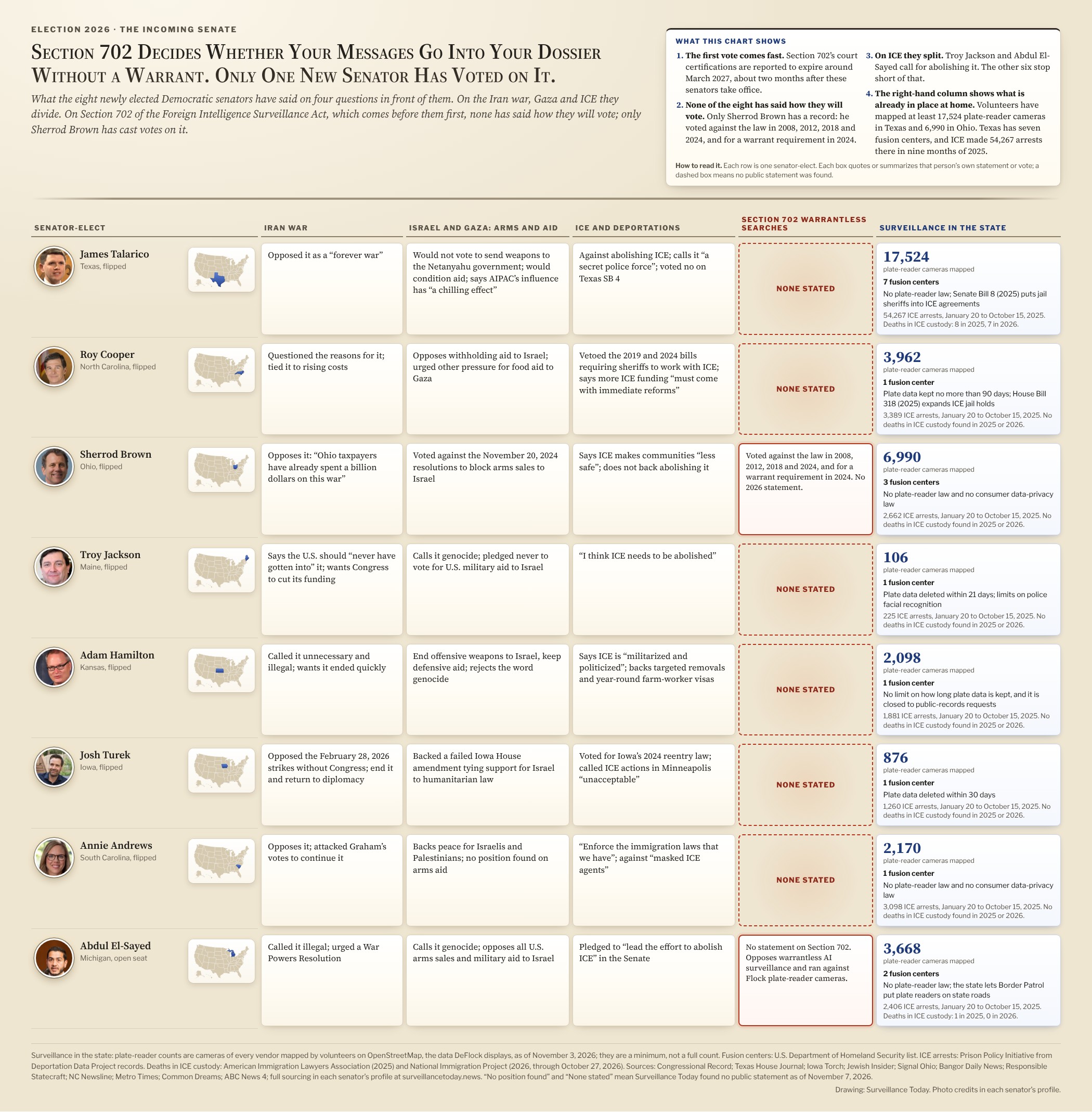
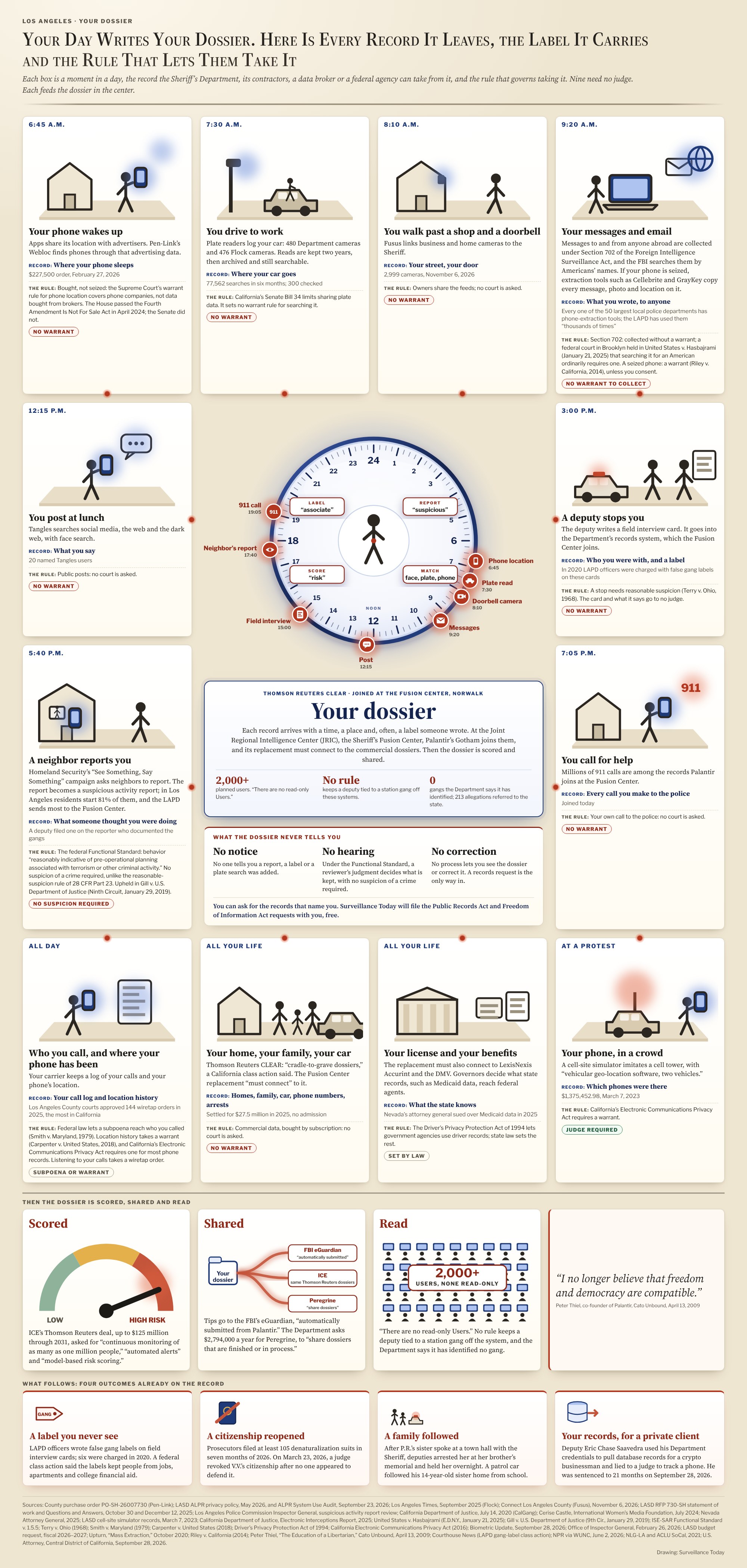
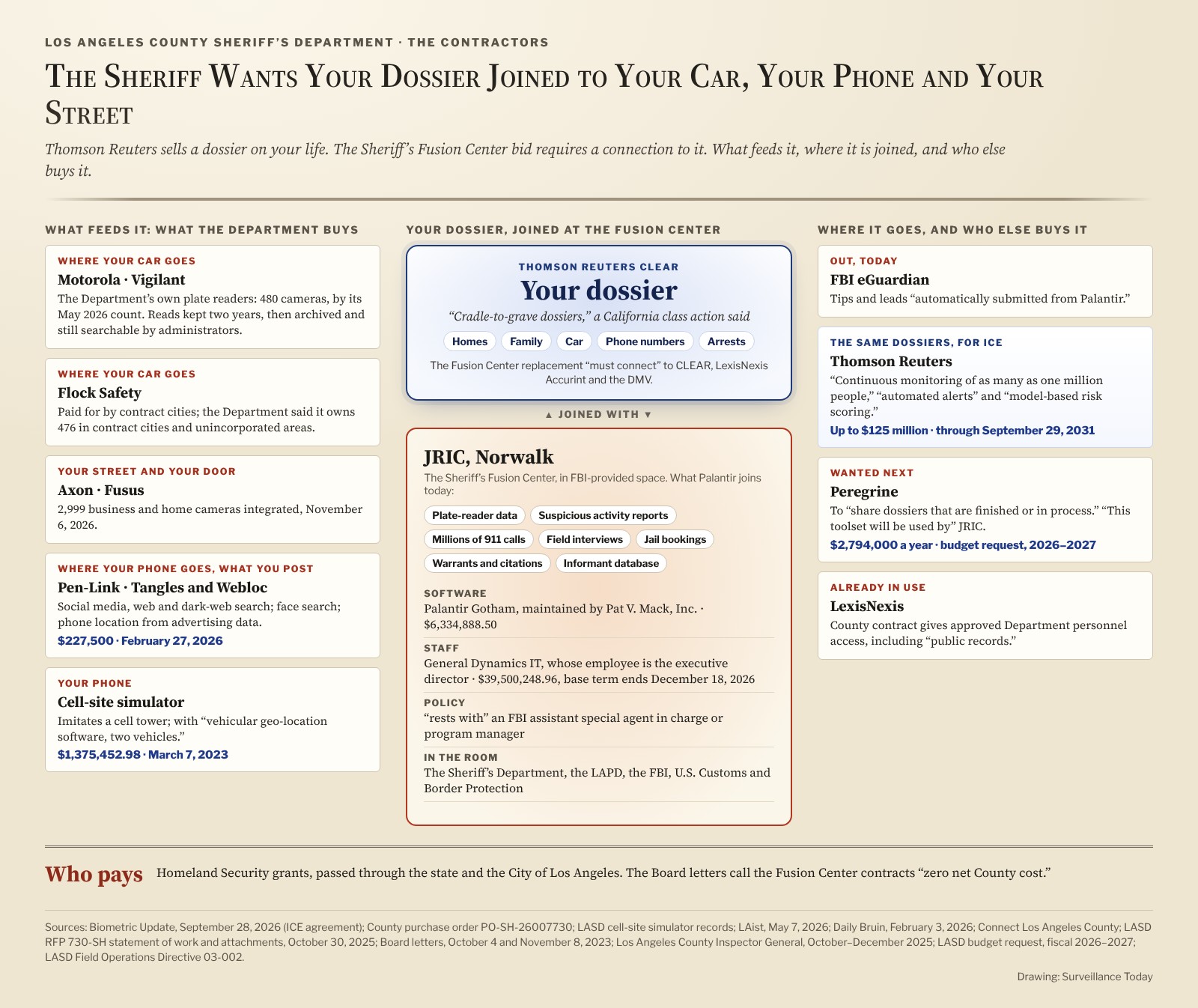
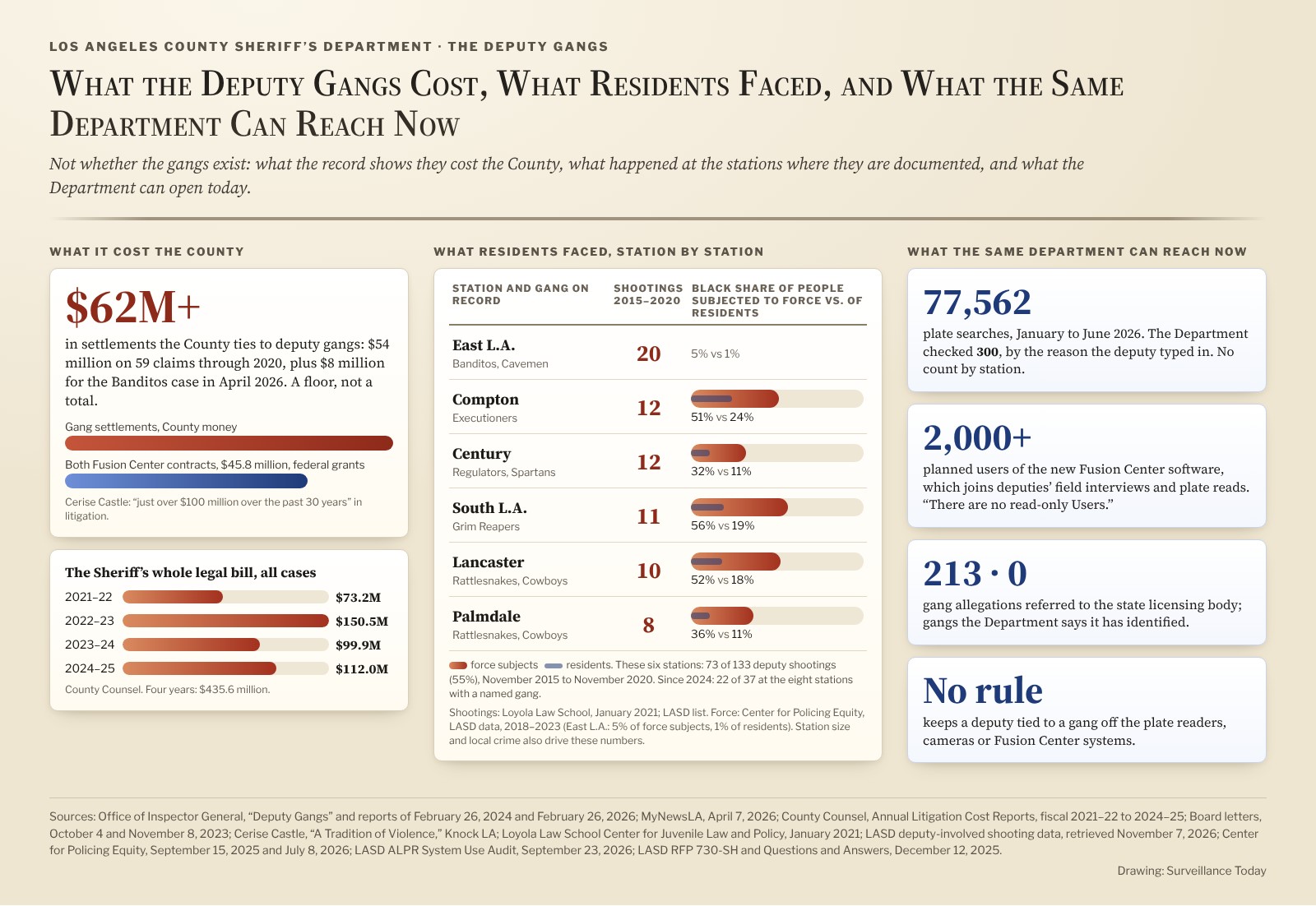
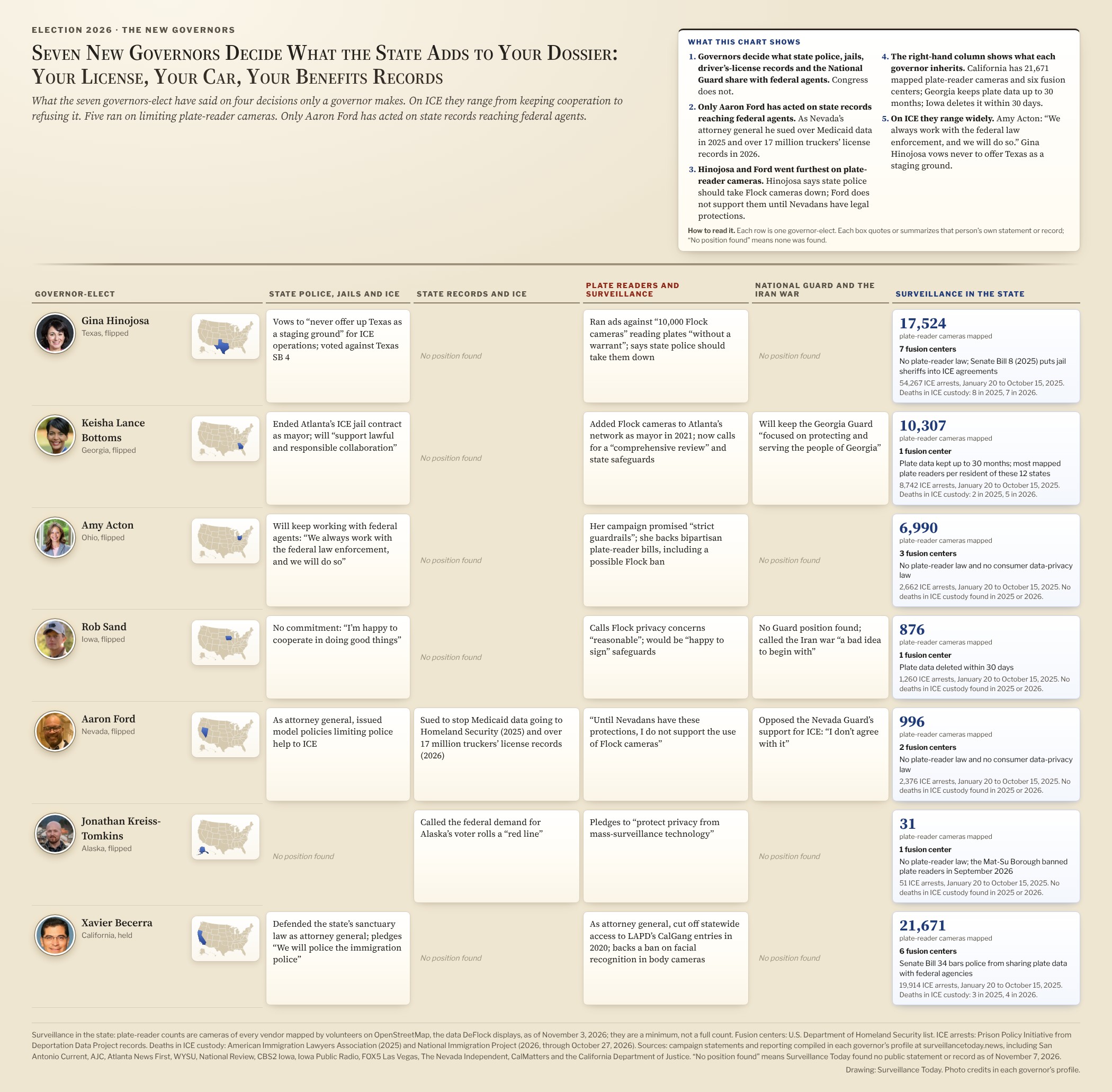



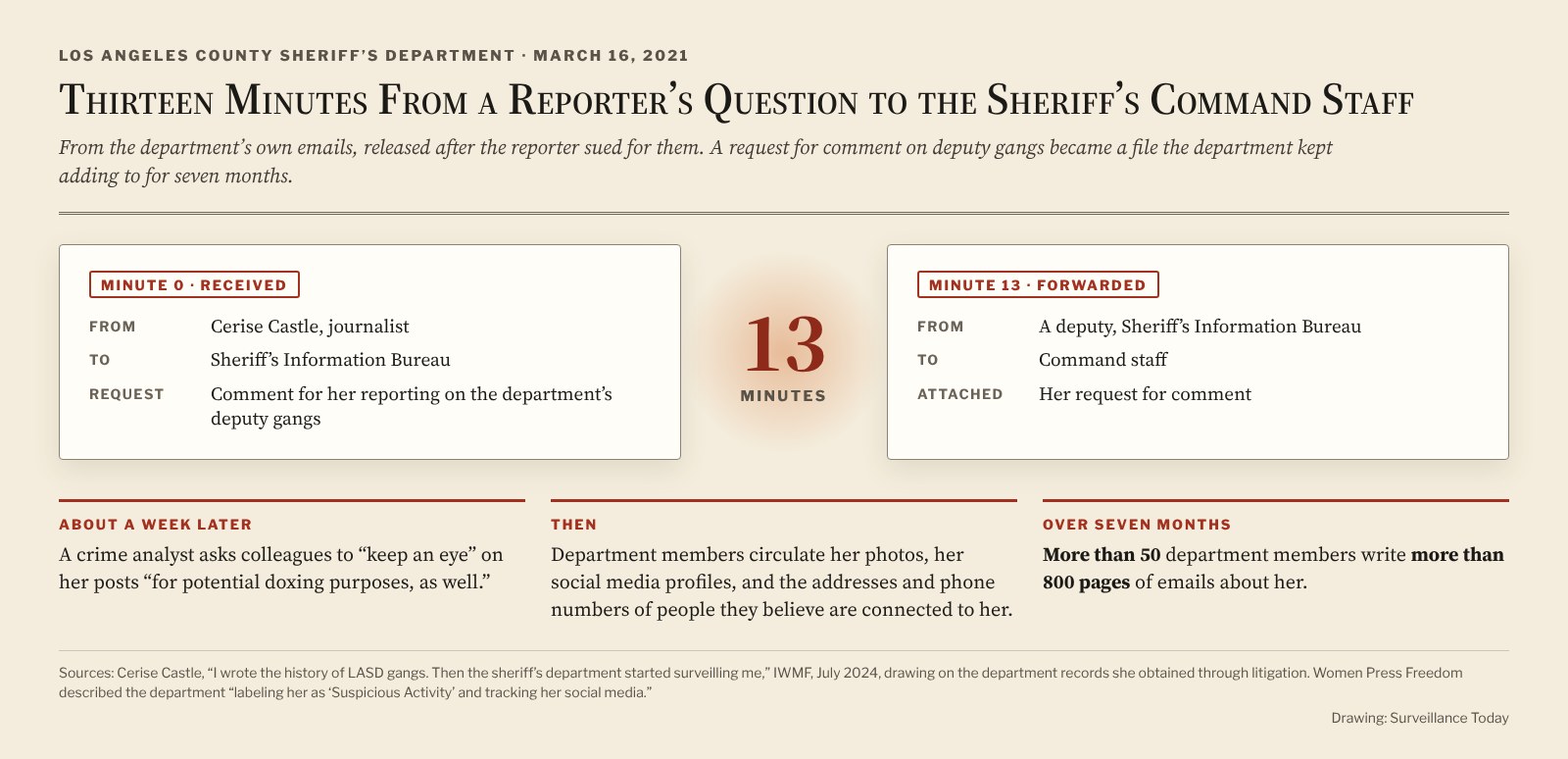
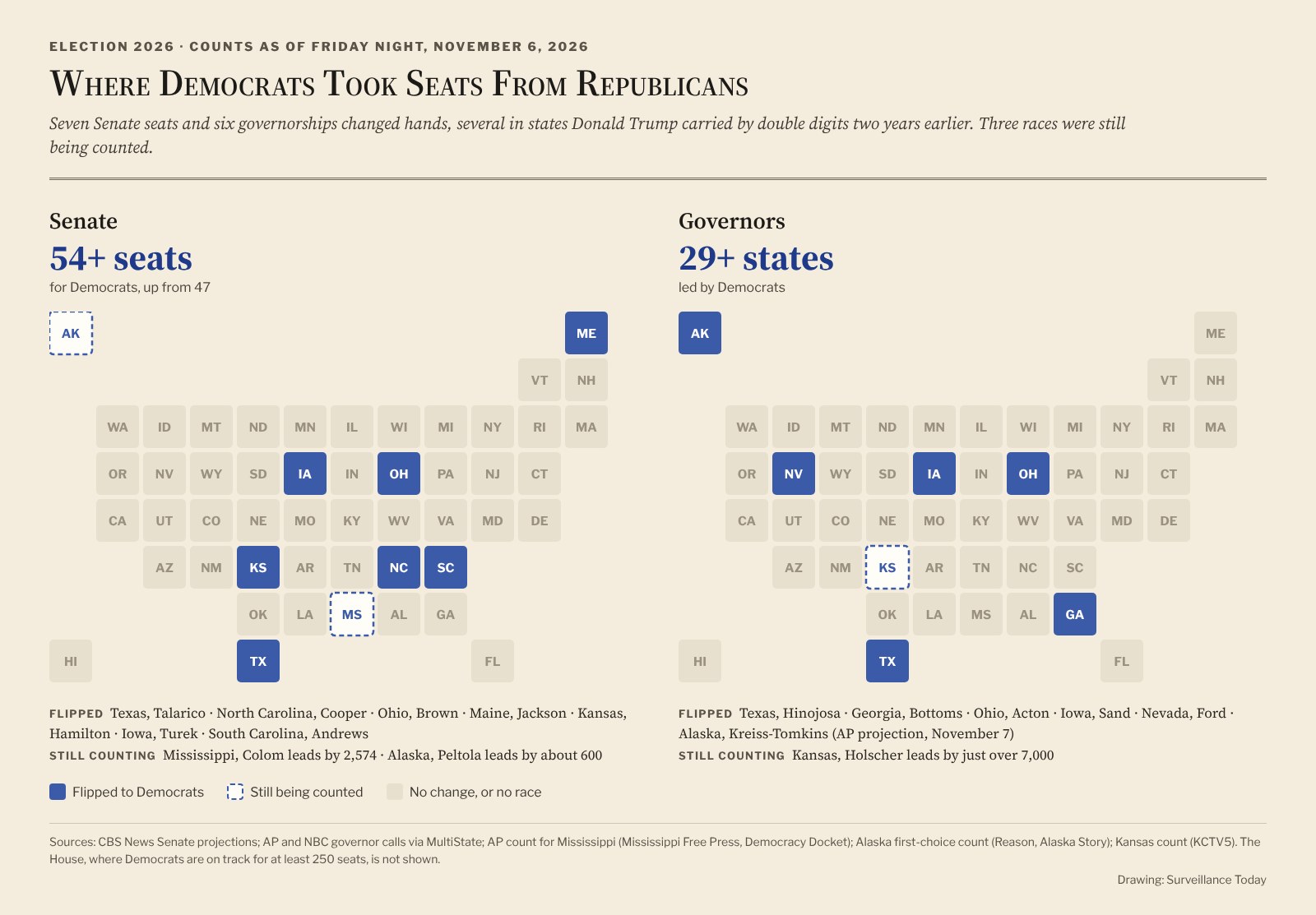
 James TalaricoTexas, flippedFull record →
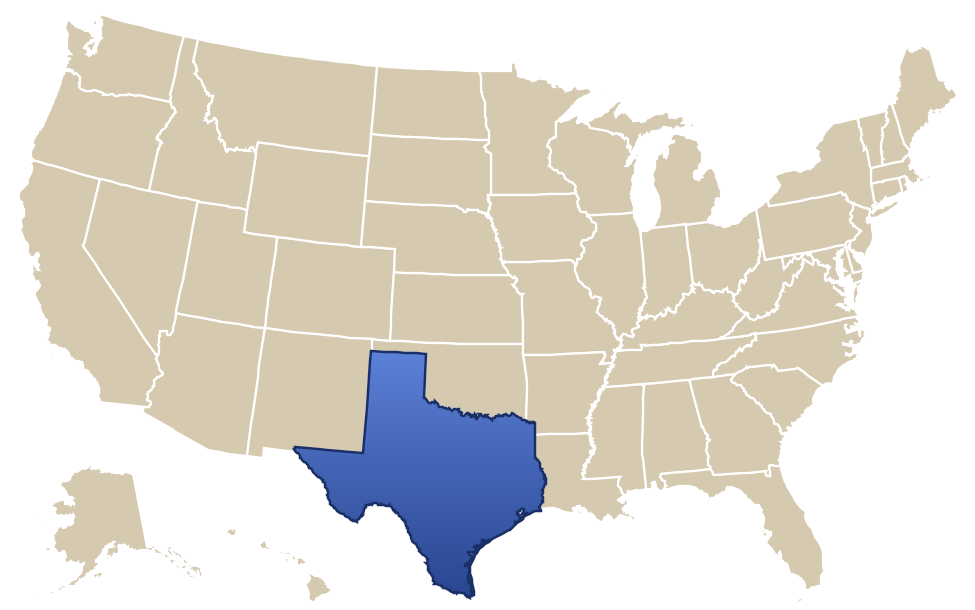 About Texas →
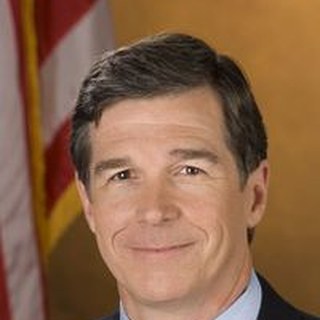 Roy CooperNorth Carolina, flippedFull record →
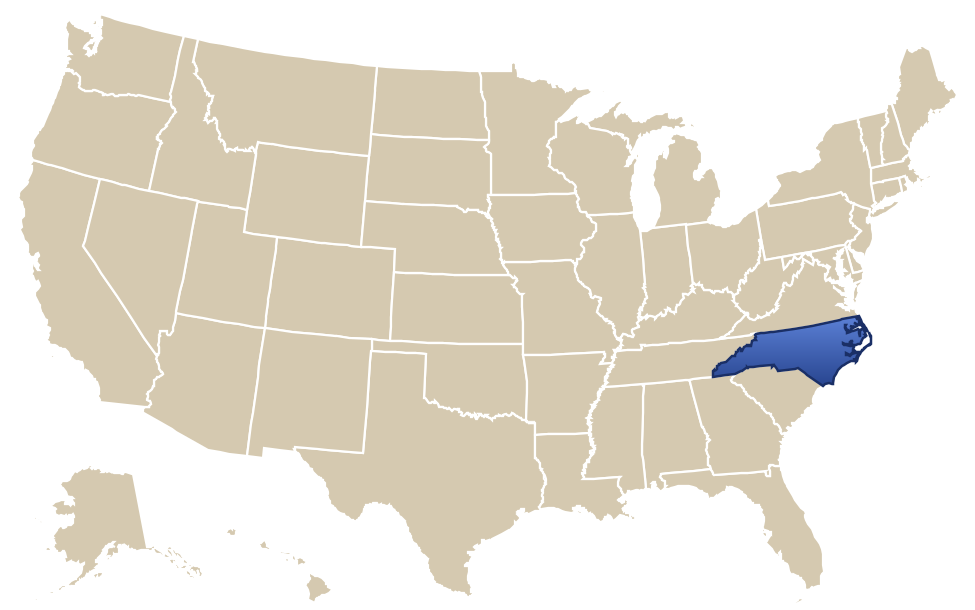 About North Carolina →
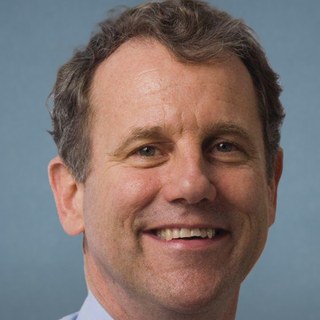 Sherrod BrownOhio, flippedFull record →
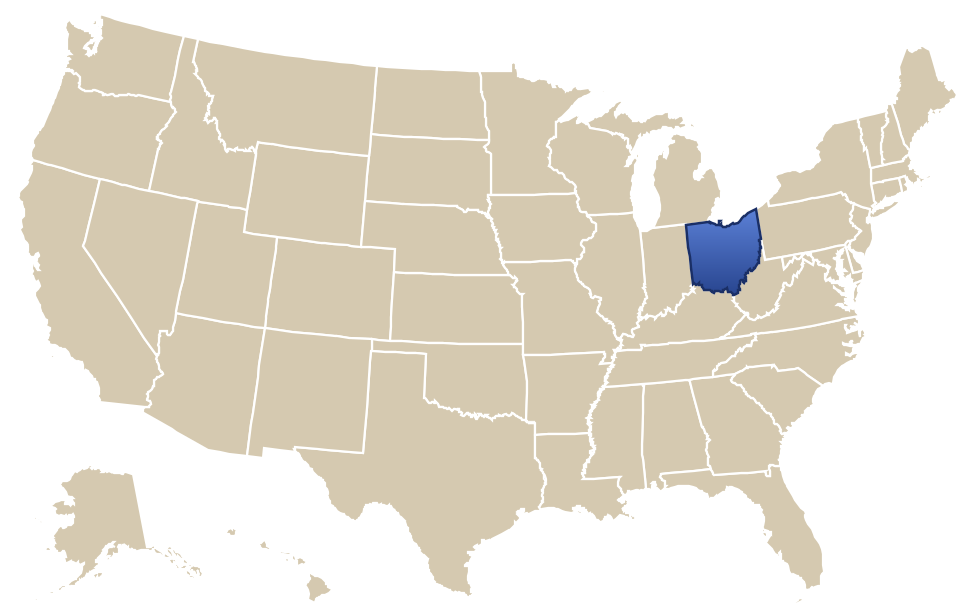 About Ohio →
 Troy JacksonMaine, flippedFull record →
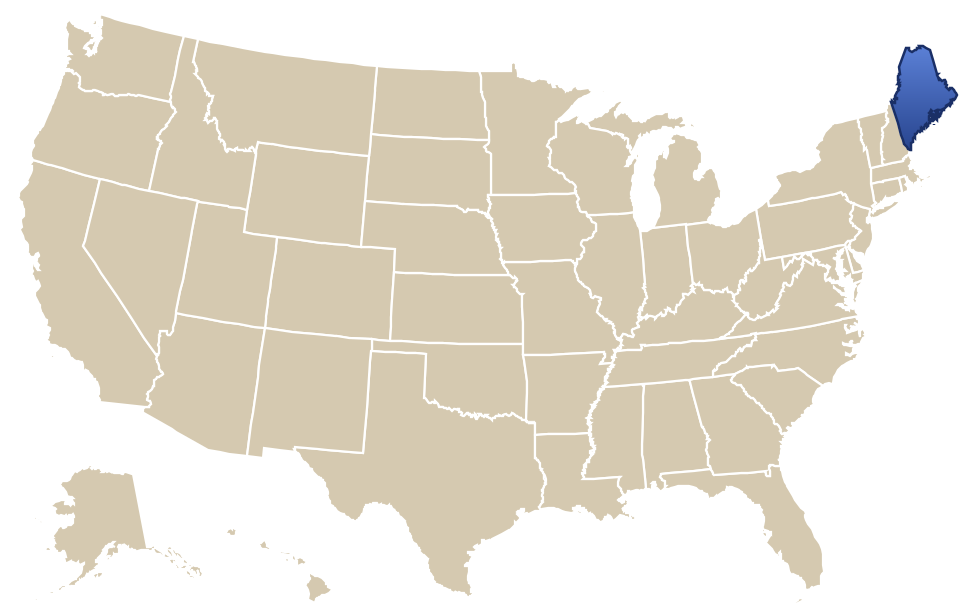 About Maine →
 Adam HamiltonKansas, flippedFull record →
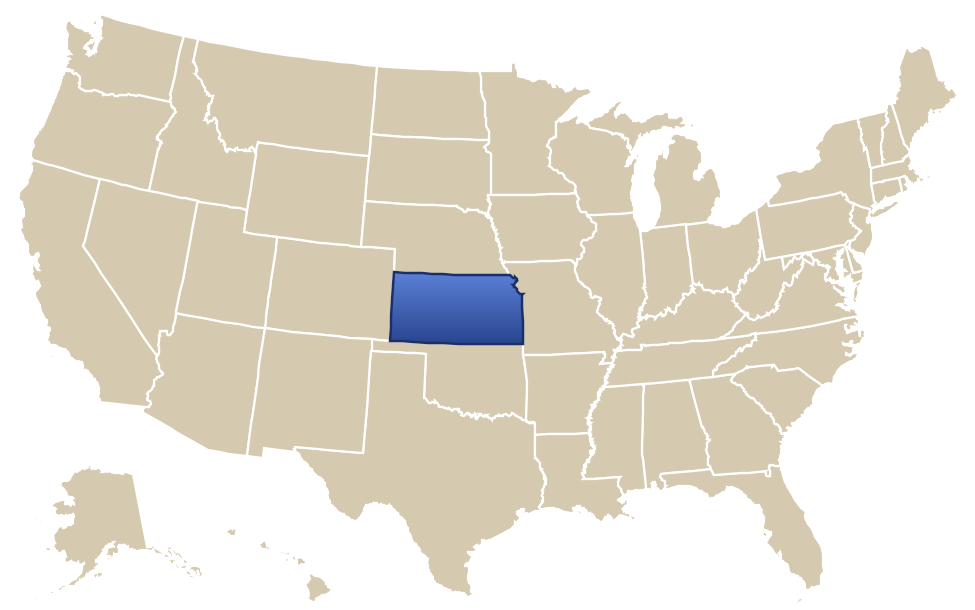 About Kansas →
 Josh TurekIowa, flippedFull record →
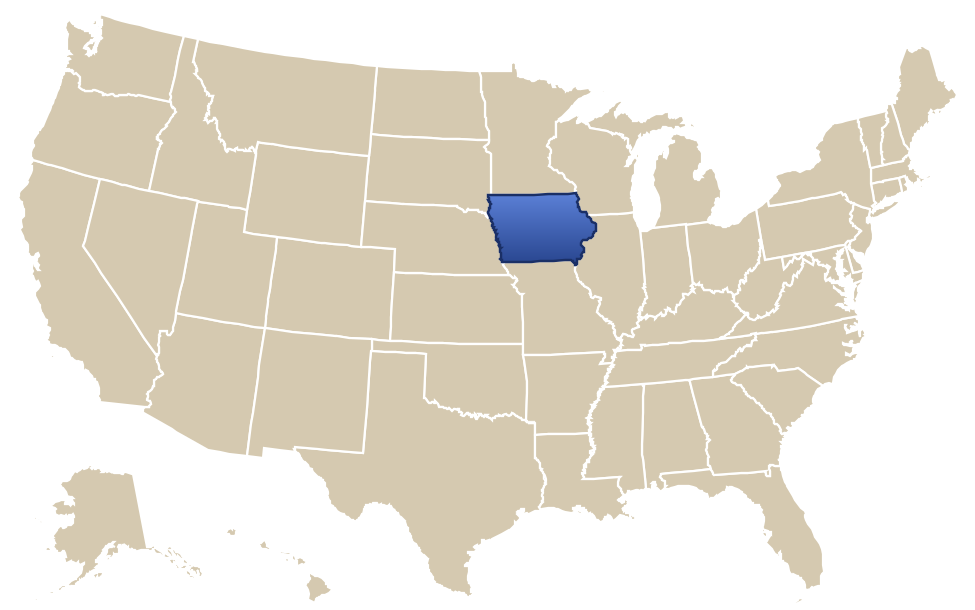 About Iowa →
 Annie AndrewsSouth Carolina, flippedFull record →
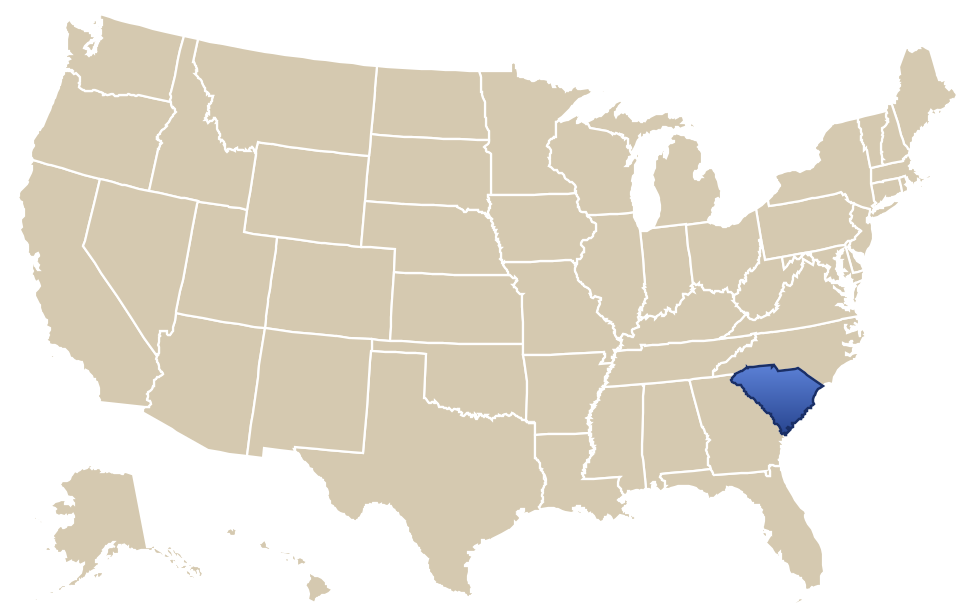 About South Carolina →
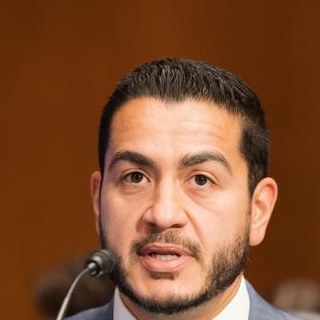 Abdul El-SayedMichigan, open seatFull record →
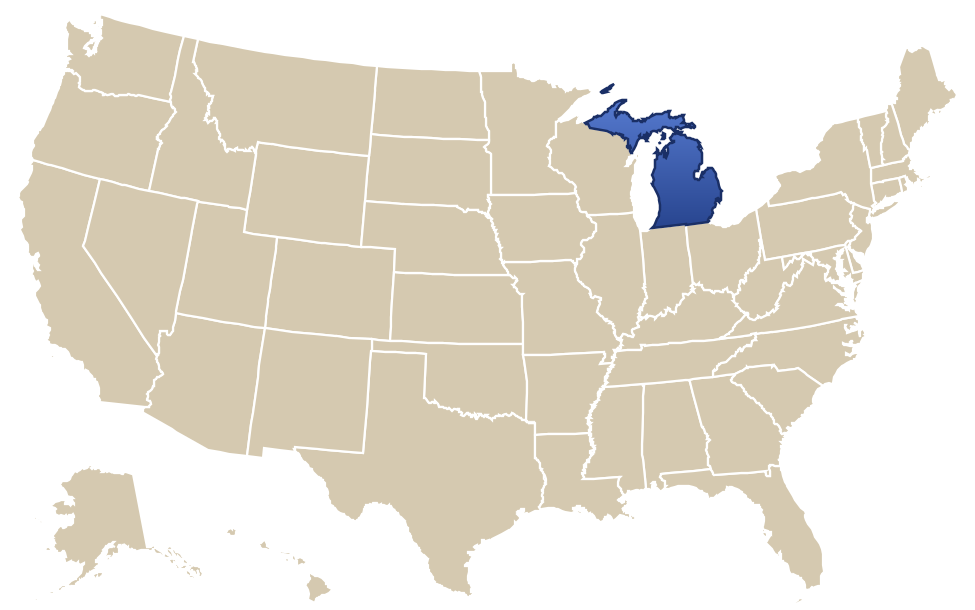 About Michigan →
 Gina HinojosaTexas, flippedFull record →
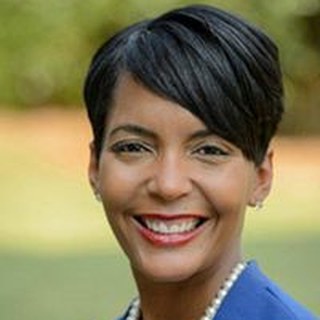 Keisha Lance BottomsGeorgia, flippedFull record →
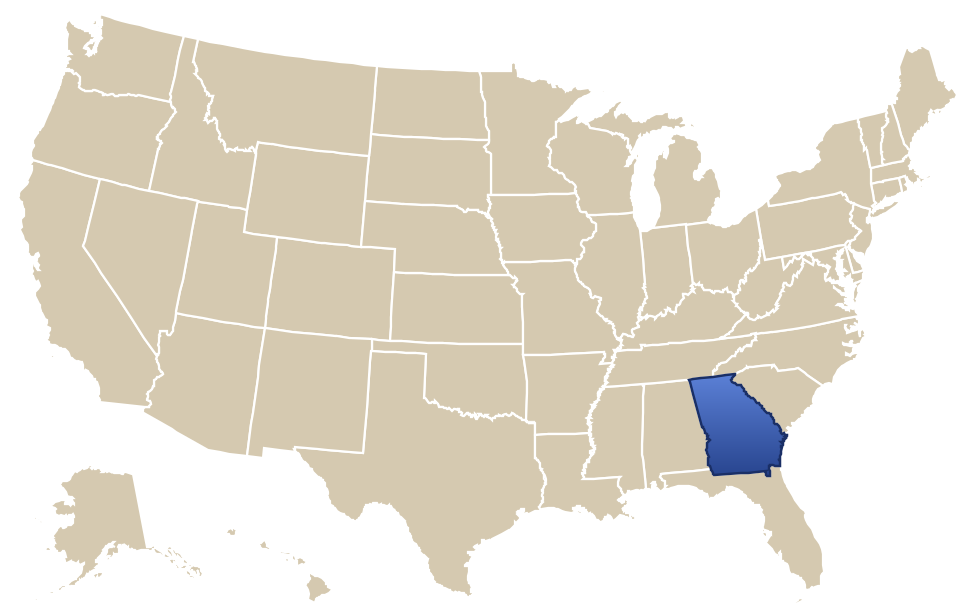 About Georgia →
 Amy ActonOhio, flippedFull record →
 Rob SandIowa, flippedFull record →
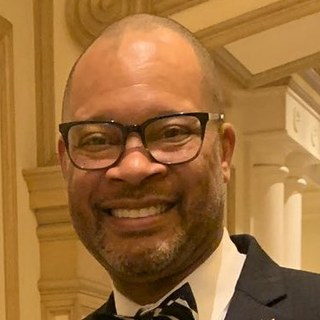 Aaron FordNevada, flippedFull record →
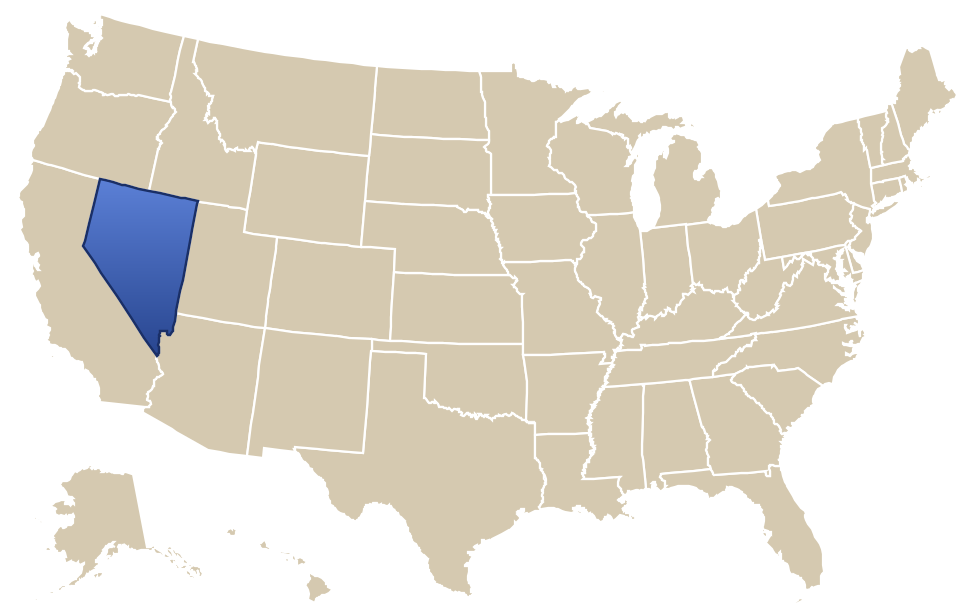 About Nevada →
 Jonathan Kreiss-TomkinsAlaska, flippedFull record →
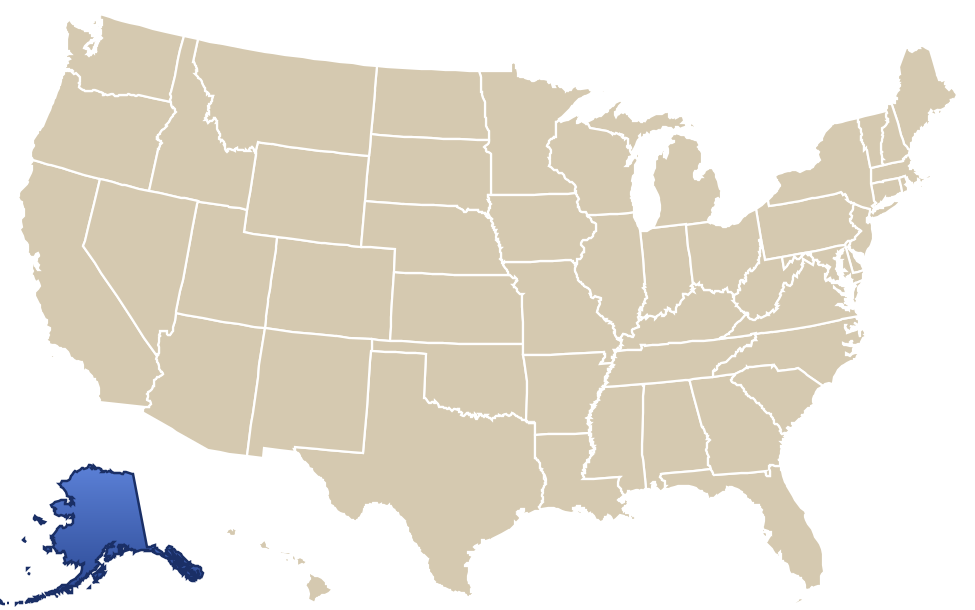 About Alaska →
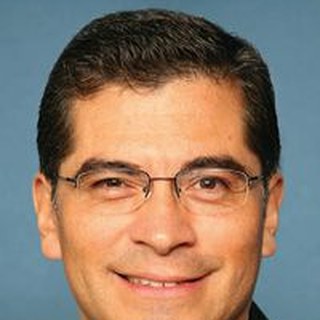 Xavier BecerraCalifornia, heldFull record →
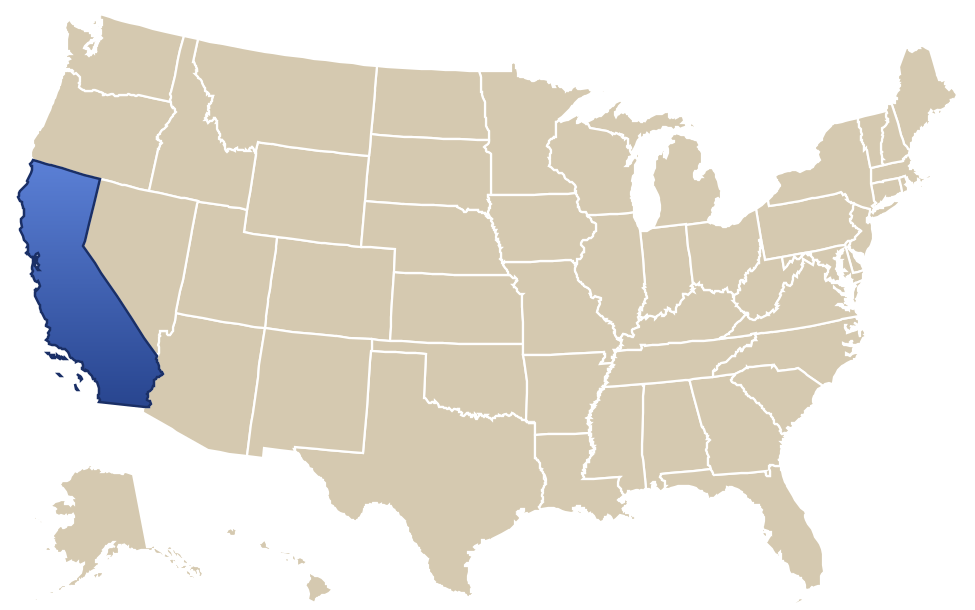 About California →